
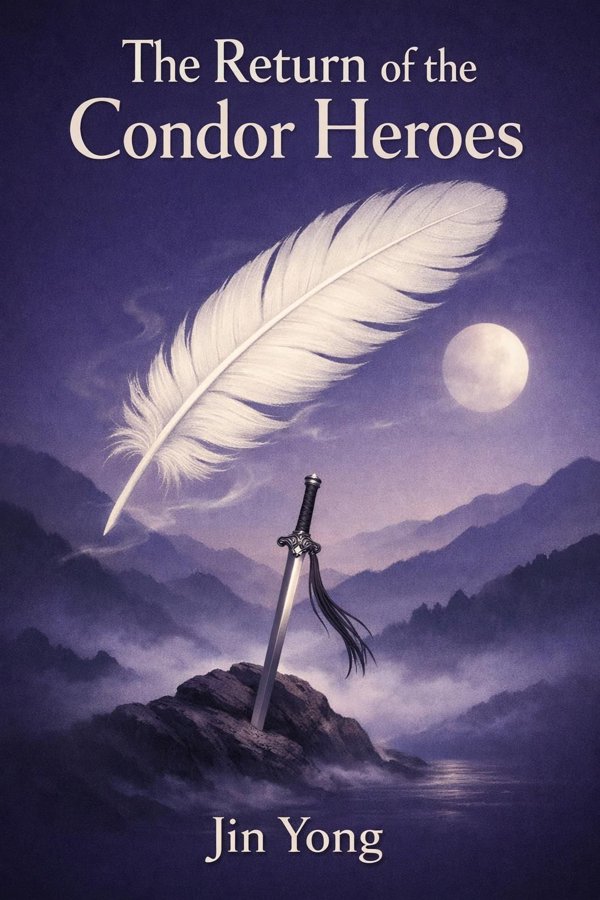
The Return of the Condor Heroes: Summary & Key Insights
by Jin Yong
 10 min8 chaptersAudio available
Key Takeaways from The Return of the Condor Heroes
A person’s reputation is often inherited long before their character is understood.
Sometimes the most transformative relationships arise where the world least expects them.
Growth often begins when the structures that were supposed to protect us fall away.
True mastery is rarely a product of talent alone; more often, it is the refinement of pain into purpose.
A hero is tested not when love is easy, but when private desire collides with public duty.
What Is The Return of the Condor Heroes About?
The Return of the Condor Heroes by Jin Yong is a classics book spanning 5 pages. The Return of the Condor Heroes is one of the great achievements of wuxia fiction: a sweeping martial arts epic that is also a deeply human story about love, identity, loneliness, and honor. Written by Jin Yong and serialized between 1959 and 1961, it forms the second part of the celebrated Condor Trilogy, continuing the world introduced in The Legend of the Condor Heroes while shifting the emotional center to the unforgettable Yang Guo. Branded by his father’s treacherous legacy and repeatedly pushed to the margins of respectable society, Yang Guo grows into a hero not by fitting into the martial world’s rules, but by exposing their limits. At the center of the novel is his bond with Xiaolongnü, his master from the Ancient Tomb Sect, a relationship that challenges convention and becomes the emotional engine of the book. Jin Yong’s authority lies in his rare ability to fuse history, philosophy, romance, and action into one seamless narrative. The result is not just an adventure tale, but a classic meditation on whether true virtue comes from obedience to tradition or fidelity to the heart.
This FizzRead summary covers all 8 key chapters of The Return of the Condor Heroes in approximately 10 minutes, distilling the most important ideas, arguments, and takeaways from Jin Yong's work. Also available as an audio summary and Key Quotes Podcast.
The Return of the Condor Heroes
The Return of the Condor Heroes is one of the great achievements of wuxia fiction: a sweeping martial arts epic that is also a deeply human story about love, identity, loneliness, and honor. Written by Jin Yong and serialized between 1959 and 1961, it forms the second part of the celebrated Condor Trilogy, continuing the world introduced in The Legend of the Condor Heroes while shifting the emotional center to the unforgettable Yang Guo. Branded by his father’s treacherous legacy and repeatedly pushed to the margins of respectable society, Yang Guo grows into a hero not by fitting into the martial world’s rules, but by exposing their limits. At the center of the novel is his bond with Xiaolongnü, his master from the Ancient Tomb Sect, a relationship that challenges convention and becomes the emotional engine of the book. Jin Yong’s authority lies in his rare ability to fuse history, philosophy, romance, and action into one seamless narrative. The result is not just an adventure tale, but a classic meditation on whether true virtue comes from obedience to tradition or fidelity to the heart.
Who Should Read The Return of the Condor Heroes?
This book is perfect for anyone interested in classics and looking to gain actionable insights in a short read. Whether you're a student, professional, or lifelong learner, the key ideas from The Return of the Condor Heroes by Jin Yong will help you think differently.
- ✓Readers who enjoy classics and want practical takeaways
- ✓Professionals looking to apply new ideas to their work and life
- ✓Anyone who wants the core insights of The Return of the Condor Heroes in just 10 minutes
Want the full summary?
Get instant access to this book summary and 100K+ more with Fizz Moment.
Get Free SummaryAvailable on App Store • Free to download
Key Chapters
A person’s reputation is often inherited long before their character is understood. That hard truth defines Yang Guo’s early life. He enters the story as the son of Yang Kang, a man remembered for betrayal, ambition, and moral collapse. Even under the care of the righteous Guo Jing and the perceptive Huang Rong, Yang Guo cannot escape suspicion. He is clever, quick, proud, and emotionally wounded, which only makes adults read him as dangerous. Instead of receiving patient guidance, he is often treated as a problem to be managed.
This matters because Jin Yong refuses to make heroism easy. Yang Guo is not born into moral clarity or social acceptance. He must form himself while fending off prejudice, misunderstanding, and manipulation. His outsider status gives him sharp insight into the martial world’s hypocrisy. Sects preach justice, elders preach virtue, and households preach duty, yet many of them fail the basic test of compassion. Yang Guo’s struggle for belonging therefore becomes more than a personal journey. It is an argument that social respectability and moral worth are not the same thing.
In practical terms, this idea speaks far beyond fiction. Many people are judged by family background, education, past mistakes, or labels imposed on them early in life. The novel suggests that identity should be built through choices, not inherited through stigma. Yang Guo becomes admirable not because others bless him, but because he keeps choosing loyalty, courage, and love under pressure.
Actionable takeaway: Examine where you may be defining yourself or others by old narratives, and replace inherited judgment with evidence from present actions.
Sometimes the most transformative relationships arise where the world least expects them. Yang Guo’s meeting with Xiaolongnü in the Ancient Tomb is the emotional turning point of the novel. Fleeing cruelty and humiliation at Quanzhen, he enters a hidden realm ruled by discipline, stillness, and distance from ordinary society. There he meets Xiaolongnü, a woman raised in emotional restraint, whose beauty and martial skill are matched by her detachment from social convention.
What begins as apprenticeship gradually deepens into one of literature’s most unusual love stories. Their bond is shaped not by flirtation or social approval, but by care, loyalty, shared isolation, and mutual recognition. Xiaolongnü gives Yang Guo what the outside world denies him: acceptance without suspicion. Yang Guo gives Xiaolongnü what her secluded life never developed: emotional warmth and human attachment. The tragedy is that the martial world does not judge their relationship by its sincerity, but by its violation of accepted roles. Master and disciple are not supposed to love. The moral code of society collides with the emotional truth of two people.
Jin Yong uses this romance to ask a lasting question: should ethics protect living hearts, or merely preserve outward order? In modern life, the exact taboo may differ, but the tension remains familiar. People often face pressure to choose relationships that are socially legible over ones that are deeply right for them.
Actionable takeaway: When evaluating a relationship, look beyond appearances and ask whether it is grounded in respect, loyalty, and mutual growth rather than mere approval from others.
Growth often begins when the structures that were supposed to protect us fall away. After separation, betrayal, and repeated misunderstanding, Yang Guo becomes a wanderer through the jianghu, the roving martial world of rivers, lakes, inns, sects, and shifting loyalties. On the surface, this movement looks unstable. In reality, it becomes the forge of his maturity. Wandering exposes him to competing ideas of justice, strength, and survival. It also forces him to rely on judgment rather than authority.
Unlike heroes who advance through orderly training under a respected master, Yang Guo develops through disruption. He meets allies and enemies, learns from fragments, suffers loss, and assembles wisdom from experience rather than doctrine. This is important because Jin Yong presents personal formation as nonlinear. Yang Guo’s brilliance does not come from staying inside one school’s worldview. It comes from testing himself against the world’s complexity.
Readers can apply this insight in many areas. Careers often unfold this way: not as a clean ladder, but as a series of detours that teach discernment. Intellectual development does too. The most insightful people are rarely those who memorized one system perfectly; they are often those who encountered multiple systems, saw their strengths and failures, and learned how to think independently.
The novel also warns that solitude can either deepen character or harden bitterness. Yang Guo becomes stronger because he remains capable of affection and moral response while alone. His wandering is not aimless escape; it is painful education.
Actionable takeaway: Treat periods of uncertainty as apprenticeship rather than failure, and actively extract lessons from each setback instead of waiting for perfect stability before growing.
True mastery is rarely a product of talent alone; more often, it is the refinement of pain into purpose. Yang Guo’s martial development is inseparable from suffering. He endures abandonment, emotional devastation, severe injury, and physical limitation, including the loss of an arm. In a lesser story, such hardship would simply make him tragic. In Jin Yong’s hands, it becomes the catalyst for transformation. Forced beyond ordinary dependence, Yang Guo develops a style of fighting and a philosophy of action uniquely his own.
His association with the great condor and with the legacy of Dugu Qiubai symbolizes something essential: the highest levels of skill are not flashy displays of technique, but stripped-down clarity. After enough struggle, excess falls away. Yang Guo’s power becomes more direct, more interior, and more integrated with judgment. This idea runs through many martial traditions, but Jin Yong turns it into a life lesson. Maturity often means giving up the illusion that progress is smooth or fair. Instead, one learns to shape limitations into strengths.
There are practical applications everywhere. A professional who loses a job may discover independence and inventiveness. An athlete adapting to injury may gain tactical intelligence. A person recovering from heartbreak may develop emotional honesty that was impossible before. Mastery does not require ideal conditions; sometimes it emerges because ideal conditions disappeared.
The novel also teaches that discipline without inner purpose is hollow. Yang Guo’s strength matters because it serves loyalty, protection, and truth, not vanity.
Actionable takeaway: Identify one hardship you still treat as pure damage, and ask how it might be converted into a discipline, perspective, or strength that no easy path could have produced.
A hero is tested not when love is easy, but when private desire collides with public duty. Yang Guo’s role in the defense of Xiangyang elevates the novel from personal romance to historical epic. Set against the Song-Mongol conflict, these scenes place individual emotion inside a civilization-scale crisis. Guo Jing and Huang Rong embody steadfast patriotic resistance, and Yang Guo, despite his distance from orthodox society, proves that he too belongs among those willing to sacrifice for others.
This is one of Jin Yong’s most powerful reversals. The martial world has often treated Yang Guo as suspect, unruly, or morally compromised. Yet when genuine danger threatens the realm, he shows the very qualities that many respectable people merely claim to possess: courage, loyalty, strategic intelligence, and readiness to act. Heroism here is not rhetorical. It is measured by what one risks when the stakes are real.
The Xiangyang episodes also resolve a central tension in Yang Guo’s character. He does not need to surrender his individuality or his love for Xiaolongnü in order to serve a larger cause. Jin Yong rejects the false choice between personal authenticity and social responsibility. The best form of heroism integrates both.
Modern readers can apply this idea to leadership and citizenship. It is easy to perform principles in safe settings; the challenge is to uphold them when doing so is inconvenient, costly, or misunderstood. Whether in family, work, or public life, commitment is revealed under pressure.
Actionable takeaway: Define one responsibility bigger than your personal comfort, and commit to a concrete act that proves your values in practice rather than in words.
Societies often confuse rules with righteousness. One of the novel’s deepest achievements is its critique of the jianghu itself. The martial world presents itself as a realm of honor, lineage, and justice, yet again and again its institutions fail morally. Sects cling to reputation, elders protect appearances, and so-called upright figures act out of jealousy, rigidity, or fear. Meanwhile, people considered eccentric, improper, or dangerous sometimes behave with greater loyalty and compassion.
Yang Guo and Xiaolongnü expose this contradiction simply by existing. Their relationship is condemned less because it is cruel than because it is unconventional. Others are ready to shame them in the name of ethics while overlooking violence, pettiness, and opportunism among the respectable. Jin Yong is not dismissing morality; he is demanding a deeper one. His target is performative virtue, the kind that punishes visible irregularity while tolerating hidden corruption.
This idea remains strikingly relevant. Institutions today also reward conformity and punish deviation, even when the conformist behavior is shallow and the unconventional behavior is humane. In workplaces, schools, families, and online communities, people may defend policy while ignoring fairness, or uphold etiquette while damaging trust.
The novel encourages readers to separate real ethics from social theater. Compassion, loyalty, honesty, and courage matter more than polished reputations. That does not mean every norm is worthless, but it does mean norms should serve human flourishing, not replace moral thought.
Actionable takeaway: The next time you judge behavior as proper or improper, ask a second question: does it actually increase justice, kindness, and integrity, or merely preserve appearances?
Not all family is inherited, and not all teaching comes through formal respect. The Return of the Condor Heroes is filled with unstable bonds between parents and children, masters and disciples, elders and successors. Yang Guo’s life in particular is shaped by broken lineage. His biological inheritance is morally damaged, his guardians are uncertain, and his formal training is repeatedly interrupted. Out of this instability, Jin Yong develops an alternative vision of kinship: bonds created through care, loyalty, and recognition can become more meaningful than those enforced by blood or hierarchy.
Xiaolongnü is at once teacher, protector, beloved, and companion. Guo Jing and Huang Rong are partial guardians, sincere but complicated by fear and history. Other martial figures influence Yang Guo through rivalry, accident, or brief encounter. The result is a mosaic model of formation. A person may be shaped by many imperfect guides, and what matters is not whether each role fits convention neatly, but whether it nurtures character.
This has practical resonance in modern life, where mentorship rarely follows one idealized path. People may find guidance from a manager, friend, professor, coach, partner, or even from difficult adversaries. Likewise, chosen family often becomes essential for those who feel estranged from inherited structures.
Jin Yong also warns that authority deserves scrutiny. A master can teach skill but still fail in wisdom. A guardian can mean well but still withhold trust. Respect should not blind us to limitation.
Actionable takeaway: Make a list of the people who have truly shaped your character, regardless of formal role, and intentionally strengthen those relationships built on trust, growth, and mutual care.
Some stories celebrate love as immediate fulfillment; this novel presents it as endurance under extreme pressure. Yang Guo and Xiaolongnü do not simply fall in love and overcome obstacles through determination alone. They are separated by injury, misunderstanding, social hostility, and time itself. Their relationship is marked by waiting, memory, uncertainty, and faith. In this, Jin Yong offers a more demanding and perhaps more realistic vision of devotion.
What makes their bond compelling is not just intensity, but persistence. Both characters suffer, and both are transformed by the cost of staying true. Waiting does not freeze them; it reveals who they are when gratification is impossible. Yang Guo’s longing could have become self-destruction, yet it becomes one of the forces that matures him. Xiaolongnü’s reserve could have remained detachment, yet love draws from her a profound constancy.
The practical insight is that lasting commitment is measured less by emotion at its peak than by what survives interruption, disappointment, and distance. In friendships, marriages, families, and creative vocations, many worthwhile things demand periods of uncertain waiting. The challenge is to distinguish endurance from passivity. The novel’s lovers do not merely wait; they continue to act, suffer, learn, and remain faithful to what they know to be true.
This idea also cautions against a culture of immediacy. Not every meaningful outcome arrives quickly, and not every delayed fulfillment is a sign that the pursuit is wrong.
Actionable takeaway: When something deeply meaningful is taking longer than you hoped, ask how you can remain actively faithful to it through growth, discipline, and patience rather than giving up at the first long delay.
All Chapters in The Return of the Condor Heroes
About the Author
Jin Yong (1924–2018), born Louis Cha Leung-yung in Hangzhou, was the most celebrated writer of modern wuxia fiction. Beginning in the 1950s, he serialized novels that transformed martial arts storytelling into a major literary and cultural force across the Chinese-speaking world. His works stand out for blending historical settings, vivid action, political tension, philosophical reflection, and emotionally complex characters. Among his best-known books are The Legend of the Condor Heroes, The Return of the Condor Heroes, and The Heaven Sword and Dragon Saber. Beyond his fiction, Jin Yong was also a journalist, newspaper founder, editor, and public intellectual. His novels have inspired countless adaptations in television, film, comics, and games. Today, he is widely regarded not just as a popular storyteller, but as a defining voice in modern Chinese literature.
Get This Summary in Your Preferred Format
Read or listen to the The Return of the Condor Heroes summary by Jin Yong anytime, anywhere. FizzRead offers multiple formats so you can learn on your terms — all free.
Available formats: App · Audio · PDF · EPUB — All included free with FizzRead
Download The Return of the Condor Heroes PDF and EPUB Summary
Key Quotes from The Return of the Condor Heroes
“A person’s reputation is often inherited long before their character is understood.”
“Sometimes the most transformative relationships arise where the world least expects them.”
“Growth often begins when the structures that were supposed to protect us fall away.”
“True mastery is rarely a product of talent alone; more often, it is the refinement of pain into purpose.”
“A hero is tested not when love is easy, but when private desire collides with public duty.”
Frequently Asked Questions about The Return of the Condor Heroes
The Return of the Condor Heroes by Jin Yong is a classics book that explores key ideas across 8 chapters. The Return of the Condor Heroes is one of the great achievements of wuxia fiction: a sweeping martial arts epic that is also a deeply human story about love, identity, loneliness, and honor. Written by Jin Yong and serialized between 1959 and 1961, it forms the second part of the celebrated Condor Trilogy, continuing the world introduced in The Legend of the Condor Heroes while shifting the emotional center to the unforgettable Yang Guo. Branded by his father’s treacherous legacy and repeatedly pushed to the margins of respectable society, Yang Guo grows into a hero not by fitting into the martial world’s rules, but by exposing their limits. At the center of the novel is his bond with Xiaolongnü, his master from the Ancient Tomb Sect, a relationship that challenges convention and becomes the emotional engine of the book. Jin Yong’s authority lies in his rare ability to fuse history, philosophy, romance, and action into one seamless narrative. The result is not just an adventure tale, but a classic meditation on whether true virtue comes from obedience to tradition or fidelity to the heart.
More by Jin Yong
You Might Also Like






Browse by Category
Ready to read The Return of the Condor Heroes?
Get the full summary and 100K+ more books with Fizz Moment.