
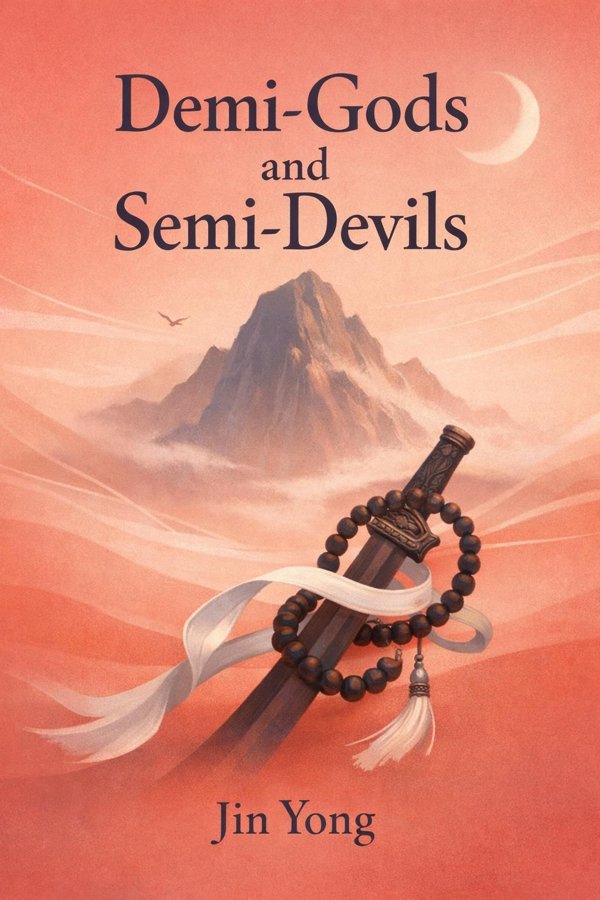
Demi-Gods and Semi-Devils: Summary & Key Insights
by Jin Yong
 10 min9 chaptersAudio available
Key Takeaways from Demi-Gods and Semi-Devils
A great wuxia novel does not merely place heroes inside history; it shows how history quietly dictates the choices they think are their own.
The cruelest tragedies begin when a person’s finest virtues become useless against suspicion.
What people call love is often a mixture of projection, yearning, vanity, and fantasy.
Sometimes the least ambitious person undergoes the greatest transformation.
The most profound battles in Demi-Gods and Semi-Devils are not fought with fists or swords but within the mind.
What Is Demi-Gods and Semi-Devils About?
Demi-Gods and Semi-Devils by Jin Yong is a classics book spanning 5 pages. Demi-Gods and Semi-Devils is one of Jin Yong’s grandest and most emotionally devastating wuxia novels, a sweeping tale of heroism, identity, love, and moral bewilderment set during the politically fractured Northern Song dynasty. At its center are three very different men—Qiao Feng, Duan Yu, and Xuzhu—whose lives unfold along separate paths before converging in ways both miraculous and tragic. Around them swirl rival kingdoms, martial sects, secret lineages, forbidden romances, and betrayals that expose how fragile honor can be in a world ruled by desire and fate. The title draws from the Buddhist concept of beings caught between spiritual power and earthly delusion, and that image captures the novel’s deepest concern: human beings are capable of greatness, yet constantly ensnared by attachment, pride, misunderstanding, and circumstance. More than a martial arts epic, this book is a meditation on suffering and compassion. Jin Yong, the undisputed master of modern wuxia, brings extraordinary historical imagination, philosophical depth, and unforgettable characterization to a story that remains one of the genre’s richest achievements.
This FizzRead summary covers all 9 key chapters of Demi-Gods and Semi-Devils in approximately 10 minutes, distilling the most important ideas, arguments, and takeaways from Jin Yong's work. Also available as an audio summary and Key Quotes Podcast.
Demi-Gods and Semi-Devils
Demi-Gods and Semi-Devils is one of Jin Yong’s grandest and most emotionally devastating wuxia novels, a sweeping tale of heroism, identity, love, and moral bewilderment set during the politically fractured Northern Song dynasty. At its center are three very different men—Qiao Feng, Duan Yu, and Xuzhu—whose lives unfold along separate paths before converging in ways both miraculous and tragic. Around them swirl rival kingdoms, martial sects, secret lineages, forbidden romances, and betrayals that expose how fragile honor can be in a world ruled by desire and fate. The title draws from the Buddhist concept of beings caught between spiritual power and earthly delusion, and that image captures the novel’s deepest concern: human beings are capable of greatness, yet constantly ensnared by attachment, pride, misunderstanding, and circumstance. More than a martial arts epic, this book is a meditation on suffering and compassion. Jin Yong, the undisputed master of modern wuxia, brings extraordinary historical imagination, philosophical depth, and unforgettable characterization to a story that remains one of the genre’s richest achievements.
Who Should Read Demi-Gods and Semi-Devils?
This book is perfect for anyone interested in classics and looking to gain actionable insights in a short read. Whether you're a student, professional, or lifelong learner, the key ideas from Demi-Gods and Semi-Devils by Jin Yong will help you think differently.
- ✓Readers who enjoy classics and want practical takeaways
- ✓Professionals looking to apply new ideas to their work and life
- ✓Anyone who wants the core insights of Demi-Gods and Semi-Devils in just 10 minutes
Want the full summary?
Get instant access to this book summary and 100K+ more with Fizz Moment.
Get Free SummaryAvailable on App Store • Free to download
Key Chapters
A great wuxia novel does not merely place heroes inside history; it shows how history quietly dictates the choices they think are their own. Demi-Gods and Semi-Devils unfolds during the Northern Song period, when multiple states—the Song, Liao, Western Xia, and Dali—exist in uneasy proximity. This unstable political geography is not background decoration. It is the hidden engine of the plot. Questions of loyalty, ethnicity, legitimacy, and power shape every major relationship in the novel.
Jin Yong uses the tensions between kingdoms to reveal a painful truth: individuals are often judged not for their character but for the blood they carry or the flag attached to their name. Qiao Feng’s tragedy is inseparable from the geopolitical hostility between Song and Liao. Duan Yu’s arc is tied to the unusual culture and royal politics of Dali. Xuzhu’s transformation depends on institutions—monasteries, sects, and courts—that are themselves products of a divided world. The martial arts community may appear independent, but it is constantly entangled with state power, military conflict, and ethnic suspicion.
This historical setting also gives the novel unusual moral complexity. There is no easy division between “civilized” and “barbarian,” nor between patriot and traitor. Different communities carry their own values, grievances, and blind spots. Jin Yong asks readers to look beyond inherited narratives and confront the human cost of political identity.
In modern life, the lesson still resonates. People often inherit assumptions about nations, classes, religions, or institutions long before they form their own judgments. The novel reminds us to ask whether our strongest loyalties are ethical commitments or unexamined habits of belonging.
Actionable takeaway: When evaluating a conflict, look beyond personal drama and ask what larger historical, social, or institutional forces are shaping people’s behavior.
The cruelest tragedies begin when a person’s finest virtues become useless against suspicion. Qiao Feng enters the novel as the ideal martial hero: courageous, generous, disciplined, and overwhelmingly respected. As chief of the Beggars’ Sect, he embodies righteousness in action rather than rhetoric. Yet his greatness cannot protect him when his hidden ancestry is revealed. Once believed to be a Han Chinese hero, he is suddenly recast as an outsider because he is ethnically Khitan, linked to the rival Liao state.
Jin Yong makes Qiao Feng’s downfall so powerful because it is not caused by moral failure. He does not become less honorable when the truth about his birth emerges. Instead, the world around him changes its interpretation of him. His loyalty, once celebrated, is questioned. His strength, once admired, becomes threatening. His every gesture is reread through the lens of fear. The novel thereby exposes how identity categories can overpower lived character.
Qiao Feng’s story also explores the torment of divided belonging. Is one loyal to the people who raised him, the bloodline from which he came, or the moral law within? He tries to honor justice above faction, but history offers him no safe ground. Even his love for Azi and his earlier bond with A’Zhu become entwined with impossible political and emotional demands.
Readers can see in Qiao Feng the experience of anyone caught between communities—immigrants, mixed-identity individuals, or professionals navigating conflicting value systems. He shows both the nobility and the cost of trying to remain ethically whole in a world that insists on simplification.
Actionable takeaway: Judge people by their conduct over time, not by labels, origins, or inherited categories that may distort your perception before you know the truth.
What people call love is often a mixture of projection, yearning, vanity, and fantasy. Duan Yu, the gentle and idealistic prince of Dali, is one of Jin Yong’s most unusual protagonists precisely because he resists the conventional hero’s path. He dislikes violence, reveres beauty, and drifts through danger with a combination of innocence, luck, and unexpected brilliance. Yet beneath his elegance lies a central weakness: he is repeatedly captivated by appearances and by the idea of love rather than the reality of another person.
His infatuation with Wang Yuyan becomes the clearest expression of this theme. Duan Yu worships her almost as a vision rather than as a fully knowable human being. Jin Yong does not mock him cruelly; instead, he uses Duan Yu’s romantic fixation to examine how attachment can obscure judgment. Desire turns the beloved into an idol, and idols are always partly self-created. The irony is that Duan Yu, despite his compassion and intelligence, often fails to see the emotional truth directly in front of him.
At the same time, Duan Yu’s arc is not simply a cautionary tale. His refusal to delight in killing and his instinctive kindness set him apart in the martial world. He gains immense power, including the Six Meridians Divine Sword and the Lingbo Microsteps, but his true distinctiveness lies in his temperament. He suggests that softness is not weakness, though softness without clarity can become confusion.
In ordinary life, many people pursue jobs, partners, or ambitions for what they symbolize rather than what they actually are. Duan Yu teaches that longing can be sincere and still be misguided.
Actionable takeaway: When you deeply want something, pause and ask whether you love the reality itself or the story you have built around it.
Sometimes the least ambitious person undergoes the greatest transformation. Xuzhu begins as a humble Shaolin monk: awkward, obedient, inexperienced, and almost comically unsuited to the glamorous world of martial heroes. Nothing about him suggests destiny in the conventional sense. Yet through a chain of accidents, inheritances, and moral tests, he becomes one of the novel’s most powerful figures, inheriting extraordinary martial abilities and leadership over vast forces he never sought.
What makes Xuzhu compelling is that his growth does not emerge from ego or conquest. He does not chase fame, romantic triumph, or political authority. Again and again, events fall upon him, and his task becomes not to exploit them but to endure them without losing his moral center. This allows Jin Yong to explore a deep paradox: power may come to those who never desired it, but innocence alone does not guarantee wisdom. Xuzhu must learn how to reconcile Buddhist vows, worldly obligations, love, and responsibility.
His story also questions rigid ideas of spiritual purity. Xuzhu’s monastic identity is repeatedly disrupted by worldly entanglements, yet these disruptions do not simply corrupt him. They humanize him. He learns that compassion requires engagement, not merely withdrawal. His relationship with Dreamlike and his role within the Carefree Sect and related power structures force him to confront life’s messy, unchosen complexity.
In practical terms, Xuzhu resembles people who are promoted unexpectedly, inherit family burdens, or find themselves responsible for others before they feel ready. His arc reassures us that growth often begins in discomfort, not confidence.
Actionable takeaway: If life gives you responsibilities you did not seek, focus first on preserving integrity; competence and clarity can develop after acceptance.
The most profound battles in Demi-Gods and Semi-Devils are not fought with fists or swords but within the mind. The novel’s title references the Buddhist image of beings caught in cycles of power, passion, and delusion, and Jin Yong uses this framework to reinterpret the entire martial world. Heroes, villains, monks, rulers, and lovers all suffer because they are attached—to identity, revenge, beauty, prestige, purity, or control. Martial arts become an outward expression of inward states.
This philosophical layer gives the story unusual depth. Qiao Feng’s anguish is not only political but existential: he cannot escape attachment to honor and belonging. Duan Yu’s romantic wanderings reveal desire’s ability to distort perception. Xuzhu’s journey tests whether renunciation can survive contact with the world. Even secondary characters are shaped by craving and aversion, often in ways that generate immense suffering. Jin Yong never turns the novel into a sermon, but the pattern is unmistakable: people fall because they cling.
At the same time, the novel is not nihilistic. Compassion, forgiveness, and moments of release do exist, though they are fragile and often hard-won. The Buddhist influence does not erase human feeling; it dignifies suffering by showing its causes. Readers are invited to see that heroism without self-knowledge is unstable, and love without wisdom easily becomes possession.
The practical relevance is striking. Modern life rewards intensity—strong opinions, obsessive striving, emotional fixation—but intensity can become a trap. The novel invites us to examine which of our habits are rooted in fear or craving rather than genuine care.
Actionable takeaway: Notice one attachment currently governing your emotions—status, resentment, approval, or desire—and ask how much suffering it is creating for you and others.
Loyalty sounds simple until different loyalties collide. One of the emotional pillars of Demi-Gods and Semi-Devils is the sworn brotherhood between Qiao Feng, Duan Yu, and Xuzhu. Their bond represents one of wuxia’s noblest ideals: chosen kinship grounded in mutual admiration rather than blood or politics. Yet Jin Yong does not present brotherhood as a sentimental escape from reality. Instead, he asks what loyalty means when brothers stand in very different moral, political, and emotional situations.
The beauty of their relationship lies in its generosity. They recognize one another’s distinct temperaments—Qiao Feng’s grandeur, Duan Yu’s sensitivity, Xuzhu’s humility—and honor those differences instead of trying to erase them. This is a rare form of friendship: not based on sameness, but on reverence for character. In a novel saturated with deception and hidden lineage, sworn brotherhood becomes one of the few freely chosen truths.
Yet even this truth is tested. Qiao Feng’s political situation creates impossible demands. Duan Yu’s romantic entanglements and royal status complicate his path. Xuzhu’s religious training and later responsibilities pull him elsewhere. Brotherhood cannot remove suffering; it can only provide meaning within it. Jin Yong thereby gives loyalty a mature definition. Real loyalty is not blind obedience but steadfast regard, even when life leads people into conflict, distance, or misunderstanding.
In modern terms, this idea applies to friendship, family, and work. Many relationships fail not because affection is absent, but because expectations are rigid. The novel suggests that durable bonds require moral flexibility, honesty, and respect for each person’s burdens.
Actionable takeaway: Strengthen one important relationship by replacing a demand for agreement with a clearer commitment to understanding and constancy.
Beauty in Jin Yong’s world is rarely just beauty; it is a force that reveals weakness, awakens longing, and often destabilizes judgment. Demi-Gods and Semi-Devils is filled with unforgettable women—A’Zhu, Azi, Wang Yuyan, Tianshan Tonglao, Li Qiushui, and others—who are not merely romantic accessories but active participants in the moral and emotional drama. Through them, the novel examines devotion, jealousy, manipulation, sacrifice, and the dangerous tendency to confuse beauty with truth.
A’Zhu, for instance, embodies tenderness, intelligence, and selfless love, making her fate one of the novel’s deepest wounds. Azi offers a darker mirror: possessive, impulsive, and emotionally destructive, she shows how love can curdle into obsession when unrestrained by empathy. Wang Yuyan’s extraordinary beauty and knowledge make her an object of desire, yet many who pursue her are captivated less by her interiority than by what she represents. Meanwhile, older female characters such as Tianshan Tonglao and Li Qiushui demonstrate that the passions of youth—envy, resentment, hunger for recognition—do not disappear with age or power.
Jin Yong’s treatment is not always modern in sensibility, but it is psychologically acute. He repeatedly shows that idealization dehumanizes both the admirer and the admired. To worship beauty is to stop seeing clearly. To weaponize beauty is to invite isolation and retaliation. The result is a network of relationships in which attraction and suffering are tightly entwined.
This remains highly relevant. Whether in romance, celebrity culture, or social media, people still project fantasies onto appearances and then suffer when reality refuses the script.
Actionable takeaway: In any relationship shaped by strong attraction, deliberately learn three truths about the other person that have nothing to do with appearance or fantasy.
In lesser stories, martial arts are spectacle; in Jin Yong’s hands, they are biography made visible. Every major skill in Demi-Gods and Semi-Devils reflects a worldview, a temperament, or a moral contradiction. Duan Yu’s Lingbo Microsteps and Six Meridians Divine Sword fit his elusive, accidental genius—he survives and excels through grace, intuition, and unusual talent rather than martial discipline in the ordinary sense. Qiao Feng’s dragon-like force expresses his directness, courage, and expansive heroic spirit. Xuzhu’s inherited internal power and complex techniques reveal a life shaped by transmission, burden, and transformation.
The novel’s many legendary arts are not random wonders. They carry lineages, rivalries, and philosophical implications. To inherit a technique is often to inherit unresolved conflict. To master a style is to embody certain strengths while exposing certain vulnerabilities. This is why martial confrontations in the book feel meaningful even when fantastical: they dramatize not only who is stronger, but who these people are.
Jin Yong also suggests that technical mastery without moral grounding is unstable. Characters with immense skills may remain petty, vengeful, or deluded. Conversely, those who begin with awkwardness or reluctance may grow into deeper forms of strength. The body becomes a record of habit, discipline, trauma, and aspiration.
In everyday life, our “martial arts” are the skills we cultivate—communication, leadership, analysis, persuasion, craft. These abilities are never neutral. They amplify whatever character underlies them. Talent without ethics can do enormous harm; modest gifts guided by integrity can have enduring value.
Actionable takeaway: Identify one skill you are developing and ask what aspect of your character it is currently reinforcing—for better or for worse.
The most haunting tragedies occur when suffering cannot be blamed on a single monster. Demi-Gods and Semi-Devils certainly contains cruel, selfish, and manipulative figures, but its deepest pain comes from misunderstanding, inherited hatred, concealed identities, and the ordinary human inability to see clearly in time. Jin Yong refuses the comfort of a neatly villain-centered world. Again and again, disaster emerges because people act from partial knowledge, wounded pride, fear, or misguided devotion.
This is why the novel feels so emotionally mature. Qiao Feng’s catastrophe is not created by one evil man alone, but by a social order ready to turn suspicion into condemnation. Duan Yu’s romantic frustrations are sustained by projection and tangled family secrets rather than straightforward rejection. Xuzhu’s ordeals arise from the collision between vows and circumstance. Even acts of love can generate suffering when they are built on concealment, sacrifice without communication, or possessiveness disguised as care.
The absence of simple villains forces readers into a more demanding moral position. We cannot outsource evil to a few obvious antagonists. We must instead recognize how systems, passions, and errors interact. This is one reason the novel has endured: it understands that human beings often create tragedy while trying to protect what they value.
In practical life, this perspective is essential. Conflicts at work, in families, or in politics often persist because each side sees only intentional malice and ignores structure, confusion, and fear. That does not mean accountability disappears; it means diagnosis must become more precise.
Actionable takeaway: In your next conflict, identify one factor beyond personal blame—miscommunication, incentive, fear, or inherited assumption—that may be intensifying the problem.
All Chapters in Demi-Gods and Semi-Devils
About the Author
Jin Yong (1924–2018), born Louis Cha Leung-yung, was a Chinese novelist, editor, and cultural commentator widely regarded as the greatest modern writer of wuxia fiction. Born in Hangzhou, Zhejiang, he rose to prominence through serialized novels that combined martial arts adventure with history, political intrigue, romance, and philosophical depth. His major works include The Legend of the Condor Heroes, The Return of the Condor Heroes, The Heaven Sword and Dragon Saber, The Smiling, Proud Wanderer, and Demi-Gods and Semi-Devils. Beyond literature, he was an influential journalist and co-founder of the Hong Kong newspaper Ming Pao. Jin Yong’s fiction helped redefine popular Chinese storytelling, shaping generations of readers and inspiring countless film, television, comic, and game adaptations across the Chinese-speaking world and beyond.
Get This Summary in Your Preferred Format
Read or listen to the Demi-Gods and Semi-Devils summary by Jin Yong anytime, anywhere. FizzRead offers multiple formats so you can learn on your terms — all free.
Available formats: App · Audio · PDF · EPUB — All included free with FizzRead
Download Demi-Gods and Semi-Devils PDF and EPUB Summary
Key Quotes from Demi-Gods and Semi-Devils
“A great wuxia novel does not merely place heroes inside history; it shows how history quietly dictates the choices they think are their own.”
“The cruelest tragedies begin when a person’s finest virtues become useless against suspicion.”
“What people call love is often a mixture of projection, yearning, vanity, and fantasy.”
“Sometimes the least ambitious person undergoes the greatest transformation.”
“The most profound battles in Demi-Gods and Semi-Devils are not fought with fists or swords but within the mind.”
Frequently Asked Questions about Demi-Gods and Semi-Devils
Demi-Gods and Semi-Devils by Jin Yong is a classics book that explores key ideas across 9 chapters. Demi-Gods and Semi-Devils is one of Jin Yong’s grandest and most emotionally devastating wuxia novels, a sweeping tale of heroism, identity, love, and moral bewilderment set during the politically fractured Northern Song dynasty. At its center are three very different men—Qiao Feng, Duan Yu, and Xuzhu—whose lives unfold along separate paths before converging in ways both miraculous and tragic. Around them swirl rival kingdoms, martial sects, secret lineages, forbidden romances, and betrayals that expose how fragile honor can be in a world ruled by desire and fate. The title draws from the Buddhist concept of beings caught between spiritual power and earthly delusion, and that image captures the novel’s deepest concern: human beings are capable of greatness, yet constantly ensnared by attachment, pride, misunderstanding, and circumstance. More than a martial arts epic, this book is a meditation on suffering and compassion. Jin Yong, the undisputed master of modern wuxia, brings extraordinary historical imagination, philosophical depth, and unforgettable characterization to a story that remains one of the genre’s richest achievements.
More by Jin Yong

You Might Also Like


Browse by Category
Ready to read Demi-Gods and Semi-Devils?
Get the full summary and 100K+ more books with Fizz Moment.