
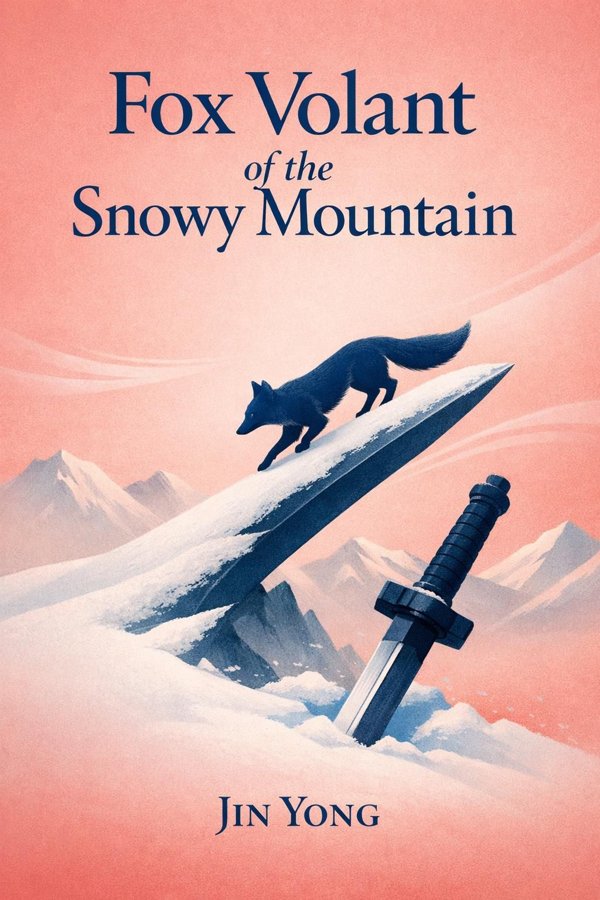
Fox Volant of the Snowy Mountain: Summary & Key Insights
by Jin Yong
 10 min9 chaptersAudio available
Key Takeaways from Fox Volant of the Snowy Mountain
A duel is rarely only about who wins; often, it reveals who everyone has already become.
Some of the deepest hatreds do not begin with evil intentions; they begin with error.
Honor can uplift human beings, but when mixed with pride and silence, it can also become a poison.
Revenge gives people direction, but it also narrows their world until justice becomes indistinguishable from obsession.
Love in a tragic world is rarely pure escape; more often, it becomes another test of conscience.
What Is Fox Volant of the Snowy Mountain About?
Fox Volant of the Snowy Mountain by Jin Yong is a classics book spanning 7 pages. Fox Volant of the Snowy Mountain is one of Jin Yong’s most compact yet artistically daring wuxia novels, built around a seemingly simple scene: a duel in the snow between the young swordsman Hu Fei and the legendary fighter Miao Renfeng. From that frozen confrontation, the story unfolds through recollections, conflicting testimonies, hidden motives, and old grievances, gradually revealing a tragedy shaped as much by misunderstanding as by martial valor. Set during the Qianlong era of the Qing dynasty, the novel transforms a tale of revenge into a meditation on justice, loyalty, love, and the limits of human judgment. What makes this book matter is not only its thrilling martial world, but its unusual structure and moral depth. Jin Yong uses reverse chronology and layered storytelling to show that truth is rarely obvious, especially when pride, guilt, and inherited hatred cloud the heart. Though shorter than many of his epics, the novel contains the same richness of history, psychology, and ethical tension that made Jin Yong the defining master of modern wuxia fiction. It is a brilliant example of how action, suspense, and philosophy can meet in a single snowbound moment.
This FizzRead summary covers all 9 key chapters of Fox Volant of the Snowy Mountain in approximately 10 minutes, distilling the most important ideas, arguments, and takeaways from Jin Yong's work. Also available as an audio summary and Key Quotes Podcast.
Fox Volant of the Snowy Mountain
Fox Volant of the Snowy Mountain is one of Jin Yong’s most compact yet artistically daring wuxia novels, built around a seemingly simple scene: a duel in the snow between the young swordsman Hu Fei and the legendary fighter Miao Renfeng. From that frozen confrontation, the story unfolds through recollections, conflicting testimonies, hidden motives, and old grievances, gradually revealing a tragedy shaped as much by misunderstanding as by martial valor. Set during the Qianlong era of the Qing dynasty, the novel transforms a tale of revenge into a meditation on justice, loyalty, love, and the limits of human judgment.
What makes this book matter is not only its thrilling martial world, but its unusual structure and moral depth. Jin Yong uses reverse chronology and layered storytelling to show that truth is rarely obvious, especially when pride, guilt, and inherited hatred cloud the heart. Though shorter than many of his epics, the novel contains the same richness of history, psychology, and ethical tension that made Jin Yong the defining master of modern wuxia fiction. It is a brilliant example of how action, suspense, and philosophy can meet in a single snowbound moment.
Who Should Read Fox Volant of the Snowy Mountain?
This book is perfect for anyone interested in classics and looking to gain actionable insights in a short read. Whether you're a student, professional, or lifelong learner, the key ideas from Fox Volant of the Snowy Mountain by Jin Yong will help you think differently.
- ✓Readers who enjoy classics and want practical takeaways
- ✓Professionals looking to apply new ideas to their work and life
- ✓Anyone who wants the core insights of Fox Volant of the Snowy Mountain in just 10 minutes
Want the full summary?
Get instant access to this book summary and 100K+ more with Fizz Moment.
Get Free SummaryAvailable on App Store • Free to download
Key Chapters
A duel is rarely only about who wins; often, it reveals who everyone has already become. In Fox Volant of the Snowy Mountain, the opening confrontation between Hu Fei and Miao Renfeng functions as far more than an action set piece. It is the novel’s dramatic frame, a suspended instant in which years of rumor, grief, pride, and misunderstanding converge. The snowy mountain is not just a backdrop. Its isolation strips away distraction, while its harsh silence magnifies every decision, every hesitation, and every hidden motive.
Hu Fei arrives carrying the burden of filial revenge. Miao Renfeng stands as both feared master and possible wrongdoer. Around them gather witnesses whose stories slowly fill in the past, turning the duel into a puzzle rather than a straightforward contest. As the narrative moves backward and sideways through memory, readers realize that the real question is not simply whether Hu Fei can defeat Miao, but whether he truly understands the man he seeks to kill. The duel thus becomes a moral crossroads: can action be just when knowledge is incomplete?
This idea has broad application beyond fiction. In real life, many confrontations begin after people have already built fixed narratives about each other. Workplace disputes, family estrangements, and political conflicts often resemble this mountain standoff: the visible clash is only the final layer of a much deeper history. When we rush to judgment, we risk fighting the wrong battle.
Jin Yong’s brilliance lies in making suspense depend not only on physical danger, but on interpretation. The snow-covered peak becomes a courtroom without certainty, where every recollection alters the meaning of the present.
Actionable takeaway: before taking irreversible action in any conflict, pause and ask what part of the story you may still be missing.
Some of the deepest hatreds do not begin with evil intentions; they begin with error. The feud between the Hu and Miao families illustrates one of Jin Yong’s most enduring insights: tragedy often grows from misread events, distorted loyalties, and incomplete truths passed across generations. What appears at first to be a straightforward legacy of vengeance gradually reveals itself as a chain of accidents, assumptions, and manipulated perceptions.
In the martial world, reputation is everything. A single act can become legend, and a legend can harden into unquestioned fact. The deaths and betrayals that link the Hu and Miao names are therefore not merely personal losses; they become moral verdicts inherited by descendants. Hu Fei grows up under the shadow of his father’s death and the belief that justice demands retribution. Yet as stories emerge, certainty weakens. Miao Renfeng, initially cast as villain or rival, proves harder to judge than inherited memory allows.
This pattern feels familiar even outside wuxia. Families preserve grievances for generations. Organizations operate on old assumptions about who is trustworthy and who is not. Nations sometimes perpetuate historical anger long after the original events have been simplified into slogans. The novel shows how inherited resentment can feel righteous while still being based on partial truth.
Importantly, Jin Yong does not deny the reality of suffering. Pain is real, even when interpretations are flawed. What he questions is the automatic conversion of pain into moral certainty. The book warns that revenge built on misunderstanding does not restore justice; it multiplies loss.
The emotional force of the feud lies in this tension. Hu Fei’s desire for vengeance is understandable, even sympathetic. But understanding his pain is not the same as endorsing his assumptions. That difference gives the novel its maturity.
Actionable takeaway: when you inherit a conflict, do not inherit the story unexamined. Investigate the facts before you adopt the grievance.
Honor can uplift human beings, but when mixed with pride and silence, it can also become a poison. One of the most compelling dimensions of Fox Volant of the Snowy Mountain is its portrayal of martial brotherhood: sworn bonds, duty, mutual respect, and the terrible consequences that follow when trust is corroded by guilt and concealment. Jin Yong shows that loyalty is not self-executing; it must be sustained by honesty, humility, and moral courage.
The world of wuxia often celebrates brotherhood as sacred, yet this novel explores how even noble men can fail one another. Characters carry obligations they cannot fulfill cleanly. They hide truths to protect reputations, preserve peace, or shield others from pain. But every concealed fact becomes an emotional toxin. Guilt accumulates silently, and what began as restraint or mercy eventually feeds suspicion and catastrophe.
Miao Renfeng embodies this tension particularly well. He is formidable, respected, and in many ways upright, yet he is surrounded by moral residues left by old events. The reader is forced to ask: what does it mean to be honorable when one is entangled in outcomes one did not fully intend? The novel suggests that honor is not a static identity. It is tested not only in combat, but in one’s willingness to confront uncomfortable truth.
This idea is immediately practical. In friendships, professional partnerships, and families, people often protect relationships by avoiding difficult conversations. They tell themselves they are preserving harmony. In reality, unspoken guilt and ambiguity can make eventual conflict much worse. Integrity requires not only noble intentions, but transparent reckoning.
Jin Yong’s moral sophistication lies in refusing simplistic categories. A guilty conscience does not always belong to a villain, and a damaged bond does not erase former sincerity. Brotherhood can be real and still fail.
Actionable takeaway: if loyalty matters to you, strengthen it with truth-telling early, before silence turns respect into resentment.
Revenge gives people direction, but it also narrows their world until justice becomes indistinguishable from obsession. Hu Fei’s journey in Fox Volant of the Snowy Mountain is not merely the rise of a young martial hero; it is the shaping of a personality under the pressure of inherited grief. He grows into a skilled, courageous, and fiercely independent swordsman, yet his strength is inseparable from loneliness. The very mission that gives his life meaning also isolates him from ambiguity, tenderness, and peace.
Hu Fei is compelling because he is not a cold avenger. He feels deeply, acts passionately, and possesses a genuine sense of right and wrong. But Jin Yong makes clear that moral passion can become dangerous when attached to a simplified narrative. Hu Fei’s image of himself as an instrument of justice depends on a fixed understanding of the past. As that understanding becomes unstable, so does his identity. If the enemy is not what he imagined, who is he without revenge?
This is a deeply human dilemma. Many people build themselves around a single wound: a betrayal, a humiliation, an unfair loss. The determination to overcome it can produce discipline and resilience, but it can also trap them in permanent opposition. They become experts at fighting, but strangers to reconciliation. In modern terms, someone may define a career around proving doubters wrong, or preserve emotional distance because anger feels safer than vulnerability.
Hu Fei’s loneliness therefore matters as much as his swordsmanship. He stands as a reminder that unresolved pain can create heroic energy while quietly draining the soul. Growth requires not only courage against opponents, but courage against one’s own cherished grievances.
Jin Yong does not mock revenge; he understands its emotional logic. What he questions is whether revenge can ever complete a life.
Actionable takeaway: ask whether the goal driving you forward is helping you grow, or merely helping you remain wounded in a more disciplined way.
Love in a tragic world is rarely pure escape; more often, it becomes another test of conscience. Tian Guinü is central to the emotional and ethical texture of Fox Volant of the Snowy Mountain. She is not merely a romantic figure placed beside martial conflict. Instead, she embodies the web of desire, vulnerability, compassion, and divided loyalty that makes the novel’s moral universe so rich. Through her, Jin Yong shows that the heart complicates every clean theory of justice.
Tian Guinü moves through a world dominated by male codes of honor, revenge, and martial reputation, yet her presence reveals what those codes often overlook. Human beings are not only fighters or heirs; they are also lovers, caregivers, dependents, and conflicted moral agents. Affection can interrupt hatred. Sympathy can arise where ideology demands hostility. Emotional bonds may expose truths that formal loyalty hides.
Her role also underscores how individuals with less overt power can still shape the moral center of a story. She influences decisions not through physical dominance but through emotional reality. Characters who might otherwise act according to rigid codes are forced to confront compassion, jealousy, tenderness, and guilt. In that sense, she widens the novel’s lens: what appears to be a duel between men is also a drama of relationships, obligations, and unspoken sacrifice.
This has modern relevance. In many conflicts, people frame issues abstractly—principle, justice, victory—while ignoring the emotional ecosystems around them. Yet decisions made in anger ripple through partners, children, friends, and communities. Tian Guinü reminds us that morality is relational. What seems righteous from one angle may look devastating from another.
Jin Yong’s treatment avoids turning her into a mere symbol. She is part of the story’s complexity precisely because emotions are morally consequential, not distractions from serious action.
Actionable takeaway: whenever you are judging a conflict, include the emotional and human costs, not just the formal principles at stake.
How a story is told determines what kind of truth it can reveal. One of the novel’s greatest achievements is its structure: rather than moving in a simple linear sequence, Fox Volant of the Snowy Mountain unfolds through layered accounts, recollections, and gradually disclosed histories. This reverse-leaning, nested method is not a stylistic trick. It is central to Jin Yong’s exploration of uncertainty, perspective, and moral complexity.
By beginning near the point of climax, Jin Yong invites readers to experience judgment before understanding. We first see tension, accusation, and the possibility of violence. Only afterward do we receive fragments of the past that explain how matters reached this point. But each fragment comes through human witnesses, each with limitations, biases, and emotional investments. The result is a narrative that mimics real life: people rarely encounter events with omniscient clarity. They inherit stories, revise them, and discover too late how much they misunderstood.
This structure changes the reader’s role. Instead of passively consuming a heroic tale, we become interpreters. We must compare accounts, note contradictions, and resist the temptation to settle too quickly on heroes and villains. In doing so, we feel the same epistemic instability the characters face. The form therefore teaches the theme: truth is layered, and moral certainty should be earned slowly.
In practical terms, this is an excellent lesson in critical thinking. News, workplace disputes, family drama, and online controversies often arrive as climactic moments stripped of background. People react to the duel without investigating the history. Jin Yong reminds us that chronology matters, context matters, and testimony is never identical to truth.
The novel’s narrative design is especially notable because it compresses philosophical richness into a relatively short work. Every revelation reinterprets what came before.
Actionable takeaway: when confronted with a charged situation, reconstruct the sequence of events before deciding what justice requires.
Not every meaningful story ends by removing doubt; some end by teaching us how to live with it. The mountain’s silence in Fox Volant of the Snowy Mountain is one of the novel’s most memorable qualities. Even as secrets surface and motives become clearer, Jin Yong resists total closure. The ending’s ambiguity is not evasive. It is the novel’s final argument about human judgment, redemption, and the costs of action taken under uncertainty.
Readers accustomed to decisive resolutions may initially find this unsettling. Wuxia often promises catharsis through combat: wrongs are avenged, villains are punished, and order is restored. Here, however, the unresolved quality of the final confrontation forces us to sit with competing truths. Hu Fei’s anger is understandable. Miao Renfeng’s position is not reducible to simple guilt. The emotional logic of revenge persists even after the moral logic weakens. That tension cannot be fully untangled by one stroke of the blade.
This ambiguity is deeply humane. Real life rarely grants perfect moral accounting. We may uncover enough truth to see that our initial assumptions were flawed, yet still not know what action would have been ideal. We may regret harm without knowing how to repair it. We may understand another person better while still mourning what they have cost us. Jin Yong honors this complexity rather than flattening it for comfort.
There is also a redemptive dimension here. Ambiguity creates space for mercy, self-questioning, and restraint. If certainty is incomplete, then violence becomes harder to justify. The novel does not deny the necessity of courage; it warns against confusing courage with absolute confidence.
For modern readers, this is a powerful antidote to polarized thinking. Not every unresolved matter is a failure. Sometimes uncertainty is the beginning of wisdom.
Actionable takeaway: when certainty collapses, do not rush to replace it with a new dogma. Let ambiguity slow you into better judgment.
Martial arts fiction endures not because of swordplay alone, but because combat can dramatize ethical choice. Fox Volant of the Snowy Mountain is an excellent example of wuxia functioning as moral literature rather than simple escapist adventure. Duels, secret histories, expert fighters, and clan rivalries give the novel energy, yet beneath that momentum lies a sustained inquiry into righteousness, loyalty, justice, and the dangers of self-deception.
Jin Yong elevates the genre by ensuring that physical skill never settles moral questions on its own. A superior swordsman may still be ethically compromised. A passionate avenger may still be mistaken. A feared opponent may deserve sympathy. This refusal to let strength equal virtue is one reason the novel feels mature despite its brevity. The martial world becomes a stage where ideas are tested under pressure.
The book also demonstrates how codes of conduct can both guide and imprison people. Wuxia heroes often strive to act according to honor, gratitude, or vengeance. These values matter, but Jin Yong insists that no code can substitute for reflective judgment. Rules inherited from tradition may lead to noble sacrifice in one context and needless tragedy in another. The true challenge is discernment.
This insight applies easily today. People often cling to identities—professional, political, religious, familial—and assume that loyalty to the code proves moral soundness. But ethical maturity requires more than consistency. It requires the willingness to ask whether your principles are being applied wisely, compassionately, and with full awareness of consequences.
For readers new to wuxia, this novel is a reminder that the genre can carry philosophical weight equal to more canonical forms of literature. For longtime fans, it showcases Jin Yong’s ability to compress action and moral reflection into a tightly designed narrative.
Actionable takeaway: do not judge a person, decision, or system solely by its stated code; judge it by how it treats real human complexity.
People do not simply remember the past; they reshape it in ways that preserve pride, justify pain, or make suffering bearable. Throughout Fox Volant of the Snowy Mountain, testimony is crucial. Characters recount earlier events, offer explanations, defend reputations, and interpret motives. Yet the novel repeatedly shows that memory is not a neutral archive. It is emotional, selective, and often self-protective.
This matters because the story’s central conflict depends on what people think happened. Hu Fei’s mission, Miao Renfeng’s standing, and the network of old grudges all rest on narratives handed down and retold. Some accounts contain deliberate deception; others contain sincere but flawed perception. Jin Yong is interested in both. A lie can distort truth, but so can wounded sincerity. The effect is to make truth fragile: available, perhaps, but only through patient comparison and moral attentiveness.
What makes this especially powerful is that readers themselves are drawn into the same uncertainty. We must decide whom to trust and how much confidence to place in any single version of events. In this way, the novel becomes a study in interpretation. It reminds us that hearing a story is not the same as understanding it.
The practical relevance is obvious in an age of endless information. Whether in social media disputes, historical debates, or office politics, people often confuse confident storytelling with factual reliability. A compelling narrative can be emotionally true to the speaker while still misleading in substance. The solution is not cynicism, but disciplined listening: gather multiple perspectives, identify incentives, and stay alert to what is missing.
Jin Yong turns this epistemological problem into gripping fiction. Every recollection adds suspense because it may illuminate the past or deepen the fog around it.
Actionable takeaway: when truth matters, do not ask only whether a story is moving or coherent; ask what evidence supports it and what perspective it leaves out.
All Chapters in Fox Volant of the Snowy Mountain
About the Author
Jin Yong (1924–2018), born Louis Cha Leung-yung in Hangzhou, Zhejiang, was the most celebrated writer in modern wuxia literature. A novelist, journalist, editor, and entrepreneur, he transformed martial arts fiction from popular entertainment into a genre capable of literary sophistication, historical resonance, and philosophical depth. His major works, including The Legend of the Condor Heroes, The Return of the Condor Heroes, and The Heaven Sword and Dragon Saber, became cultural landmarks across the Chinese-speaking world and beyond. Jin Yong’s fiction is renowned for its memorable heroes, intricate plots, vivid historical settings, and nuanced treatment of ethics, politics, and human desire. His influence extends far beyond literature into film, television, comics, and gaming, securing his place as one of the most important Chinese-language storytellers of the twentieth century.
Get This Summary in Your Preferred Format
Read or listen to the Fox Volant of the Snowy Mountain summary by Jin Yong anytime, anywhere. FizzRead offers multiple formats so you can learn on your terms — all free.
Available formats: App · Audio · PDF · EPUB — All included free with FizzRead
Download Fox Volant of the Snowy Mountain PDF and EPUB Summary
Key Quotes from Fox Volant of the Snowy Mountain
“A duel is rarely only about who wins; often, it reveals who everyone has already become.”
“Some of the deepest hatreds do not begin with evil intentions; they begin with error.”
“Honor can uplift human beings, but when mixed with pride and silence, it can also become a poison.”
“Revenge gives people direction, but it also narrows their world until justice becomes indistinguishable from obsession.”
“Love in a tragic world is rarely pure escape; more often, it becomes another test of conscience.”
Frequently Asked Questions about Fox Volant of the Snowy Mountain
Fox Volant of the Snowy Mountain by Jin Yong is a classics book that explores key ideas across 9 chapters. Fox Volant of the Snowy Mountain is one of Jin Yong’s most compact yet artistically daring wuxia novels, built around a seemingly simple scene: a duel in the snow between the young swordsman Hu Fei and the legendary fighter Miao Renfeng. From that frozen confrontation, the story unfolds through recollections, conflicting testimonies, hidden motives, and old grievances, gradually revealing a tragedy shaped as much by misunderstanding as by martial valor. Set during the Qianlong era of the Qing dynasty, the novel transforms a tale of revenge into a meditation on justice, loyalty, love, and the limits of human judgment. What makes this book matter is not only its thrilling martial world, but its unusual structure and moral depth. Jin Yong uses reverse chronology and layered storytelling to show that truth is rarely obvious, especially when pride, guilt, and inherited hatred cloud the heart. Though shorter than many of his epics, the novel contains the same richness of history, psychology, and ethical tension that made Jin Yong the defining master of modern wuxia fiction. It is a brilliant example of how action, suspense, and philosophy can meet in a single snowbound moment.
More by Jin Yong

You Might Also Like





Browse by Category
Ready to read Fox Volant of the Snowy Mountain?
Get the full summary and 100K+ more books with Fizz Moment.