
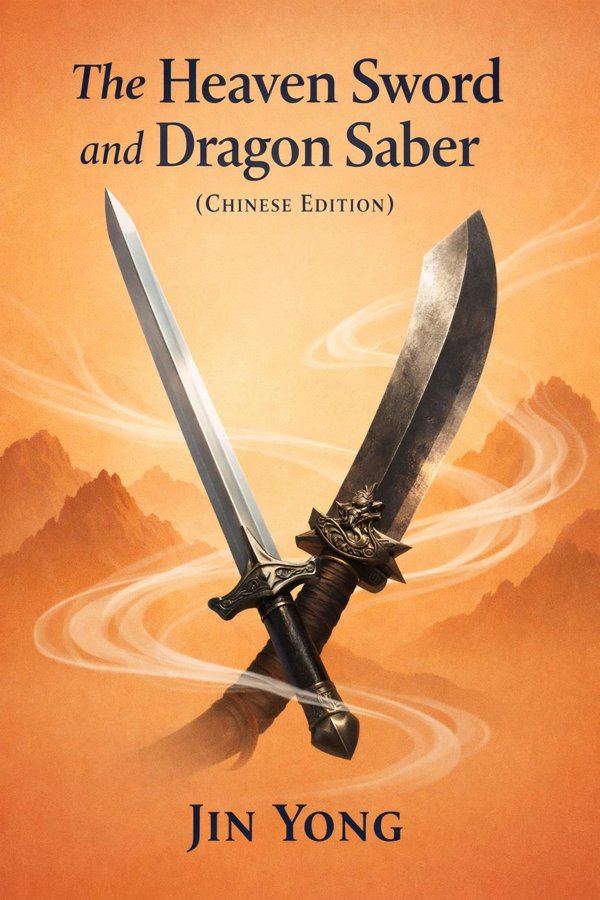
The Heaven Sword and Dragon Saber (Chinese Edition): Summary & Key Insights
by Jin Yong
 10 min9 chaptersAudio available
Key Takeaways from The Heaven Sword and Dragon Saber (Chinese Edition)
Great stories often begin with an illusion: people think they are chasing objects, when in truth they are chasing meaning.
Character is rarely formed in comfort; more often, it is forged where innocence meets pain.
Power becomes dangerous when it arrives before wisdom, but transformative when paired with restraint.
Leadership is often mistaken for triumph, when in reality it is a burden of contradictions.
The heart can reveal a person’s humanity, but it can also expose the limits of judgment.
What Is The Heaven Sword and Dragon Saber (Chinese Edition) About?
The Heaven Sword and Dragon Saber (Chinese Edition) by Jin Yong is a classics book spanning 5 pages. The Heaven Sword and Dragon Saber is one of Jin Yong’s grandest achievements: an epic wuxia novel where martial arts legend, political upheaval, romance, and moral uncertainty are woven into a single vast tapestry. Set near the end of the Yuan dynasty, the story follows Zhang Wuji, a gifted but conflicted young man drawn into a world of rival sects, secret manuals, sacred weapons, and rebellion against foreign rule. At the center stand two famous objects—the Heaven Sword and the Dragon Saber—whose legends ignite greed, loyalty, and bloodshed across the jianghu. Yet this is far more than a treasure hunt or a martial adventure. It is a study of how power distorts ideals, how kindness survives betrayal, and how a hero can be shaped as much by hesitation and compassion as by strength. As the concluding volume of the Condor Trilogy, the novel carries historical breadth and emotional depth, linking personal destiny with national crisis. Jin Yong’s authority lies in his unmatched ability to blend history, philosophy, character psychology, and exhilarating action into fiction that remains endlessly readable and culturally foundational.
This FizzRead summary covers all 9 key chapters of The Heaven Sword and Dragon Saber (Chinese Edition) in approximately 10 minutes, distilling the most important ideas, arguments, and takeaways from Jin Yong's work. Also available as an audio summary and Key Quotes Podcast.
The Heaven Sword and Dragon Saber (Chinese Edition)
The Heaven Sword and Dragon Saber is one of Jin Yong’s grandest achievements: an epic wuxia novel where martial arts legend, political upheaval, romance, and moral uncertainty are woven into a single vast tapestry. Set near the end of the Yuan dynasty, the story follows Zhang Wuji, a gifted but conflicted young man drawn into a world of rival sects, secret manuals, sacred weapons, and rebellion against foreign rule. At the center stand two famous objects—the Heaven Sword and the Dragon Saber—whose legends ignite greed, loyalty, and bloodshed across the jianghu. Yet this is far more than a treasure hunt or a martial adventure. It is a study of how power distorts ideals, how kindness survives betrayal, and how a hero can be shaped as much by hesitation and compassion as by strength. As the concluding volume of the Condor Trilogy, the novel carries historical breadth and emotional depth, linking personal destiny with national crisis. Jin Yong’s authority lies in his unmatched ability to blend history, philosophy, character psychology, and exhilarating action into fiction that remains endlessly readable and culturally foundational.
Who Should Read The Heaven Sword and Dragon Saber (Chinese Edition)?
This book is perfect for anyone interested in classics and looking to gain actionable insights in a short read. Whether you're a student, professional, or lifelong learner, the key ideas from The Heaven Sword and Dragon Saber (Chinese Edition) by Jin Yong will help you think differently.
- ✓Readers who enjoy classics and want practical takeaways
- ✓Professionals looking to apply new ideas to their work and life
- ✓Anyone who wants the core insights of The Heaven Sword and Dragon Saber (Chinese Edition) in just 10 minutes
Want the full summary?
Get instant access to this book summary and 100K+ more with Fizz Moment.
Get Free SummaryAvailable on App Store • Free to download
Key Chapters
Great stories often begin with an illusion: people think they are chasing objects, when in truth they are chasing meaning. In The Heaven Sword and Dragon Saber, the legendary Heaven Sword and Dragon Saber appear at first to be prized weapons, symbols of supremacy in the martial world. But Jin Yong quickly reveals that they are also magnets for fear, ambition, and projection. Entire sects organize themselves around rumors of hidden power, while individuals betray allies, forge temporary partnerships, and ignite feuds because they believe possession of these weapons will solve deeper anxieties about status, legitimacy, and survival.
The novel unfolds in the late Yuan dynasty, when Mongol rule has weakened the social fabric and rebellion simmers beneath everyday life. In this unstable world, the jianghu mirrors the broader political disorder. Martial sects are not detached from history; they are shaped by it. Legends surrounding the sword and saber spread because people long for certainty in uncertain times. A weapon becomes a promise, a prophecy, and a shortcut to control.
This idea has broad relevance beyond fiction. In real life, people often attach exaggerated hopes to titles, institutions, technologies, or symbols of success. A promotion, a credential, a political movement, or even a brand can become the modern equivalent of the Heaven Sword: something believed to contain the answer to personal insecurity or social confusion. Yet what matters most is not the object but the human desire surrounding it.
Jin Yong uses the opening movements of the story to show how myths shape behavior before truth is ever known. Characters are often trapped by stories they have inherited, not by facts they have examined. Actionable takeaway: whenever a goal seems overwhelmingly powerful or irresistible, pause and ask whether you are pursuing the thing itself or the meaning you have projected onto it.
Character is rarely formed in comfort; more often, it is forged where innocence meets pain. Zhang Wuji’s early life is defined by loss, vulnerability, and wandering. Orphaned under tragic circumstances and poisoned by the devastating Xuanming Divine Palm, he begins his journey physically weakened and emotionally exposed. Unlike straightforward heroes who rise through confidence and conquest, Zhang Wuji develops through endurance. He survives by absorbing the lessons of hardship rather than hardening into cruelty.
Jin Yong makes suffering central to growth, but never sentimentalizes it. Pain does not automatically ennoble. Zhang Wuji’s misfortunes could have produced bitterness, paranoia, or revenge. Instead, his encounters with teachers, enemies, and protectors gradually deepen his empathy. His brush with mortality teaches him how fragile people are; his isolation teaches him how much human warmth matters. Even his accidental discoveries and unusual martial training reflect a life shaped by detours, not planned advancement.
One of the novel’s strengths is that Zhang Wuji is not a hero because he dominates others at every turn. He becomes compelling because he retains compassion even after repeated betrayal and suffering. He understands weakness from the inside. That understanding later affects how he leads, whom he trusts, and why he hesitates to punish harshly.
This arc applies well outside the martial world. Many people measure growth only by visible success, but lasting maturity often comes from surviving confusion, disappointment, illness, family crisis, or professional setbacks without losing moral balance. The key is to convert suffering into perspective rather than identity.
Jin Yong suggests that true strength is not invulnerability but the ability to remain humane while carrying scars. Zhang Wuji’s early trials prepare him not merely to fight, but to understand the broken world he inhabits. Actionable takeaway: when facing hardship, ask not only how to escape it, but what kind of person the experience is training you to become.
Leadership is often mistaken for triumph, when in reality it is a burden of contradictions. A major turning point in The Heaven Sword and Dragon Saber is Zhang Wuji’s rise within the Ming Cult, a group widely misunderstood and vilified by the orthodox martial sects. Jin Yong uses this development to challenge simplistic judgments. The so-called righteous factions are not always righteous, and the allegedly demonic cult is not simply evil. Labels, the novel suggests, are often weapons in ideological struggle.
When Zhang Wuji becomes a central leader of the Ming Cult, he does not inherit clean authority. He enters a fractured organization marked by internal rivalries, historical grievances, and external hostility. His compassion and broad-mindedness help him mediate disputes, win loyalty, and prevent bloodshed. Yet these same qualities also expose his weaknesses. He dislikes domination, avoids ruthless calculation, and struggles to impose hard decisions quickly. The result is a nuanced portrait of leadership: moral decency can inspire trust, but indecision can also invite chaos.
Jin Yong links the cult’s fate to the wider political crisis of the age. Anti-Yuan resistance movements need unity, but unity is hard to sustain when sectarian pride, personal ambition, and emotional entanglements distort collective goals. Zhang Wuji’s leadership reveals how difficult it is to serve both principle and practicality.
This idea is highly relevant today. Whether in business, civic groups, families, or institutions, leaders are often chosen because they seem morally appealing or technically brilliant. But real leadership demands conflict management, timing, delegation, and tolerance for imperfect outcomes. One must hold people together without becoming their captive.
The Ming Cult arc shows that authority is not possession of power but responsibility for competing needs and unstable loyalties. Actionable takeaway: if you lead others, do not define success only by good intentions; build systems, boundaries, and decision habits that allow your values to survive under pressure.
The heart can reveal a person’s humanity, but it can also expose the limits of judgment. Zhang Wuji’s relationships with the women in his life form one of the novel’s richest and most debated dimensions. Zhou Zhiruo, Zhao Min, Xiao Zhao, and Yin Li are not decorative romantic interests; each embodies different values, temptations, emotional possibilities, and moral tensions. Through them, Jin Yong turns romance into a test of perception.
Zhang Wuji is kind, sincere, and deeply responsive to the feelings of others. These traits make him lovable, but they also leave him vulnerable to confusion. He often hesitates because he sees too much pain on every side. He struggles to distinguish compassion from commitment and obligation from desire. His emotional indecision causes suffering not because he lacks feeling, but because he lacks the clarity to act decisively.
The women themselves are vividly drawn. Some are politically shrewd, some sacrificial, some wounded, some manipulative, and some transformed by circumstance. Through them, the novel explores how love interacts with power, resentment, social identity, and personal ambition. Romance is never isolated from the wider world of sect loyalties and political intrigue. To love someone in this story is also to inherit their history and enemies.
This has practical echoes in modern life. Relationships are rarely only about chemistry. They involve values, timing, emotional maturity, communication, and the ability to make difficult choices without drifting. Kindness alone is not enough if it avoids truth. Good intentions do not compensate for prolonged ambiguity.
Jin Yong’s treatment of love is compassionate yet unsparing. Emotional depth is admirable, but without self-knowledge it can create avoidable harm. Zhang Wuji’s romantic life shows that being unwilling to choose is itself a choice, often with consequences for everyone involved. Actionable takeaway: in important relationships, practice honest clarity early; empathy matters, but ambiguity can wound more deeply than refusal.
What society calls righteous is not always just, and what it condemns is not always corrupt. One of Jin Yong’s most enduring achievements in The Heaven Sword and Dragon Saber is his dismantling of moral binaries. The orthodox martial sects often claim legitimacy through tradition, hierarchy, and reputation. Yet again and again, the novel reveals pettiness, hypocrisy, cruelty, and self-interest beneath respectable language. Meanwhile, groups labeled unorthodox may display loyalty, courage, sacrifice, and political clarity.
This moral complexity gives the story much of its force. Jin Yong does not replace one simplistic schema with another; he does not argue that the unorthodox are secretly pure. Instead, he shows that every faction contains a mix of virtue and vice, and that institutional identity can easily obscure individual character. People use doctrine to protect ego. They invoke justice to settle personal grudges. They cling to inherited labels because labels spare them the discomfort of discernment.
For Zhang Wuji, this world is especially difficult because he is naturally compassionate and reluctant to condemn. His instinct is often wiser than the prejudices around him, but his generosity can also blur necessary distinctions. The reader is therefore invited to practice a mature ethical vision: reject caricatures, but do not become naive.
This theme is highly practical in public life, workplaces, and communities. We often assume that prestige, credentials, official language, or group identity guarantees integrity. Yet organizations can become morally compromised while still sounding noble. Likewise, outsiders can be dismissed unfairly because they threaten existing power structures.
Jin Yong’s message is that morality requires independent judgment. Traditions matter, but they cannot replace conscience. Reputation matters, but it cannot substitute for conduct. Actionable takeaway: when evaluating people or institutions, look beyond labels and ask what their behavior consistently produces—for allies, opponents, and the vulnerable.
Private lives are never fully private when history is collapsing around them. Although The Heaven Sword and Dragon Saber is filled with duels, secret manuals, and romantic entanglements, its larger canvas is national transformation. Set during the decline of the Yuan dynasty, the novel captures an era when resistance to Mongol rule gathers force and multiple groups compete to shape China’s future. This historical framing gives the story unusual gravity. The struggles of the jianghu are not escapist diversions; they are entangled with questions of sovereignty, legitimacy, and cultural survival.
Jin Yong excels at showing how broad political currents filter into personal choices. Characters are drawn into rebellion by patriotism, ambition, revenge, faith, or circumstance. Alliances shift because national liberation is not a single unified cause but a contested field of competing leaders and visions. The emergence of the Ming movement gives the novel both momentum and irony: noble ideals can animate a revolution, yet the path to political success is often morally compromised.
Zhang Wuji stands at the center of these tensions. His martial standing and moral prestige make him relevant to history, but his temperament is inwardly resistant to power politics. He can influence events, yet he is never fully at home in political struggle. This conflict between personal disposition and historical necessity gives the novel emotional realism. Not everyone suited to greatness desires the kind of greatness history demands.
For modern readers, this theme illuminates how social upheaval reshapes ordinary ethics. During polarized or unstable periods, neutrality becomes difficult, affiliation becomes morally charged, and personal relationships are strained by public commitments.
Jin Yong suggests that patriotism, while powerful, must still be examined critically. A just cause does not automatically produce just conduct. Actionable takeaway: when caught in large political or organizational struggles, stay attentive to both the cause you serve and the methods you normalize in serving it.
What people inherit can guide them, burden them, or destroy them, depending on how tightly they cling to it. The mysteries hidden within the Heaven Sword and Dragon Saber drive much of the plot, but Jin Yong uses these secrets to explore a broader human pattern: the obsession with legacy. Manuals, weapons, sect teachings, family vows, and historical grudges pass from one generation to the next, shaping destinies long after their origins are forgotten or distorted.
In the novel, inheritance is rarely simple. A treasured object contains both promise and danger. A secret technique can preserve wisdom or unleash disaster. A duty handed down from elders can inspire courage, but it can also trap descendants in outdated hatred. Characters often suffer not because the past is irrelevant, but because they receive it uncritically. They inherit instructions without context, honor without reflection, and enemies without firsthand understanding.
The central weapons themselves are perfect symbols of this problem. Everyone wants them, but few ask what it means to build one’s life around possession. Obsession narrows perception. Once consumed by acquisition, characters justify betrayal, violence, and self-deception. What was meant to preserve greatness instead corrodes character.
This dynamic remains familiar today. Families pass down expectations, companies preserve rigid traditions, and societies inherit narratives about status, victimhood, or destiny. These inheritances can offer identity and continuity, but they can also become prisons if never questioned. Wisdom requires distinguishing what deserves preservation from what deserves release.
Jin Yong ultimately shows that the past should be interpreted, not worshipped. Legacy is valuable when it serves life in the present; it becomes destructive when people sacrifice the living for the sake of symbols. Actionable takeaway: examine the beliefs, ambitions, and loyalties you have inherited, and keep only those that help you act more wisely and humanely now.
Not every triumph ends in possession; sometimes the deepest victory is the refusal to keep fighting for what no longer belongs to the soul. The resolution of The Heaven Sword and Dragon Saber is striking because it resists the conventional fantasy of total conquest. By the end, Zhang Wuji has gained extraordinary martial skill, influence, and historical significance. He has stood near the center of rebellion, legend, and emotional turmoil. Yet his final movement is not toward domination, but away from it.
This detachment does not arise from weakness. It grows from exhaustion, self-recognition, and moral weariness. Zhang Wuji comes to understand that power, leadership, and fame are inseparable from compromise, projection, and endless conflict. The world keeps demanding that he become a symbol. But he remains, at heart, a man drawn more to affection and peace than to command. His withdrawal is therefore bittersweet: noble in its honesty, frustrating in its incompleteness.
Jin Yong’s ending underscores one of the novel’s central insights: human beings do not always fit the roles history assigns them. A person may be capable of rule yet unsuited to its sacrifices. A hero may save the world without wanting to govern it. This gives the book an unusually mature emotional register. Fulfillment is not always found in public achievement. Sometimes it lies in choosing a smaller, truer life.
Modern readers can apply this idea whenever success begins to drift away from personal integrity. Careers, leadership posts, and public recognition can become self-perpetuating traps. Walking away may look like surrender from the outside, but it can be clarity from within.
The novel leaves us with a complex farewell: history moves on, ideals remain unstable, and no victory is absolute. Actionable takeaway: regularly ask whether the goals you are winning still match the life you actually want to live.
All Chapters in The Heaven Sword and Dragon Saber (Chinese Edition)
About the Author
Jin Yong (1924–2018), born Louis Cha Leung-yung in Hangzhou, was the most celebrated writer of modern wuxia fiction. A novelist, journalist, editor, and cultural commentator, he transformed martial arts storytelling from popular entertainment into a sophisticated literary form. His novels, including The Legend of the Condor Heroes, The Return of the Condor Heroes, and The Heaven Sword and Dragon Saber, are known for blending history, philosophy, romance, political conflict, and intricate character development. Writing with immense narrative energy and cultural depth, he created stories that shaped generations of readers across the Chinese-speaking world. His work has inspired countless film, television, comic, and game adaptations. Jin Yong remains a towering figure in Chinese literature and one of the most influential storytellers of the twentieth century.
Get This Summary in Your Preferred Format
Read or listen to the The Heaven Sword and Dragon Saber (Chinese Edition) summary by Jin Yong anytime, anywhere. FizzRead offers multiple formats so you can learn on your terms — all free.
Available formats: App · Audio · PDF · EPUB — All included free with FizzRead
Download The Heaven Sword and Dragon Saber (Chinese Edition) PDF and EPUB Summary
Key Quotes from The Heaven Sword and Dragon Saber (Chinese Edition)
“Great stories often begin with an illusion: people think they are chasing objects, when in truth they are chasing meaning.”
“Character is rarely formed in comfort; more often, it is forged where innocence meets pain.”
“Power becomes dangerous when it arrives before wisdom, but transformative when paired with restraint.”
“Leadership is often mistaken for triumph, when in reality it is a burden of contradictions.”
“The heart can reveal a person’s humanity, but it can also expose the limits of judgment.”
Frequently Asked Questions about The Heaven Sword and Dragon Saber (Chinese Edition)
The Heaven Sword and Dragon Saber (Chinese Edition) by Jin Yong is a classics book that explores key ideas across 9 chapters. The Heaven Sword and Dragon Saber is one of Jin Yong’s grandest achievements: an epic wuxia novel where martial arts legend, political upheaval, romance, and moral uncertainty are woven into a single vast tapestry. Set near the end of the Yuan dynasty, the story follows Zhang Wuji, a gifted but conflicted young man drawn into a world of rival sects, secret manuals, sacred weapons, and rebellion against foreign rule. At the center stand two famous objects—the Heaven Sword and the Dragon Saber—whose legends ignite greed, loyalty, and bloodshed across the jianghu. Yet this is far more than a treasure hunt or a martial adventure. It is a study of how power distorts ideals, how kindness survives betrayal, and how a hero can be shaped as much by hesitation and compassion as by strength. As the concluding volume of the Condor Trilogy, the novel carries historical breadth and emotional depth, linking personal destiny with national crisis. Jin Yong’s authority lies in his unmatched ability to blend history, philosophy, character psychology, and exhilarating action into fiction that remains endlessly readable and culturally foundational.
More by Jin Yong


You Might Also Like






Browse by Category
Ready to read The Heaven Sword and Dragon Saber (Chinese Edition)?
Get the full summary and 100K+ more books with Fizz Moment.