
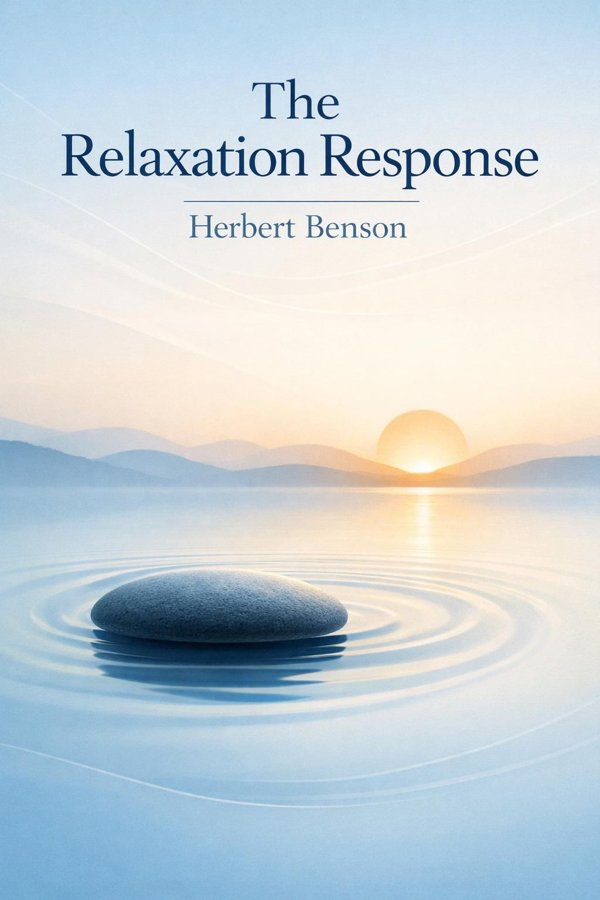
The Relaxation Response: Summary & Key Insights
 10 min7 chaptersAudio available
What Is The Relaxation Response About?
The Relaxation Response by Herbert Benson is a health_med book spanning 7 pages. The Relaxation Response es un libro de divulgación científica que presenta una técnica sencilla para contrarrestar los efectos del estrés mediante la activación de una respuesta fisiológica opuesta, caracterizada por una disminución del ritmo cardíaco, la presión arterial y el consumo de oxígeno. Herbert Benson, médico de Harvard, describe cómo esta respuesta puede inducirse a través de prácticas como la meditación, la oración o la repetición de palabras, y cómo su aplicación regular puede mejorar la salud física y mental.
This FizzRead summary covers all 7 key chapters of The Relaxation Response in approximately 10 minutes, distilling the most important ideas, arguments, and takeaways from Herbert Benson's work. Also available as an audio summary and Key Quotes Podcast.
The Relaxation Response
The Relaxation Response es un libro de divulgación científica que presenta una técnica sencilla para contrarrestar los efectos del estrés mediante la activación de una respuesta fisiológica opuesta, caracterizada por una disminución del ritmo cardíaco, la presión arterial y el consumo de oxígeno. Herbert Benson, médico de Harvard, describe cómo esta respuesta puede inducirse a través de prácticas como la meditación, la oración o la repetición de palabras, y cómo su aplicación regular puede mejorar la salud física y mental.
Who Should Read The Relaxation Response?
This book is perfect for anyone interested in health_med and looking to gain actionable insights in a short read. Whether you're a student, professional, or lifelong learner, the key ideas from The Relaxation Response by Herbert Benson will help you think differently.
- ✓Readers who enjoy health_med and want practical takeaways
- ✓Professionals looking to apply new ideas to their work and life
- ✓Anyone who wants the core insights of The Relaxation Response in just 10 minutes
Want the full summary?
Get instant access to this book summary and 100K+ more with Fizz Moment.
Get Free SummaryAvailable on App Store • Free to download
Key Chapters
In medicine, the stress response is one of the most remarkable and destructive automatic mechanisms of the human body. When we perceive danger—real or imagined—our sympathetic nervous system springs into action. Hormones like adrenaline and noradrenaline surge into the bloodstream. Heart rate accelerates, breathing quickens, muscles tense, and glucose floods our circulation to prepare us for combat or escape. This is the fight-or-flight response, a brilliant adaptation for survival in primitive environments where threats were physical and brief.
But modern life is not a jungle of predators—it is a web of deadlines, traffic, finances, and social pressures. Yet, the body reacts to each email or argument as though it were a charging tiger. Worse, we rarely gain the relief of physical movement or resolution that our ancestors had. As a result, our cardiovascular and metabolic systems operate under near-constant duress. Over time, this persistent activation contributes to hypertension, anxiety, insomnia, and even a compromised immune system.
When I first began to examine blood pressure patients at Harvard, I was struck by how pervasive this 'overdrive' had become. Many were conscientious, hard-working individuals who simply could not 'turn off.' No amount of reassurance or medication could grant them the calm they sought. The more I probed, the more evident it became that chronic stress was not only psychological—it was a systemic physiological state. To restore their health, we needed to discover an equally systemic way to calm the body, not merely the mind. That search would lead to the discovery of what I now call the relaxation response.
The path toward identifying the relaxation response did not begin in a laboratory; it began with curiosity about meditation. In the late 1960s and early 70s, as the American public began exploring Eastern spiritual practices, I, a Harvard-trained cardiologist, was confronted with an unconventional stream of patients—people who had learned transcendental meditation and reported lower blood pressure and a profound sense of peace. Their experiences did not fit neatly into Western medical models.
As I observed them, it became clear that something measurable was occurring. They exhibited slower breathing, decreased oxygen consumption, lower lactate levels—biochemical signs of genuine physiological change. But unlike the fight-or-flight reaction, this state was characterized by systematic quieting of most bodily systems. This was not hypnosis, nor sleep, nor passivity—it was an active state of restful alertness.
Through a series of rigorous experiments, my team and I confirmed that this quieting could be elicited through simple, repeatable methods of focusing the mind and disengaging from distracting thoughts. In effect, the meditators were tapping a built-in capacity to shift the body into balance. And crucially, this response did not depend on any specific cultural or religious form—it was universal, rooted in human biology.
Thus, the 'relaxation response' entered the scientific lexicon not as a mystical state, but as a demonstrable, measurable physiological opposite to the stress response. From that discovery, an entire field of mind-body medicine began to take shape.
+ 5 more chapters — available in the FizzRead app
All Chapters in The Relaxation Response
About the Author
Herbert Benson fue un médico y profesor de la Facultad de Medicina de Harvard, conocido por sus investigaciones sobre la conexión entre la mente y el cuerpo. Fundó el Benson-Henry Institute for Mind Body Medicine y dedicó su carrera a estudiar cómo las técnicas de relajación y meditación pueden influir positivamente en la salud.
Get This Summary in Your Preferred Format
Read or listen to the The Relaxation Response summary by Herbert Benson anytime, anywhere. FizzRead offers multiple formats so you can learn on your terms — all free.
Available formats: App · Audio · PDF · EPUB — All included free with FizzRead
Download The Relaxation Response PDF and EPUB Summary
Key Quotes from The Relaxation Response
“In medicine, the stress response is one of the most remarkable and destructive automatic mechanisms of the human body.”
“The path toward identifying the relaxation response did not begin in a laboratory; it began with curiosity about meditation.”
Frequently Asked Questions about The Relaxation Response
The Relaxation Response by Herbert Benson is a health_med book that explores key ideas across 7 chapters. The Relaxation Response es un libro de divulgación científica que presenta una técnica sencilla para contrarrestar los efectos del estrés mediante la activación de una respuesta fisiológica opuesta, caracterizada por una disminución del ritmo cardíaco, la presión arterial y el consumo de oxígeno. Herbert Benson, médico de Harvard, describe cómo esta respuesta puede inducirse a través de prácticas como la meditación, la oración o la repetición de palabras, y cómo su aplicación regular puede mejorar la salud física y mental.
You Might Also Like

On Immunity
Eula Biss
10 min
The Three-Body Problem
Liu Cixin
10 min
Community Health Volunteer Toolkit: Training and Practical Activities
World Health Organization
10 min
Healing Back Pain: The Mind-Body Connection
John E. Sarno
10 min
Health Literacy for All: Practical Guides to Communicate Health Information (Compilations)
World Health Organization
10 min
The Complete Guide to Sports Supplements: An Evidence-Based Review
Anita Bean
10 minBrowse by Category
Ready to read The Relaxation Response?
Get the full summary and 100K+ more books with Fizz Moment.