
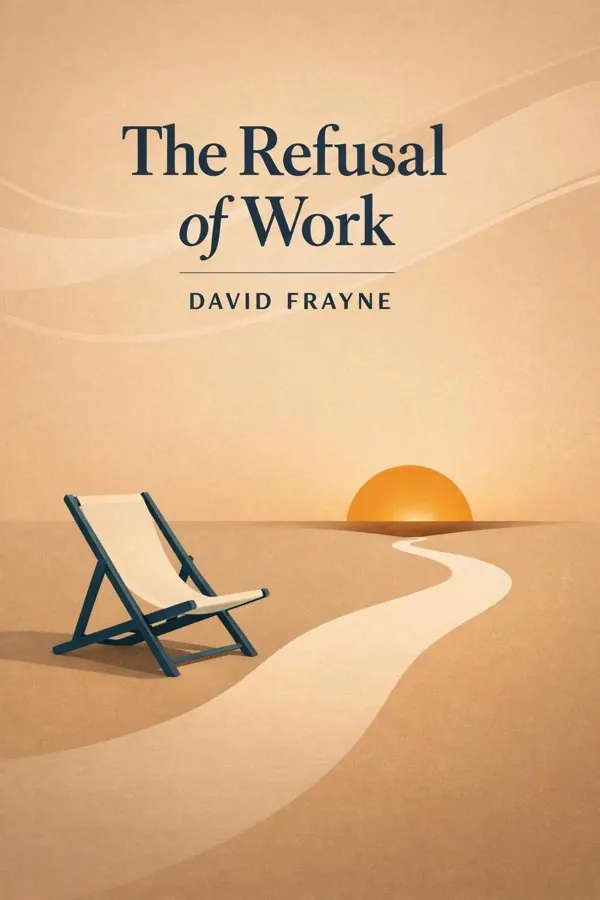
The Refusal of Work: The Theory and Practice of Resistance to Work: Summary & Key Insights
by David Frayne
 10 min9 chaptersAudio available
Key Takeaways from The Refusal of Work: The Theory and Practice of Resistance to Work
What feels natural today was historically constructed.
Work is not only something we do to earn money; it is also an idea that organizes moral life.
Many people assume dissatisfaction with work is a private failure, but Frayne shows it is often a social symptom.
Refusing work sounds abstract until you hear from people who have tried it.
A refusal of work is not meaningful unless it opens space for something better.
What Is The Refusal of Work: The Theory and Practice of Resistance to Work About?
The Refusal of Work: The Theory and Practice of Resistance to Work by David Frayne is a sociology book spanning 9 pages. The Refusal of Work: The Theory and Practice of Resistance to Work examines one of the most deeply rooted assumptions of modern life: that paid employment is the central source of identity, virtue, and meaning. In this provocative sociological study, David Frayne explores what happens when people begin to challenge that assumption. Drawing on critical social theory, political history, and interviews with individuals who have actively reduced, rejected, or reorganized their relationship to work, Frayne asks why contemporary society treats work as a moral obligation rather than merely an economic activity. The book matters because it speaks directly to a widespread but often private dissatisfaction with work-centered living. At a time of burnout, precarious employment, and constant pressure to be productive, Frayne offers a language for questioning the dominance of work without romanticizing idleness or ignoring material constraints. His authority comes from combining rigorous sociological analysis with real-world voices, showing both the structural power of work ideology and the personal experiments people make in resisting it. The result is a thoughtful, challenging book for anyone wondering whether a good life must revolve around a job.
This FizzRead summary covers all 9 key chapters of The Refusal of Work: The Theory and Practice of Resistance to Work in approximately 10 minutes, distilling the most important ideas, arguments, and takeaways from David Frayne's work. Also available as an audio summary and Key Quotes Podcast.
The Refusal of Work: The Theory and Practice of Resistance to Work
The Refusal of Work: The Theory and Practice of Resistance to Work examines one of the most deeply rooted assumptions of modern life: that paid employment is the central source of identity, virtue, and meaning. In this provocative sociological study, David Frayne explores what happens when people begin to challenge that assumption. Drawing on critical social theory, political history, and interviews with individuals who have actively reduced, rejected, or reorganized their relationship to work, Frayne asks why contemporary society treats work as a moral obligation rather than merely an economic activity.
The book matters because it speaks directly to a widespread but often private dissatisfaction with work-centered living. At a time of burnout, precarious employment, and constant pressure to be productive, Frayne offers a language for questioning the dominance of work without romanticizing idleness or ignoring material constraints. His authority comes from combining rigorous sociological analysis with real-world voices, showing both the structural power of work ideology and the personal experiments people make in resisting it. The result is a thoughtful, challenging book for anyone wondering whether a good life must revolve around a job.
Who Should Read The Refusal of Work: The Theory and Practice of Resistance to Work?
This book is perfect for anyone interested in sociology and looking to gain actionable insights in a short read. Whether you're a student, professional, or lifelong learner, the key ideas from The Refusal of Work: The Theory and Practice of Resistance to Work by David Frayne will help you think differently.
- ✓Readers who enjoy sociology and want practical takeaways
- ✓Professionals looking to apply new ideas to their work and life
- ✓Anyone who wants the core insights of The Refusal of Work: The Theory and Practice of Resistance to Work in just 10 minutes
Want the full summary?
Get instant access to this book summary and 100K+ more with Fizz Moment.
Get Free SummaryAvailable on App Store • Free to download
Key Chapters
Work is not only something we do to earn money; it is also an idea that organizes moral life. Frayne argues that modern society treats work as an ideology, meaning it frames labor as inherently virtuous and idleness as suspect, regardless of what the work actually is or whether it contributes to human flourishing. This is why low-paid, exhausting, or meaningless jobs are often praised simply because they are jobs, while unpaid caregiving, creative play, or rest can be dismissed as unproductive.
The power of this ideology lies in how deeply it shapes identity. People are routinely asked, “What do you do?” as if employment were the clearest summary of who they are. Success is measured through career progression, busyness, and visible effort. Even suffering at work can become morally charged, with overwork presented as proof of seriousness and commitment. Frayne’s critique is not that all work is bad, but that the social glorification of work prevents us from judging labor on more meaningful terms: Does it support life? Is it dignified? Is it necessary? Does it leave room for care, leisure, and civic participation?
In everyday life, this ideological power appears when people remain in harmful jobs because leaving feels shameful, or when governments speak of employment rates as if any increase in work is automatically a social good. A practical example is the pressure to turn every skill, hobby, or interest into a monetized side hustle rather than allowing it to remain a source of joy.
Frayne encourages readers to separate moral worth from market activity. Actionable takeaway: evaluate work by its human consequences, not by the prestige of being busy, and start describing yourself in terms broader than your occupation.
Refusing work sounds abstract until you hear from people who have tried it. A distinctive feature of Frayne’s book is his use of interviews with individuals who consciously reduced their hours, left conventional employment, embraced simple living, or sought income arrangements that minimized dependence on full-time work. These stories reveal that resisting work is neither a fantasy of laziness nor an easy escape. It is often a difficult, experimental process marked by both liberation and vulnerability.
The interviewees frequently describe a sense of regained time and psychological space. Without the constant pressure of full-time employment, they report deeper engagement with family, art, political activism, reading, exercise, volunteering, or simply rest. Some rediscover capacities that work had crowded out: patience, curiosity, attentiveness, and unstructured thought. Yet their experiences also expose the penalties of nonconformity. Friends may judge them, institutions may make survival difficult, and internalized guilt can persist long after leaving work.
These accounts matter because they make post-work thinking concrete. They show that alternatives are possible, but also unevenly distributed. Someone with savings, shared housing, low expenses, or supportive relationships has more room to experiment than someone trapped by debt or caring responsibilities. Frayne does not romanticize refusal; he presents it as a social and emotional negotiation.
For readers, the value lies in seeing that resistance can take many forms. It might mean moving to part-time work, rejecting careerist ambition, simplifying consumption, or setting stronger boundaries around availability. One need not fully exit the labor market to challenge its dominance.
Actionable takeaway: identify one realistic form of work resistance available to you now, such as reducing unnecessary expenses, declining unpaid extra labor, or reclaiming protected time from employer demands.
A refusal of work is not meaningful unless it opens space for something better. Frayne emphasizes that resistance is not simply negative or oppositional; it often involves choosing alternative values that modern work culture sidelines. These values include autonomy, leisure, friendship, care, creativity, slowness, and the freedom to engage in activities that are worthwhile even when they generate no income. The book asks readers to imagine a life organized less around productivity and more around human flourishing.
This shift is radical because capitalist culture tends to absorb everything into work logic. Hobbies become side hustles, exercise becomes optimization, and even relaxation becomes preparation for more efficient labor. Against this, Frayne highlights forms of living that preserve non-market purposes. For example, someone might garden for pleasure and self-provisioning rather than profit, devote time to community organizing, care for relatives without treating that care as secondary to paid employment, or choose modest consumption in exchange for fewer work hours.
The practical challenge is that many people have lost the habit of asking what they actually value apart from career goals. Work society tells us what to pursue: advancement, status, income, and measurable achievement. Refusing work requires relearning how to value open-ended activities and relationships that do not fit performance metrics.
A good application is to review your week and notice which activities feel intrinsically meaningful and which are pursued mainly for external validation. You may find that the most nourishing parts of life are precisely those least rewarded by the labor market.
Actionable takeaway: choose one non-monetized activity that matters to you and protect regular time for it, treating it as central rather than optional.
If work is so damaging, why don’t more people just leave? Frayne’s answer is sociological rather than moral: most people face powerful economic and institutional constraints. The refusal of work is not merely a question of courage or imagination. It is limited by rent, debt, childcare, social policy, labor markets, and unequal access to resources. This is one of the book’s most important balancing moves. Frayne takes anti-work desires seriously without blaming individuals for failing to escape.
Modern societies make paid work the gateway to survival, healthcare, housing, pensions, and social legitimacy. Even those who dislike their jobs may have no realistic path out. Insecure workers often accept poor conditions because the alternatives are worse. Meanwhile, welfare systems can be punitive, requiring recipients to prove their willingness to work rather than recognizing unemployment or underemployment as structural issues. The result is a social order in which dependence on work is manufactured and maintained.
This perspective prevents shallow interpretations of work refusal as a lifestyle choice available to all. For a middle-class professional, downshifting may mean earning less but retaining stability. For a low-wage worker, reducing hours could mean hunger or eviction. Frayne insists that a serious critique of work must also be a critique of inequality.
For readers, the practical lesson is twofold. First, be honest about the material barriers shaping your choices. Second, support structural reforms that expand real freedom, such as stronger social safety nets, affordable housing, universal services, or basic income experiments. Personal resistance matters, but collective change matters more.
Actionable takeaway: pair any personal attempt to reduce work dependence with at least one structural commitment, such as supporting policies or organizations that make non-work survival more viable for everyone.
A better future requires more than private dissatisfaction; it requires political imagination. Frayne connects individual acts of resistance to wider debates about post-work politics, asking what society might look like if work were no longer treated as the unquestioned center of social life. This does not mean abolishing all effort, cooperation, or necessary labor. It means reorganizing technology, institutions, and values so that fewer people must spend most of their lives in compulsory employment.
The book engages with questions raised by automation, productivity gains, and unevenly distributed wealth. If modern economies can produce enormous abundance with less human labor, why are so many people still overworked while others are unemployed or trapped in precarious jobs? Frayne suggests that the problem is political and moral, not merely technical. Productivity gains have often been captured as profit rather than converted into more leisure, security, or shared prosperity.
Post-work politics therefore includes proposals such as shorter working weeks, basic income, stronger labor protections, decommodified public services, and cultural shifts that value time over output. A practical example is the four-day workweek movement, which challenges the assumption that full-time labor should consume most of adult life. Another is the recognition that unpaid reproductive labor, such as caregiving, deserves social support even when it does not fit market definitions of productivity.
Frayne’s contribution is to frame these ideas not as utopian indulgence but as necessary responses to a society where work has become both excessive and unevenly distributed. Actionable takeaway: engage politically with at least one reform that reduces compulsory labor time, because changing work culture ultimately requires changing the institutions that sustain it.
To refuse work is often treated as selfish, but Frayne asks a more difficult question: what if uncritical obedience to work norms is itself ethically compromised? The moral prestige of work can hide the fact that not all labor is good, necessary, or socially beneficial. Some jobs are harmful, pointless, exploitative, or environmentally destructive. In such cases, continuing to work simply because work is sacred may not be morally admirable at all.
Frayne invites readers to rethink the ethical language surrounding labor. Instead of asking only whether a person is working hard enough, we should ask what kind of world their work supports. Does it deepen inequality? Does it waste human life? Does it erode ecological stability? At the same time, he does not deny that societies require effort, maintenance, and contribution. The challenge is to distinguish meaningful contribution from labor performed primarily to satisfy market imperatives or preserve social respectability.
This ethical reflection matters in ordinary life. Someone may stay in a high-status role that damages public well-being, while another devotes time to care work, mutual aid, or civic action that is socially valuable but poorly rewarded. Conventional morality often honors the first and ignores the second. Frayne pushes against this distortion.
For readers, this means examining not only how much you work but also the moral content of what your work does and displaces. It may be more ethical to consume less, earn less, and contribute differently than to pursue endless professional advancement within harmful systems.
Actionable takeaway: assess your labor through an ethical lens by asking two questions: whom does this work help, and what worthwhile forms of life does it prevent me from sustaining?
What cannot be imagined cannot be built. Frayne ends up defending a form of utopian thinking, not as naïve fantasy but as a necessary tool for loosening the hold of present assumptions. Work society survives partly because people struggle to picture a respectable, meaningful life outside the standard job-centered model. When imagination is constrained, alternatives appear unrealistic before they are even considered.
Utopian thinking in this context means allowing ourselves to ask questions that mainstream politics often dismisses: What if technological progress were used to reduce labor for everyone? What if social citizenship did not depend on employment? What if leisure, care, and democratic participation were treated as central goods rather than leftovers after work? Frayne argues that such questions are practical in a deeper sense, because they help expose how narrow existing definitions of realism really are.
In everyday life, cultural imagination matters because it shapes what people dare to want. If every film, school system, policy debate, and family expectation assumes that adulthood means lifelong submission to work, then resisting that script feels deviant. But when people encounter alternative narratives, they can begin making different choices, however modest: reducing consumption, organizing collectively, or valuing time more fiercely.
This is not escapism. It is preparation for change. Social transformations often begin with ideas that once seemed impossible, from shorter working hours to retirement rights to weekends themselves. Frayne reminds us that many gains now treated as normal were once utopian demands.
Actionable takeaway: regularly expose yourself to ideas, communities, and stories that imagine life beyond work dominance, because expanding your political imagination expands your practical options.
All Chapters in The Refusal of Work: The Theory and Practice of Resistance to Work
About the Author
David Frayne is a British sociologist and writer whose work centers on labor, leisure, social criticism, and the possibility of post-work futures. He is best known for examining how modern societies came to treat paid employment as a moral obligation and a core source of identity. His research combines critical theory with close attention to lived experience, especially the perspectives of people who question conventional work norms. Frayne’s writing speaks to readers interested in burnout, inequality, anti-work politics, and the broader cultural meaning of labor. In The Refusal of Work, he brings together history, sociology, and interviews to challenge the assumption that a worthwhile life must revolve around a job, making him an important contemporary voice in debates about work and freedom.
Get This Summary in Your Preferred Format
Read or listen to the The Refusal of Work: The Theory and Practice of Resistance to Work summary by David Frayne anytime, anywhere. FizzRead offers multiple formats so you can learn on your terms — all free.
Available formats: App · Audio · PDF · EPUB — All included free with FizzRead
Download The Refusal of Work: The Theory and Practice of Resistance to Work PDF and EPUB Summary
Key Quotes from The Refusal of Work: The Theory and Practice of Resistance to Work
“What feels natural today was historically constructed.”
“Work is not only something we do to earn money; it is also an idea that organizes moral life.”
“Many people assume dissatisfaction with work is a private failure, but Frayne shows it is often a social symptom.”
“Refusing work sounds abstract until you hear from people who have tried it.”
“A refusal of work is not meaningful unless it opens space for something better.”
Frequently Asked Questions about The Refusal of Work: The Theory and Practice of Resistance to Work
The Refusal of Work: The Theory and Practice of Resistance to Work by David Frayne is a sociology book that explores key ideas across 9 chapters. The Refusal of Work: The Theory and Practice of Resistance to Work examines one of the most deeply rooted assumptions of modern life: that paid employment is the central source of identity, virtue, and meaning. In this provocative sociological study, David Frayne explores what happens when people begin to challenge that assumption. Drawing on critical social theory, political history, and interviews with individuals who have actively reduced, rejected, or reorganized their relationship to work, Frayne asks why contemporary society treats work as a moral obligation rather than merely an economic activity. The book matters because it speaks directly to a widespread but often private dissatisfaction with work-centered living. At a time of burnout, precarious employment, and constant pressure to be productive, Frayne offers a language for questioning the dominance of work without romanticizing idleness or ignoring material constraints. His authority comes from combining rigorous sociological analysis with real-world voices, showing both the structural power of work ideology and the personal experiments people make in resisting it. The result is a thoughtful, challenging book for anyone wondering whether a good life must revolve around a job.
You Might Also Like

Between the World and Me
Ta-Nehisi Coates
10 min
Half the Sky
Nicholas D. Kristof, Sheryl WuDunn
10 min
Men Explain Things To Me
Rebecca Solnit
10 min
Rational Ritual
Michael Suk-Young Chwe
10 min
The New Jim Crow
Michelle Alexander
10 min
Beyond Culture
Edward T. Hall
10 minBrowse by Category
Ready to read The Refusal of Work: The Theory and Practice of Resistance to Work?
Get the full summary and 100K+ more books with Fizz Moment.