
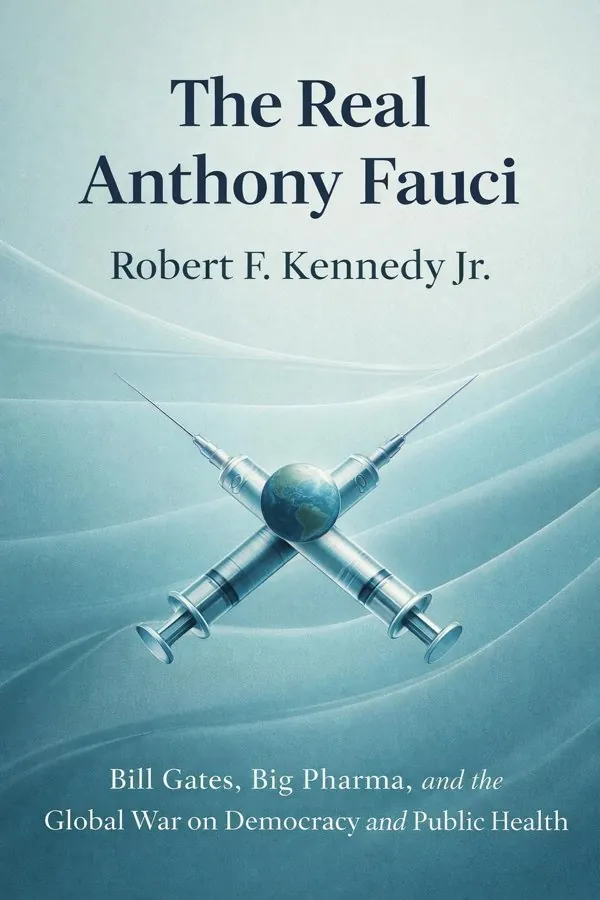
The Real Anthony Fauci: Bill Gates, Big Pharma, and the Global War on Democracy and Public Health: Summary & Key Insights
 10 min5 chaptersAudio available
What Is The Real Anthony Fauci: Bill Gates, Big Pharma, and the Global War on Democracy and Public Health About?
The Real Anthony Fauci: Bill Gates, Big Pharma, and the Global War on Democracy and Public Health by Robert F. Kennedy Jr. is a politics book spanning 5 pages. This book critically examines the role of Dr. Anthony Fauci in U.S. public health policy, alleging conflicts of interest and undue influence by pharmaceutical corporations and global health organizations. It presents a controversial narrative about the COVID-19 pandemic, vaccine development, and the intersection of government, media, and industry.
This FizzRead summary covers all 5 key chapters of The Real Anthony Fauci: Bill Gates, Big Pharma, and the Global War on Democracy and Public Health in approximately 10 minutes, distilling the most important ideas, arguments, and takeaways from Robert F. Kennedy Jr.'s work. Also available as an audio summary and Key Quotes Podcast.
The Real Anthony Fauci: Bill Gates, Big Pharma, and the Global War on Democracy and Public Health
This book critically examines the role of Dr. Anthony Fauci in U.S. public health policy, alleging conflicts of interest and undue influence by pharmaceutical corporations and global health organizations. It presents a controversial narrative about the COVID-19 pandemic, vaccine development, and the intersection of government, media, and industry.
Who Should Read The Real Anthony Fauci: Bill Gates, Big Pharma, and the Global War on Democracy and Public Health?
This book is perfect for anyone interested in politics and looking to gain actionable insights in a short read. Whether you're a student, professional, or lifelong learner, the key ideas from The Real Anthony Fauci: Bill Gates, Big Pharma, and the Global War on Democracy and Public Health by Robert F. Kennedy Jr. will help you think differently.
- ✓Readers who enjoy politics and want practical takeaways
- ✓Professionals looking to apply new ideas to their work and life
- ✓Anyone who wants the core insights of The Real Anthony Fauci: Bill Gates, Big Pharma, and the Global War on Democracy and Public Health in just 10 minutes
Want the full summary?
Get instant access to this book summary and 100K+ more with Fizz Moment.
Get Free SummaryAvailable on App Store • Free to download
Key Chapters
When Anthony Fauci took charge of the NIAID in the 1980s, few understood how profoundly that position would come to influence not just research directions but the entire system of medical funding. The institute controlled billions of dollars in grants, effectively deciding which hypotheses would be tested and which voices would be heard. In the book, I trace how Fauci’s bureaucratic style made loyalty more valuable than innovation; scientists found that questioning official doctrine often meant losing access to funding. This dynamic shaped a generation of researchers whose survival depended on compliance.
The AIDS crisis serves as a pivotal example. Independent physicians and virologists proposed competing theories and treatments, yet Fauci’s NIAID concentrated nearly all federal support on a narrow pathway — the development of expensive antiviral drugs. Patients seeking alternative approaches were stigmatized, while promising low-cost interventions struggled to gain traction. I argue that this reflected not purely scientific judgment but an institutional pattern: public health became inseparable from pharmaceutical economics. Once NIAID’s financial interests coincided with patent revenues, the distinction between research and commerce blurred irrevocably.
Through this history, we glimpse how government health agencies evolved into extensions of industry. The message I deliver is not one of cynicism but awareness: the same mechanisms that once protected the public now frequently protect profits. Recognizing this is the first step toward reforming medical science so that curiosity and compassion may again guide its course.
One of the most troubling revelations to emerge from decades of public health evolution is the fusion of regulatory bodies and the corporations they are meant to oversee. In tracing this convergence, I show that the National Institutes of Health, the Centers for Disease Control and Prevention (CDC), and NIAID all developed financial dependencies on patent royalties and partnership agreements with drug manufacturers. This meant that senior officials often stood to benefit personally from the commercial success of vaccines or therapies developed under their supervision.
I recount how Fauci and his peers created a revolving door of influence that entwined public service with private reward. Research priorities increasingly favored pharmaceutical interventions; prevention strategies that offered no financial upside received scant support. The narrative of objectivity was preserved for public consumption, yet behind the scenes, clinical decisions and funding allocations were driven by a logic of shareholder value. When you understand this architecture, the policy outcomes during crises — from AIDS to COVID-19 — become eminently predictable.
In this section, I speak directly to your sense of fairness. Health governance was designed to protect the many, not to enrich the few. But when administrative leaders become stakeholders in the very industries they regulate, the ethic of public service collapses. By examining these relationships candidly, I hope readers can see the pattern not as an abstraction but as a lived reality influencing the medicines we take, the research we trust, and the information we receive.
+ 3 more chapters — available in the FizzRead app
All Chapters in The Real Anthony Fauci: Bill Gates, Big Pharma, and the Global War on Democracy and Public Health
About the Author
Robert F. Kennedy Jr. is an American environmental attorney, author, and activist known for his work on environmental issues and vaccine safety. He is the son of Robert F. Kennedy and nephew of President John F. Kennedy.
Get This Summary in Your Preferred Format
Read or listen to the The Real Anthony Fauci: Bill Gates, Big Pharma, and the Global War on Democracy and Public Health summary by Robert F. Kennedy Jr. anytime, anywhere. FizzRead offers multiple formats so you can learn on your terms — all free.
Available formats: App · Audio · PDF · EPUB — All included free with FizzRead
Download The Real Anthony Fauci: Bill Gates, Big Pharma, and the Global War on Democracy and Public Health PDF and EPUB Summary
Key Quotes from The Real Anthony Fauci: Bill Gates, Big Pharma, and the Global War on Democracy and Public Health
“When Anthony Fauci took charge of the NIAID in the 1980s, few understood how profoundly that position would come to influence not just research directions but the entire system of medical funding.”
“One of the most troubling revelations to emerge from decades of public health evolution is the fusion of regulatory bodies and the corporations they are meant to oversee.”
Frequently Asked Questions about The Real Anthony Fauci: Bill Gates, Big Pharma, and the Global War on Democracy and Public Health
The Real Anthony Fauci: Bill Gates, Big Pharma, and the Global War on Democracy and Public Health by Robert F. Kennedy Jr. is a politics book that explores key ideas across 5 chapters. This book critically examines the role of Dr. Anthony Fauci in U.S. public health policy, alleging conflicts of interest and undue influence by pharmaceutical corporations and global health organizations. It presents a controversial narrative about the COVID-19 pandemic, vaccine development, and the intersection of government, media, and industry.
You Might Also Like
Antifa: The Anti-Fascist Handbook
Mark Bray
10 min
Attack from Within: How Disinformation Is Sabotaging America
Barbara McQuade
10 min
Coercion, Capital, and European States, AD 990–1992
Charles Tilly
10 min
Digital Democracy: Concepts, Methodologies, Tools, and Applications
Various Authors
10 min
Fascism
Stanley G. Payne
10 min
Fire And Fury: Inside The Trump White House
Michael Wolff
10 minBrowse by Category
Ready to read The Real Anthony Fauci: Bill Gates, Big Pharma, and the Global War on Democracy and Public Health?
Get the full summary and 100K+ more books with Fizz Moment.