
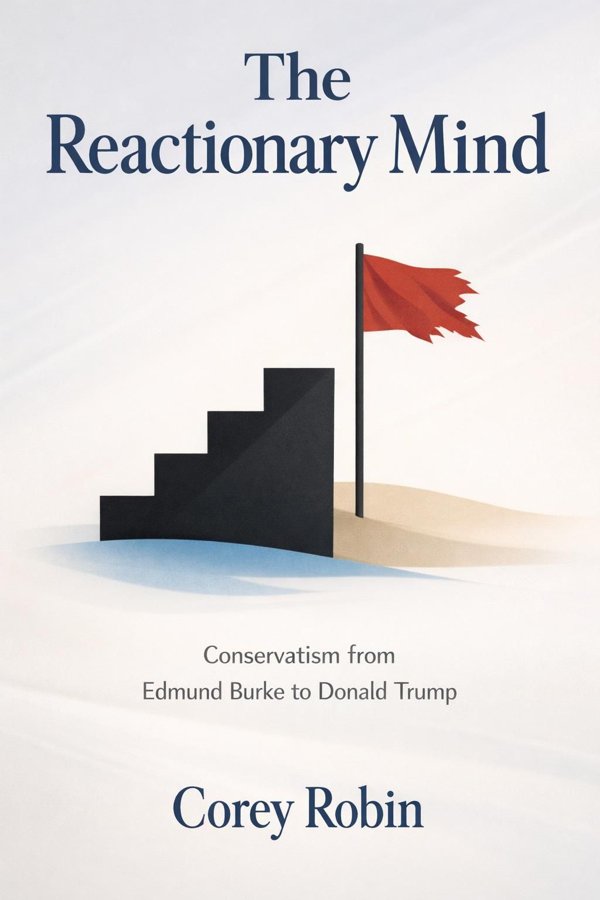
The Reactionary Mind: Conservatism from Edmund Burke to Donald Trump: Summary & Key Insights
by Corey Robin
 10 min11 chaptersAudio available
What Is The Reactionary Mind: Conservatism from Edmund Burke to Donald Trump About?
The Reactionary Mind: Conservatism from Edmund Burke to Donald Trump by Corey Robin is a politics book spanning 11 pages. In this influential work, political theorist Corey Robin argues that conservatism is not merely a defense of tradition but a dynamic reaction to progressive movements. Tracing the intellectual lineage from Edmund Burke to modern figures like Donald Trump, Robin contends that conservatism’s core impulse is to defend hierarchy and privilege against challenges from below. The book combines political theory, history, and cultural analysis to reinterpret the conservative tradition as a counterrevolutionary force shaped by its opposition to emancipation and equality.
This FizzRead summary covers all 11 key chapters of The Reactionary Mind: Conservatism from Edmund Burke to Donald Trump in approximately 10 minutes, distilling the most important ideas, arguments, and takeaways from Corey Robin's work. Also available as an audio summary and Key Quotes Podcast.
The Reactionary Mind: Conservatism from Edmund Burke to Donald Trump
In this influential work, political theorist Corey Robin argues that conservatism is not merely a defense of tradition but a dynamic reaction to progressive movements. Tracing the intellectual lineage from Edmund Burke to modern figures like Donald Trump, Robin contends that conservatism’s core impulse is to defend hierarchy and privilege against challenges from below. The book combines political theory, history, and cultural analysis to reinterpret the conservative tradition as a counterrevolutionary force shaped by its opposition to emancipation and equality.
Who Should Read The Reactionary Mind: Conservatism from Edmund Burke to Donald Trump?
This book is perfect for anyone interested in politics and looking to gain actionable insights in a short read. Whether you're a student, professional, or lifelong learner, the key ideas from The Reactionary Mind: Conservatism from Edmund Burke to Donald Trump by Corey Robin will help you think differently.
- ✓Readers who enjoy politics and want practical takeaways
- ✓Professionals looking to apply new ideas to their work and life
- ✓Anyone who wants the core insights of The Reactionary Mind: Conservatism from Edmund Burke to Donald Trump in just 10 minutes
Want the full summary?
Get instant access to this book summary and 100K+ more with Fizz Moment.
Get Free SummaryAvailable on App Store • Free to download
Key Chapters
The modern conservative imagination begins in the shadow of revolution, with Edmund Burke standing before the turmoil of the French Revolution. Burke’s writings are often remembered as the first great defense of tradition against radical upheaval, but what truly animates his thought is not simple nostalgia—it is the terror and fascination provoked by equality. In Burke’s eyes, the revolution was not merely a regime change; it threatened the cosmic order. The aristocracy was more than a social class—it embodied virtue and refinement born from centuries of cultivation. To tear this down was to make the world submit to mere quantity over quality, passion over reason, mass over mastery.
Burke’s response established a template for conservative thought that persists even today. He saw hierarchy as an organic, aesthetic arrangement, and the bonds between ruler and ruled as paternal rather than contractual. This view allowed him to transform privilege into duty, inequality into harmony. But beneath this lyrical vision lay a profound anxiety—if the people could overturn kings, what might they not overturn next? Burke’s conservatism thus defended not only aristocracy but a metaphysics of authority itself.
To understand Burke is to see how conservatism transforms fear into reverence. He did not simply argue that revolution betrayed tradition; he argued that it violated beauty. The French crowd appeared grotesque to him, its demands for equality vulgar and destructive. He turned politics into aesthetics, elevating hierarchy to the level of art. Later conservatives—from Maistre to modern pundits—would echo this rhetorical move, portraying rebellion as ugly and authority as sublime.
Burke’s legacy is immense because he gave conservatism its first powerful emotional grammar. He taught that hierarchy could be defended not through coercion alone but through moral imagination. His opposition to revolution thus became the foundational myth for all subsequent forms of reaction, offering conservatives a language with which to love their masters and fear democracy in equal measure.
Conservatism thrives not in calm but in challenge. It needs a foe—the movement from below that threatens to unmake settled hierarchies. This reactive essence gives conservatism its peculiar vitality. When women demand equality, when workers organize, when enslaved or colonized peoples claim freedom—these moments of emancipation summon conservatives to action. Their defining project is to resist the democratization of social relations.
This reaction, however, is never purely defensive. History shows conservatives as active interpreters of social change, reimagining inequality as natural, desirable, even empowering. They sense that mere obstruction is insufficient; hierarchy must be moralized and dramatized. Thus, the conservative mind becomes inventive in its counterattack, transforming the loss of privilege into a story of virtue under siege.
You can see this dynamic in nineteenth-century Europe as aristocrats bemoaned the rise of liberal democracy, or in the American South as planters crafted intellectual defenses of slavery. Each movement of reaction reshapes itself around the emancipatory challenge of its time. The abolitionist’s dream conjures the pro-slavery theorist; feminism calls forth the patriarchal revivalist; civil rights provoke the moral language of “tradition.”
What unites these episodes is not policy but passion. Conservatism’s impulse is emotional—a yearning for a world where power feels legitimate again. The conservative does not merely want to keep the old order; he wants to restore its lost grandeur. His reaction to equality is therefore creative, performing drama after drama of nostalgic reclamation. In that sense, conservatism grows as democracy advances. Its energy is parasitic on progress—without the movements that challenge the hierarchy, the reactionary mind would have nothing to defend.
+ 9 more chapters — available in the FizzRead app
All Chapters in The Reactionary Mind: Conservatism from Edmund Burke to Donald Trump
About the Author
Corey Robin is an American political theorist and professor of political science at Brooklyn College and the CUNY Graduate Center. His work focuses on political ideas, power, and the history of political thought, with writings appearing in major publications such as The New Yorker and The London Review of Books. He is also the author of 'Fear: The History of a Political Idea.'
Get This Summary in Your Preferred Format
Read or listen to the The Reactionary Mind: Conservatism from Edmund Burke to Donald Trump summary by Corey Robin anytime, anywhere. FizzRead offers multiple formats so you can learn on your terms — all free.
Available formats: App · Audio · PDF · EPUB — All included free with FizzRead
Download The Reactionary Mind: Conservatism from Edmund Burke to Donald Trump PDF and EPUB Summary
Key Quotes from The Reactionary Mind: Conservatism from Edmund Burke to Donald Trump
“The modern conservative imagination begins in the shadow of revolution, with Edmund Burke standing before the turmoil of the French Revolution.”
“Conservatism thrives not in calm but in challenge.”
Frequently Asked Questions about The Reactionary Mind: Conservatism from Edmund Burke to Donald Trump
The Reactionary Mind: Conservatism from Edmund Burke to Donald Trump by Corey Robin is a politics book that explores key ideas across 11 chapters. In this influential work, political theorist Corey Robin argues that conservatism is not merely a defense of tradition but a dynamic reaction to progressive movements. Tracing the intellectual lineage from Edmund Burke to modern figures like Donald Trump, Robin contends that conservatism’s core impulse is to defend hierarchy and privilege against challenges from below. The book combines political theory, history, and cultural analysis to reinterpret the conservative tradition as a counterrevolutionary force shaped by its opposition to emancipation and equality.
You Might Also Like
Antifa: The Anti-Fascist Handbook
Mark Bray
10 min
Attack from Within: How Disinformation Is Sabotaging America
Barbara McQuade
10 min
Coercion, Capital, and European States, AD 990–1992
Charles Tilly
10 min
Digital Democracy: Concepts, Methodologies, Tools, and Applications
Various Authors
10 min
Fascism
Stanley G. Payne
10 min
Fire And Fury: Inside The Trump White House
Michael Wolff
10 minBrowse by Category
Ready to read The Reactionary Mind: Conservatism from Edmund Burke to Donald Trump?
Get the full summary and 100K+ more books with Fizz Moment.