
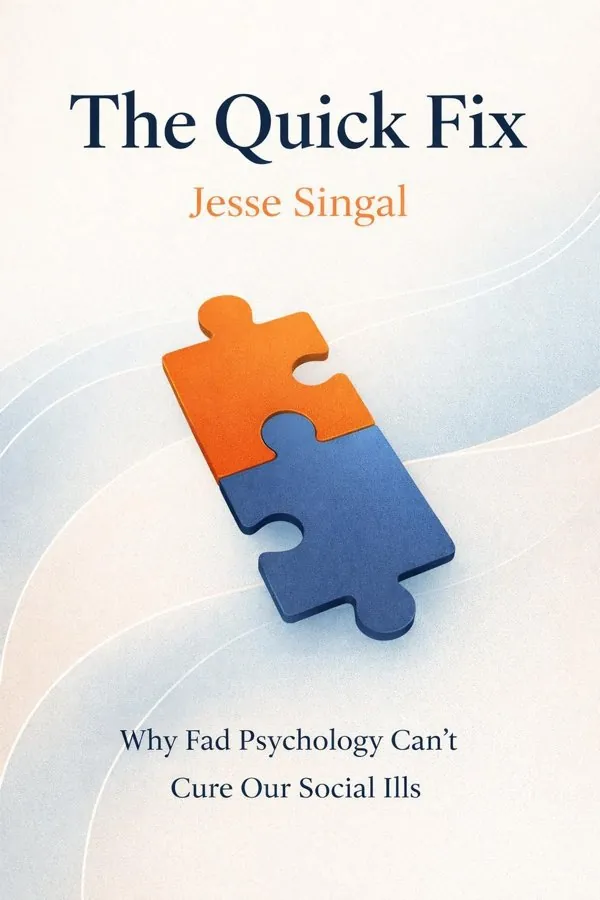
The Quick Fix: Why Fad Psychology Can't Cure Our Social Ills: Summary & Key Insights
by Jesse Singal
 10 min10 chapters
What Is The Quick Fix: Why Fad Psychology Can't Cure Our Social Ills About?
The Quick Fix: Why Fad Psychology Can't Cure Our Social Ills by Jesse Singal is a psychology book spanning 10 pages. In this book, journalist Jesse Singal critically examines popular psychological trends and interventions that promise quick solutions to complex social and personal problems. He explores how ideas like power posing, grit, and growth mindset gained traction despite limited scientific evidence, and argues for a more rigorous, evidence-based approach to understanding human behavior and social change.
This FizzRead summary covers all 10 key chapters of The Quick Fix: Why Fad Psychology Can't Cure Our Social Ills in approximately 10 minutes, distilling the most important ideas, arguments, and takeaways from Jesse Singal's work.
The Quick Fix: Why Fad Psychology Can't Cure Our Social Ills
In this book, journalist Jesse Singal critically examines popular psychological trends and interventions that promise quick solutions to complex social and personal problems. He explores how ideas like power posing, grit, and growth mindset gained traction despite limited scientific evidence, and argues for a more rigorous, evidence-based approach to understanding human behavior and social change.
Who Should Read The Quick Fix: Why Fad Psychology Can't Cure Our Social Ills?
This book is perfect for anyone interested in psychology and looking to gain actionable insights in a short read. Whether you're a student, professional, or lifelong learner, the key ideas from The Quick Fix: Why Fad Psychology Can't Cure Our Social Ills by Jesse Singal will help you think differently.
- ✓Readers who enjoy psychology and want practical takeaways
- ✓Professionals looking to apply new ideas to their work and life
- ✓Anyone who wants the core insights of The Quick Fix: Why Fad Psychology Can't Cure Our Social Ills in just 10 minutes
Want the full summary?
Get instant access to this book summary and 100K+ more with Fizz Moment.
Get Free SummaryAvailable on App Store • Free to download
Key Chapters
In the early years of the twenty-first century, psychology achieved a kind of cultural stardom. Once confined to academic journals, psychological insights began to spill into the mainstream. TED Talks by researchers became viral sensations, social media amplified snippets of studies into universal truths, and business leaders embraced simplified frameworks that seemed to promise measurable performance gains. The appeal was obvious. In an era defined by uncertainty, the idea that human behavior could be fine-tuned like software was intoxicating.
But behind this enthusiasm lay a quieter, more complicated truth. Much of the research being popularized was based on small sample sizes, uncontrolled contexts, and fragile statistical effects. The field was facing what would soon be called a replication crisis—an unprecedented period when many well-known findings failed to hold up under scrutiny. Yet the cultural appetite for quick psychological solutions only grew stronger.
I trace this paradox to a fundamental tension between the slow, self-correcting process of science and the media’s need for compelling stories. The public doesn’t want nuance; it wants answers. So, academics and journalists alike often trim the edges of complexity to fit a clearer narrative arc. Through this dynamic, ideas are born, inflated, and then—more often than not—quietly deflated. The rise of pop psychology tells us as much about our hunger for meaning and certainty as it does about the studies themselves.
Few concepts better capture the spirit of pop psychology’s ascent than the idea of ‘power posing.’ In 2010, a TED Talk by social psychologist Amy Cuddy exploded across the internet, suggesting that simply adopting confident body postures could alter not only how others perceive us but also our internal chemistry. The message was irresistible: if you could stand like a winner, you could become one.
At the time, I, like many others, was caught up in the enthusiasm. But as follow-up studies emerged, cracks began to show. Independent researchers were unable to replicate the hormonal and behavioral effects that had been so widely reported. Some of the original data didn’t fully support the sweeping claims made in popular media. What began as an intriguing hypothesis had transformed into a global motivational movement—outpacing the actual science behind it.
This was not an isolated failure. It revealed something deeper about how modern psychology interfaces with public culture. The idea that minor, controllable tweaks in behavior could yield major life improvements aligned perfectly with the ethos of self-help and individual empowerment. Yet in reality, behavioral outcomes are messy, contingent, and context-dependent. A confident pose can’t compensate for systemic inequality or social pressure. To reduce complex human experiences to a single gesture is to mistake the symbol for the substance.
+ 8 more chapters — available in the FizzRead app
All Chapters in The Quick Fix: Why Fad Psychology Can't Cure Our Social Ills
About the Author
Jesse Singal is an American journalist known for his work on social science, psychology, and public policy. He has written for publications such as New York Magazine and The Atlantic, and is recognized for his analytical approach to evaluating research and media narratives.
Get This Summary in Your Preferred Format
Read or listen to the The Quick Fix: Why Fad Psychology Can't Cure Our Social Ills summary by Jesse Singal anytime, anywhere. FizzRead offers multiple formats so you can learn on your terms — all free.
Available formats: App · Audio · PDF · EPUB — All included free with FizzRead
Download The Quick Fix: Why Fad Psychology Can't Cure Our Social Ills PDF and EPUB Summary
Key Quotes from The Quick Fix: Why Fad Psychology Can't Cure Our Social Ills
“In the early years of the twenty-first century, psychology achieved a kind of cultural stardom.”
“Few concepts better capture the spirit of pop psychology’s ascent than the idea of ‘power posing.”
Frequently Asked Questions about The Quick Fix: Why Fad Psychology Can't Cure Our Social Ills
The Quick Fix: Why Fad Psychology Can't Cure Our Social Ills by Jesse Singal is a psychology book that explores key ideas across 10 chapters. In this book, journalist Jesse Singal critically examines popular psychological trends and interventions that promise quick solutions to complex social and personal problems. He explores how ideas like power posing, grit, and growth mindset gained traction despite limited scientific evidence, and argues for a more rigorous, evidence-based approach to understanding human behavior and social change.
You Might Also Like

The Body Keeps the Score
Bessel van der Kolk
10 min
Surrounded by Idiots
Thomas Erikson
10 min
Emotional Intelligence
Daniel Goleman
10 min
Attached
Amir Levine
10 min
Why Does He Do That
Lundy Bancroft
10 min
Women Who Run with the Wolves
Clarissa Pinkola Estés
10 minBrowse by Category
Ready to read The Quick Fix: Why Fad Psychology Can't Cure Our Social Ills?
Get the full summary and 100K+ more books with Fizz Moment.