
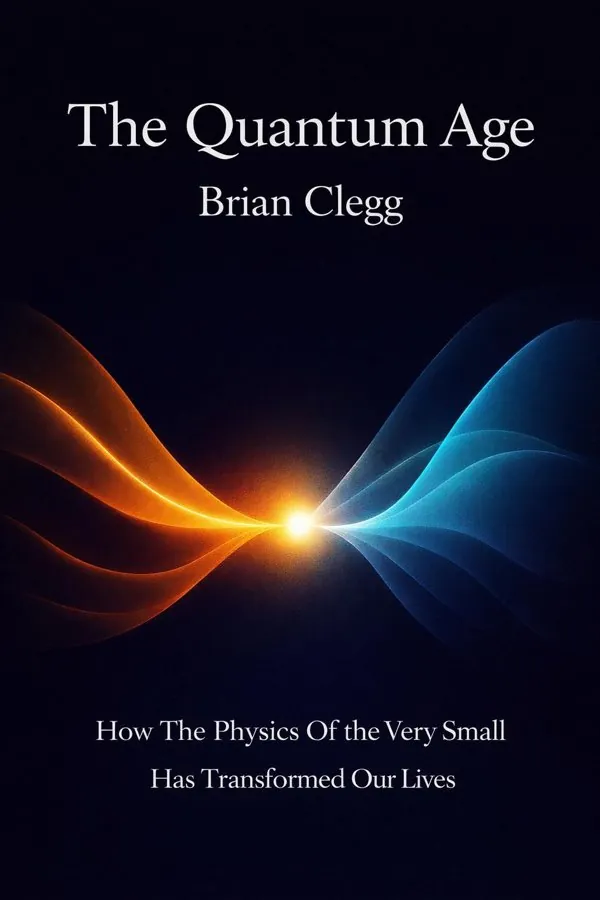
The Quantum Age: How The Physics Of The Very Small Has Transformed Our Lives: Summary & Key Insights
by Brian Clegg
 10 min10 chaptersAudio available
What Is The Quantum Age: How The Physics Of The Very Small Has Transformed Our Lives About?
The Quantum Age: How The Physics Of The Very Small Has Transformed Our Lives by Brian Clegg is a popular_sci book spanning 10 pages. In The Quantum Age, science writer Brian Clegg explores how quantum physics has shaped the modern world. From electronics and MRI scanners to quantum computing and cryptography, Clegg explains how the physics of the very small underpins the technology that defines our age. Written with clarity and enthusiasm, the book makes complex scientific ideas accessible to general readers.
This FizzRead summary covers all 10 key chapters of The Quantum Age: How The Physics Of The Very Small Has Transformed Our Lives in approximately 10 minutes, distilling the most important ideas, arguments, and takeaways from Brian Clegg's work. Also available as an audio summary and Key Quotes Podcast.
The Quantum Age: How The Physics Of The Very Small Has Transformed Our Lives
In The Quantum Age, science writer Brian Clegg explores how quantum physics has shaped the modern world. From electronics and MRI scanners to quantum computing and cryptography, Clegg explains how the physics of the very small underpins the technology that defines our age. Written with clarity and enthusiasm, the book makes complex scientific ideas accessible to general readers.
Who Should Read The Quantum Age: How The Physics Of The Very Small Has Transformed Our Lives?
This book is perfect for anyone interested in popular_sci and looking to gain actionable insights in a short read. Whether you're a student, professional, or lifelong learner, the key ideas from The Quantum Age: How The Physics Of The Very Small Has Transformed Our Lives by Brian Clegg will help you think differently.
- ✓Readers who enjoy popular_sci and want practical takeaways
- ✓Professionals looking to apply new ideas to their work and life
- ✓Anyone who wants the core insights of The Quantum Age: How The Physics Of The Very Small Has Transformed Our Lives in just 10 minutes
Want the full summary?
Get instant access to this book summary and 100K+ more with Fizz Moment.
Get Free SummaryAvailable on App Store • Free to download
Key Chapters
At the dawn of the twentieth century, physics seemed complete. Newton’s laws explained motion and gravity; Maxwell’s equations described light and electromagnetism. Yet, little cracks began to form. Experiments showed that radiation did not behave as expected—the so-called ultraviolet catastrophe hinted that classical physics could not account for reality at small scales.
Then came Max Planck. In 1900, he introduced the radical notion that energy could only be exchanged in discrete units—quanta. It was an act of desperation to make his equations fit the data, but it opened a door no one could close. Albert Einstein followed by explaining the photoelectric effect, demonstrating that light itself behaved as if composed of particles. Niels Bohr applied quantum ideas to the structure of atoms, showing how electrons occupied distinct energy levels.
What was forming was not merely a new branch of physics—it was a new philosophy of nature. Reality, once thought predictable and continuous, proved granular and uncertain. Werner Heisenberg introduced his uncertainty principle, reminding us that observation itself alters what is observed. Schrödinger imagined his famous cat to illustrate the strangeness of superposition, where possibilities coexist until measured.
I found it vital to trace this historical journey in the book because it reveals the human side of science—the confusion, resistance, and eventual triumph of new ideas. These pioneers were not just theorists; they were explorers of a world no instrument could directly show. Their discoveries built a foundation that modern technology still stands on: the understanding that everything, from the circuits in your phone to the magnetic resonance in your body, is a manifestation of quantum behavior.
To truly see the quantum age, you must grasp a few fundamental principles that define this realm. Wave-particle duality taught us that light and matter can behave as both waves and particles—a concept so baffling that even Einstein found it unsettling. Yet this duality describes precisely how electrons travel through circuits and how photons are born and absorbed within lasers.
Then there is uncertainty—a feature not of human ignorance but of nature itself. Heisenberg’s principle does not say we fail to measure accurately; it says the universe cannot simultaneously define an electron’s position and momentum. At quantum scales, probabilities replace certainties. This is not chaos—it’s a deeper order beneath the smooth appearance of reality.
In my writing, I emphasize that these principles aren’t confined to academic curiosity. They describe how transistors work, how imaging systems detect signals, and how encryption systems secure data. Quantization—the notion that energy comes in discrete chunks—makes semiconductors possible. Quantum tunneling enables electrons to leap barriers, powering devices thinner than a strand of hair.
Understanding these principles transforms how we see our world. The quantum domain is not a separate universe; it is the foundation of the one we inhabit. Everything we touch, use, or perceive resonates with the whisper of quantum rules. Once you recognize that, technology ceases to be magic—it becomes a profound expression of the universe’s elegant weirdness.
+ 8 more chapters — available in the FizzRead app
All Chapters in The Quantum Age: How The Physics Of The Very Small Has Transformed Our Lives
About the Author
Brian Clegg is a British science writer known for his engaging explanations of complex scientific topics. He studied Natural Sciences at Cambridge University and has written numerous books on physics, mathematics, and the history of science.
Get This Summary in Your Preferred Format
Read or listen to the The Quantum Age: How The Physics Of The Very Small Has Transformed Our Lives summary by Brian Clegg anytime, anywhere. FizzRead offers multiple formats so you can learn on your terms — all free.
Available formats: App · Audio · PDF · EPUB — All included free with FizzRead
Download The Quantum Age: How The Physics Of The Very Small Has Transformed Our Lives PDF and EPUB Summary
Key Quotes from The Quantum Age: How The Physics Of The Very Small Has Transformed Our Lives
“At the dawn of the twentieth century, physics seemed complete.”
“To truly see the quantum age, you must grasp a few fundamental principles that define this realm.”
Frequently Asked Questions about The Quantum Age: How The Physics Of The Very Small Has Transformed Our Lives
The Quantum Age: How The Physics Of The Very Small Has Transformed Our Lives by Brian Clegg is a popular_sci book that explores key ideas across 10 chapters. In The Quantum Age, science writer Brian Clegg explores how quantum physics has shaped the modern world. From electronics and MRI scanners to quantum computing and cryptography, Clegg explains how the physics of the very small underpins the technology that defines our age. Written with clarity and enthusiasm, the book makes complex scientific ideas accessible to general readers.
You Might Also Like
Structures: Or Why Things Don"t Fall Down
J.E. Gordon
10 min
The Road to Wigan Pier
George Orwell
10 min
Bonk: The Curious Coupling of Science and Sex
Mary Roach
10 min
First Bite: How We Learn to Eat
Bee Wilson
10 min
In Pursuit Of The Unknown: 17 Equations That Changed The World
Ian Stewart
10 min
Napoleon's Buttons: 17 Molecules That Changed History
Penny Le Couteur and Jay Burreson
10 minBrowse by Category
Ready to read The Quantum Age: How The Physics Of The Very Small Has Transformed Our Lives?
Get the full summary and 100K+ more books with Fizz Moment.