
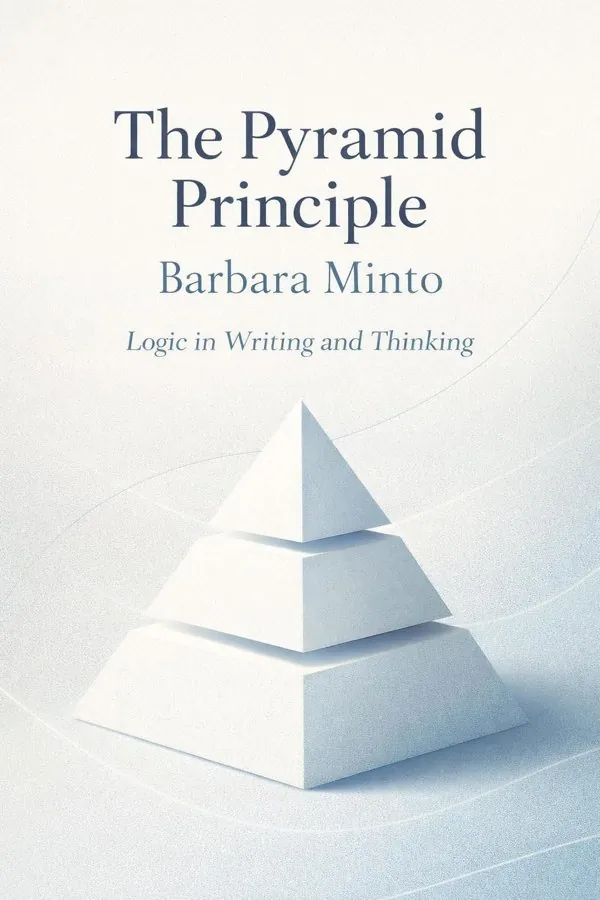
The Pyramid Principle: Logic in Writing and Thinking: Summary & Key Insights
 10 min9 chaptersAudio available
Key Takeaways from The Pyramid Principle: Logic in Writing and Thinking
A confused audience is often a symptom of confused structure, not confused intelligence.
Random lists create mental friction, while well-grouped ideas create instant comprehension.
Every statement in strong communication should earn its place by supporting a larger one.
Even good ideas lose force when arranged badly.
People pay attention when a message answers the question already forming in their minds.
What Is The Pyramid Principle: Logic in Writing and Thinking About?
The Pyramid Principle: Logic in Writing and Thinking by Barbara Minto is a communication book spanning 12 pages. Most communication fails not because the ideas are weak, but because the ideas arrive in the wrong order. In The Pyramid Principle, Barbara Minto offers a practical remedy: organize your thinking so the audience can grasp your conclusion first, then follow the supporting logic step by step. Developed during her time at McKinsey & Company, the method became a foundational tool for consultants, executives, and professionals who need to explain complex issues clearly and persuasively. At the heart of the book is a simple but powerful insight: people understand ideas more easily when those ideas are grouped logically and presented in a top-down structure. Instead of burying the point under background details, Minto teaches readers to begin with the answer, then support it with carefully ordered arguments and evidence. The result is sharper writing, stronger presentations, and more disciplined problem-solving. This book matters because clarity is a competitive advantage. Whether you are writing a memo, building a slide deck, making a recommendation, or solving a business problem, Minto’s framework helps you think better so you can communicate better.
This FizzRead summary covers all 9 key chapters of The Pyramid Principle: Logic in Writing and Thinking in approximately 10 minutes, distilling the most important ideas, arguments, and takeaways from Barbara Minto's work. Also available as an audio summary and Key Quotes Podcast.
The Pyramid Principle: Logic in Writing and Thinking
Most communication fails not because the ideas are weak, but because the ideas arrive in the wrong order. In The Pyramid Principle, Barbara Minto offers a practical remedy: organize your thinking so the audience can grasp your conclusion first, then follow the supporting logic step by step. Developed during her time at McKinsey & Company, the method became a foundational tool for consultants, executives, and professionals who need to explain complex issues clearly and persuasively.
At the heart of the book is a simple but powerful insight: people understand ideas more easily when those ideas are grouped logically and presented in a top-down structure. Instead of burying the point under background details, Minto teaches readers to begin with the answer, then support it with carefully ordered arguments and evidence. The result is sharper writing, stronger presentations, and more disciplined problem-solving.
This book matters because clarity is a competitive advantage. Whether you are writing a memo, building a slide deck, making a recommendation, or solving a business problem, Minto’s framework helps you think better so you can communicate better.
Who Should Read The Pyramid Principle: Logic in Writing and Thinking?
This book is perfect for anyone interested in communication and looking to gain actionable insights in a short read. Whether you're a student, professional, or lifelong learner, the key ideas from The Pyramid Principle: Logic in Writing and Thinking by Barbara Minto will help you think differently.
- ✓Readers who enjoy communication and want practical takeaways
- ✓Professionals looking to apply new ideas to their work and life
- ✓Anyone who wants the core insights of The Pyramid Principle: Logic in Writing and Thinking in just 10 minutes
Want the full summary?
Get instant access to this book summary and 100K+ more with Fizz Moment.
Get Free SummaryAvailable on App Store • Free to download
Key Chapters
A confused audience is often a symptom of confused structure, not confused intelligence. Barbara Minto’s central lesson is that effective communication should begin with the answer, not wander toward it. In business settings, readers and listeners want to know the point quickly: What are you recommending? What happened? What should we do next? If you delay the conclusion, you force your audience to assemble the meaning themselves.
The Pyramid Principle solves this by placing the governing idea at the top. Every supporting point below it must answer the question raised by that higher-level statement. This creates a clear hierarchy: the conclusion comes first, major reasons come second, and details come afterward. The structure mirrors how decision-makers prefer to process information—first the message, then the rationale, then the proof.
Imagine writing an email to a leadership team about falling customer retention. A weak version begins with pages of data, historical context, and interview notes. A pyramid version begins: “Customer retention is falling because onboarding is unclear, support response times are slow, and pricing is confusing.” Each of those three points can then be explained with evidence and recommendations.
This approach does not oversimplify thinking. It disciplines it. If you cannot state your conclusion clearly at the top, you probably have not yet clarified your thinking. Actionable takeaway: before writing or speaking, force yourself to complete this sentence in one line: “My main point is…” Then build everything else beneath it.
Random lists create mental friction, while well-grouped ideas create instant comprehension. Minto emphasizes that ideas should not merely be collected; they should be classified into meaningful groups. When similar points are grouped together and labeled by a unifying thought, the audience can see the pattern instead of struggling through fragments.
Good grouping follows two rules. First, points in a group must belong together at the same level of abstraction. Second, the group should be summarized by a single idea that captures what the members have in common. Without that summarizing logic, a set of bullets is just a pile. With it, the set becomes an argument.
For example, if a company’s sales are declining, possible observations might include weak digital ads, poor lead follow-up, limited sales training, and outdated territory plans. These should not be listed haphazardly. They might be grouped into marketing issues, sales execution issues, and coverage strategy issues. Each group can then be summarized and explored in a structured way.
This principle matters in reports, presentations, and even day-to-day conversation. If you tell a colleague, “There are three reasons the launch slipped,” you immediately create a frame. Their mind prepares to receive organized information. If instead you mention causes in no particular order, they must do the sorting for you.
Minto’s insight is that grouping is not cosmetic formatting; it is evidence of disciplined thought. Actionable takeaway: whenever you create a list, ask two questions: “Do these items truly belong together?” and “What single sentence best summarizes the whole group?”
Every statement in strong communication should earn its place by supporting a larger one. Minto calls this the vertical relationship of ideas: each lower-level point answers the question raised by the point above. This creates a natural chain of reasoning that allows readers to move from conclusion to explanation without getting lost.
If your top statement says, “We should expand into the mid-market segment,” the next level must explain why. Perhaps the reasons are higher margins, weaker competition, and better product fit. Under each of those reasons, you can add evidence: financial analysis, competitor mapping, customer interviews, and product performance data. The audience sees not just your conclusion, but the logic holding it up.
The power of vertical structure is that it prevents unsupported assertions. In weak writing, authors often stack claims without proving them. They say a market is attractive, a strategy is urgent, or a team needs change—but never clearly connect reasons to recommendations. Minto’s method forces every level to answer an implied question. If the reader asks “Why?” the layer below should answer. If they ask “How do you know?” the next layer should provide proof.
This is especially useful in high-stakes communication. A board memo, investment case, or policy recommendation needs more than opinion. It needs traceable reasoning. Vertical logic ensures your message is persuasive because it is structurally accountable.
Actionable takeaway: after drafting any argument, test each statement by asking, “What question does this answer from the level above?” If the connection is unclear, revise until the support is explicit.
Even good ideas lose force when arranged badly. Minto stresses that once ideas are grouped, they must also be ordered logically. The sequence should help the audience move through the material naturally instead of guessing why one point follows another.
She highlights several common ways to order ideas: time order, structural order, and order of importance. Time order works when explaining a process, such as how a product launch failed across planning, testing, and execution. Structural order works when describing parts of a whole, such as regions, departments, or components of a system. Order of importance works when ranking reasons, risks, or recommendations.
Consider a presentation on improving customer service. If you jump from hiring to software to training to incentives and then back to staffing, the audience must reorganize the story mentally. But if you say, “We need to improve customer service in three areas: people, process, and tools,” and then discuss each in turn, the path becomes easy to follow.
Sequence also shapes persuasion. If your strongest point comes last, you may build toward impact. If executives care most about risk, you may lead with risk. The right order depends on context, but the rule remains the same: make the progression deliberate and visible.
This principle applies beyond formal documents. In meetings, people often sound vague because they think aloud rather than present an ordered line of thought. A clear sequence makes you sound more credible because it signals mastery over the material.
Actionable takeaway: before finalizing any outline, label the ordering logic for each major section—time, structure, or importance—so your audience always knows why the points appear in that order.
People pay attention when a message answers the question already forming in their minds. One of Minto’s most practical contributions is the idea that communication should unfold as a series of question-and-answer steps. The top statement raises a question; the layer below answers it. Then each supporting point raises the next question, and the structure continues downward.
This mirrors how readers think. If you say, “We should redesign our pricing,” the natural question is “Why?” If you answer, “Because our current pricing reduces conversion, confuses customers, and limits upsell opportunities,” the next questions become “How does it reduce conversion?” and “What evidence shows confusion?” Strong communication anticipates these questions and answers them before the audience has to ask.
Minto also connects this to introductions. A useful introduction sets up a situation, identifies a complication, and leads to the key question your document will answer. For example: “We launched a new subscription offer. Adoption is below forecast. What changes will improve conversion?” Once that question is clear, the recommendation feels like a direct and relevant response.
This technique is powerful because it transforms communication from data dumping into guided reasoning. Instead of overwhelming people with facts, you lead them through a logical path of curiosity and resolution. It also improves writing speed. When you know the core question, you can exclude information that does not help answer it.
Actionable takeaway: before drafting, write down the one central question your audience needs answered. Then structure every section so it responds to that question or to a logical sub-question beneath it.
Clear writing is usually the visible result of clear analysis. Minto shows that the Pyramid Principle is not only a communication tool but also a problem-solving discipline. If you can decompose a messy issue into logically related parts, you are already halfway to solving it.
Business problems often arrive as vague concerns: profits are down, teams are misaligned, customers are dissatisfied. The temptation is to jump into solutions. Minto argues for a more structured approach. Define the problem clearly, break it into components, analyze each component, and then reassemble your findings into a pyramid that leads to a recommendation.
For instance, suppose a retailer’s margins are shrinking. Rather than brainstorming randomly, you might divide the problem into revenue drivers and cost drivers. Revenue may then split into pricing, volume, and mix. Costs may split into procurement, operations, and logistics. This creates a logical issue tree that helps teams identify where analysis is needed. Once the facts are gathered, the final communication can present the answer in concise pyramid form.
This approach is especially helpful in consulting, strategy, operations, and management roles, where the hardest part is often deciding how to think about the problem in the first place. A structured framework prevents teams from getting lost in detail or arguing at cross-purposes.
The deeper lesson is that good communicators are not simply better at wording. They are better at organizing reality. Actionable takeaway: when faced with a complex issue, resist immediate solutions. First break the problem into mutually distinct, collectively useful parts, then build your recommendation from the analysis upward.
Many people write in the order they discover their thoughts, but readers prefer the order that makes those thoughts easy to grasp. Minto recommends drafting business documents from the top down: begin with the core message, then outline the supporting arguments, and only then fill in the evidence and detail.
This is the opposite of how many reports are written. Authors gather notes, assemble facts, and gradually hope the meaning emerges. The result is often bloated, repetitive, and unclear. A top-down draft imposes structure before prose. It tells you what belongs, what does not, and where each piece of information should sit.
A practical template might look like this: first, write the governing thought in one sentence. Second, identify the two to four major points that support it. Third, place supporting facts under each point. Finally, turn the outline into full paragraphs, keeping headings aligned with the logic. The document becomes easier to read because it was easier to think through.
This method also improves editing. If a section is weak, you can ask whether the problem lies in the top statement, the supporting grouping, or the evidence. It is far easier to repair logic at the outline level than after pages of prose have been written.
For managers and executives, this style of writing respects time. A reader can skim the headings and still understand the argument. That is not a luxury in modern organizations; it is a requirement.
Actionable takeaway: before writing any important memo or report, create a one-page pyramid outline first. Do not begin full drafting until your conclusion, major supports, and evidence hierarchy are clear.
A presentation fails when the audience must work harder than the presenter. Minto’s framework is especially valuable in spoken communication because listeners cannot reread what they missed. In presentations, meetings, and briefings, structure has to be unmistakable.
Using the Pyramid Principle, a presenter begins with the answer or recommendation, then walks through a few major supporting points in a clear sequence. Each section should be signposted, and each slide or talking point should serve a specific role in the larger argument. This prevents the common mistake of turning presentations into information archives rather than decision tools.
Imagine briefing executives on a new market entry. Instead of opening with 20 slides of country data, start with the recommendation: “We should enter Market A next year through a distributor partnership.” Then support it with three reasons: attractive demand, manageable regulatory complexity, and lower capital risk than direct entry. Every subsequent slide should strengthen one of those reasons. The audience immediately knows what they are evaluating.
Minto’s method also makes Q&A easier. Because your argument is clearly layered, you can move up and down the pyramid depending on the question. If someone asks for evidence, go down a level. If they ask about implications, go back up. You are not trapped in a linear script.
In a world of overloaded calendars and shrinking attention spans, concise structure increases influence. Actionable takeaway: for every presentation, define one governing message and no more than three or four major support points, then make each slide title state a conclusion rather than a topic.
Most weak communication suffers from a few predictable problems: unclear conclusions, mixed levels of abstraction, overlapping points, and unsupported claims. Minto’s framework helps diagnose these mistakes because it provides a standard for what good structure looks like.
One common error is presenting topics instead of ideas. A heading like “Market Trends” tells the audience almost nothing. A stronger heading says, “Market growth is slowing in our core segment.” Another mistake is grouping points that do not belong together. For example, putting “declining sales,” “customer complaints,” and “hire more staff” in one list mixes symptoms, evidence, and solutions. Good structure requires points of the same type and level.
A further mistake is burying the recommendation under background. Writers often feel they must prove they have done the work before stating the conclusion. But executives usually want the recommendation first, with the evidence available beneath it. There is also the danger of overloading communication with every fact collected. Minto reminds us that relevance matters more than completeness.
Fixing these issues often means stepping back from sentences and reviewing the logic of the outline itself. Are the points mutually distinct? Do they answer the same question? Is there a unifying summary above them? Does each lower level actually support the higher one?
What makes the Pyramid Principle enduring is its usefulness as an editing tool. It teaches you how to think, but also how to spot when your thinking has gone off course. Actionable takeaway: when revising, audit your structure before your wording—improve the logic tree first, then polish the language.
All Chapters in The Pyramid Principle: Logic in Writing and Thinking
About the Author
Barbara Minto is a former McKinsey & Company consultant and the creator of the Minto Pyramid Principle, one of the most influential frameworks for structured business communication. As one of the first women hired by McKinsey, she observed that many smart professionals struggled not with analysis, but with expressing their ideas clearly. In response, she developed a method for organizing thinking and writing in a logical top-down structure. Minto later founded Minto International Inc., where she trained consultants, executives, and organizations around the world in clear writing, presentation design, and problem-solving. Her work has had a lasting impact on consulting, corporate communication, and executive education, making her a leading authority on how to turn complex ideas into concise, persuasive messages.
Get This Summary in Your Preferred Format
Read or listen to the The Pyramid Principle: Logic in Writing and Thinking summary by Barbara Minto anytime, anywhere. FizzRead offers multiple formats so you can learn on your terms — all free.
Available formats: App · Audio · PDF · EPUB — All included free with FizzRead
Download The Pyramid Principle: Logic in Writing and Thinking PDF and EPUB Summary
Key Quotes from The Pyramid Principle: Logic in Writing and Thinking
“A confused audience is often a symptom of confused structure, not confused intelligence.”
“Random lists create mental friction, while well-grouped ideas create instant comprehension.”
“Every statement in strong communication should earn its place by supporting a larger one.”
“Even good ideas lose force when arranged badly.”
“People pay attention when a message answers the question already forming in their minds.”
Frequently Asked Questions about The Pyramid Principle: Logic in Writing and Thinking
The Pyramid Principle: Logic in Writing and Thinking by Barbara Minto is a communication book that explores key ideas across 9 chapters. Most communication fails not because the ideas are weak, but because the ideas arrive in the wrong order. In The Pyramid Principle, Barbara Minto offers a practical remedy: organize your thinking so the audience can grasp your conclusion first, then follow the supporting logic step by step. Developed during her time at McKinsey & Company, the method became a foundational tool for consultants, executives, and professionals who need to explain complex issues clearly and persuasively. At the heart of the book is a simple but powerful insight: people understand ideas more easily when those ideas are grouped logically and presented in a top-down structure. Instead of burying the point under background details, Minto teaches readers to begin with the answer, then support it with carefully ordered arguments and evidence. The result is sharper writing, stronger presentations, and more disciplined problem-solving. This book matters because clarity is a competitive advantage. Whether you are writing a memo, building a slide deck, making a recommendation, or solving a business problem, Minto’s framework helps you think better so you can communicate better.
You Might Also Like

Magic Words: The Science and Secrets Behind Seven Words That Motivate, Engage, and Influence
Tim David
10 min
Talking Across The Divide: How to Communicate with People You Disagree with and Maybe Even Change the World
Justin Lee
10 min
The Exceptional Presenter: A Proven Formula to Open Up! and Own the Room
Timothy J. Koegel
10 min
4 Essential Keys to Effective Communication in Love, Life, Work--Anywhere!: Including the 12-Day Communication Challenge!
Bento C. Leal III
10 min
Active Listening Techniques: 30 Practical Tools to Hone Your Communication Skills
Nisha Gupta
10 min
Bargaining for Advantage: Negotiation Strategies for Reasonable People
G. Richard Shell
10 minBrowse by Category
Ready to read The Pyramid Principle: Logic in Writing and Thinking?
Get the full summary and 100K+ more books with Fizz Moment.