
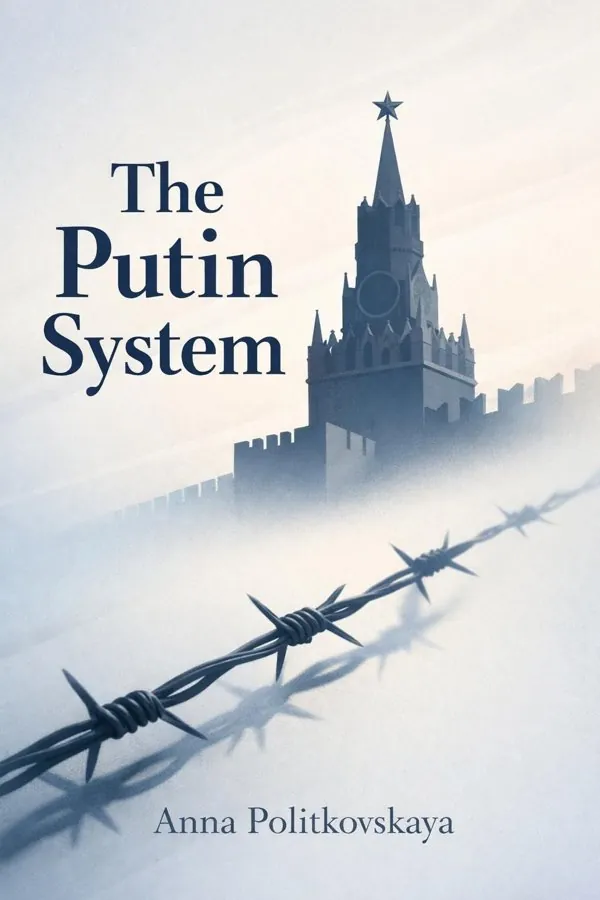
The Putin System: Summary & Key Insights
 10 min11 chaptersAudio available
What Is The Putin System About?
The Putin System by Anna Politkovskaya is a politics book spanning 11 pages. This book offers a critical analysis of Vladimir Putin's rise to power and the political system that emerged under his leadership. Written by Russian journalist Anna Politkovskaya, it examines the mechanisms of control, corruption, and suppression of dissent that characterize modern Russia, providing firsthand accounts and investigative insights into the country's transformation since the early 2000s.
This FizzRead summary covers all 11 key chapters of The Putin System in approximately 10 minutes, distilling the most important ideas, arguments, and takeaways from Anna Politkovskaya's work. Also available as an audio summary and Key Quotes Podcast.
The Putin System
This book offers a critical analysis of Vladimir Putin's rise to power and the political system that emerged under his leadership. Written by Russian journalist Anna Politkovskaya, it examines the mechanisms of control, corruption, and suppression of dissent that characterize modern Russia, providing firsthand accounts and investigative insights into the country's transformation since the early 2000s.
Who Should Read The Putin System?
This book is perfect for anyone interested in politics and looking to gain actionable insights in a short read. Whether you're a student, professional, or lifelong learner, the key ideas from The Putin System by Anna Politkovskaya will help you think differently.
- ✓Readers who enjoy politics and want practical takeaways
- ✓Professionals looking to apply new ideas to their work and life
- ✓Anyone who wants the core insights of The Putin System in just 10 minutes
Want the full summary?
Get instant access to this book summary and 100K+ more with Fizz Moment.
Get Free SummaryAvailable on App Store • Free to download
Key Chapters
I first sought to understand who Vladimir Putin was before he became the symbol of a new order. Born and raised in Leningrad, trained in the KGB, he learned early that loyalty and secrecy were more valuable than truth. His service was not glamorous; it was routine surveillance, reporting, and quiet observation—a life within an institution that worshiped obedience.
When I spoke to former colleagues and acquaintances, a pattern emerged: Putin embodied the ideal of a disciplined operative rather than a visionary leader. His years in Dresden with the KGB during the fall of East Germany taught him one unmistakable lesson—never trust spontaneity, never let chaos emerge without control. That experience shaped his later obsession with stability. It was not democracy he admired in the West, but efficiency, hierarchy, and the power to command.
His ascent through the political ranks was facilitated by the vacuum left after Boris Yeltsin’s era. By 1999, the Kremlin was exhausted, split by corruption and fear of economic collapse. Into this void stepped Putin—a man seemingly incorruptible, resolute, and quiet. His blandness was his camouflage. To the Russian elite, he promised order without moral questioning; to the people, he promised normal life. Each promise was an echo of the same KGB logic: security above freedom.
Studying his early speeches and interviews, I noticed a lack of warmth, a mechanical tone. He spoke of patriotism not as love but as discipline, of the state as a fortress under siege. From these foundations, the Putin system began—a regime where personal loyalty outweighed justice, and fear was rebranded as strength.
From the moment Putin entered the presidency in 2000, he moved swiftly to dismantle the fragile checks that could question his rule. Regional governors lost their power of independence as the federal system was restructured to report directly to Moscow. The Duma, once a restless arena of political debate, became an obedient chamber of approval. Step by step, the state was rebuilt to speak with one voice.
This centralization was justified publicly as the restoration of order after the 'wild nineties.' In reality, it was the birth of a new hierarchy—a pyramid where every official’s authority depended on proximity to the Kremlin. Bureaucrats learned quickly that loyalty was the currency of survival. Those who hesitated were replaced.
I watched as television channels changed ownership, as investigative committees dissolved, and as courts began to interpret law in ways that favored the executive. The language of governance shifted; instead of accountability, officials spoke of 'national unity'; instead of press freedom, they invoked 'information security.' Behind these phrases lay the same logic: power must not be questioned.
For many Russians, the early years of this consolidation felt deceptively calm. Salaries were paid. The economy grew on oil. But it was calm purchased through silence. The political system was ceasing to contain competition. Every election—whether parliamentary or local—became a managed ritual designed to confirm the illusion of consent. I have seen fear return in the eyes of those who once spoke openly. That fear is the soul of the Putin system.
+ 9 more chapters — available in the FizzRead app
All Chapters in The Putin System
About the Author
Anna Politkovskaya (1958–2006) was a Russian journalist, writer, and human rights activist known for her courageous reporting on the Second Chechen War and the Putin administration. She worked for the newspaper Novaya Gazeta and was internationally recognized for her investigative journalism and advocacy for civil liberties in Russia.
Get This Summary in Your Preferred Format
Read or listen to the The Putin System summary by Anna Politkovskaya anytime, anywhere. FizzRead offers multiple formats so you can learn on your terms — all free.
Available formats: App · Audio · PDF · EPUB — All included free with FizzRead
Download The Putin System PDF and EPUB Summary
Key Quotes from The Putin System
“I first sought to understand who Vladimir Putin was before he became the symbol of a new order.”
“From the moment Putin entered the presidency in 2000, he moved swiftly to dismantle the fragile checks that could question his rule.”
Frequently Asked Questions about The Putin System
The Putin System by Anna Politkovskaya is a politics book that explores key ideas across 11 chapters. This book offers a critical analysis of Vladimir Putin's rise to power and the political system that emerged under his leadership. Written by Russian journalist Anna Politkovskaya, it examines the mechanisms of control, corruption, and suppression of dissent that characterize modern Russia, providing firsthand accounts and investigative insights into the country's transformation since the early 2000s.
You Might Also Like
Antifa: The Anti-Fascist Handbook
Mark Bray
10 min
Attack from Within: How Disinformation Is Sabotaging America
Barbara McQuade
10 min
Coercion, Capital, and European States, AD 990–1992
Charles Tilly
10 min
Digital Democracy: Concepts, Methodologies, Tools, and Applications
Various Authors
10 min
Fascism
Stanley G. Payne
10 min
Fire And Fury: Inside The Trump White House
Michael Wolff
10 minBrowse by Category
Ready to read The Putin System?
Get the full summary and 100K+ more books with Fizz Moment.