
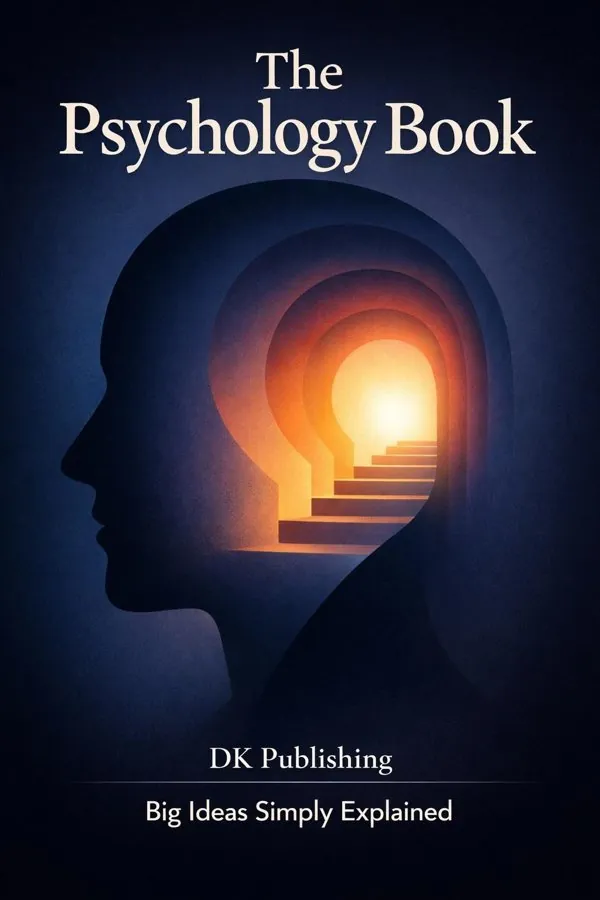
The Psychology Book: Big Ideas Simply Explained: Summary & Key Insights
 10 min9 chaptersAudio available
Key Takeaways from The Psychology Book: Big Ideas Simply Explained
Long before psychology became a science, people were already asking one essential question: what is a human mind, and how can we know it?
Much of what drives us may lie outside awareness, and few ideas have shaped popular culture more than that one.
If you want to change behavior, sometimes the most important thing to study is not hidden feelings but visible consequences.
People are not just problems to fix or behaviors to control; they are meaning-seeking beings capable of growth.
What if the key to behavior lies in how we process information rather than simply in rewards or unconscious drives?
What Is The Psychology Book: Big Ideas Simply Explained About?
The Psychology Book: Big Ideas Simply Explained by DK Publishing is a popular_sci book spanning 6 pages. Why do people obey authority, form habits they cannot explain, misremember events, or thrive when they feel understood? The Psychology Book: Big Ideas Simply Explained takes these timeless questions and maps them across the full history of psychology, turning a complex academic field into a vivid, readable journey through the human mind. Rather than presenting psychology as a single theory, the book shows it as an evolving conversation shaped by philosophers, clinicians, lab researchers, and social scientists—from Aristotle and Freud to Skinner, Rogers, Piaget, Beck, and contemporary neuroscientists. What makes this book valuable is its ability to connect landmark ideas to everyday life. It explains how early thinkers defined the mind, how psychoanalysis explored hidden motives, how behaviorists studied learning, how cognitive psychologists examined memory and perception, and how modern researchers link biology, relationships, and society to behavior. The result is both an introduction and a reference guide for curious readers. DK Publishing brings authority through its signature strength: making difficult subjects accessible without stripping away their depth. With clear explanations, visual structure, and carefully selected big ideas, this book helps readers understand not just what psychologists discovered, but why those discoveries still shape education, therapy, work, and daily life.
This FizzRead summary covers all 9 key chapters of The Psychology Book: Big Ideas Simply Explained in approximately 10 minutes, distilling the most important ideas, arguments, and takeaways from DK Publishing's work. Also available as an audio summary and Key Quotes Podcast.
The Psychology Book: Big Ideas Simply Explained
Why do people obey authority, form habits they cannot explain, misremember events, or thrive when they feel understood? The Psychology Book: Big Ideas Simply Explained takes these timeless questions and maps them across the full history of psychology, turning a complex academic field into a vivid, readable journey through the human mind. Rather than presenting psychology as a single theory, the book shows it as an evolving conversation shaped by philosophers, clinicians, lab researchers, and social scientists—from Aristotle and Freud to Skinner, Rogers, Piaget, Beck, and contemporary neuroscientists.
What makes this book valuable is its ability to connect landmark ideas to everyday life. It explains how early thinkers defined the mind, how psychoanalysis explored hidden motives, how behaviorists studied learning, how cognitive psychologists examined memory and perception, and how modern researchers link biology, relationships, and society to behavior. The result is both an introduction and a reference guide for curious readers.
DK Publishing brings authority through its signature strength: making difficult subjects accessible without stripping away their depth. With clear explanations, visual structure, and carefully selected big ideas, this book helps readers understand not just what psychologists discovered, but why those discoveries still shape education, therapy, work, and daily life.
Who Should Read The Psychology Book: Big Ideas Simply Explained?
This book is perfect for anyone interested in popular_sci and looking to gain actionable insights in a short read. Whether you're a student, professional, or lifelong learner, the key ideas from The Psychology Book: Big Ideas Simply Explained by DK Publishing will help you think differently.
- ✓Readers who enjoy popular_sci and want practical takeaways
- ✓Professionals looking to apply new ideas to their work and life
- ✓Anyone who wants the core insights of The Psychology Book: Big Ideas Simply Explained in just 10 minutes
Want the full summary?
Get instant access to this book summary and 100K+ more with Fizz Moment.
Get Free SummaryAvailable on App Store • Free to download
Key Chapters
Long before psychology became a science, people were already asking one essential question: what is a human mind, and how can we know it? The Psychology Book begins by showing that psychology did not appear fully formed in a laboratory. It grew out of philosophy, medicine, and curiosity about perception, memory, emotion, and free will. Thinkers like Plato and Aristotle debated whether knowledge is innate or learned through experience, while later philosophers such as Descartes, Locke, and Hume wrestled with consciousness, reason, and the role of the senses. These early debates created the conceptual foundation for psychology.
The turning point came when researchers began treating the mind as something that could be studied systematically. Wilhelm Wundt, often called the father of experimental psychology, established one of the first psychology laboratories in 1879 and tried to measure mental processes scientifically. William James broadened the field by focusing on how mental life functions in real-world adaptation. Together, these figures helped psychology shift from abstract speculation to observation, measurement, and theory-building.
This historical transition matters because it reminds us that many current debates—nature versus nurture, emotion versus reason, conscious versus unconscious processes—have deep roots. Even today, educators, therapists, and researchers still draw on these core questions. For example, when schools debate whether intelligence is fixed or trainable, they echo arguments that have been evolving for centuries.
The practical lesson is simple: understanding psychology starts with understanding its questions, not just its answers. When you encounter a theory about behavior or mental health, ask what assumptions it makes about human nature, learning, and consciousness. Actionable takeaway: when reading any psychological claim, pause and identify whether it emphasizes biology, experience, thought, or environment—this habit will make you a more critical and informed thinker.
Much of what drives us may lie outside awareness, and few ideas have shaped popular culture more than that one. Sigmund Freud transformed psychology by arguing that human behavior is not fully rational or transparent to itself. Beneath conscious thought, he proposed, sits an unconscious world of wishes, fears, memories, and conflicts that quietly influence our feelings and choices. His psychoanalytic framework introduced concepts such as repression, defense mechanisms, dream symbolism, and the dynamic struggle among the id, ego, and superego.
Freud’s theory suggested that symptoms like anxiety, compulsive behaviors, or emotional distress could reflect unresolved inner conflict rather than obvious external causes. He developed psychoanalysis as a method to bring hidden material into awareness through free association, dream interpretation, and close attention to slips of the tongue and recurring patterns. Even where Freud’s theories are disputed or outdated, his biggest contribution remains powerful: he taught psychology to take inner life seriously.
In everyday life, Freudian ideas still echo. When someone repeatedly sabotages relationships, overreacts to criticism, or avoids painful memories, we often recognize that surface behavior may not tell the full story. Modern therapy may not follow Freud exactly, but it often retains the insight that present distress can be shaped by past experience, unconscious habits, and emotional defenses.
The value of this chapter is not that Freud explained everything, but that he expanded the idea of what psychology could examine. He made motives, childhood experience, and emotional ambivalence legitimate topics of inquiry.
Actionable takeaway: when your reactions seem stronger than a situation warrants, ask yourself what older fear, unmet need, or hidden expectation might be getting activated. That simple question can turn confusion into self-understanding.
If you want to change behavior, sometimes the most important thing to study is not hidden feelings but visible consequences. That is the central promise of behaviorism. Rejecting vague speculation about the inner mind, behaviorists such as John B. Watson, Ivan Pavlov, and B.F. Skinner argued that psychology should focus on what can be observed, measured, and tested. Their work showed that behavior is not random; it is shaped by conditioning, reinforcement, punishment, and environmental cues.
Pavlov’s experiments with dogs demonstrated classical conditioning: organisms can learn to associate one stimulus with another, as when a neutral sound becomes linked with food and eventually triggers salivation on its own. Watson extended these ideas to humans, suggesting that emotions and responses could also be conditioned. Skinner then developed operant conditioning, showing how behaviors increase when rewarded and decrease when ignored or punished. A child who receives praise for completing homework may become more diligent; an employee recognized for initiative may repeat that behavior.
Behaviorism had enormous influence on education, parenting, therapy, and workplace systems. Token economies, habit trackers, reward charts, and many training programs all rely on behavioral principles. It also helped psychology become more rigorously experimental by emphasizing prediction and control.
Of course, behaviorism has limits. It can underplay thoughts, intentions, and meaning. Still, its practical power is undeniable. If you want to build better habits, reduce procrastination, or shape group behavior, consequences matter.
Actionable takeaway: choose one behavior you want to strengthen and make the reward immediate, specific, and consistent. Whether it is exercise, reading, or focused work, pairing the behavior with a clear positive consequence dramatically increases the odds that it will stick.
People are not just problems to fix or behaviors to control; they are meaning-seeking beings capable of growth. Humanistic psychology emerged partly as a response to both psychoanalysis and behaviorism, arguing that these schools often overlooked human dignity, choice, creativity, and the drive toward fulfillment. Figures such as Carl Rogers and Abraham Maslow placed the lived experience of the person at the center of psychology.
Maslow’s hierarchy of needs proposed that human motivation unfolds through levels, from physiological survival and safety to love, esteem, and self-actualization. His model suggests that people flourish when basic needs are met and they are free to pursue purpose, competence, and authenticity. Rogers, meanwhile, emphasized empathy, unconditional positive regard, and congruence in relationships. He believed people naturally move toward growth when they feel truly seen and accepted rather than judged or controlled.
These ideas transformed counseling, education, leadership, and personal development. In therapy, the humanistic approach encouraged therapists to listen deeply rather than impose interpretations. In schools and workplaces, it inspired practices that support autonomy, trust, and intrinsic motivation. A manager who gives employees ownership and recognition may unlock more engagement than one who relies only on pressure and rewards.
Humanistic psychology matters because it restores hope and agency. It reminds us that mental health is not only the absence of disorder but also the presence of meaning, healthy relationships, and self-respect. It also explains why environments of shame, chronic criticism, or emotional neglect can stunt growth even when basic tasks are performed successfully.
Actionable takeaway: identify one area of your life where you are acting to please others rather than align with your values. Take one small step this week toward greater authenticity, such as setting a boundary, expressing an honest opinion, or investing time in work that feels meaningful.
What if the key to behavior lies in how we process information rather than simply in rewards or unconscious drives? Cognitive psychology brought the mind back into psychology by focusing on perception, attention, memory, language, problem-solving, and decision-making. Rather than treating the brain as a black box, cognitive psychologists explored how people interpret the world, store knowledge, make sense of experience, and sometimes distort reality in predictable ways.
This shift was revolutionary because it explained why two people can face the same event and respond differently. Our behavior depends not only on what happens, but on how we encode and interpret what happens. Research on schemas, memory errors, heuristics, and cognitive biases revealed that the mind is efficient but not always accurate. We overlook information, misremember events, jump to conclusions, and rely on mental shortcuts that can help or mislead us.
The practical reach of cognitive psychology is vast. In education, it informs effective learning methods such as retrieval practice, spacing, and chunking. In design, it shapes how information is presented so users can understand it quickly. In mental health, it underpins cognitive behavioral therapy, which helps people identify distorted thoughts and replace them with more balanced ones. For example, someone who interprets one criticism as proof of complete failure may be trapped by a faulty thinking pattern rather than an objective fact.
The broader lesson is that thought is active, selective, and constructive. We do not simply receive reality; we interpret it.
Actionable takeaway: the next time you feel overwhelmed by a negative assumption, write down the thought and ask three questions: What evidence supports it? What evidence challenges it? What is a more accurate interpretation? This simple cognitive habit can interrupt many unhelpful mental spirals.
A mind is not a finished object; it is something that unfolds over time. Developmental psychology asks how people change from infancy to old age and how cognition, emotion, identity, and social understanding emerge across the lifespan. The Psychology Book highlights thinkers such as Jean Piaget, Erik Erikson, and Lev Vygotsky, each of whom showed that human growth is not merely physical but deeply psychological and relational.
Piaget argued that children do not think like miniature adults. Instead, they move through stages of cognitive development, building increasingly complex ways of understanding the world. This insight transformed education by showing that teaching must match the learner’s developmental capacity. Erikson broadened development beyond childhood, proposing psychosocial stages in which individuals face tasks such as trust, identity, intimacy, and generativity. Vygotsky emphasized the social nature of learning, showing how language, culture, and guidance from others shape mental development.
These ideas matter because they challenge one-size-fits-all expectations. A child’s tantrum, a teenager’s identity struggle, or an older adult’s search for meaning may not be signs of failure but normal developmental work. Parents, teachers, and leaders become more effective when they understand the stage-specific needs of the people they support.
In practice, developmental thinking helps with everything from classroom design to parenting style to self-compassion. If you know that children learn through scaffolding, you offer support without doing everything for them. If you recognize adolescence as a period of identity formation, you respond with guidance rather than panic.
Actionable takeaway: when someone in your life seems difficult, ask whether their behavior reflects a developmental need—such as autonomy, security, or belonging—rather than simple stubbornness. Responding to the need instead of the symptom often creates far better outcomes.
Every thought, feeling, and impulse has a biological dimension. Modern psychology increasingly connects behavior to the brain, nervous system, hormones, genes, and evolution. Biological psychology does not reduce people to chemistry, but it does show that mental life is inseparable from the body. Emotions involve physiological arousal, attention depends on neural systems, stress affects cognition, and even social bonding is influenced by hormones and brain circuits.
Neuroscience has helped explain how different brain regions contribute to memory, language, movement, reward, and emotional regulation. Research on brain injury and imaging has revealed that changes in neural function can alter personality, judgment, or perception. Evolutionary psychology adds another layer by asking how certain psychological tendencies may have developed because they supported survival and reproduction, such as threat detection, attachment, or pattern recognition.
These ideas have practical consequences. Understanding stress biology can improve sleep, exercise, and recovery habits. Knowing that addiction changes reward pathways can shift the conversation from moral failure to treatment and support. Appreciating the brain’s plasticity can inspire rehabilitation and lifelong learning, since neural systems can adapt through practice and experience.
At the same time, the book helps readers avoid simplistic conclusions. Biology influences behavior, but it does not write destiny in permanent ink. Genes interact with environment. Brain differences matter, yet context, training, relationships, and culture matter too.
Actionable takeaway: treat your mind as embodied. If concentration, mood, or resilience is suffering, start with basic biological levers—sleep quality, physical movement, nutrition, and stress regulation. Small changes in the body often produce surprisingly meaningful changes in thought and emotion.
A theory becomes powerful when it changes what people do. One of the strengths of The Psychology Book is that it shows psychology not as an abstract academic subject but as a toolkit that influences therapy, education, business, law, health care, and daily decision-making. Across its many schools of thought, psychology repeatedly asks the same practical question: how can understanding the mind improve human life?
Clinical psychology applies theories of thought, emotion, trauma, and personality to reduce suffering and improve functioning. Educational psychology helps teachers understand attention, motivation, memory, and developmental readiness. Industrial-organizational psychology studies hiring, teamwork, leadership, incentives, and burnout. Health psychology explores how beliefs, habits, and stress affect physical well-being. Even legal systems draw on psychology when considering eyewitness memory, persuasion, and bias.
What ties these applications together is the recognition that people are patterned but changeable. Habits can be retrained. Relationships can heal. Workplaces can be redesigned. Communication can be improved by understanding motivation, perception, and social influence. For example, a team struggling with productivity may not need more pressure; it may need clearer goals, better feedback loops, psychological safety, or improved attention management.
This applied perspective also reminds readers to be thoughtful consumers of psychological advice. Not every popular claim is well supported. Real psychology demands evidence, context, and humility. Still, when used carefully, psychological insights can improve how we study, parent, lead, collaborate, and care for ourselves.
Actionable takeaway: choose one domain of your life—health, work, relationships, or learning—and identify the psychological factor most shaping it right now: habit, belief, motivation, environment, or social pressure. Change that factor first instead of relying on willpower alone.
All Chapters in The Psychology Book: Big Ideas Simply Explained
About the Author
DK Publishing is a British publishing company renowned for creating visually rich, accessible nonfiction books that make complex subjects easy to understand. Founded in 1974, DK has built a global reputation for combining clear writing, strong editorial structure, and distinctive design across fields such as science, history, philosophy, health, and psychology. Rather than relying solely on dense academic prose, DK books typically use illustrations, diagrams, timelines, and concise explanations to help readers absorb big ideas quickly and confidently. This approach has made the publisher especially popular with students, families, and lifelong learners. In The Psychology Book: Big Ideas Simply Explained, DK applies its signature style to the history of psychology, turning major theories and thinkers into an engaging, accessible guide for anyone curious about the human mind.
Get This Summary in Your Preferred Format
Read or listen to the The Psychology Book: Big Ideas Simply Explained summary by DK Publishing anytime, anywhere. FizzRead offers multiple formats so you can learn on your terms — all free.
Available formats: App · Audio · PDF · EPUB — All included free with FizzRead
Download The Psychology Book: Big Ideas Simply Explained PDF and EPUB Summary
Key Quotes from The Psychology Book: Big Ideas Simply Explained
“Long before psychology became a science, people were already asking one essential question: what is a human mind, and how can we know it?”
“Much of what drives us may lie outside awareness, and few ideas have shaped popular culture more than that one.”
“If you want to change behavior, sometimes the most important thing to study is not hidden feelings but visible consequences.”
“People are not just problems to fix or behaviors to control; they are meaning-seeking beings capable of growth.”
“What if the key to behavior lies in how we process information rather than simply in rewards or unconscious drives?”
Frequently Asked Questions about The Psychology Book: Big Ideas Simply Explained
The Psychology Book: Big Ideas Simply Explained by DK Publishing is a popular_sci book that explores key ideas across 9 chapters. Why do people obey authority, form habits they cannot explain, misremember events, or thrive when they feel understood? The Psychology Book: Big Ideas Simply Explained takes these timeless questions and maps them across the full history of psychology, turning a complex academic field into a vivid, readable journey through the human mind. Rather than presenting psychology as a single theory, the book shows it as an evolving conversation shaped by philosophers, clinicians, lab researchers, and social scientists—from Aristotle and Freud to Skinner, Rogers, Piaget, Beck, and contemporary neuroscientists. What makes this book valuable is its ability to connect landmark ideas to everyday life. It explains how early thinkers defined the mind, how psychoanalysis explored hidden motives, how behaviorists studied learning, how cognitive psychologists examined memory and perception, and how modern researchers link biology, relationships, and society to behavior. The result is both an introduction and a reference guide for curious readers. DK Publishing brings authority through its signature strength: making difficult subjects accessible without stripping away their depth. With clear explanations, visual structure, and carefully selected big ideas, this book helps readers understand not just what psychologists discovered, but why those discoveries still shape education, therapy, work, and daily life.
You Might Also Like

Structures: Or Why Things Don"t Fall Down
J.E. Gordon
10 min
The Road to Wigan Pier
George Orwell
10 min
Bonk: The Curious Coupling of Science and Sex
Mary Roach
10 min
First Bite: How We Learn to Eat
Bee Wilson
10 min
In Pursuit Of The Unknown: 17 Equations That Changed The World
Ian Stewart
10 min
Napoleon's Buttons: 17 Molecules That Changed History
Penny Le Couteur and Jay Burreson
10 minBrowse by Category
Ready to read The Psychology Book: Big Ideas Simply Explained?
Get the full summary and 100K+ more books with Fizz Moment.