
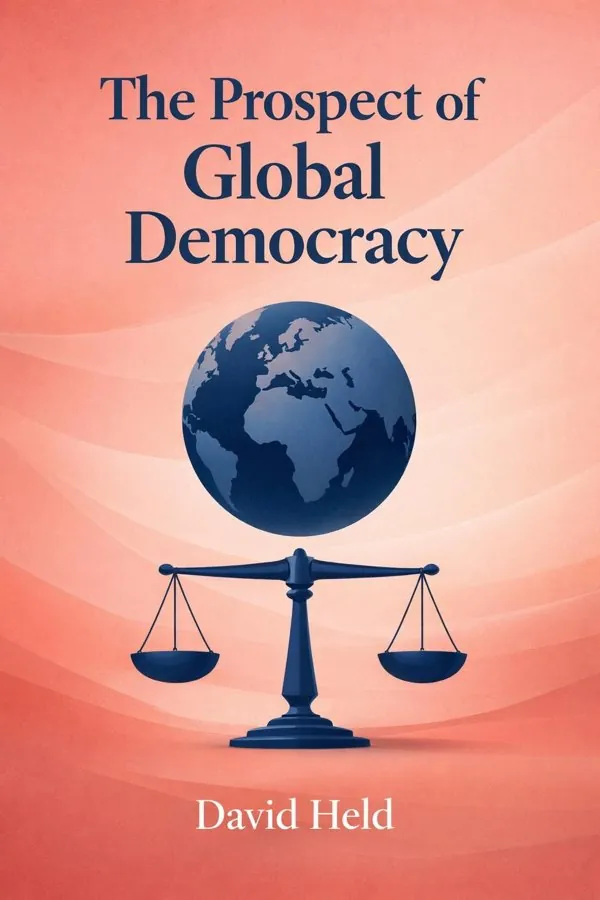
The Prospect of Global Democracy: Summary & Key Insights
by David Held
 10 min6 chaptersAudio available
What Is The Prospect of Global Democracy About?
The Prospect of Global Democracy by David Held is a politics book spanning 6 pages. This book explores the theoretical and practical challenges of establishing democratic governance on a global scale. David Held examines the evolution of democracy beyond the nation-state, addressing issues such as global inequality, international institutions, and the role of civil society in shaping a more just and accountable world order.
This FizzRead summary covers all 6 key chapters of The Prospect of Global Democracy in approximately 10 minutes, distilling the most important ideas, arguments, and takeaways from David Held's work. Also available as an audio summary and Key Quotes Podcast.
The Prospect of Global Democracy
This book explores the theoretical and practical challenges of establishing democratic governance on a global scale. David Held examines the evolution of democracy beyond the nation-state, addressing issues such as global inequality, international institutions, and the role of civil society in shaping a more just and accountable world order.
Who Should Read The Prospect of Global Democracy?
This book is perfect for anyone interested in politics and looking to gain actionable insights in a short read. Whether you're a student, professional, or lifelong learner, the key ideas from The Prospect of Global Democracy by David Held will help you think differently.
- ✓Readers who enjoy politics and want practical takeaways
- ✓Professionals looking to apply new ideas to their work and life
- ✓Anyone who wants the core insights of The Prospect of Global Democracy in just 10 minutes
Want the full summary?
Get instant access to this book summary and 100K+ more with Fizz Moment.
Get Free SummaryAvailable on App Store • Free to download
Key Chapters
To understand democracy’s future, we must first recall its past. Democracy did not emerge fully formed as a universal idea; it grew from small, local practices of collective self-rule. In the ancient Greek polis, democracy meant the deliberation of citizens bound by a shared community, though tragically excluding women, slaves, and foreigners. Its revival in early modern Europe drew on very different foundations: the expansion of commerce, the rise of literacy, and the birth of sovereign states capable of organizing large-scale political participation. Democracy became linked to the nation as its natural container—the people coinciding with the borders of a territorial state.
In the modern era, particularly from the late eighteenth century onward, the democratic project fused with nationalism. The people were imagined as a political community with a shared history, language, and destiny. This union produced powerful legitimacy: the idea that governments should derive their authority from the consent of citizens who inhabit the same political space. Yet, this same union also planted democracy’s limitation. The mechanisms of participation, accountability, and representation were designed for bounded societies. From the Enlightenment to the twentieth century, the representative model became dominant, emphasizing constitutionalism and periodic elections as safeguards against tyranny. But as the scope of human interdependence expanded, democracy’s spatial assumptions began to fail.
Today, we still live with these legacies. Our democratic institutions remain tied to the Westphalian map, but our problems—climate change, financial crises, pandemics—ignore it entirely. The historical trajectory of democracy is thus one from the local to the national, and now, I argue, to the global. Each expansion demands not only technical reform but a rethinking of the principles that underlie democratic legitimacy. We must learn from democracy’s past without being imprisoned by it.
The transformative power of globalization lies in its capacity to reorder human relations across all domains. Economic globalization reshapes production and consumption through transnational corporations and digital trade networks; technological globalization compresses space and time, making local decisions reverberate globally; cultural globalization fosters hybrid identities, but also cultural conflict. Politics, however, has lagged behind. Governments remain territorially confined while power flows through borderless systems.
This mismatch generates what I call a new ‘overlapping authority’—a system where decision-making power is dispersed among states, multinational firms, international agencies, and networks of experts. No single actor governs the world, but many exercise global power. Consequently, citizens experience governance without representation, rules without voice. The traditional model of democracy—where voters elect officials to manage national affairs—proves inadequate when those officials cannot control economic or environmental outcomes determined elsewhere.
Globalization does not dissolve sovereignty outright, but transforms its meaning. It compels states to cooperate, to negotiate constraints, and to submit to regulatory frameworks beyond their direct control. This interdependence need not be framed as a threat. If properly institutionalized, it can deepen democracy by fostering shared rule and collective accountability. The challenge, however, is to devise political arrangements that turn global interdependence into a realm of democratic deliberation rather than domination. That is the goal of cosmopolitan democracy.
+ 4 more chapters — available in the FizzRead app
All Chapters in The Prospect of Global Democracy
About the Author
David Held (1951–2019) was a British political theorist known for his influential work on democracy, globalization, and political theory. He was a professor at Durham University and co-director of the Institute for Global Policy, contributing significantly to debates on cosmopolitan democracy and global governance.
Get This Summary in Your Preferred Format
Read or listen to the The Prospect of Global Democracy summary by David Held anytime, anywhere. FizzRead offers multiple formats so you can learn on your terms — all free.
Available formats: App · Audio · PDF · EPUB — All included free with FizzRead
Download The Prospect of Global Democracy PDF and EPUB Summary
Key Quotes from The Prospect of Global Democracy
“To understand democracy’s future, we must first recall its past.”
“The transformative power of globalization lies in its capacity to reorder human relations across all domains.”
Frequently Asked Questions about The Prospect of Global Democracy
The Prospect of Global Democracy by David Held is a politics book that explores key ideas across 6 chapters. This book explores the theoretical and practical challenges of establishing democratic governance on a global scale. David Held examines the evolution of democracy beyond the nation-state, addressing issues such as global inequality, international institutions, and the role of civil society in shaping a more just and accountable world order.
You Might Also Like

Antifa: The Anti-Fascist Handbook
Mark Bray
10 min
Attack from Within: How Disinformation Is Sabotaging America
Barbara McQuade
10 min
Coercion, Capital, and European States, AD 990–1992
Charles Tilly
10 min
Digital Democracy: Concepts, Methodologies, Tools, and Applications
Various Authors
10 min
Fascism
Stanley G. Payne
10 min
Fire And Fury: Inside The Trump White House
Michael Wolff
10 minBrowse by Category
Ready to read The Prospect of Global Democracy?
Get the full summary and 100K+ more books with Fizz Moment.