
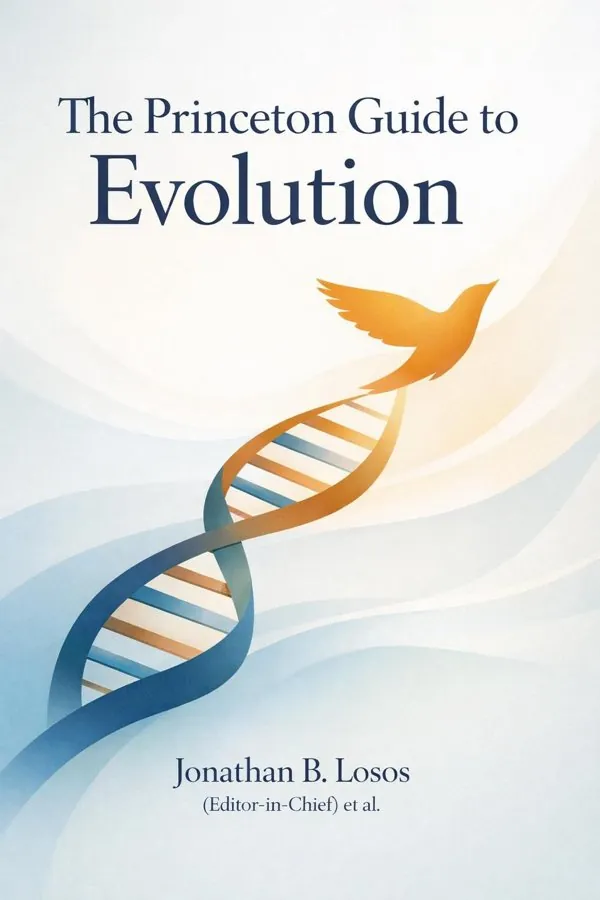
The Princeton Guide to Evolution: Summary & Key Insights
by Jonathan B. Losos (Editor-in-Chief) et al.
 10 min11 chaptersAudio available
What Is The Princeton Guide to Evolution About?
The Princeton Guide to Evolution by Jonathan B. Losos (Editor-in-Chief) et al. is a life_science book spanning 11 pages. The Princeton Guide to Evolution es una referencia integral y autorizada sobre los principales temas y conceptos de la biología evolutiva. Reúne contribuciones de expertos líderes en el campo y cubre áreas como genética, selección natural, especiación, adaptación y evolución humana. Su objetivo es proporcionar una visión completa y actualizada de la teoría y la evidencia de la evolución biológica.
This FizzRead summary covers all 11 key chapters of The Princeton Guide to Evolution in approximately 10 minutes, distilling the most important ideas, arguments, and takeaways from Jonathan B. Losos (Editor-in-Chief) et al.'s work. Also available as an audio summary and Key Quotes Podcast.
The Princeton Guide to Evolution
The Princeton Guide to Evolution es una referencia integral y autorizada sobre los principales temas y conceptos de la biología evolutiva. Reúne contribuciones de expertos líderes en el campo y cubre áreas como genética, selección natural, especiación, adaptación y evolución humana. Su objetivo es proporcionar una visión completa y actualizada de la teoría y la evidencia de la evolución biológica.
Who Should Read The Princeton Guide to Evolution?
This book is perfect for anyone interested in life_science and looking to gain actionable insights in a short read. Whether you're a student, professional, or lifelong learner, the key ideas from The Princeton Guide to Evolution by Jonathan B. Losos (Editor-in-Chief) et al. will help you think differently.
- ✓Readers who enjoy life_science and want practical takeaways
- ✓Professionals looking to apply new ideas to their work and life
- ✓Anyone who wants the core insights of The Princeton Guide to Evolution in just 10 minutes
Want the full summary?
Get instant access to this book summary and 100K+ more with Fizz Moment.
Get Free SummaryAvailable on App Store • Free to download
Key Chapters
The foundation of all evolutionary change lies in the genetic variation that pulses through every living population. As Losos and contributors carefully detail, evolution cannot exist without heredity, and heredity cannot proceed without variation. The molecular alphabet of DNA—its four simple bases—contains nearly endless potential for transformation.
Mutation arises as the raw material of change. Most mutations are neutral or deleterious, yet a small fraction opens new paths of possibility. Recombination and sexual reproduction shuffle these variations, ensuring that even within a single species, no two individuals are genetically identical. Modern evolutionary synthesis merged these concepts with population genetics, allowing scientists to express biological evolution as measurable shifts in gene frequencies over generations.
Molecular biology enriched this foundation. The discovery of DNA’s structure revealed the material basis of inheritance, while sequencing technologies have since uncovered entire genomes. We now compare the genomes of species and populations, revealing the deep genetic roots of adaptation and divergence. What once were abstract statistical models are now backed by direct molecular evidence.
The genetic view of evolution does not reduce life to chemistry, but instead illuminates how information, encoded and transmitted, becomes innovation. It shows that the seeds of diversity are sown in every cell, and that evolution operates through the continuous interplay between genetic constraint and creative potential.
Natural selection is the sculptor of evolutionary change. In this section, the guide presents selection not as a metaphor, but as a measurable process. Variation exists within populations; some variants confer higher reproductive success in a given environment; and over time, those variations become more common. It is a simple logic, yet capable of producing staggering complexity.
Darwin lacked the language of genetics, yet his insight into adaptive evolution remains the cornerstone of the field. Today, fitness landscapes and quantitative models allow us to explore how environments shape populations. We can trace the way selection pressures favor certain traits—camouflage in an insect, resistance in bacteria, or intelligence in primates—and how adaptation reflects both opportunity and constraint.
Adaptation is not perfection. Every organism carries traces of its history, compromises shaped by evolutionary trade-offs. The same forces that drive specialization can also lead to vulnerability when environments change. By viewing adaptation through both historical and mechanistic lenses, we come to appreciate the fluid balance between selection, chance, and constraint that defines evolution’s creative power.
+ 9 more chapters — available in the FizzRead app
All Chapters in The Princeton Guide to Evolution
About the Author
Jonathan B. Losos es profesor de biología en la Universidad de Harvard y un destacado investigador en ecología evolutiva y biología de la adaptación. Ha publicado extensamente sobre evolución de especies y biogeografía, y es miembro de la Academia Nacional de Ciencias de Estados Unidos.
Get This Summary in Your Preferred Format
Read or listen to the The Princeton Guide to Evolution summary by Jonathan B. Losos (Editor-in-Chief) et al. anytime, anywhere. FizzRead offers multiple formats so you can learn on your terms — all free.
Available formats: App · Audio · PDF · EPUB — All included free with FizzRead
Download The Princeton Guide to Evolution PDF and EPUB Summary
Key Quotes from The Princeton Guide to Evolution
“The foundation of all evolutionary change lies in the genetic variation that pulses through every living population.”
“Natural selection is the sculptor of evolutionary change.”
Frequently Asked Questions about The Princeton Guide to Evolution
The Princeton Guide to Evolution by Jonathan B. Losos (Editor-in-Chief) et al. is a life_science book that explores key ideas across 11 chapters. The Princeton Guide to Evolution es una referencia integral y autorizada sobre los principales temas y conceptos de la biología evolutiva. Reúne contribuciones de expertos líderes en el campo y cubre áreas como genética, selección natural, especiación, adaptación y evolución humana. Su objetivo es proporcionar una visión completa y actualizada de la teoría y la evidencia de la evolución biológica.
You Might Also Like
The Selfish Gene
Richard Dawkins
10 min
Awakenings
Oliver Sacks
10 min
Parasite Rex: Inside the Bizarre World of Nature's Most Dangerous Creatures
Carl Zimmer
10 min
The Atlas of Life on Earth
Various
10 min
The Book of Humans: The Story of How We Became Us
Adam Rutherford
10 min
The Horse
Wendy Williams
10 minBrowse by Category
Ready to read The Princeton Guide to Evolution?
Get the full summary and 100K+ more books with Fizz Moment.