
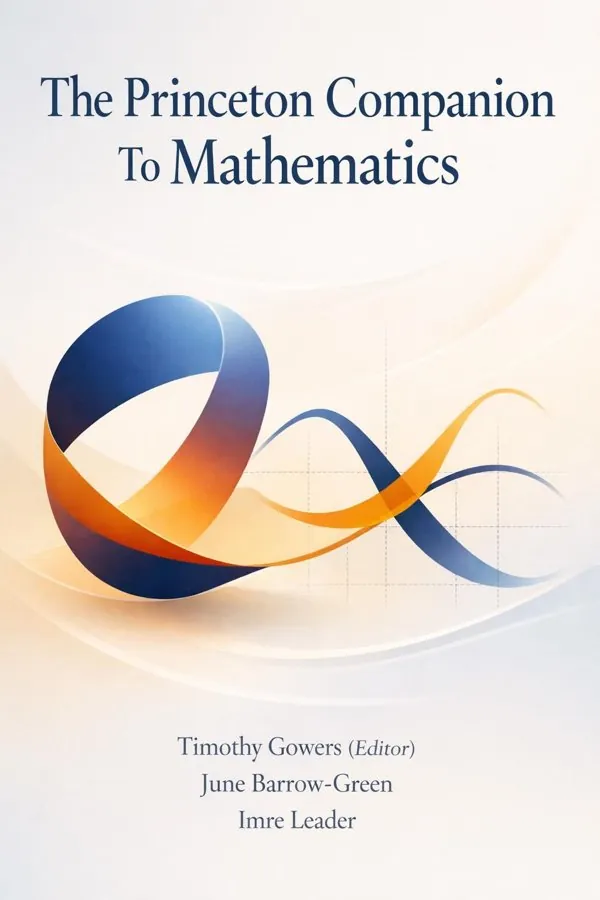
The Princeton Companion To Mathematics: Summary & Key Insights
by Timothy Gowers (Editor), June Barrow-Green, Imre Leader
 10 min11 chaptersAudio available
What Is The Princeton Companion To Mathematics About?
The Princeton Companion To Mathematics by Timothy Gowers (Editor), June Barrow-Green, Imre Leader is a popular_sci book spanning 11 pages. The Princeton Companion to Mathematics es una obra de referencia exhaustiva que ofrece una visión panorámica del campo de las matemáticas. Editada por Timothy Gowers, con contribuciones de más de un centenar de matemáticos, el libro cubre la historia, los conceptos fundamentales, las áreas de investigación y las aplicaciones modernas de las matemáticas. Está diseñado tanto para estudiantes avanzados como para profesionales que buscan una comprensión más profunda del panorama matemático contemporáneo.
This FizzRead summary covers all 11 key chapters of The Princeton Companion To Mathematics in approximately 10 minutes, distilling the most important ideas, arguments, and takeaways from Timothy Gowers (Editor), June Barrow-Green, Imre Leader's work. Also available as an audio summary and Key Quotes Podcast.
The Princeton Companion To Mathematics
The Princeton Companion to Mathematics es una obra de referencia exhaustiva que ofrece una visión panorámica del campo de las matemáticas. Editada por Timothy Gowers, con contribuciones de más de un centenar de matemáticos, el libro cubre la historia, los conceptos fundamentales, las áreas de investigación y las aplicaciones modernas de las matemáticas. Está diseñado tanto para estudiantes avanzados como para profesionales que buscan una comprensión más profunda del panorama matemático contemporáneo.
Who Should Read The Princeton Companion To Mathematics?
This book is perfect for anyone interested in popular_sci and looking to gain actionable insights in a short read. Whether you're a student, professional, or lifelong learner, the key ideas from The Princeton Companion To Mathematics by Timothy Gowers (Editor), June Barrow-Green, Imre Leader will help you think differently.
- ✓Readers who enjoy popular_sci and want practical takeaways
- ✓Professionals looking to apply new ideas to their work and life
- ✓Anyone who wants the core insights of The Princeton Companion To Mathematics in just 10 minutes
Want the full summary?
Get instant access to this book summary and 100K+ more with Fizz Moment.
Get Free SummaryAvailable on App Store • Free to download
Key Chapters
At its heart, mathematics is a pursuit of truth by means of reason. Its defining tool is not the experiment or observation, but proof—a chain of logic that binds one truth to another. In editing this section, I wished the contributors to convey that mathematics is not mere calculation but an exploration of possibility guided by rigor. Abstraction allows us to strip away the accidental and reveal the essential. When we speak of numbers, we are not merely counting objects; we are engaging with the idea of quantity itself. When we study geometry, we do not just measure shapes; we explore the structure of space and form.
Rigor, then, is not an obsession with detail but a commitment to clarity. It protects us from self-deception and ensures that our conclusions can be trusted universally. Yet rigor exists hand-in-hand with creativity. To construct a proof is to invent—to discover paths that connect diverse ideas. In this sense, mathematics resembles art: it values elegance and economy, the delight of seeing complex truths emerge from simple premises.
Throughout the book, you will encounter examples of this dual nature. Consider the development of calculus by Newton and Leibniz—born from physical intuition yet solidified through formal reasoning. Or think of Cantor’s theory of sets, which arose from the desire to understand infinity, a concept that itself blurs the boundary between logic and imagination. Such episodes illustrate that mathematical thinking is both disciplined and free.
To engage with mathematics means to learn a way of thinking that transcends particular problems. It teaches you precision in expression, patience in reasoning, and humility before truth. I encourage readers not simply to memorize results but to participate in this mode of thought—to see mathematics as a conversation between the mind and the world, between logic and beauty.
Mathematics has never been static. From the counting systems of ancient civilizations to the symbolic abstraction of modern algebra, each era has transformed how humanity understands quantity and relation. In the historical chapters, we trace this evolution not as a sequence of discoveries but as a narrative of ideas gradually refining and redefining themselves.
The Greeks, with Euclid’s *Elements*, gave us the prototype of logical deduction—a model of proof that still underpins mathematics today. The Indian and Arabic mathematicians expanded the numeric system, introducing the concept of zero and positional notation, without which modern computation would be impossible. The Renaissance revived geometry and gave rise to analytic methods that merged algebra and space. Newton and Leibniz’s invention of calculus opened an epoch where motion, growth, and change could be described precisely.
The 19th century saw a profound transformation: the invention of rigorous analysis by Cauchy and Weierstrass, the abstraction of algebra through Galois, and the birth of non-Euclidean geometry through Lobachevsky and Bolyai. Mathematics detached itself from physical intuition and began to construct worlds of pure logic. Then came Cantor’s set theory and Hilbert’s axiomatization—a redefinition that gave modern mathematics both its foundation and its freedom.
Our story shows how mathematics, though ancient, remains perpetually modern. Each milestone marks not an endpoint but a new start. To know this history is to appreciate that today’s mathematics stands on centuries of thought, each generation daring to question what its predecessors assumed.
+ 9 more chapters — available in the FizzRead app
All Chapters in The Princeton Companion To Mathematics
About the Authors
Timothy Gowers es un matemático británico, profesor en la Universidad de Cambridge y ganador de la Medalla Fields en 1998. Es conocido por sus contribuciones en análisis funcional y combinatoria, así como por su labor de divulgación y edición de obras de referencia sobre matemáticas.
Get This Summary in Your Preferred Format
Read or listen to the The Princeton Companion To Mathematics summary by Timothy Gowers (Editor), June Barrow-Green, Imre Leader anytime, anywhere. FizzRead offers multiple formats so you can learn on your terms — all free.
Available formats: App · Audio · PDF · EPUB — All included free with FizzRead
Download The Princeton Companion To Mathematics PDF and EPUB Summary
Key Quotes from The Princeton Companion To Mathematics
“At its heart, mathematics is a pursuit of truth by means of reason.”
“From the counting systems of ancient civilizations to the symbolic abstraction of modern algebra, each era has transformed how humanity understands quantity and relation.”
Frequently Asked Questions about The Princeton Companion To Mathematics
The Princeton Companion To Mathematics by Timothy Gowers (Editor), June Barrow-Green, Imre Leader is a popular_sci book that explores key ideas across 11 chapters. The Princeton Companion to Mathematics es una obra de referencia exhaustiva que ofrece una visión panorámica del campo de las matemáticas. Editada por Timothy Gowers, con contribuciones de más de un centenar de matemáticos, el libro cubre la historia, los conceptos fundamentales, las áreas de investigación y las aplicaciones modernas de las matemáticas. Está diseñado tanto para estudiantes avanzados como para profesionales que buscan una comprensión más profunda del panorama matemático contemporáneo.
You Might Also Like
Structures: Or Why Things Don"t Fall Down
J.E. Gordon
10 min
The Road to Wigan Pier
George Orwell
10 min
Bonk: The Curious Coupling of Science and Sex
Mary Roach
10 min
First Bite: How We Learn to Eat
Bee Wilson
10 min
In Pursuit Of The Unknown: 17 Equations That Changed The World
Ian Stewart
10 min
Napoleon's Buttons: 17 Molecules That Changed History
Penny Le Couteur and Jay Burreson
10 minBrowse by Category
Ready to read The Princeton Companion To Mathematics?
Get the full summary and 100K+ more books with Fizz Moment.