
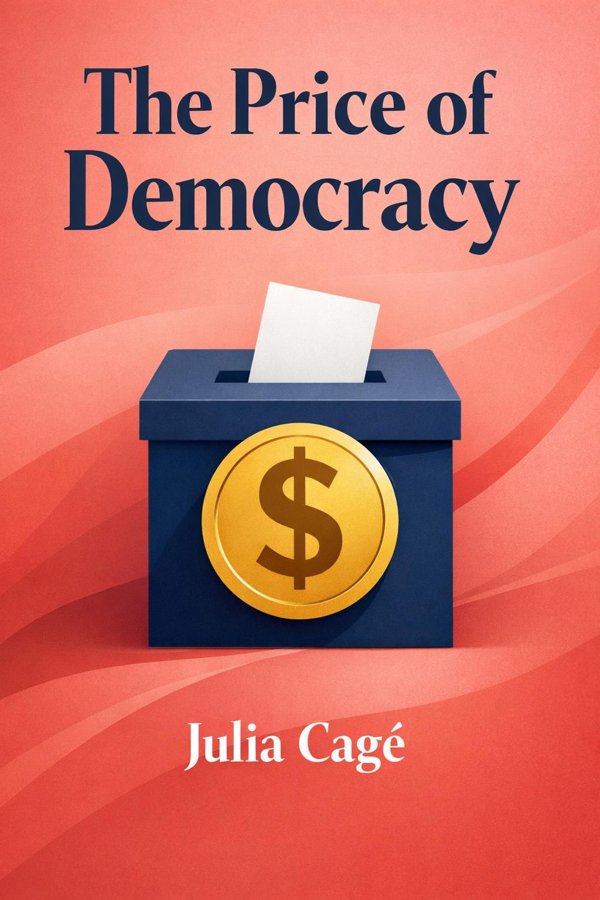
The Price of Democracy: How Money Shapes Politics and What to Do About It: Summary & Key Insights
by Julia Cagé
 10 min7 chaptersAudio available
What Is The Price of Democracy: How Money Shapes Politics and What to Do About It About?
The Price of Democracy: How Money Shapes Politics and What to Do About It by Julia Cagé is a politics book spanning 7 pages. In this influential work, French economist Julia Cagé examines how financial inequality undermines democratic systems. She analyzes the role of money in political campaigns, media ownership, and policymaking, arguing that democracy has become increasingly dependent on private wealth. Cagé proposes innovative reforms to restore fairness and transparency in political financing, including new models of public funding and citizen participation.
This FizzRead summary covers all 7 key chapters of The Price of Democracy: How Money Shapes Politics and What to Do About It in approximately 10 minutes, distilling the most important ideas, arguments, and takeaways from Julia Cagé's work. Also available as an audio summary and Key Quotes Podcast.
The Price of Democracy: How Money Shapes Politics and What to Do About It
In this influential work, French economist Julia Cagé examines how financial inequality undermines democratic systems. She analyzes the role of money in political campaigns, media ownership, and policymaking, arguing that democracy has become increasingly dependent on private wealth. Cagé proposes innovative reforms to restore fairness and transparency in political financing, including new models of public funding and citizen participation.
Who Should Read The Price of Democracy: How Money Shapes Politics and What to Do About It?
This book is perfect for anyone interested in politics and looking to gain actionable insights in a short read. Whether you're a student, professional, or lifelong learner, the key ideas from The Price of Democracy: How Money Shapes Politics and What to Do About It by Julia Cagé will help you think differently.
- ✓Readers who enjoy politics and want practical takeaways
- ✓Professionals looking to apply new ideas to their work and life
- ✓Anyone who wants the core insights of The Price of Democracy: How Money Shapes Politics and What to Do About It in just 10 minutes
Want the full summary?
Get instant access to this book summary and 100K+ more with Fizz Moment.
Get Free SummaryAvailable on App Store • Free to download
Key Chapters
To understand how democracy reached its current state of financial dependency, we must begin with a historical lens. In the nineteenth century, the expansion of suffrage gave political rights to broader segments of the population — yet campaign financing remained a private affair. Wealthy patrons funded political parties, and while this model was justified as philanthropy, it entrenched the idea that politics was a domain of elites supporting their own kind. As political competition intensified in the twentieth century, campaign costs soared — first due to the expansion of mass political parties, and later with the rise of television and digital media. Elections became not just contests of ideas but of budgets.
Public financing emerged in some democracies as a response to these pressures. France, Germany, and the Scandinavian countries began experimenting with subsidies to political parties, viewing them as collective institutions serving the public interest. Yet while public funding partially reduced dependence on private donors, it also produced new inequalities: established parties captured the lion’s share, locking out newcomers and reducing voter choice. Elsewhere, particularly in the United States, campaign financing remained dominated by private contributions. Legal limits were loosened over time, culminating in the emergence of Super PACs and virtually unlimited independent expenditures.
These trajectories show how the idea of democracy has increasingly been intertwined with the capacity to pay. Where once voters dominated parties, donors now overshadow members. Budget lines define visibility: candidates who cannot buy exposure cannot compete fairly. A democracy in such a condition risks becoming a plutocracy — rule by money rather than by the people.
Politics, I argue, must be analyzed as a market — but a highly distorted one. Unlike ordinary markets, its currency is influence, its goods are collective, and its consumers are voters. Money in politics acts as both barrier and accelerator: it dictates who can enter the competition and how far they can reach the electorate. The result is a feedback loop where political success often correlates not with citizen enthusiasm but with financial muscle.
Empirical data confirm that campaign spending is strongly correlated with electoral outcomes. Candidates who outspend their rivals significantly improve their chances of victory, particularly in majoritarian systems. Donor networks, often concentrated in economic elites, do not merely contribute — they coordinate strategically. Parties, in turn, tailor their platforms to appeal to these funders’ interests, producing policy convergence among competing blocs. The electorate thus faces a diminished spectrum of genuine alternatives, reinforcing apathy and distrust.
Such dynamics are not inevitable. Economic theory emphasizes that public goods suffer from underinvestment when left to private initiative. Democracy is exactly such a public good. The challenge, then, is to design institutions that restore incentives for broad participation rather than elite capture. That is the essence of the democratic financing model I later propose.
+ 5 more chapters — available in the FizzRead app
All Chapters in The Price of Democracy: How Money Shapes Politics and What to Do About It
About the Author
Julia Cagé is a French economist and professor at Sciences Po Paris. Her research focuses on political economy, media economics, and democratic institutions. She is known for her work on the intersection of money, politics, and information, and for advocating reforms to strengthen democratic accountability.
Get This Summary in Your Preferred Format
Read or listen to the The Price of Democracy: How Money Shapes Politics and What to Do About It summary by Julia Cagé anytime, anywhere. FizzRead offers multiple formats so you can learn on your terms — all free.
Available formats: App · Audio · PDF · EPUB — All included free with FizzRead
Download The Price of Democracy: How Money Shapes Politics and What to Do About It PDF and EPUB Summary
Key Quotes from The Price of Democracy: How Money Shapes Politics and What to Do About It
“To understand how democracy reached its current state of financial dependency, we must begin with a historical lens.”
“Politics, I argue, must be analyzed as a market — but a highly distorted one.”
Frequently Asked Questions about The Price of Democracy: How Money Shapes Politics and What to Do About It
The Price of Democracy: How Money Shapes Politics and What to Do About It by Julia Cagé is a politics book that explores key ideas across 7 chapters. In this influential work, French economist Julia Cagé examines how financial inequality undermines democratic systems. She analyzes the role of money in political campaigns, media ownership, and policymaking, arguing that democracy has become increasingly dependent on private wealth. Cagé proposes innovative reforms to restore fairness and transparency in political financing, including new models of public funding and citizen participation.
You Might Also Like

Antifa: The Anti-Fascist Handbook
Mark Bray
10 min
Attack from Within: How Disinformation Is Sabotaging America
Barbara McQuade
10 min
Coercion, Capital, and European States, AD 990–1992
Charles Tilly
10 min
Digital Democracy: Concepts, Methodologies, Tools, and Applications
Various Authors
10 min
Fascism
Stanley G. Payne
10 min
Fire And Fury: Inside The Trump White House
Michael Wolff
10 minBrowse by Category
Ready to read The Price of Democracy: How Money Shapes Politics and What to Do About It?
Get the full summary and 100K+ more books with Fizz Moment.