
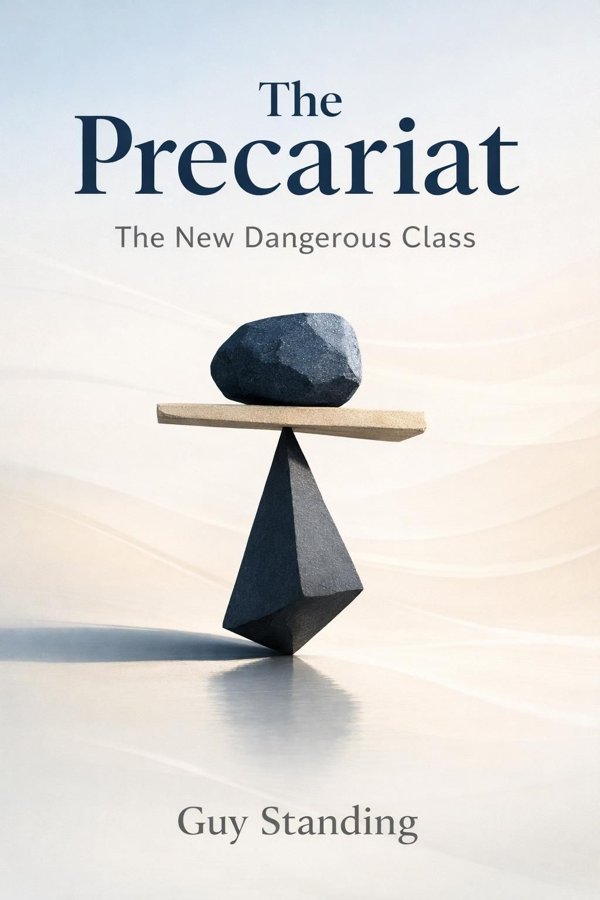
The Precariat: The New Dangerous Class: Summary & Key Insights
by Guy Standing
 10 min5 chaptersAudio available
What Is The Precariat: The New Dangerous Class About?
The Precariat: The New Dangerous Class by Guy Standing is a sociology book spanning 5 pages. The book analyzes the emergence of a new social class—the precariat—characterized by insecurity, unstable employment, and lack of occupational identity. Guy Standing argues that globalization and neoliberal policies have created a growing group of people living precariously, without the stability or rights once associated with the working class. He explores the political, social, and economic implications of this shift and calls for new policies to address inequality and restore social justice.
This FizzRead summary covers all 5 key chapters of The Precariat: The New Dangerous Class in approximately 10 minutes, distilling the most important ideas, arguments, and takeaways from Guy Standing's work. Also available as an audio summary and Key Quotes Podcast.
The Precariat: The New Dangerous Class
The book analyzes the emergence of a new social class—the precariat—characterized by insecurity, unstable employment, and lack of occupational identity. Guy Standing argues that globalization and neoliberal policies have created a growing group of people living precariously, without the stability or rights once associated with the working class. He explores the political, social, and economic implications of this shift and calls for new policies to address inequality and restore social justice.
Who Should Read The Precariat: The New Dangerous Class?
This book is perfect for anyone interested in sociology and looking to gain actionable insights in a short read. Whether you're a student, professional, or lifelong learner, the key ideas from The Precariat: The New Dangerous Class by Guy Standing will help you think differently.
- ✓Readers who enjoy sociology and want practical takeaways
- ✓Professionals looking to apply new ideas to their work and life
- ✓Anyone who wants the core insights of The Precariat: The New Dangerous Class in just 10 minutes
Want the full summary?
Get instant access to this book summary and 100K+ more with Fizz Moment.
Get Free SummaryAvailable on App Store • Free to download
Key Chapters
In the decades following World War II, industrial societies enjoyed what seemed like a golden age of labor. People could expect stable employment, clear career trajectories, and social protection through welfare states. This was the world of the 'industrial working class'—the proletariat as Marx would have recognized it. Jobs were not only sources of income but anchors of identity. The Fordist model, supported by unions and collective agreements, provided predictability and a sense of belonging.
Yet beginning in the late twentieth century, globalization and neoliberal reforms unraveled this equilibrium. Governments dismantled welfare systems, weakened labor rights, and promoted market deregulation in the name of efficiency. Multinational corporations expanded across borders, outsourcing production to cheaper regions. The old compact—work in exchange for stability—disintegrated. Under neoliberalism, labor was reimagined as a flexible commodity to be bought and sold on demand.
I witnessed this shift as both economist and observer. Technological changes facilitated mobility and fragmentation, while financial capitalism prioritized shareholder value over social welfare. Digitalization enabled just-in-time production, diminishing long-term employment relationships. Workers became disposable units. The narrative of freedom—choose your jobs, define your own paths—masked growing insecurity. Behind the rhetoric of self-reliance lay the erosion of all safety nets.
The consequences were profound: not only did job stability vanish, but the very notion of occupational identity weakened. No longer were individuals defined by long-term professions; instead, they became part-time freelancers, temporary staffers, perpetual 'interns.' The historical transition from the proletariat to the precariat marked a seismic shift in class relations. This was not simply a change in employment patterns—it was a transformation in the architecture of social life.
Flexible labor markets were hailed as sources of innovation and growth, but in reality, they fragmented both work and workers. The old structures of solidarity dissolved, replaced by competition among individuals for scarce opportunities. Workers were encouraged to see themselves as entrepreneurs of the self—responsible for every success and failure. This seductive narrative concealed the systemic precarity now embedded in global capitalism.
In my research across countries, I found that outsourcing, subcontracting, and digital platforms have created multi-layered labor systems where accountability vanishes. A worker may serve a brand but be formally employed through a chain of intermediaries. This complexity ensures that no one bears full responsibility for wages, benefits, or rights. Technology—while liberating for some—has become the infrastructure of control, monitoring performance minute by minute, atomizing workers into data points.
Such fragmentation ruptures social bonds. A person who once shared a workplace and a collective voice now competes in isolation. Gig work exemplifies this alienation: it promises flexibility but delivers insecurity. Each individual is a temporary occupant of economic space, with no enduring claim to rights or recognition.
The dismantling of stable occupations is not accidental—it is engineered. Economic policies that valorize flexibility serve corporate efficiency, not human well-being. Labor itself has lost its moral status as a foundation of citizenship. By fragmenting work, we fragment society. In the world of the precariat, everyone is potentially replaceable, perpetually anxious, and structurally disempowered.
+ 3 more chapters — available in the FizzRead app
All Chapters in The Precariat: The New Dangerous Class
About the Author
Guy Standing is a British economist and professor of Development Studies at the School of Oriental and African Studies (SOAS), University of London. He is a co-founder of the Basic Income Earth Network (BIEN) and has written extensively on labor economics, social protection, and the concept of the precariat.
Get This Summary in Your Preferred Format
Read or listen to the The Precariat: The New Dangerous Class summary by Guy Standing anytime, anywhere. FizzRead offers multiple formats so you can learn on your terms — all free.
Available formats: App · Audio · PDF · EPUB — All included free with FizzRead
Download The Precariat: The New Dangerous Class PDF and EPUB Summary
Key Quotes from The Precariat: The New Dangerous Class
“In the decades following World War II, industrial societies enjoyed what seemed like a golden age of labor.”
“Flexible labor markets were hailed as sources of innovation and growth, but in reality, they fragmented both work and workers.”
Frequently Asked Questions about The Precariat: The New Dangerous Class
The Precariat: The New Dangerous Class by Guy Standing is a sociology book that explores key ideas across 5 chapters. The book analyzes the emergence of a new social class—the precariat—characterized by insecurity, unstable employment, and lack of occupational identity. Guy Standing argues that globalization and neoliberal policies have created a growing group of people living precariously, without the stability or rights once associated with the working class. He explores the political, social, and economic implications of this shift and calls for new policies to address inequality and restore social justice.
You Might Also Like

Between the World and Me
Ta-Nehisi Coates
10 min
Half the Sky
Nicholas D. Kristof, Sheryl WuDunn
10 min
Men Explain Things To Me
Rebecca Solnit
10 min
Rational Ritual
Michael Suk-Young Chwe
10 min
The New Jim Crow
Michelle Alexander
10 min
Beyond Culture
Edward T. Hall
10 minBrowse by Category
Ready to read The Precariat: The New Dangerous Class?
Get the full summary and 100K+ more books with Fizz Moment.