
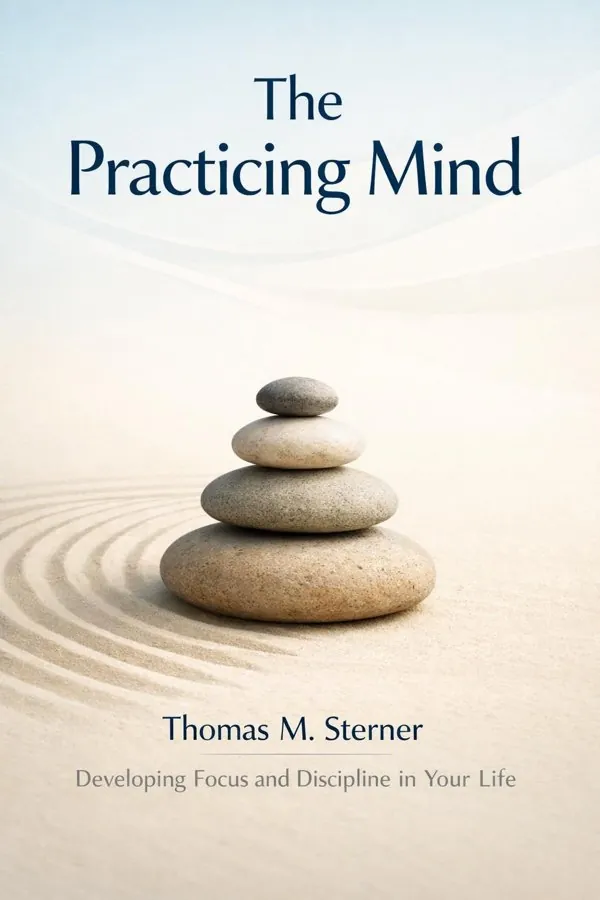
The Practicing Mind: Developing Focus and Discipline in Your Life: Summary & Key Insights
 10 min9 chaptersAudio available
Key Takeaways from The Practicing Mind: Developing Focus and Discipline in Your Life
Much of human frustration comes from living mentally in the future.
Many people approach life as a list to be conquered.
Mastery is rarely dramatic; it is built in small, repeated moments that most people overlook.
One of the book’s most useful ideas is that you are not identical to every thought passing through your mind.
Most people say they want mastery, but they resist the monotony required to develop it.
What Is The Practicing Mind: Developing Focus and Discipline in Your Life About?
The Practicing Mind: Developing Focus and Discipline in Your Life by Thomas M. Sterner is a mindset book spanning 8 pages. The Practicing Mind is a practical guide to finding calm, discipline, and steady progress in a culture obsessed with speed and results. Thomas M. Sterner argues that most stress does not come from the task itself, but from our restless demand to be finished, successful, or somewhere else. Instead of treating practice as a painful means to an end, he shows how to make the process itself the place of satisfaction. When attention returns to the present moment, repetition becomes less irritating, mistakes become useful, and improvement becomes more natural. Sterner writes with unusual authority because his ideas were shaped through lived experience. As a musician, trainer, and craftsman, he spent years observing how people learn, where they lose focus, and why frustration derails performance. His insight is simple but powerful: mastery is not built by bursts of intensity but by relaxed, consistent engagement with what is in front of us right now. That message matters far beyond music or skill training. Whether you are trying to build a business, improve your health, parent more patiently, or work with less anxiety, this book offers a disciplined but humane way to think, act, and grow.
This FizzRead summary covers all 9 key chapters of The Practicing Mind: Developing Focus and Discipline in Your Life in approximately 10 minutes, distilling the most important ideas, arguments, and takeaways from Thomas M. Sterner's work. Also available as an audio summary and Key Quotes Podcast.
The Practicing Mind: Developing Focus and Discipline in Your Life
The Practicing Mind is a practical guide to finding calm, discipline, and steady progress in a culture obsessed with speed and results. Thomas M. Sterner argues that most stress does not come from the task itself, but from our restless demand to be finished, successful, or somewhere else. Instead of treating practice as a painful means to an end, he shows how to make the process itself the place of satisfaction. When attention returns to the present moment, repetition becomes less irritating, mistakes become useful, and improvement becomes more natural.
Sterner writes with unusual authority because his ideas were shaped through lived experience. As a musician, trainer, and craftsman, he spent years observing how people learn, where they lose focus, and why frustration derails performance. His insight is simple but powerful: mastery is not built by bursts of intensity but by relaxed, consistent engagement with what is in front of us right now. That message matters far beyond music or skill training. Whether you are trying to build a business, improve your health, parent more patiently, or work with less anxiety, this book offers a disciplined but humane way to think, act, and grow.
Who Should Read The Practicing Mind: Developing Focus and Discipline in Your Life?
This book is perfect for anyone interested in mindset and looking to gain actionable insights in a short read. Whether you're a student, professional, or lifelong learner, the key ideas from The Practicing Mind: Developing Focus and Discipline in Your Life by Thomas M. Sterner will help you think differently.
- ✓Readers who enjoy mindset and want practical takeaways
- ✓Professionals looking to apply new ideas to their work and life
- ✓Anyone who wants the core insights of The Practicing Mind: Developing Focus and Discipline in Your Life in just 10 minutes
Want the full summary?
Get instant access to this book summary and 100K+ more with Fizz Moment.
Get Free SummaryAvailable on App Store • Free to download
Key Chapters
Much of human frustration comes from living mentally in the future. Sterner argues that we are conditioned to evaluate life through outcomes: grades, promotions, applause, money, weight loss, and completed tasks. Goals are not the problem. The problem begins when our emotional state depends on reaching them as quickly as possible. Then every step feels like an inconvenience, every delay feels like failure, and the present moment becomes something to escape rather than inhabit.
This mindset creates tension because the future is always one step away. Even when we achieve something, relief is brief, and the mind quickly invents the next target. Sterner shows that this habit makes people impatient, distracted, and surprisingly ineffective. A pianist who obsesses over performing flawlessly will tighten up during practice. An entrepreneur who only thinks about revenue targets may miss the daily actions that actually produce results. A person focused only on losing twenty pounds often resents the workouts and meals required to get there.
The antidote is to shift your attention from the result to the process that creates the result. That means asking better questions: What is the next repetition? What am I learning right now? How can I participate fully in this stage instead of mentally fast-forwarding beyond it? Progress becomes more stable when the process itself earns your respect.
Actionable takeaway: Keep your goals, but stop using them as your emotional home. At the start of any task, name one process-based focus such as rhythm, posture, consistency, or attention, and commit to that for the session.
Many people approach life as a list to be conquered. Sterner describes this as living in “doing” mode: rushing to complete, clear, fix, and move on. In this state, the mind treats each activity as an obstacle standing between the present and some imagined relief. The result is predictable: haste, irritation, shallow attention, and the feeling that life is always happening somewhere ahead of now.
“Being” mode is different. It does not mean passivity or laziness. It means bringing full presence to what you are already doing instead of dividing yourself between the action and the desire to be done. When you are in being mode, washing dishes is not merely a chore to survive; it is the activity currently occupying your life. Practicing scales is not dead time before mastery; it is where mastery is formed. Writing a report is not a burden blocking your weekend; it is the work itself, and your attention can rest inside it.
Sterner suggests that this shift changes not only performance but emotional experience. People in doing mode often feel pressured even when nothing terrible is happening. People in being mode conserve energy because they are not fighting reality. A parent listening fully to a child, an athlete training one movement at a time, or a manager handling one conversation without mentally juggling ten others all demonstrate this quality.
Actionable takeaway: Several times a day, pause and ask, “Am I trying to get through this, or am I fully here for this?” If you notice doing mode, slow your breathing and return your attention to the specific action in front of you.
Mastery is rarely dramatic; it is built in small, repeated moments that most people overlook. Sterner’s central principle is that the process, not the product, deserves your deepest loyalty. Products are occasional. Process is daily. Products are visible. Process is often invisible. Yet only process can be practiced, refined, and controlled.
This perspective transforms the emotional experience of improvement. If your satisfaction comes only from finished products, then most of your time will feel unsatisfying because most of your time is spent in development. But if satisfaction comes from engaging well with the process, then every practice session, draft, workout, rehearsal, or conversation becomes meaningful. The path is no longer something to endure until success arrives. The path becomes the substance of success.
Sterner uses examples from music and craftsmanship to show that excellence emerges from careful repetition without emotional drama. A golfer improves not by wishing for lower scores but by patiently returning to grip, balance, and tempo. A writer improves not by fantasizing about publication but by revising sentences with attention. A team improves not by celebrating a quarterly target but by strengthening its daily habits of communication and follow-through.
This principle also reduces anxiety. When your attention is anchored in what you can do now, uncertainty about the future loses some of its grip. You stop trying to force outcomes and start cooperating with the only mechanism that creates them: practice.
Actionable takeaway: For any important goal, define the repeatable process that produces it. Measure success this week by how consistently you engaged the process, not by whether the final result has arrived yet.
One of the book’s most useful ideas is that you are not identical to every thought passing through your mind. Sterner encourages readers to develop an “observer” perspective: the ability to notice impatience, distraction, self-criticism, and urgency without immediately obeying them. This inner distance is essential because unexamined thoughts quickly become emotional weather that dictates behavior.
Without an observer self, practice becomes chaotic. You miss a note, lose your place, get interrupted, or feel bored, and the mind instantly declares, “I’m bad at this,” “This is taking too long,” or “I should be further along.” Once fused with those reactions, you tense up or quit. But when you observe them, you gain choice. You can say, “I notice frustration,” instead of “I am frustrated and therefore this session is ruined.” That slight shift restores stability.
Sterner’s point is not to suppress emotion. It is to witness it cleanly. A student preparing for an exam can observe the urge to check the phone. A manager can notice defensiveness before replying. An exerciser can catch the mind bargaining for shortcuts. This observer stance allows course correction without added shame.
Developing this capacity takes repetition. Brief pauses, simple breath awareness, and honest self-monitoring help train it. Over time, the observer becomes a kind of internal coach, helping you stay connected to the process rather than tossed around by every mental impulse.
Actionable takeaway: During practice or work, schedule a short check-in every 10 to 15 minutes. Ask, “What is my mind doing right now?” Label the state without judgment and gently return to the task.
Repetition reveals character. Most people say they want mastery, but they resist the monotony required to develop it. Sterner argues that impatience is often not about the task itself; it is about our refusal to accept the pace of real growth. We want competence without awkwardness, improvement without boredom, and results without the long middle stage where little seems to happen.
Mindful repetition changes this relationship. Instead of treating repetition as proof that you are not finished yet, you learn to see it as the very means by which you are transformed. A violinist repeats a passage not because something has gone wrong, but because this is exactly how musical intelligence is built. Someone practicing calm communication repeats new habits in difficult conversations until they become natural. A person recovering fitness repeats basic movements until strength returns.
Sterner connects patience and discipline closely. Discipline is not self-punishment; it is the ability to stay in the process without emotional resistance. Patience is not waiting passively; it is trusting the gradual nature of development. Together, they turn repetition from drudgery into training. The key is quality of attention. Ten distracted repetitions often accomplish less than three conscious ones.
This idea matters in everyday life because nearly every worthwhile change requires repetition: budgeting, parenting, studying, sleeping better, listening better, managing anger. The question is whether you resent repetition or use it.
Actionable takeaway: Pick one habit or skill and commit to a small, repeatable daily practice. Keep the session short enough that you can do it consistently, and focus on quality attention rather than quantity alone.
Many people reserve mindfulness for meditation cushions, retreats, or quiet mornings. Sterner broadens the idea dramatically. For him, mindfulness is not a separate spiritual activity; it is a way of relating to any activity. It is available while making coffee, answering email, driving, exercising, talking with a spouse, or standing in line. In fact, ordinary moments are where the practicing mind is most needed.
This matters because stress often enters through small, habitual reactions. We rush while brushing our teeth because we are already mentally at work. We half-listen during conversations because we are planning our response. We become irritated in traffic because reality is not moving according to preference. Sterner invites us to use these moments as training grounds. Every interruption can become a chance to notice agitation. Every routine task can become a chance to return attention to the senses and the present action.
Seen this way, life itself becomes practice. The office worker learns to answer one email at a time with full attention. The parent notices the urge to hurry a child and softens. The athlete carries training discipline into recovery, meals, and sleep. Mindfulness stops being occasional relief and becomes a stable operating system.
This does not mean living slowly at all times. It means living consciously. Speed and intensity are sometimes necessary, but unconsciousness is never helpful. Bringing awareness to ordinary life builds the same focus that supports larger goals.
Actionable takeaway: Choose one routine activity today, such as washing dishes or walking to your car, and do it with full sensory awareness. Treat it as mental training, not empty time.
Sterner does not argue against ambition. He argues against clinging. Goals provide direction, structure, and motivation. They help you choose your process. But once a goal becomes psychologically loaded, it begins to distort performance. You tighten, rush, overthink, compare, and fear mistakes because too much of your identity is tied to a future outcome.
Healthy goal-setting combines intention with acceptance. You can care deeply about an outcome while understanding that your influence exists primarily in present effort. This balance is subtle but powerful. A salesperson can pursue targets without panic if daily outreach becomes the main focus. A student can aim for excellent grades without spiraling if each study block is treated as the real work. A runner can train for a race without obsession if the rhythm of training itself becomes rewarding.
Acceptance here does not mean surrendering standards. It means making peace with reality as it unfolds: current skill level, temporary setbacks, slower-than-hoped progress, and the fact that no outcome is ever guaranteed. This calm realism preserves energy. It keeps ambition from becoming desperation.
Sterner’s model is especially valuable in high-performance settings where external pressure is constant. The more important the goal, the more necessary it becomes to detach from fantasy and return to process. Otherwise the goal starts consuming the very focus needed to achieve it.
Actionable takeaway: Write down one important goal and then list the three daily or weekly behaviors that influence it most. Review the goal briefly, then spend your energy tracking the behaviors rather than emotionally rehearsing the result.
People often imagine discipline as force: gritting teeth, overriding resistance, and pushing through with sheer will. Sterner offers a quieter model. Real discipline becomes sustainable when you remove unnecessary mental drama. Much of what feels hard about practice comes not from the action itself but from the story wrapped around it: “This is taking forever,” “I should be naturally better,” “I’m behind,” “I don’t feel like it.”
When these stories dominate, even small tasks feel heavy. But if you simply begin and stay with the current step, effort often becomes more manageable. A writer does not need to conquer an entire book this morning; they need to attend to one page. Someone building a meditation habit does not need to become enlightened; they need to sit for ten minutes. A person learning budgeting does not need instant financial perfection; they need to review this week’s numbers honestly.
Sterner’s insight is freeing because it separates discipline from mood. You do not need to wait until you feel inspired. You also do not need to bully yourself. The practicing mind works by returning, not by dramatizing. Each return strengthens trust in your own consistency.
This approach also reduces burnout. People who rely only on emotional intensity often swing between overexertion and avoidance. People who build gentle consistency create durable progress. Discipline becomes less theatrical and more reliable.
Actionable takeaway: The next time you resist a task, strip it down to the smallest meaningful unit and start there. Replace “I have to finish this” with “I will calmly do the next five minutes well.”
The deepest lesson of The Practicing Mind is that practice is not confined to formal skill-building. Every recurring situation trains you into someone. If you meet delays with irritation, you practice irritation. If you meet challenges with attention, you practice steadiness. If you repeatedly return to the present, you practice presence. Sterner invites readers to see identity not as a fixed trait but as the cumulative result of what they repeatedly do with awareness.
This broad application makes the book especially useful. Focus is not only for musicians or athletes. It matters in leadership, marriage, learning, creativity, and personal health. A leader practices clarity each time they listen before reacting. A partner practices patience each time they stay present during conflict. A student practices concentration each time they resist fragmented multitasking. Over months and years, these small moments shape character.
The practical power of this idea lies in consistency across domains. Instead of compartmentalizing discipline, you begin to carry the same mindset into everything. The calm attention used in exercise can support difficult conversations. The patience developed in learning an instrument can help with parenting. The observer self strengthened in meditation can improve work performance.
Sterner ultimately presents a philosophy of living: stop postponing life until achievement arrives, and learn to inhabit the unfolding process with care. When you do, progress and peace stop competing with each other.
Actionable takeaway: Choose one recurring life situation that usually triggers impatience, such as meetings, commuting, or household chores, and consciously redefine it as practice for focus, patience, and presence.
All Chapters in The Practicing Mind: Developing Focus and Discipline in Your Life
About the Author
Thomas M. Sterner is an American author, speaker, and founder of The Practicing Mind Institute. He is best known for teaching a process-centered approach to focus, discipline, and performance. Sterner’s ideas grew out of decades of experience in music, training, and craftsmanship, where he saw firsthand that frustration often comes not from the work itself but from our impatience with the learning process. His writing combines mindfulness principles with practical methods for building steady habits and reducing stress. Rather than emphasizing willpower alone, he encourages present-moment awareness, calm repetition, and self-observation. Through his books, talks, and programs, Sterner has helped individuals and organizations pursue excellence with greater patience, clarity, and consistency.
Get This Summary in Your Preferred Format
Read or listen to the The Practicing Mind: Developing Focus and Discipline in Your Life summary by Thomas M. Sterner anytime, anywhere. FizzRead offers multiple formats so you can learn on your terms — all free.
Available formats: App · Audio · PDF · EPUB — All included free with FizzRead
Download The Practicing Mind: Developing Focus and Discipline in Your Life PDF and EPUB Summary
Key Quotes from The Practicing Mind: Developing Focus and Discipline in Your Life
“Much of human frustration comes from living mentally in the future.”
“Many people approach life as a list to be conquered.”
“Mastery is rarely dramatic; it is built in small, repeated moments that most people overlook.”
“One of the book’s most useful ideas is that you are not identical to every thought passing through your mind.”
“Most people say they want mastery, but they resist the monotony required to develop it.”
Frequently Asked Questions about The Practicing Mind: Developing Focus and Discipline in Your Life
The Practicing Mind: Developing Focus and Discipline in Your Life by Thomas M. Sterner is a mindset book that explores key ideas across 9 chapters. The Practicing Mind is a practical guide to finding calm, discipline, and steady progress in a culture obsessed with speed and results. Thomas M. Sterner argues that most stress does not come from the task itself, but from our restless demand to be finished, successful, or somewhere else. Instead of treating practice as a painful means to an end, he shows how to make the process itself the place of satisfaction. When attention returns to the present moment, repetition becomes less irritating, mistakes become useful, and improvement becomes more natural. Sterner writes with unusual authority because his ideas were shaped through lived experience. As a musician, trainer, and craftsman, he spent years observing how people learn, where they lose focus, and why frustration derails performance. His insight is simple but powerful: mastery is not built by bursts of intensity but by relaxed, consistent engagement with what is in front of us right now. That message matters far beyond music or skill training. Whether you are trying to build a business, improve your health, parent more patiently, or work with less anxiety, this book offers a disciplined but humane way to think, act, and grow.
You Might Also Like




Browse by Category
Ready to read The Practicing Mind: Developing Focus and Discipline in Your Life?
Get the full summary and 100K+ more books with Fizz Moment.