
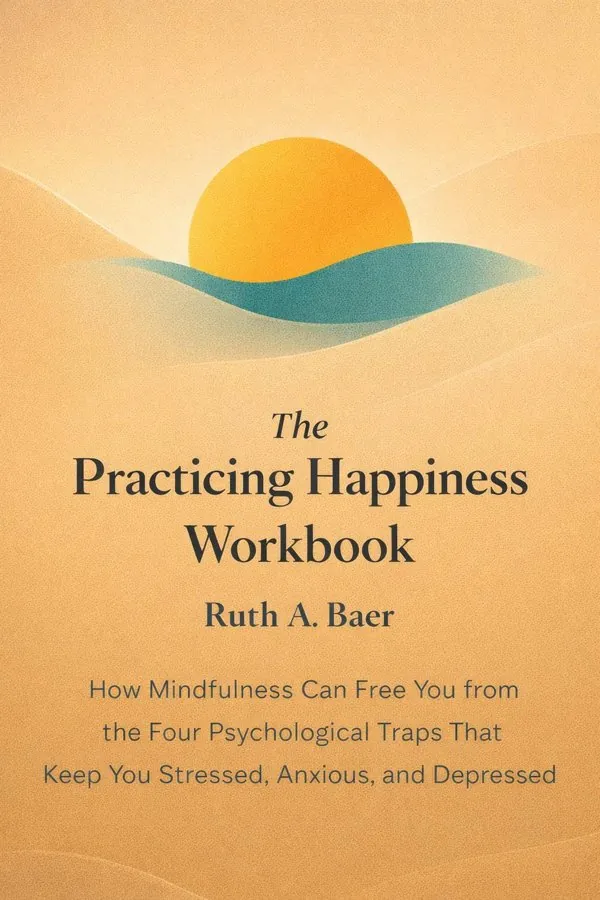
The Practicing Happiness Workbook: How Mindfulness Can Free You from the Four Psychological Traps That Keep You Stressed, Anxious, and Depressed: Summary & Key Insights
by Ruth A. Baer
 10 min10 chaptersAudio available
What Is The Practicing Happiness Workbook: How Mindfulness Can Free You from the Four Psychological Traps That Keep You Stressed, Anxious, and Depressed About?
The Practicing Happiness Workbook: How Mindfulness Can Free You from the Four Psychological Traps That Keep You Stressed, Anxious, and Depressed by Ruth A. Baer is a positive_psych book spanning 10 pages. The Practicing Happiness Workbook offers a practical, mindfulness-based approach to overcoming stress, anxiety, and depression. Drawing on evidence-based techniques from cognitive behavioral therapy and mindfulness research, Ruth A. Baer guides readers through exercises designed to cultivate awareness, acceptance, and emotional balance. The workbook helps readers identify and break free from four common psychological traps—rumination, avoidance, self-criticism, and emotional suppression—while building skills for lasting happiness and well-being.
This FizzRead summary covers all 10 key chapters of The Practicing Happiness Workbook: How Mindfulness Can Free You from the Four Psychological Traps That Keep You Stressed, Anxious, and Depressed in approximately 10 minutes, distilling the most important ideas, arguments, and takeaways from Ruth A. Baer's work. Also available as an audio summary and Key Quotes Podcast.
The Practicing Happiness Workbook: How Mindfulness Can Free You from the Four Psychological Traps That Keep You Stressed, Anxious, and Depressed
The Practicing Happiness Workbook offers a practical, mindfulness-based approach to overcoming stress, anxiety, and depression. Drawing on evidence-based techniques from cognitive behavioral therapy and mindfulness research, Ruth A. Baer guides readers through exercises designed to cultivate awareness, acceptance, and emotional balance. The workbook helps readers identify and break free from four common psychological traps—rumination, avoidance, self-criticism, and emotional suppression—while building skills for lasting happiness and well-being.
Who Should Read The Practicing Happiness Workbook: How Mindfulness Can Free You from the Four Psychological Traps That Keep You Stressed, Anxious, and Depressed?
This book is perfect for anyone interested in positive_psych and looking to gain actionable insights in a short read. Whether you're a student, professional, or lifelong learner, the key ideas from The Practicing Happiness Workbook: How Mindfulness Can Free You from the Four Psychological Traps That Keep You Stressed, Anxious, and Depressed by Ruth A. Baer will help you think differently.
- ✓Readers who enjoy positive_psych and want practical takeaways
- ✓Professionals looking to apply new ideas to their work and life
- ✓Anyone who wants the core insights of The Practicing Happiness Workbook: How Mindfulness Can Free You from the Four Psychological Traps That Keep You Stressed, Anxious, and Depressed in just 10 minutes
Want the full summary?
Get instant access to this book summary and 100K+ more with Fizz Moment.
Get Free SummaryAvailable on App Store • Free to download
Key Chapters
Throughout my work with clients and mindfulness practitioners, I noticed four recurring mental patterns that consistently drain happiness and maintain emotional distress. These are rumination, avoidance, self-criticism, and emotional suppression. They are not signs of weakness but natural human tendencies that become problematic when they operate automatically and without awareness.
Rumination is the mind’s habit of circling endlessly around painful thoughts—replaying mistakes, analyzing conversations, and attempting to find meaning in suffering by overthinking it. The problem with rumination is that it feels like problem-solving, but it rarely leads to insight. Instead, it keeps you anchored to the past, amplifying negative mood. Mindfulness offers a clear alternative. When you simply notice the urge to ruminate and anchor your attention in the present—perhaps focusing on the breath or the body—you disrupt the cycle. The mind learns that it can observe a thought without following it.
Avoidance, on the other hand, is the tendency to pull away from anything uncomfortable. It may take many forms: procrastination, distraction, or emotional withdrawal. Avoidance offers short-term relief but long-term suffering, because unprocessed emotions and unaddressed issues only grow more powerful over time. Through mindfulness, we cultivate a willingness to face discomfort with openness. When you stay present with an unpleasant feeling instead of fleeing from it, you discover that sensations rise and fall. Experience becomes manageable when it is allowed rather than resisted.
Self-criticism is often a subtle companion to achievement and responsibility. Many people believe that harsh self-judgment will motivate improvement, but the opposite is true. The inner critic exhausts us, damages confidence, and prevents learning. Mindfulness invites a gentler tone: instead of judging mistakes, we acknowledge imperfection as part of the shared human experience. Compassion-based awareness helps to shift our relationship with failure—from rejection to curiosity.
The fourth trap, emotional suppression, occurs when we try to push down feelings that seem too painful or inappropriate. Society often teaches us to contain emotion, but suppression does not eliminate it—it drives it deeper, leading to tension, numbness, and disconnection. Mindfulness encourages expression and acceptance: to recognize emotions as passing experiences in the body and mind, neither dangerous nor permanent. When we allow emotions to emerge with kindness, they move through us more freely, restoring emotional balance.
Recognizing these four traps is the foundation of practicing happiness. Awareness is the first step to liberation. Once you can see how these habits function in your own mind, you can begin to respond to them differently. The rest of the book systematically guides you in developing the mindfulness skills needed to loosen their grip, restoring a sense of clarity, confidence, and contentment.
Mindfulness is not about becoming calm or emptying the mind—it is about learning to be with whatever is here. In this, mindfulness is perfectly suited to counteract the traps of rumination, avoidance, self-criticism, and suppression. Each moment of mindful attention rewires your relationship to experience. You begin to notice automatic thoughts and compulsive reactions, but with a new quality of awareness: gentle, accepting, and curious.
When we practice mindfulness, we engage specific cognitive and emotional processes that have been measured and validated in research. For example, mindful attention reduces activity in brain regions associated with self-referential rumination and increases activation in regions responsible for emotional regulation. Over time, this changes how the mind processes distress. Instead of being entangled in negative thoughts, we observe them as transient mental events. Instead of fighting emotion, we open space for it to exist.
This openness cultivates what psychologists call decentering—the ability to see thoughts as passing experiences rather than truths. From this vantage point, you can experience sadness without becoming consumed by it, and recognize anxiety as a natural bodily response rather than a threat. Mindfulness also enhances acceptance, which does not mean resignation but rather a willingness to engage life as it is. Acceptance dissolves the secondary suffering we create through resistance.
As you explore mindfulness exercises in the workbook—such as breathing, body scans, mindful walking, or informal awareness—you develop the skill of returning, again and again, to the present. You discover how attention anchors you during emotional storms. Even when difficulty persists, your relationship to it transforms: you become less reactive, more grounded, and more compassionate. This, in turn, creates space for happiness to arise naturally. Happiness here is not a euphoric high; it is a quality of inner steadiness, the quiet contentment that emerges from being in harmony with the moment.
+ 8 more chapters — available in the FizzRead app
All Chapters in The Practicing Happiness Workbook: How Mindfulness Can Free You from the Four Psychological Traps That Keep You Stressed, Anxious, and Depressed
About the Author
Ruth A. Baer, PhD, is a clinical psychologist and professor emeritus of psychology at the University of Kentucky. She is an internationally recognized expert in mindfulness-based interventions and psychological assessment, and the author of numerous scholarly articles and books on mindfulness and mental health.
Get This Summary in Your Preferred Format
Read or listen to the The Practicing Happiness Workbook: How Mindfulness Can Free You from the Four Psychological Traps That Keep You Stressed, Anxious, and Depressed summary by Ruth A. Baer anytime, anywhere. FizzRead offers multiple formats so you can learn on your terms — all free.
Available formats: App · Audio · PDF · EPUB — All included free with FizzRead
Download The Practicing Happiness Workbook: How Mindfulness Can Free You from the Four Psychological Traps That Keep You Stressed, Anxious, and Depressed PDF and EPUB Summary
Key Quotes from The Practicing Happiness Workbook: How Mindfulness Can Free You from the Four Psychological Traps That Keep You Stressed, Anxious, and Depressed
“Throughout my work with clients and mindfulness practitioners, I noticed four recurring mental patterns that consistently drain happiness and maintain emotional distress.”
“Mindfulness is not about becoming calm or emptying the mind—it is about learning to be with whatever is here.”
Frequently Asked Questions about The Practicing Happiness Workbook: How Mindfulness Can Free You from the Four Psychological Traps That Keep You Stressed, Anxious, and Depressed
The Practicing Happiness Workbook: How Mindfulness Can Free You from the Four Psychological Traps That Keep You Stressed, Anxious, and Depressed by Ruth A. Baer is a positive_psych book that explores key ideas across 10 chapters. The Practicing Happiness Workbook offers a practical, mindfulness-based approach to overcoming stress, anxiety, and depression. Drawing on evidence-based techniques from cognitive behavioral therapy and mindfulness research, Ruth A. Baer guides readers through exercises designed to cultivate awareness, acceptance, and emotional balance. The workbook helps readers identify and break free from four common psychological traps—rumination, avoidance, self-criticism, and emotional suppression—while building skills for lasting happiness and well-being.
You Might Also Like

Don't Sweat the Small Stuff... and It's All Small Stuff
Richard Carlson
10 min
Option B
Sheryl Sandberg & Adam Grant
10 min
Hallelujah Anyway: Rediscovering Mercy
Anne Lamott
10 min
I Can Do It: How to Use Affirmations to Change Your Life
Louise Hay
10 min
The Coffee Bean: A Simple Lesson to Create Positive Change
Jon Gordon, Damon West
10 min
The Happiness Hypothesis: Finding Modern Truth in Ancient Wisdom
Jonathan Haidt
10 minBrowse by Category
Ready to read The Practicing Happiness Workbook: How Mindfulness Can Free You from the Four Psychological Traps That Keep You Stressed, Anxious, and Depressed?
Get the full summary and 100K+ more books with Fizz Moment.