
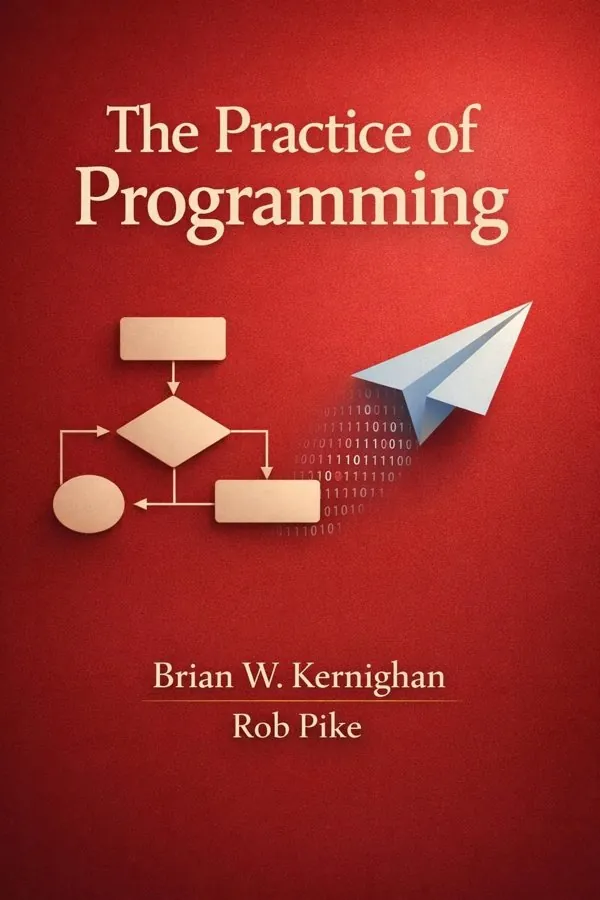
The Practice of Programming: Summary & Key Insights
by Brian W. Kernighan, Rob Pike
 10 min10 chaptersAudio available
Key Takeaways from The Practice of Programming
One of the fastest ways to judge a program is not to run it, but to read it.
Performance problems are often solved long before anyone reaches for a profiler.
A program becomes manageable when its pieces can be understood independently.
When software fails, the worst instinct is to guess wildly.
Programs do not become trustworthy because their authors feel confident.
What Is The Practice of Programming About?
The Practice of Programming by Brian W. Kernighan, Rob Pike is a programming book spanning 10 pages. The Practice of Programming is a classic guide to writing software that is not just functional, but clear, reliable, efficient, and maintainable. Rather than teaching the syntax of one language, Brian W. Kernighan and Rob Pike focus on the habits and judgment that separate competent coders from thoughtful programmers. They examine the full craft of programming: style, algorithms, interfaces, debugging, testing, performance, portability, notation, documentation, and tools. Across examples drawn from C, C++, Java, and Unix-style development, they show how good code emerges from disciplined thinking more than from fashionable technology. What makes this book enduring is its practicality. It does not offer abstract theory detached from real work; it gives principles that apply whether you are writing scripts, building libraries, or maintaining production systems. Kernighan and Pike write with unusual authority. Both helped shape modern computing through work on Unix and influential programming tools, and their experience shows in every page. For developers who want to improve how they think about software—not just how they type it—this book remains one of the most valuable and timeless guides in programming.
This FizzRead summary covers all 10 key chapters of The Practice of Programming in approximately 10 minutes, distilling the most important ideas, arguments, and takeaways from Brian W. Kernighan, Rob Pike's work. Also available as an audio summary and Key Quotes Podcast.
The Practice of Programming
The Practice of Programming is a classic guide to writing software that is not just functional, but clear, reliable, efficient, and maintainable. Rather than teaching the syntax of one language, Brian W. Kernighan and Rob Pike focus on the habits and judgment that separate competent coders from thoughtful programmers. They examine the full craft of programming: style, algorithms, interfaces, debugging, testing, performance, portability, notation, documentation, and tools. Across examples drawn from C, C++, Java, and Unix-style development, they show how good code emerges from disciplined thinking more than from fashionable technology.
What makes this book enduring is its practicality. It does not offer abstract theory detached from real work; it gives principles that apply whether you are writing scripts, building libraries, or maintaining production systems. Kernighan and Pike write with unusual authority. Both helped shape modern computing through work on Unix and influential programming tools, and their experience shows in every page. For developers who want to improve how they think about software—not just how they type it—this book remains one of the most valuable and timeless guides in programming.
Who Should Read The Practice of Programming?
This book is perfect for anyone interested in programming and looking to gain actionable insights in a short read. Whether you're a student, professional, or lifelong learner, the key ideas from The Practice of Programming by Brian W. Kernighan, Rob Pike will help you think differently.
- ✓Readers who enjoy programming and want practical takeaways
- ✓Professionals looking to apply new ideas to their work and life
- ✓Anyone who wants the core insights of The Practice of Programming in just 10 minutes
Want the full summary?
Get instant access to this book summary and 100K+ more with Fizz Moment.
Get Free SummaryAvailable on App Store • Free to download
Key Chapters
One of the fastest ways to judge a program is not to run it, but to read it. Kernighan and Pike argue that programming style is the first visible sign of discipline. Good style does not guarantee a correct program, yet it makes correctness easier to inspect, discuss, and improve. Badly named variables, inconsistent formatting, oversized functions, and clever but opaque expressions create friction for everyone, including the original author six months later.
The authors treat style as a practical tool, not a matter of personal taste. Clear names communicate intent. Consistent indentation exposes structure. Small functions make behavior easier to reason about. A simple control flow reduces hidden surprises. Even comments should serve the reader by explaining why something exists, not restating what the code already says. The broader lesson is that code is read far more often than it is written, so readability is a core engineering requirement.
Consider a function that parses log files. A stylish version might break the task into smaller helpers like parseTimestamp, parseLevel, and parseMessage, rather than burying everything in a single loop full of index arithmetic. The result is easier to test, debug, and extend. Teams also benefit because shared style reduces cognitive switching and code review friction.
The actionable takeaway is simple: write every line as if a teammate must understand it quickly under pressure. Favor clarity over cleverness, choose meaningful names, keep functions focused, and use formatting to make structure obvious.
Performance problems are often solved long before anyone reaches for a profiler. The book stresses that the most important speed decisions usually come from choosing the right algorithm and data structure, not from low-level code tricks. Elegant implementation cannot rescue a poor algorithm. A program that uses the wrong approach may remain slow, memory-hungry, or fragile no matter how polished the syntax looks.
Kernighan and Pike encourage programmers to think about scale early. How large can the input grow? How often will operations occur? What trade-offs matter most: speed, memory, simplicity, or ease of updates? These questions guide whether to use arrays, linked structures, hash tables, trees, or sorting-based methods. They also help avoid premature optimization, because understanding the problem often reveals where efficiency actually matters.
A simple example is duplicate detection. A beginner might compare every item with every other item, producing quadratic behavior. A more thoughtful programmer might use a hash set to track seen values in near-linear time. The implementation may even become shorter and more readable. Similarly, searching a sorted dataset with binary search changes performance dramatically without requiring complicated code.
The authors also emphasize measurement. It is not enough to assume that one technique is faster; good programmers test their assumptions against realistic data. Efficiency should be grounded in evidence.
The actionable takeaway: before tuning statements and loops, step back and ask whether the underlying algorithm fits the problem. Analyze input size, choose data structures deliberately, and use measurement to confirm that your design decisions actually improve results.
A program becomes manageable when its pieces can be understood independently. That is why this book treats interface design as central to software quality. Good interfaces hide complexity, define responsibilities clearly, and make misuse difficult. Poor interfaces leak implementation details, force callers to know too much, and turn small changes into expensive rewrites.
Kernighan and Pike advocate building modules around coherent purposes. Each component should do one thing well and expose a clean boundary. Names, function signatures, and data ownership all matter because they shape how programmers think about the module. The best interfaces are often small. They avoid unnecessary options, strange special cases, and deep coupling to internal representations. When users of a module can accomplish their tasks without understanding its internals, the design is usually on the right track.
Imagine a string processing library. A weak interface might require callers to allocate internal buffers correctly, understand hidden size limits, and call operations in a fragile order. A strong interface would encapsulate those details, validate inputs, and provide predictable behavior across common cases. This makes the code safer for clients and easier to evolve for maintainers.
The authors also hint at a larger truth: interface design is really about future change. Software lasts longer than expected, and requirements shift. A clean interface absorbs those shifts better than tangled dependencies do.
The actionable takeaway is to design APIs from the user’s perspective. Minimize what callers must know, keep contracts explicit, hide implementation details, and review every exposed function by asking: does this make the system easier to use and easier to change?
When software fails, the worst instinct is to guess wildly. The debugging chapter teaches that effective debugging is a disciplined process of gathering evidence, reducing possibilities, and testing hypotheses. Programmers often waste hours because they assume they already know what the bug is. Kernighan and Pike instead recommend treating bugs like investigations: observe carefully, reproduce reliably, isolate the fault, and only then apply a fix.
A key principle is to mistrust assumptions, especially your own. If a variable seems impossible, print it. If an input should never occur, verify it. If a function "must" be correct because it worked yesterday, test it anyway. Many bugs survive because programmers focus on where they expect the problem to be instead of where the evidence points.
The authors favor simple tools and repeatable methods. Add logging. Create minimal test cases. Check recent changes. Compare working and broken versions. Use assertions to catch impossible states earlier. Read error messages closely rather than skimming past them. In many cases, the shortest path to the bug is to simplify the situation until the cause becomes visible.
For example, if a program crashes only in production, you might begin by reproducing the issue with a reduced dataset, then tracing the input path, then inserting checks at module boundaries. This beats random code edits that merely move the failure around.
The actionable takeaway: debug like a scientist. Reproduce the problem, gather facts, isolate the failure, and fix the cause instead of the symptom. A calm, evidence-based process solves bugs faster and prevents them from returning.
Programs do not become trustworthy because their authors feel confident. They become trustworthy when behavior is checked systematically. In The Practice of Programming, testing is presented as a core development activity, not a last-minute chore. Good tests reveal assumptions, expose edge cases, and create a safety net that makes future changes less dangerous.
Kernighan and Pike emphasize that testing should happen at multiple levels. Unit tests verify individual functions. Integration tests check how components work together. Regression tests ensure that known bugs stay fixed. Input variation matters as much as normal cases: empty files, malformed data, huge inputs, duplicates, null values, and boundary conditions often reveal weaknesses that polished demos never show.
The authors also encourage automation. A test that depends on someone remembering to run it will eventually be skipped. Automated tests create repeatability and reduce the cost of careful development. They are especially useful during refactoring, because they let programmers improve structure without losing confidence in behavior.
Suppose you build a parser for CSV data. Testing only one clean example proves little. Better tests would include quoted commas, missing fields, blank lines, very long records, invalid encodings, and random fuzzed input. These cases not only find defects but also clarify the intended contract of the parser.
The actionable takeaway is to treat testing as part of design. Write tests that cover normal use, edge cases, and past failures; automate them whenever possible; and use them to define what correctness means before you trust the code.
Fast code is not always good code, and good code is not always slow. The authors take a mature view of performance: it matters, but only in proportion to real needs. Many programmers optimize the wrong things because they rely on intuition, folklore, or microbenchmarks detached from actual workloads. Kernighan and Pike argue that performance work should begin with evidence.
The first step is to identify where time and memory are actually being spent. Profiling and realistic testing prevent wasted effort on irrelevant details. A tiny function called millions of times may matter more than a visibly complicated routine that rarely runs. Likewise, a performance issue may stem from poor I/O patterns, unnecessary allocation, or repeated computation rather than from the low-level operations developers tend to obsess over.
The book also warns against trading away clarity too early. A complicated optimization can make a program harder to debug, maintain, and port. Often the best improvements come from redesign rather than code contortions: caching expensive results, reducing duplicated work, selecting better data structures, or changing algorithms entirely.
Imagine a report generator that repeatedly scans the same large file. Rather than squeezing cycles from each scan, a better solution may be to preprocess the file into an index and answer queries from that structure. This improves performance while preserving readability.
The actionable takeaway: optimize only after measuring, target the real bottlenecks, and prefer simple structural improvements over obscure tricks. The best performance work preserves correctness and readability while solving a demonstrated problem.
Software often lives longer and travels farther than its creators expect. A program written for one machine, compiler, operating system, or locale may later need to run somewhere very different. The portability chapter teaches that portable software is not an accident; it is the result of deliberate choices that minimize dependence on fragile assumptions.
Kernighan and Pike highlight common traps: assuming integer sizes, relying on undefined language behavior, hardcoding file paths, expecting a specific byte order, or using tools available only in one environment. These shortcuts may seem harmless during initial development, but they make software brittle when requirements expand. Portable code instead relies on standards, isolates system-specific logic, and avoids hidden environmental dependencies.
A practical example is text handling. A tool that assumes Unix newlines, ASCII input, and case-sensitive file systems may fail unexpectedly on other platforms. By centralizing file and encoding operations behind well-defined abstractions, the program becomes easier to adapt. Similarly, using standard library features and explicit conversions reduces surprises across compilers.
Portability also improves code quality even when cross-platform support is not the immediate goal. When assumptions are made explicit, bugs become easier to see. Programs become more predictable, and their dependencies clearer.
The actionable takeaway is to code as though your software may someday run elsewhere—because it probably will. Avoid nonstandard behavior when possible, isolate platform-specific code, test in multiple environments, and document assumptions that cannot be avoided.
The symbols and forms programmers use are not neutral. They influence what is easy to express, what is hard to see, and how others understand the solution. In discussing notation, Kernighan and Pike broaden the idea beyond programming syntax alone. Data formats, mini-languages, regular expressions, tables, and textual conventions all affect how clearly a problem is represented and how safely a solution can be maintained.
Good notation compresses complexity without hiding meaning. A poor notation may save a few keystrokes while making intent obscure. This matters when designing configuration files, command-line interfaces, input grammars, or output reports. If the notation is inconsistent or overloaded with special cases, users and future maintainers must memorize rules instead of understanding patterns.
Take log formats as an example. A sloppy format with ambiguous separators and inconsistent timestamps creates downstream parsing headaches. A cleaner, regular notation makes tools easier to write and errors easier to diagnose. Likewise, a well-designed domain-specific mini-language can make repetitive tasks expressive, while a badly designed one becomes a maintenance burden that only its creator understands.
The authors push programmers to think about representation as part of design, not merely as decoration. The way data and commands are written affects tooling, debugging, portability, and documentation.
The actionable takeaway is to choose notations that are regular, explicit, and easy to parse by both people and programs. When defining formats or mini-languages, prefer consistency over clever shortcuts and test whether a new reader can understand them without private background knowledge.
Code shows how a system works, but it does not always explain why it was built that way. That gap is where documentation matters most. Kernighan and Pike reject bloated, stale documentation that no one reads. Instead, they recommend concise, accurate material that supports understanding, use, and maintenance. The point of documentation is not to create paperwork; it is to reduce confusion.
Useful documentation exists at multiple levels. Within code, comments should explain purpose, assumptions, constraints, and non-obvious decisions. At the module or system level, documentation should describe interfaces, expected inputs and outputs, dependencies, error behavior, and examples of use. Good documentation is especially valuable around boundaries: APIs, command-line tools, file formats, build steps, and operational procedures.
A common failure is writing comments that merely repeat code. For instance, a comment saying "increment i" beside i++ adds no value. A better comment might explain why a loop skips certain records or why a specific timeout was chosen. Documentation earns its keep when it captures context that would otherwise live only in someone’s memory.
The authors also imply that good documentation improves design. If an interface is difficult to explain simply, it may be too complicated. Writing examples often reveals missing cases or awkward behavior before users encounter them.
The actionable takeaway: document decisions, contracts, and usage, not the obvious mechanics. Keep documentation close to the code when possible, update it as behavior changes, and write with the next maintainer in mind rather than the current author’s assumptions.
A skilled programmer does not solve every problem by writing more code from scratch. One of the book’s most practical lessons is that tools expand your reach. Compilers, debuggers, profilers, version control systems, build utilities, text-processing commands, scripting languages, and generators help developers work faster and more reliably. The real craft lies partly in knowing when to build and when to use existing leverage.
Kernighan and Pike come from a Unix tradition that values composable tools. Small utilities that do one thing well can be combined to inspect data, automate repetitive tasks, or prototype ideas quickly. This mindset saves time and encourages experimentation. Instead of manually editing hundreds of files, write a script. Instead of guessing about memory use, run a profiler. Instead of reproducing a build by hand, encode it in a repeatable build process.
Tools also improve quality. Static analyzers catch suspicious patterns. Linters enforce consistency. Regression test runners make change safer. Source control preserves history and supports collaboration. The larger principle is that engineering improves when important tasks become repeatable rather than manual.
For example, a team maintaining a command-line application might create automated builds, test scripts, formatting checks, and release packaging. Each tool removes friction and reduces the risk of human error. Over time, this infrastructure pays for itself many times over.
The actionable takeaway is to invest in tools that save thought, time, and mistakes. Learn your debugger, automate repetitive work, adopt tooling that enforces quality, and build a workflow where reliable processes replace avoidable manual effort.
All Chapters in The Practice of Programming
About the Authors
Brian W. Kernighan and Rob Pike are influential computer scientists whose work helped shape modern programming practice. Kernighan, long associated with Bell Labs, is widely known for contributions to Unix, AWK, and classic programming books that taught generations of developers how to think clearly about code. Rob Pike also emerged from Bell Labs and became known for work on Unix, Plan 9, and Inferno, later playing a major role in the development of the Go programming language at Google. Both authors are admired for their ability to combine deep technical expertise with unusually clear writing. In The Practice of Programming, they draw on decades of real-world systems experience to teach programming as a disciplined, practical craft rather than a collection of language-specific tricks.
Get This Summary in Your Preferred Format
Read or listen to the The Practice of Programming summary by Brian W. Kernighan, Rob Pike anytime, anywhere. FizzRead offers multiple formats so you can learn on your terms — all free.
Available formats: App · Audio · PDF · EPUB — All included free with FizzRead
Download The Practice of Programming PDF and EPUB Summary
Key Quotes from The Practice of Programming
“One of the fastest ways to judge a program is not to run it, but to read it.”
“Performance problems are often solved long before anyone reaches for a profiler.”
“A program becomes manageable when its pieces can be understood independently.”
“When software fails, the worst instinct is to guess wildly.”
“Programs do not become trustworthy because their authors feel confident.”
Frequently Asked Questions about The Practice of Programming
The Practice of Programming by Brian W. Kernighan, Rob Pike is a programming book that explores key ideas across 10 chapters. The Practice of Programming is a classic guide to writing software that is not just functional, but clear, reliable, efficient, and maintainable. Rather than teaching the syntax of one language, Brian W. Kernighan and Rob Pike focus on the habits and judgment that separate competent coders from thoughtful programmers. They examine the full craft of programming: style, algorithms, interfaces, debugging, testing, performance, portability, notation, documentation, and tools. Across examples drawn from C, C++, Java, and Unix-style development, they show how good code emerges from disciplined thinking more than from fashionable technology. What makes this book enduring is its practicality. It does not offer abstract theory detached from real work; it gives principles that apply whether you are writing scripts, building libraries, or maintaining production systems. Kernighan and Pike write with unusual authority. Both helped shape modern computing through work on Unix and influential programming tools, and their experience shows in every page. For developers who want to improve how they think about software—not just how they type it—this book remains one of the most valuable and timeless guides in programming.
You Might Also Like

ANSI Common Lisp
Paul Graham
10 min
Automate the Boring Stuff with Python: Practical Programming for Total Beginners
Al Sweigart
10 min
Black Hat Python: Python Programming for Hackers and Pentesters
Justin Seitz
10 min
Building Microservices: Designing Fine-Grained Systems
Sam Newman
10 min
C++ Primer
Stanley B. Lippman, Josée Lajoie, Barbara E. Moo
10 min
Clean Code: A Handbook of Agile Software Craftsmanship
Robert C. Martin
10 minBrowse by Category
Ready to read The Practice of Programming?
Get the full summary and 100K+ more books with Fizz Moment.