
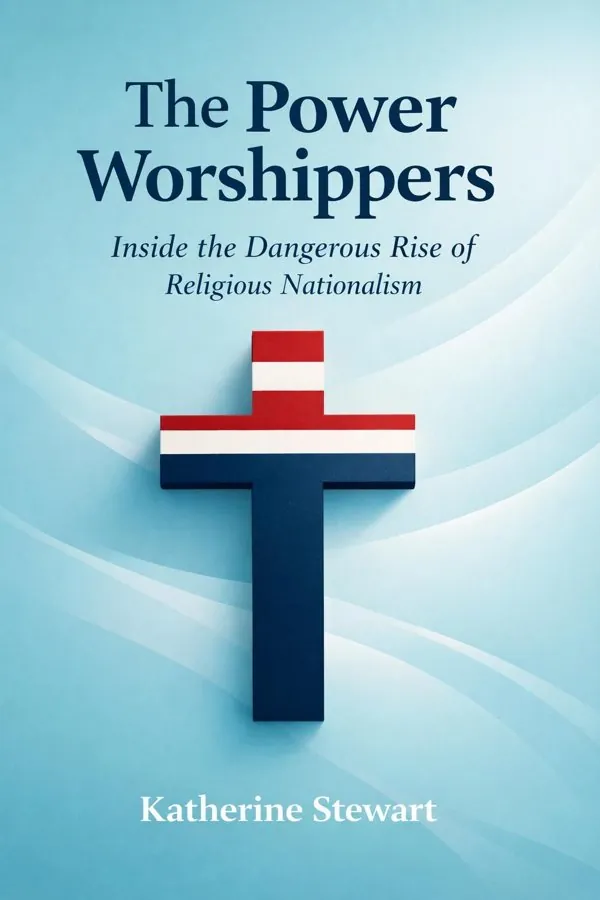
The Power Worshippers: Inside the Dangerous Rise of Religious Nationalism: Summary & Key Insights
 10 min11 chaptersAudio available
What Is The Power Worshippers: Inside the Dangerous Rise of Religious Nationalism About?
The Power Worshippers: Inside the Dangerous Rise of Religious Nationalism by Katherine Stewart is a politics book spanning 11 pages. An investigative work that explores the growing influence of Christian nationalism in American politics, examining how religious movements have shaped policy, culture, and democracy in the United States.
This FizzRead summary covers all 11 key chapters of The Power Worshippers: Inside the Dangerous Rise of Religious Nationalism in approximately 10 minutes, distilling the most important ideas, arguments, and takeaways from Katherine Stewart's work. Also available as an audio summary and Key Quotes Podcast.
The Power Worshippers: Inside the Dangerous Rise of Religious Nationalism
An investigative work that explores the growing influence of Christian nationalism in American politics, examining how religious movements have shaped policy, culture, and democracy in the United States.
Who Should Read The Power Worshippers: Inside the Dangerous Rise of Religious Nationalism?
This book is perfect for anyone interested in politics and looking to gain actionable insights in a short read. Whether you're a student, professional, or lifelong learner, the key ideas from The Power Worshippers: Inside the Dangerous Rise of Religious Nationalism by Katherine Stewart will help you think differently.
- ✓Readers who enjoy politics and want practical takeaways
- ✓Professionals looking to apply new ideas to their work and life
- ✓Anyone who wants the core insights of The Power Worshippers: Inside the Dangerous Rise of Religious Nationalism in just 10 minutes
Want the full summary?
Get instant access to this book summary and 100K+ more with Fizz Moment.
Get Free SummaryAvailable on App Store • Free to download
Key Chapters
To understand the present face of Christian nationalism, we begin in the mid‑twentieth century, when the fusion of religion and right‑wing politics emerged as a deliberate project rather than a spontaneous alliance. The popular memory often locates the political awakening of evangelicals in the 1970s, amid protests over Roe v. Wade and school prayer debates, but the roots go deeper. After World War II, conservative thinkers and businessmen found religion useful as a counterweight against secularism, communism, and the expanding federal government. Working with preachers who saw capitalism and Christianity as moral twins, these activists nurtured the idea that political liberty and godliness were inseparable.
By the 1950s, more than patriotic faith, this became ideological infrastructure. Organizations such as Spiritual Mobilization promoted “freedom under God,” a slogan that would echo through decades. In the civil rights era, opposition to desegregation and social reform found a theological wrapper: defenders of the old hierarchy claimed divine sanction for social order. In the 1970s, as white evangelical schools were challenged over racial admissions, the leaders who later formed the Moral Majority reframed their cause—not as resistance to civil rights, but as protection of “religious freedom.” This rhetorical shift was crucial. It allowed resentment to masquerade as righteousness.
Through successive generations, from Billy Graham’s ecumenical outreach to Jerry Falwell’s political mobilization, religious conservatives built a coherent narrative: America was founded as a Christian nation, fallen into secular decay, and must be reclaimed through political action. Stewart shows that this myth of a lost golden age powers contemporary mobilization. It tells believers they are restoring divine order, not enforcing sectarian rule. But the history exposes how deliberately that myth was constructed—how a broad faith community was transformed into a disciplined political constituency.
In my reporting travels—from megachurch rallies in the South to strategy sessions in Washington—I saw how skillfully the movement turns spiritual institutions into political networks. Churches are not just houses of worship; they are information hubs, training grounds, and turnout machines. Through thousands of small ministries and nonprofits, political operatives collect data, distribute voter guides, and coordinate messaging from pulpit to ballot box.
Movements like Focus on the Family, Family Research Council, and Liberty Counsel operate at this nexus of religion and politics. They frame their activism as moral duty rather than partisan effort, yet their alignment with one party is near total. Stewart traces how networks such as Ralph Reed’s Faith & Freedom Coalition and Tony Perkins’s organizations convert grassroots enthusiasm into policy influence. The model is efficient: pastors receive briefings on political priorities, then preach on biblical themes that mirror legislation. Congregants hear those priorities not as campaign slogans, but as moral imperatives.
This mobilization also depends on sophisticated digital infrastructure. Email lists, church directories, and donation platforms merge into political databases. At revival events, worshipers sign petitions and share contact information, often unaware that their data becomes a tool for micro‑targeting voters. When faith becomes data, devotion turns into demographic capital. The church is not merely being politicized—it is being instrumentalized. Stewart emphasizes that this violates the traditional boundary between pastoral care and partisan manipulation. Yet for organizers, that boundary is precisely what they seek to erase, because a politicized congregation is more loyal and predictable than a general electorate.
+ 9 more chapters — available in the FizzRead app
All Chapters in The Power Worshippers: Inside the Dangerous Rise of Religious Nationalism
About the Author
Katherine Stewart is an American journalist and author known for her reporting on religion, politics, and education. Her work has appeared in major publications such as The New York Times and The Guardian.
Get This Summary in Your Preferred Format
Read or listen to the The Power Worshippers: Inside the Dangerous Rise of Religious Nationalism summary by Katherine Stewart anytime, anywhere. FizzRead offers multiple formats so you can learn on your terms — all free.
Available formats: App · Audio · PDF · EPUB — All included free with FizzRead
Download The Power Worshippers: Inside the Dangerous Rise of Religious Nationalism PDF and EPUB Summary
Key Quotes from The Power Worshippers: Inside the Dangerous Rise of Religious Nationalism
“The popular memory often locates the political awakening of evangelicals in the 1970s, amid protests over Roe v.”
“In my reporting travels—from megachurch rallies in the South to strategy sessions in Washington—I saw how skillfully the movement turns spiritual institutions into political networks.”
Frequently Asked Questions about The Power Worshippers: Inside the Dangerous Rise of Religious Nationalism
The Power Worshippers: Inside the Dangerous Rise of Religious Nationalism by Katherine Stewart is a politics book that explores key ideas across 11 chapters. An investigative work that explores the growing influence of Christian nationalism in American politics, examining how religious movements have shaped policy, culture, and democracy in the United States.
You Might Also Like

Antifa: The Anti-Fascist Handbook
Mark Bray
10 min
Attack from Within: How Disinformation Is Sabotaging America
Barbara McQuade
10 min
Coercion, Capital, and European States, AD 990–1992
Charles Tilly
10 min
Digital Democracy: Concepts, Methodologies, Tools, and Applications
Various Authors
10 min
Fascism
Stanley G. Payne
10 min
Fire And Fury: Inside The Trump White House
Michael Wolff
10 minBrowse by Category
Ready to read The Power Worshippers: Inside the Dangerous Rise of Religious Nationalism?
Get the full summary and 100K+ more books with Fizz Moment.