
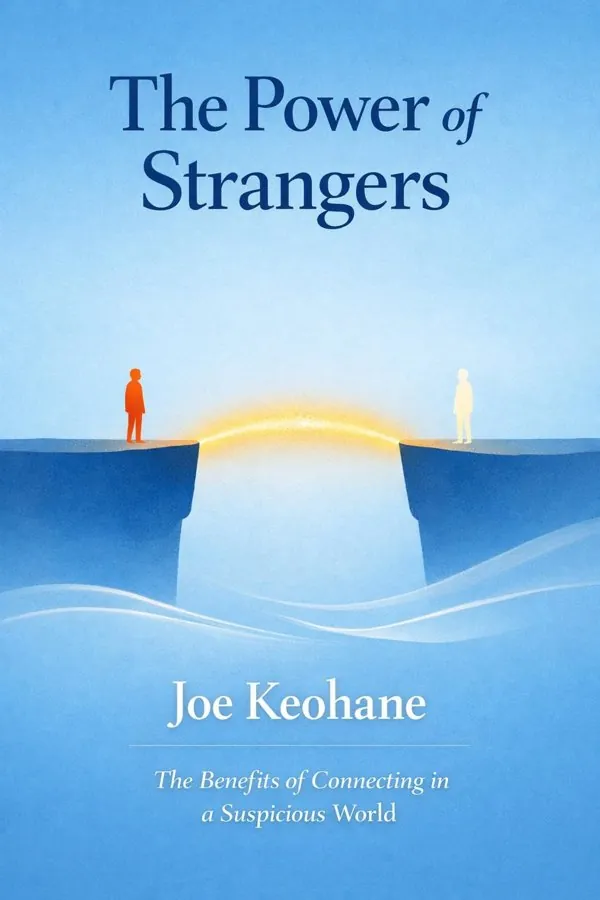
The Power of Strangers: The Benefits of Connecting in a Suspicious World: Summary & Key Insights
by Joe Keohane
 10 min10 chaptersAudio available
What Is The Power of Strangers: The Benefits of Connecting in a Suspicious World About?
The Power of Strangers: The Benefits of Connecting in a Suspicious World by Joe Keohane is a sociology book spanning 10 pages. In this thought-provoking work, journalist Joe Keohane explores the social, psychological, and historical importance of talking to strangers. Drawing on research from sociology, psychology, and anthropology, he argues that human connection with unfamiliar people fosters empathy, trust, and community resilience. Through engaging stories and scientific insights, Keohane demonstrates how modern society’s fear of strangers undermines our collective well-being and offers practical ways to rebuild social bonds.
This FizzRead summary covers all 10 key chapters of The Power of Strangers: The Benefits of Connecting in a Suspicious World in approximately 10 minutes, distilling the most important ideas, arguments, and takeaways from Joe Keohane's work. Also available as an audio summary and Key Quotes Podcast.
The Power of Strangers: The Benefits of Connecting in a Suspicious World
In this thought-provoking work, journalist Joe Keohane explores the social, psychological, and historical importance of talking to strangers. Drawing on research from sociology, psychology, and anthropology, he argues that human connection with unfamiliar people fosters empathy, trust, and community resilience. Through engaging stories and scientific insights, Keohane demonstrates how modern society’s fear of strangers undermines our collective well-being and offers practical ways to rebuild social bonds.
Who Should Read The Power of Strangers: The Benefits of Connecting in a Suspicious World?
This book is perfect for anyone interested in sociology and looking to gain actionable insights in a short read. Whether you're a student, professional, or lifelong learner, the key ideas from The Power of Strangers: The Benefits of Connecting in a Suspicious World by Joe Keohane will help you think differently.
- ✓Readers who enjoy sociology and want practical takeaways
- ✓Professionals looking to apply new ideas to their work and life
- ✓Anyone who wants the core insights of The Power of Strangers: The Benefits of Connecting in a Suspicious World in just 10 minutes
Want the full summary?
Get instant access to this book summary and 100K+ more with Fizz Moment.
Get Free SummaryAvailable on App Store • Free to download
Key Chapters
If you step back into the story of humankind, you’ll see that strangers once made us who we are. The earliest societies—hunter-gatherer groups, nomadic tribes, and emerging city-states—were all built on the ability to encounter the unknown and find common ground. Trade routes like the Silk Road weren’t merely channels for goods; they were conduits for stories, ideas, and relationships among strangers. Hospitality—the welcoming of those who were not kin—was sacred in cultures from ancient Greece to the Bedouins of the Arabian desert. It was understood that survival depended on generosity and shared trust.
Contrast this with our modern world. Our ancestors’ open doors have become locked gates; our communal fires have become private screens. We’ve shifted from curiosity to caution. As I examined how societies evolved from interdependence to isolation, I discovered that the decline in everyday interactions between strangers is more than a social quirk—it’s a historical rupture. By forgetting how to relate to those unlike us, we risk losing a crucial mechanism of cultural resilience.
This section uncovers how the stranger has always been a mirror: someone who reveals who we are by showing us what we are not. Understanding our past helps us grasp the deep roots of our social instincts and reminds us that comfort often grows from the courage to meet the unfamiliar.
Our brains are wired for connection. Evolution shaped humans into one of the most socially dependent species on Earth, and talking to strangers taps into that evolutionary circuitry. Psychologists and neuroscientists have long documented how social interaction releases oxytocin and dopamine—the same chemicals associated with trust, joy, and bonding. Even brief exchanges can trigger these effects.
When I spoke with researchers about this phenomenon, they described how humans suffer when deprived of new social input. Routine contacts—family, colleagues—reinforce stability, but it’s in the unpredictable encounters that we expand our worldview. Strangers present novelty; they activate curiosity and empathy, and they help our brains stay supple, adaptable.
Social psychology experiments—from the classic studies on subway conversations to modern fieldwork in urban cafés—show that people consistently underestimate how positive interactions with strangers will make them feel. Fear tells us to avoid; experience tells us to engage. The gap between expectation and reality—that space of surprise and delight—is where transformation happens.
From these insights, we begin to see connecting with strangers not merely as polite behavior, but as mental nourishment, a kind of exercise for emotional intelligence. Our neural architecture thrives on diversity of contact; when we cut ourselves off, we starve the mind.
+ 8 more chapters — available in the FizzRead app
All Chapters in The Power of Strangers: The Benefits of Connecting in a Suspicious World
About the Author
Joe Keohane is an American journalist and editor whose work has appeared in publications such as The New Yorker, The Atlantic, and New York Magazine. He writes extensively on social behavior, politics, and culture, focusing on how human interaction shapes modern life.
Get This Summary in Your Preferred Format
Read or listen to the The Power of Strangers: The Benefits of Connecting in a Suspicious World summary by Joe Keohane anytime, anywhere. FizzRead offers multiple formats so you can learn on your terms — all free.
Available formats: App · Audio · PDF · EPUB — All included free with FizzRead
Download The Power of Strangers: The Benefits of Connecting in a Suspicious World PDF and EPUB Summary
Key Quotes from The Power of Strangers: The Benefits of Connecting in a Suspicious World
“If you step back into the story of humankind, you’ll see that strangers once made us who we are.”
“Evolution shaped humans into one of the most socially dependent species on Earth, and talking to strangers taps into that evolutionary circuitry.”
Frequently Asked Questions about The Power of Strangers: The Benefits of Connecting in a Suspicious World
The Power of Strangers: The Benefits of Connecting in a Suspicious World by Joe Keohane is a sociology book that explores key ideas across 10 chapters. In this thought-provoking work, journalist Joe Keohane explores the social, psychological, and historical importance of talking to strangers. Drawing on research from sociology, psychology, and anthropology, he argues that human connection with unfamiliar people fosters empathy, trust, and community resilience. Through engaging stories and scientific insights, Keohane demonstrates how modern society’s fear of strangers undermines our collective well-being and offers practical ways to rebuild social bonds.
You Might Also Like

Between the World and Me
Ta-Nehisi Coates
10 min
Half the Sky
Nicholas D. Kristof, Sheryl WuDunn
10 min
Men Explain Things To Me
Rebecca Solnit
10 min
Rational Ritual
Michael Suk-Young Chwe
10 min
The New Jim Crow
Michelle Alexander
10 min
Beyond Culture
Edward T. Hall
10 minBrowse by Category
Ready to read The Power of Strangers: The Benefits of Connecting in a Suspicious World?
Get the full summary and 100K+ more books with Fizz Moment.