
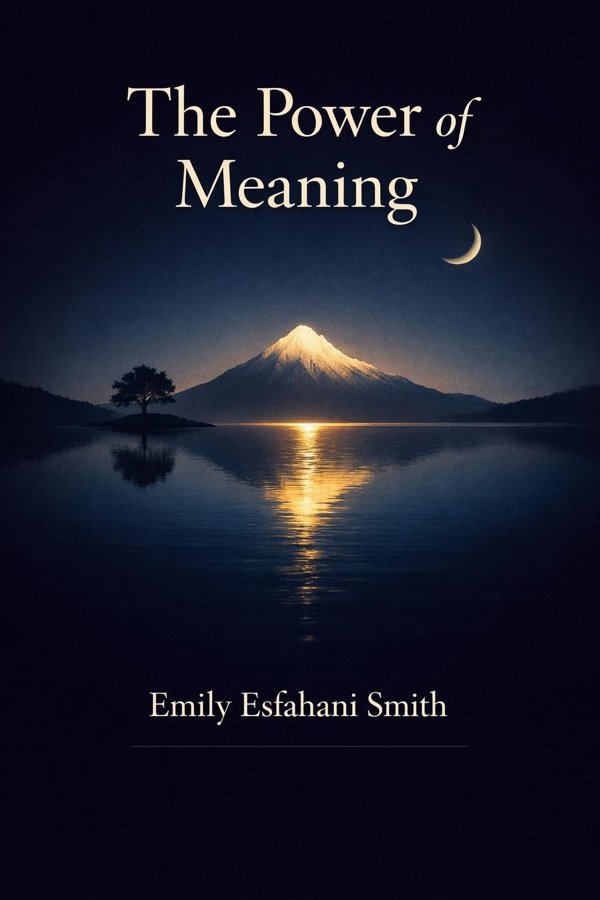
The Power of Meaning: Crafting a Life That Matters: Summary & Key Insights
 10 min9 chaptersAudio available
Key Takeaways from The Power of Meaning: Crafting a Life That Matters
One of the most unsettling truths of modern life is that comfort and freedom do not automatically produce fulfillment.
A meaningful life is rarely created by one dramatic revelation; more often, it is built through a set of repeatable experiences.
People do not become secure and alive merely by being around others; they need to feel seen, affirmed, and welcomed.
A life can be busy without being meaningful.
Human beings do not merely live events; they interpret them.
What Is The Power of Meaning: Crafting a Life That Matters About?
The Power of Meaning: Crafting a Life That Matters by Emily Esfahani Smith is a positive_psych book spanning 8 pages. What makes life truly worth living: pleasure, success, or something deeper? In The Power of Meaning, Emily Esfahani Smith argues that modern culture has overvalued personal happiness and underestimated the human need for meaning. Drawing on psychology, philosophy, literature, religion, and her own reporting, she shows that a fulfilling life is not built on constant positive emotion, but on a sense of significance, connection, and coherence. At the center of her book are four pillars of meaning: belonging, purpose, storytelling, and transcendence. Together, they offer a practical framework for building a life that can withstand loneliness, disappointment, and uncertainty. This book matters because many people today feel successful on paper yet inwardly adrift. Smith helps explain why. She combines academic research with vivid stories of ordinary people, communities, and historical figures who found depth even in hardship. As a journalist and cultural observer with expertise in psychology and philosophy, she translates big ideas into clear, humane insights. The result is a wise and accessible guide for anyone who wants not just to feel good, but to live in a way that matters.
This FizzRead summary covers all 9 key chapters of The Power of Meaning: Crafting a Life That Matters in approximately 10 minutes, distilling the most important ideas, arguments, and takeaways from Emily Esfahani Smith's work. Also available as an audio summary and Key Quotes Podcast.
The Power of Meaning: Crafting a Life That Matters
What makes life truly worth living: pleasure, success, or something deeper? In The Power of Meaning, Emily Esfahani Smith argues that modern culture has overvalued personal happiness and underestimated the human need for meaning. Drawing on psychology, philosophy, literature, religion, and her own reporting, she shows that a fulfilling life is not built on constant positive emotion, but on a sense of significance, connection, and coherence. At the center of her book are four pillars of meaning: belonging, purpose, storytelling, and transcendence. Together, they offer a practical framework for building a life that can withstand loneliness, disappointment, and uncertainty.
This book matters because many people today feel successful on paper yet inwardly adrift. Smith helps explain why. She combines academic research with vivid stories of ordinary people, communities, and historical figures who found depth even in hardship. As a journalist and cultural observer with expertise in psychology and philosophy, she translates big ideas into clear, humane insights. The result is a wise and accessible guide for anyone who wants not just to feel good, but to live in a way that matters.
Who Should Read The Power of Meaning: Crafting a Life That Matters?
This book is perfect for anyone interested in positive_psych and looking to gain actionable insights in a short read. Whether you're a student, professional, or lifelong learner, the key ideas from The Power of Meaning: Crafting a Life That Matters by Emily Esfahani Smith will help you think differently.
- ✓Readers who enjoy positive_psych and want practical takeaways
- ✓Professionals looking to apply new ideas to their work and life
- ✓Anyone who wants the core insights of The Power of Meaning: Crafting a Life That Matters in just 10 minutes
Want the full summary?
Get instant access to this book summary and 100K+ more with Fizz Moment.
Get Free SummaryAvailable on App Store • Free to download
Key Chapters
One of the most unsettling truths of modern life is that comfort and freedom do not automatically produce fulfillment. Emily Esfahani Smith begins by examining what she calls a meaning crisis: many people have more choices, more conveniences, and more opportunities than previous generations, yet they often feel lonely, anxious, and spiritually unmoored. The problem is not that happiness is bad. It is that happiness, especially when defined as pleasure, achievement, or the avoidance of pain, is too fragile to serve as life’s foundation.
Happiness rises and falls with circumstance. A promotion, vacation, or compliment can lift us; a setback, rejection, or boring week can deflate us. Meaning works differently. It gives people a reason to endure suffering, contribute to others, and see their lives as part of something larger. Research in psychology supports this distinction: people who orient their lives around meaning tend to show greater resilience, generosity, and long-term well-being than those focused mainly on feeling good.
Smith also points out a cultural paradox. The more aggressively people chase happiness, the more likely they are to become self-conscious and dissatisfied. When life is evaluated by the question “Am I happy right now?”, normal struggle starts to feel like failure. Meaning offers a more stable measure. It asks, “Am I connected, contributing, and living in alignment with what matters?”
In practical terms, this means shifting attention away from constant mood management and toward deeper commitments: relationships, service, identity, and awe. Instead of organizing your life around pleasure or status, ask what gives you a sense of worth and rootedness. Actionable takeaway: replace the daily question “What will make me happy?” with “What will make today meaningful?”
A meaningful life is rarely created by one dramatic revelation; more often, it is built through a set of repeatable experiences. Through interviews, research, and reflection, Smith identifies four pillars that support meaning across cultures and life stages: belonging, purpose, storytelling, and transcendence. These are not rigid steps or personality types. They are sources of strength that people can cultivate intentionally, even in difficult circumstances.
Belonging is the experience of being valued for who you are and of valuing others in return. Purpose is having a goal or role that allows you to contribute beyond yourself. Storytelling is the way you interpret your life and create coherence from past events. Transcendence involves moments when you rise beyond the ordinary self and feel connected to a larger reality. Together, these pillars provide emotional stability, moral direction, and existential depth.
A key contribution of Smith’s framework is that it makes meaning practical. Many people think of meaning as abstract or mystical, something either discovered accidentally or reserved for philosophers and saints. Smith shows that meaning can be built in ordinary life: through family rituals, committed work, reflective writing, acts of service, prayer, nature, art, or community.
The pillars also compensate for one another. Someone who loses a job may still have belonging and storytelling. A person in grief may not feel happy, but transcendence or purpose can sustain them. Meaning is therefore not a single feeling but a structure.
To apply the framework, assess your life honestly. Which pillar feels strongest? Which one has weakened? A teacher may have purpose but little transcendence; a retiree may have belonging but need a renewed story. Actionable takeaway: choose one of the four pillars this week and create one concrete practice to strengthen it.
People do not become secure and alive merely by being around others; they need to feel seen, affirmed, and welcomed. Smith distinguishes true belonging from mere fitting in. Fitting in asks people to adjust themselves to earn approval. Belonging tells them they are inherently worthy and invites mutual care. This distinction is crucial because many modern environments, from competitive workplaces to curated social media spaces, offer visibility without genuine acceptance.
Belonging grows through small acts that communicate dignity. A parent who listens attentively, a manager who treats every employee with respect, a friend who remembers important details, or a neighbor who includes someone new in a gathering all reinforce the feeling that a person matters. Such moments can seem ordinary, but they shape identity. When people feel valued, they become more open, more generous, and more resilient.
Smith draws on research showing that social isolation harms mental and physical health, while strong relationships protect against despair. Yet belonging is not only about receiving love; it is also about giving it. Communities become meaningful when members practice what some traditions call radical mattering: interacting as if each person carries inherent worth.
This has practical implications. Families can create rituals such as shared meals without phones. Leaders can learn names, solicit input, and recognize unseen contributions. Individuals can stop treating relationships as transactions and instead offer presence. Belonging is built less through grand speeches than through patterns of attention and respect.
If you often feel disconnected, the answer may not be to find more people, but to deepen the quality of your interactions. Ask not only where you belong, but how you help others belong. Actionable takeaway: choose one person today and make them feel unmistakably valued through focused attention, appreciation, or inclusion.
A life can be busy without being meaningful. Smith argues that purpose is not simply having goals, nor is it identical to passion. Purpose arises when our efforts are directed toward something larger than ourselves. It gives structure to time, directs energy, and transforms ordinary labor into contribution. The crucial question is not “What do I enjoy?” but “Whom does my work serve?”
This insight broadens purpose beyond elite careers or heroic missions. A doctor saving lives may feel purposeful, but so can a bus driver who safely transports children, a caregiver who supports an aging parent, or an entrepreneur who solves a practical problem with integrity. Purpose often lives in responsibility. It appears when people recognize that their actions matter to others.
Smith also clarifies that purpose does not have to be singular or grand. Different seasons of life may call forth different purposes. Young adults may focus on building a vocation; parents may experience purpose through raising children; retirees may mentor, volunteer, or sustain community institutions. What matters is sustained commitment to a worthwhile aim.
For many people, the obstacle is not a lack of importance but a lack of reflection. They are so immersed in tasks that they lose sight of the larger contribution behind them. Reframing can help. A teacher is not just grading papers; she is shaping lives. A customer support agent is not just answering complaints; he is restoring trust.
To cultivate purpose, identify the people affected by your work, however indirectly. Consider how your role relieves burdens, creates beauty, transmits knowledge, or builds order. Then align daily choices with that service. Actionable takeaway: write one sentence that begins, “The deeper purpose of my work is to…” and place it where you can see it every day.
Human beings do not merely live events; they interpret them. Smith’s third pillar, storytelling, highlights the narratives we construct about our lives. These stories shape identity, influence emotion, and determine whether adversity becomes a source of growth or a trap of bitterness. Two people can experience similar hardships and emerge with radically different inner worlds depending on how they explain what happened.
A healthy life story is not fantasy or denial. It does not pretend that pain was pleasant or that every loss had a neat purpose. Instead, it creates coherence. It answers questions like: Who am I? What have I endured? What values have guided me? How have my struggles shaped me? Research suggests that people who can tell “redemptive” stories, narratives in which suffering leads to insight, service, maturity, or renewed commitment, often show greater well-being and resilience.
Smith encourages reflection because many people operate inside inherited or unexamined stories: “I’m a failure,” “My best years are over,” “Nothing ever works out for me.” Such narratives become invisible prisons. Rewriting them begins with honesty. A difficult childhood might become not proof of brokenness, but evidence of strength and empathy. A career setback might become the turning point that clarified one’s values.
Practical tools include journaling, therapy, meaningful conversation, and life review. The goal is not self-dramatization but self-understanding. By naming patterns and reinterpreting events, people can move from chaos to coherence.
When you feel stuck, ask what story you are telling about your situation and whether it is the only possible interpretation. The narrative may need revision, not your entire life. Actionable takeaway: write about one painful event and describe not only what it took from you, but also what it taught, revealed, or redirected.
Some of life’s most meaningful moments arrive when the self falls quiet. Smith calls these experiences transcendence: times when people feel connected to something vast, sacred, or deeply beautiful. This can happen in prayer, meditation, nature, music, art, communal ritual, acts of love, or even intense focus. In such moments, the ordinary preoccupation with status, worry, and ego gives way to wonder and perspective.
Transcendence matters because the self can become a cramped place to live. When people are trapped in constant self-monitoring, they become more anxious and less generous. Transcendent experiences remind them that they are part of a larger reality. For some, that reality is God. For others, it may be humanity, the natural world, truth, beauty, or moral order. The book does not insist on one metaphysical interpretation, but it does insist that human beings need occasions of self-transcendence.
Importantly, transcendence is not escapism. Properly understood, it returns people to daily life with humility, gratitude, and renewed commitment. A walk beneath stars can make personal worries seem smaller. A spiritual ritual can restore courage. A symphony can awaken reverence. Even flow states, such as complete absorption in craft or sport, can offer release from the narrow self.
In a distracted culture, transcendence often requires intentionality. Silence must be protected. Phones must be put away. Rituals must be practiced. People must place themselves before beauty or mystery often enough for attention to deepen.
You do not have to wait for a dramatic mystical experience. Begin by creating conditions in which awe can occur. Actionable takeaway: schedule one recurring activity each week, such as time in nature, worship, meditation, or art, that helps you step beyond everyday self-concern.
One of the book’s most powerful insights is that meaning is not the absence of suffering but a way of responding to it. Modern culture often treats pain as an interruption to life, something to eliminate as quickly as possible. Smith does not romanticize hardship, but she shows that adversity can become a doorway to deeper identity, compassion, and purpose when people are supported in making sense of it.
This idea echoes both psychology and ancient wisdom traditions. Hard experiences can strip away illusions, clarify priorities, and intensify bonds with others. Grief can reveal love. Illness can awaken gratitude. Failure can expose false ambitions and redirect a person toward a truer calling. Yet this transformation is not automatic. Suffering can also isolate, embitter, and wound. Meaning emerges when pain is integrated through belonging, storytelling, service, and transcendence.
Smith highlights how communities and rituals help people metabolize loss. Funerals, shared meals, memorial traditions, support groups, and spiritual practices all create containers in which pain becomes speakable and survivable. Individuals, too, can respond creatively. Someone recovering from addiction may mentor others. A bereaved parent may advocate for a cause. A survivor of hardship may cultivate unusual tenderness toward those in pain.
The lesson is not to seek suffering, but to stop assuming that hardship makes life meaningless. In many cases, hardship becomes the very place where meaning is forged. The question shifts from “Why is this happening to me?” to “How will I meet this, and what can it awaken in me?”
If you are in difficulty, resist the pressure to extract a lesson immediately. First seek support, then understanding, then contribution. Actionable takeaway: in the face of one current struggle, identify one source of support and one small way this experience might deepen your compassion or clarify your values.
A common misconception is that meaningful lives are discovered by lucky people who stumble into the right calling, relationship, or belief. Smith offers a more empowering view: meaning can be cultivated through habits, attention, and intentional choices. While no one controls all circumstances, everyone can strengthen the conditions under which meaning grows.
This begins with noticing. Many meaningful moments are missed because people are rushed, distracted, or evaluating everything by productivity. A conversation with a grandparent, a volunteer commitment, a creative practice, a religious service, or a quiet walk may seem small compared with career milestones, yet these are often the very experiences that nourish the pillars of meaning. The challenge is to treat them as central rather than optional.
Deliberate meaning-making also involves alignment. People suffer when their calendar reflects priorities they do not actually believe in. If belonging matters, relationships need protected time. If transcendence matters, silence and awe need space. If purpose matters, work must be connected to service. If storytelling matters, reflection must become a practice rather than an afterthought.
The book ultimately replaces passivity with agency. You do not have to wait to feel inspired before acting. You can host dinner, mentor someone, begin journaling, pray, read poetry, volunteer, apologize, or establish a family ritual. These are modest acts, but they compound into a life that feels rooted and significant.
Meaning is not a mood that arrives; it is a pattern that is built. The most powerful changes are often small, repeated, and relational. Actionable takeaway: design a weekly meaning routine that includes one practice for connection, one for contribution, one for reflection, and one for transcendence.
All Chapters in The Power of Meaning: Crafting a Life That Matters
About the Author
Emily Esfahani Smith is an American writer, editor, and speaker whose work focuses on meaning, psychology, culture, and philosophy. She studied philosophy at Dartmouth College and later earned a master’s degree in positive psychology from the University of Pennsylvania, where she explored the difference between happiness and meaning in human flourishing. Smith has written for leading publications including The Atlantic, The New York Times, and The Wall Street Journal, and she is known for making complex psychological and philosophical ideas accessible to a broad audience. Her work often examines the spiritual and emotional challenges of modern life, especially loneliness, purpose, and identity. In The Power of Meaning, she brings together research, literature, and real-life stories to offer a practical and deeply humane vision of what makes life matter.
Get This Summary in Your Preferred Format
Read or listen to the The Power of Meaning: Crafting a Life That Matters summary by Emily Esfahani Smith anytime, anywhere. FizzRead offers multiple formats so you can learn on your terms — all free.
Available formats: App · Audio · PDF · EPUB — All included free with FizzRead
Download The Power of Meaning: Crafting a Life That Matters PDF and EPUB Summary
Key Quotes from The Power of Meaning: Crafting a Life That Matters
“One of the most unsettling truths of modern life is that comfort and freedom do not automatically produce fulfillment.”
“A meaningful life is rarely created by one dramatic revelation; more often, it is built through a set of repeatable experiences.”
“People do not become secure and alive merely by being around others; they need to feel seen, affirmed, and welcomed.”
“A life can be busy without being meaningful.”
“Human beings do not merely live events; they interpret them.”
Frequently Asked Questions about The Power of Meaning: Crafting a Life That Matters
The Power of Meaning: Crafting a Life That Matters by Emily Esfahani Smith is a positive_psych book that explores key ideas across 9 chapters. What makes life truly worth living: pleasure, success, or something deeper? In The Power of Meaning, Emily Esfahani Smith argues that modern culture has overvalued personal happiness and underestimated the human need for meaning. Drawing on psychology, philosophy, literature, religion, and her own reporting, she shows that a fulfilling life is not built on constant positive emotion, but on a sense of significance, connection, and coherence. At the center of her book are four pillars of meaning: belonging, purpose, storytelling, and transcendence. Together, they offer a practical framework for building a life that can withstand loneliness, disappointment, and uncertainty. This book matters because many people today feel successful on paper yet inwardly adrift. Smith helps explain why. She combines academic research with vivid stories of ordinary people, communities, and historical figures who found depth even in hardship. As a journalist and cultural observer with expertise in psychology and philosophy, she translates big ideas into clear, humane insights. The result is a wise and accessible guide for anyone who wants not just to feel good, but to live in a way that matters.
You Might Also Like
Don't Sweat the Small Stuff... and It's All Small Stuff
Richard Carlson
10 min
Option B
Sheryl Sandberg & Adam Grant
10 min
Hallelujah Anyway: Rediscovering Mercy
Anne Lamott
10 min
I Can Do It: How to Use Affirmations to Change Your Life
Louise Hay
10 min
The Coffee Bean: A Simple Lesson to Create Positive Change
Jon Gordon, Damon West
10 min
The Happiness Hypothesis: Finding Modern Truth in Ancient Wisdom
Jonathan Haidt
10 minBrowse by Category
Ready to read The Power of Meaning: Crafting a Life That Matters?
Get the full summary and 100K+ more books with Fizz Moment.