
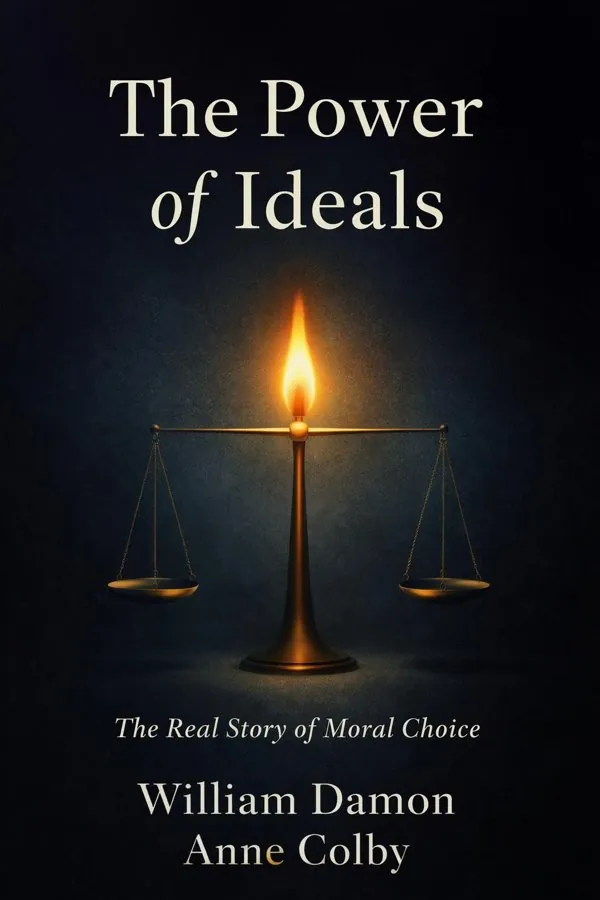
The Power of Ideals: The Real Story of Moral Choice: Summary & Key Insights
 10 min5 chaptersAudio available
What Is The Power of Ideals: The Real Story of Moral Choice About?
The Power of Ideals: The Real Story of Moral Choice by William Damon, Anne Colby is a ethics book spanning 5 pages. This book explores the lives and moral choices of six twentieth-century leaders who exemplified virtues such as truthfulness, humility, and faith. Damon and Colby, both leading scholars in moral development, challenge deterministic views of human behavior and argue that moral excellence and ideals can guide individuals toward meaningful and ethical lives. Through detailed case studies, they demonstrate how moral conviction can shape decisions and inspire social progress.
This FizzRead summary covers all 5 key chapters of The Power of Ideals: The Real Story of Moral Choice in approximately 10 minutes, distilling the most important ideas, arguments, and takeaways from William Damon, Anne Colby's work. Also available as an audio summary and Key Quotes Podcast.
The Power of Ideals: The Real Story of Moral Choice
This book explores the lives and moral choices of six twentieth-century leaders who exemplified virtues such as truthfulness, humility, and faith. Damon and Colby, both leading scholars in moral development, challenge deterministic views of human behavior and argue that moral excellence and ideals can guide individuals toward meaningful and ethical lives. Through detailed case studies, they demonstrate how moral conviction can shape decisions and inspire social progress.
Who Should Read The Power of Ideals: The Real Story of Moral Choice?
This book is perfect for anyone interested in ethics and looking to gain actionable insights in a short read. Whether you're a student, professional, or lifelong learner, the key ideas from The Power of Ideals: The Real Story of Moral Choice by William Damon, Anne Colby will help you think differently.
- ✓Readers who enjoy ethics and want practical takeaways
- ✓Professionals looking to apply new ideas to their work and life
- ✓Anyone who wants the core insights of The Power of Ideals: The Real Story of Moral Choice in just 10 minutes
Want the full summary?
Get instant access to this book summary and 100K+ more with Fizz Moment.
Get Free SummaryAvailable on App Store • Free to download
Key Chapters
Our work builds upon the strong foundation of moral development theory, especially the traditions following William James, Lawrence Kohlberg, and other thinkers who saw morality not as a fixed trait but as a developmental achievement. Yet we found that most theories of moral development left out something vital—the human capacity to live according to ideals that transcend immediate rewards or social conformity.
Our model begins with the recognition that moral behavior is not mechanically produced by external rules. It springs from within, from the interplay between an individual’s ideals and their sense of personal agency. Ideals, as we define them, are guiding visions of the good. They are both cognitive and emotional constructs: they embody our understanding of moral truth and ignite our desire to realize it. Agency, meanwhile, is the power to act intentionally in pursuit of these ideals. Together, these two forces—ideals and agency—constitute the inner architecture of moral life.
In moral development, ideals often begin as external authorities: parental teachings, cultural narratives, or religious doctrines. Over time, through reflection and life experience, they can become personally owned—transformed into self-defining commitments. This transformation is neither automatic nor inevitable. It requires what we call moral imagination: the ability to envision the practical realities of living one’s ideals amid the complexities of human life. For example, Nelson Mandela’s moral imagination allowed him to transform years of imprisonment into a moral mission of reconciliation rather than revenge.
Another key concept in our framework is purpose. Purpose aligns ideals with goals and gives them a concrete expression in life. Jane Addams’s purpose was to alleviate social inequity through direct community engagement. Her moral ideals of compassion and justice guided every decision she made, from founding Hull House to advocating for world peace. Purpose ensures that ideals do not remain abstract; they become lived commitments that integrate thought, emotion, and action.
Through this lens, we come to see morality not as a set of externally enforced rules, but as a deeply human pursuit of meaning. Ideals guide us toward coherence—toward lives where values, actions, and aspirations align. When that alignment occurs, moral behavior emerges not from fear or compulsion but from conviction.
One of our main aims in writing this book was to challenge the pervasive belief that morality is simply an illusion—the product of genes, instincts, or cultural conditioning. From the early behaviorists to the evolutionary psychologists of our own era, many have claimed that human beings cannot truly act on moral principles. According to this view, so-called moral action is merely the rationalization of self-interest.
We find such a view profoundly mistaken and, more importantly, dispiriting. It denies the very agency that gives life meaning. If people are only puppets of their environment, then acts of moral courage become statistical anomalies; heroes become lucky accidents. We reject this cynicism. Our research and the lives of the exemplars we study show that individuals do, in fact, transcend circumstance.
Consider Chiune Sugihara, the Japanese diplomat in Lithuania during World War II who issued thousands of life-saving visas to Jewish refugees against the direct orders of his government. No deterministic theory—biological, economic, or sociological—can explain his decision. Sugihara defied every incentive of self-preservation and social conformity. He acted from moral conviction, guided by the principle of human dignity. Deterministic models leave no space for such moments of moral freedom. Yet these moments define our humanity.
Moral idealism, as we use the term, does not mean naïveté. It acknowledges constraints. It recognizes the power of circumstance. But it also insists that human beings can choose to act otherwise. This is not wishful thinking—it is empirically grounded in the study of real lives. When Eleanor Roosevelt championed human rights at the United Nations, she did so in the face of political hostility and personal doubt. Her choices cannot be explained merely by social conditioning or political calculation. They reflect the internalization of moral ideals that had become her compass.
By confronting determinism, we restore faith in moral education, personal responsibility, and civic possibility. If people truly can act from ideals, then cultivating those ideals becomes one of the highest aims of human development.
+ 3 more chapters — available in the FizzRead app
All Chapters in The Power of Ideals: The Real Story of Moral Choice
About the Authors
William Damon is a professor of education at Stanford University and a senior fellow at the Hoover Institution, known for his research on moral development and purpose in life. Anne Colby is a consulting professor at Stanford University and has collaborated extensively with Damon on studies of moral and character education.
Get This Summary in Your Preferred Format
Read or listen to the The Power of Ideals: The Real Story of Moral Choice summary by William Damon, Anne Colby anytime, anywhere. FizzRead offers multiple formats so you can learn on your terms — all free.
Available formats: App · Audio · PDF · EPUB — All included free with FizzRead
Download The Power of Ideals: The Real Story of Moral Choice PDF and EPUB Summary
Key Quotes from The Power of Ideals: The Real Story of Moral Choice
“Yet we found that most theories of moral development left out something vital—the human capacity to live according to ideals that transcend immediate rewards or social conformity.”
“One of our main aims in writing this book was to challenge the pervasive belief that morality is simply an illusion—the product of genes, instincts, or cultural conditioning.”
Frequently Asked Questions about The Power of Ideals: The Real Story of Moral Choice
The Power of Ideals: The Real Story of Moral Choice by William Damon, Anne Colby is a ethics book that explores key ideas across 5 chapters. This book explores the lives and moral choices of six twentieth-century leaders who exemplified virtues such as truthfulness, humility, and faith. Damon and Colby, both leading scholars in moral development, challenge deterministic views of human behavior and argue that moral excellence and ideals can guide individuals toward meaningful and ethical lives. Through detailed case studies, they demonstrate how moral conviction can shape decisions and inspire social progress.
You Might Also Like
What We Owe the Future
William MacAskill
10 min
Abortion
David Boonin
10 min
Blind Spots: Why We Fail to Do What's Right and What to Do About It
Max H. Bazerman, Ann E. Tenbrunsel
10 min
Digital Ethics: Research and Practice
Christopher Burr, Luciano Floridi (Editors)
10 min
Doing Good Better: Effective Altruism and a Radical New Way to Make a Difference
William MacAskill
10 min
Eating Animals
Jonathan Safran Foer
10 minBrowse by Category
Ready to read The Power of Ideals: The Real Story of Moral Choice?
Get the full summary and 100K+ more books with Fizz Moment.