
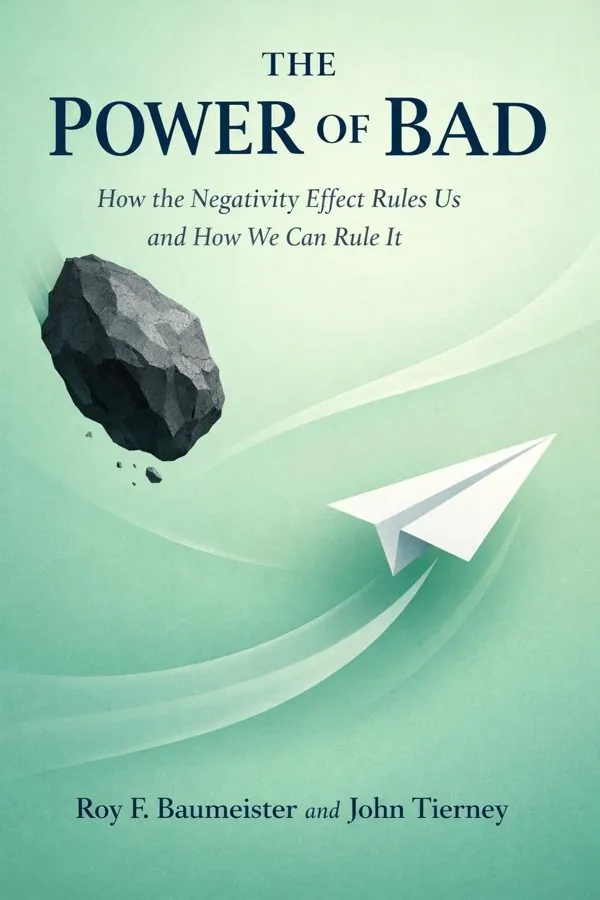
The Power of Bad: How the Negativity Effect Rules Us and How We Can Rule It: Summary & Key Insights
by Roy F. Baumeister, John Tierney
 10 min12 chaptersAudio available
What Is The Power of Bad: How the Negativity Effect Rules Us and How We Can Rule It About?
The Power of Bad: How the Negativity Effect Rules Us and How We Can Rule It by Roy F. Baumeister and John Tierney is a psychology book spanning 12 pages. In this book, social psychologist Roy F. Baumeister and science writer John Tierney explore the 'negativity effect'—the psychological phenomenon that bad events, emotions, and feedback have a stronger impact on our minds than good ones. Drawing on decades of research in psychology, neuroscience, and behavioral economics, the authors explain how this bias shapes our relationships, workplaces, and societies, and offer strategies to counteract it by emphasizing positive reinforcement, gratitude, and resilience.
This FizzRead summary covers all 12 key chapters of The Power of Bad: How the Negativity Effect Rules Us and How We Can Rule It in approximately 10 minutes, distilling the most important ideas, arguments, and takeaways from Roy F. Baumeister and John Tierney's work. Also available as an audio summary and Key Quotes Podcast.
The Power of Bad: How the Negativity Effect Rules Us and How We Can Rule It
In this book, social psychologist Roy F. Baumeister and science writer John Tierney explore the 'negativity effect'—the psychological phenomenon that bad events, emotions, and feedback have a stronger impact on our minds than good ones. Drawing on decades of research in psychology, neuroscience, and behavioral economics, the authors explain how this bias shapes our relationships, workplaces, and societies, and offer strategies to counteract it by emphasizing positive reinforcement, gratitude, and resilience.
Who Should Read The Power of Bad: How the Negativity Effect Rules Us and How We Can Rule It?
This book is perfect for anyone interested in psychology and looking to gain actionable insights in a short read. Whether you're a student, professional, or lifelong learner, the key ideas from The Power of Bad: How the Negativity Effect Rules Us and How We Can Rule It by Roy F. Baumeister and John Tierney will help you think differently.
- ✓Readers who enjoy psychology and want practical takeaways
- ✓Professionals looking to apply new ideas to their work and life
- ✓Anyone who wants the core insights of The Power of Bad: How the Negativity Effect Rules Us and How We Can Rule It in just 10 minutes
Want the full summary?
Get instant access to this book summary and 100K+ more with Fizz Moment.
Get Free SummaryAvailable on App Store • Free to download
Key Chapters
When I first encountered the concept that bad is stronger than good, it felt both intuitive and unsettling. Every psychologist knows that our minds cling to bad experiences. A single mistake overshadows a record of successes; one betrayal erases months of trust. In chapter one, we lay out the evidence—the brain’s response to negative stimuli is faster, stronger, and more persistent than its reaction to positive ones. Evolution wired us this way because vigilance against threats had survival value. Happiness could wait; danger couldn’t. This effect operates on a simple rule: the bad weighs more heavily than the good. In experiments on memory and emotion, participants remember insults longer than praise, tragedies longer than triumphs. Even neutral experiences are interpreted through the shadow cast by negativity. It’s why media thrives on outrage and fear, and why gossip spreads when it’s unpleasant. Yet understanding this effect offers power. Once you see that bad dominates perception, you start noticing how easily it distorts judgment. You recognize that most impressions of decline or dysfunction—whether in relationships or society—stem not from factual change but from emotional amplification. The negativity effect isn’t destiny; it’s a bias we can learn to regulate. The rest of the book isn’t just about describing the beast, but about taming it.
To grasp why bad gained supremacy, we trace it back to our evolutionary past. Imagine early humans scanning the savanna. Those who ignored possible dangers—rustling grass, unfamiliar shapes—didn’t last long enough to reproduce. Our nervous system therefore became exquisitely tuned to threats. Loss, pain, rejection—these served as warnings that demanded attention. Over time, this sensitivity turned into a bias. Bad outcomes created stronger learning. When a hunter failed and risked starvation, he learned intensely to avoid that mistake. Success rewarded him, but not with the same urgency. Neuroscience confirms this pattern today: the amygdala and other threat-detection circuits light up more readily than the areas processing reward. Economists see it too—people fear losses more than they seek gains. This asymmetry shapes behavior from personal investment to politics. But evolution has not doomed us to pessimism. The brilliant paradox is that once we recognize the origins of our negativity bias, we can build systems that outsmart it. Awareness is the first step toward mastery. Civilization itself is an effort to buffer against excessive fear—a way to replace instinct with structure. In modern life, the balance has tilted too far: we are safe, yet bombarded by signals of danger. The challenge before us is not to erase our negativity bias, but to harness it—to use its vigilance while refusing its distortion.
+ 10 more chapters — available in the FizzRead app
All Chapters in The Power of Bad: How the Negativity Effect Rules Us and How We Can Rule It
About the Authors
Roy F. Baumeister is an American social psychologist known for his research on self-control, decision-making, and the psychology of evil. John Tierney is a science journalist and columnist for The New York Times, recognized for his work on behavioral science and social trends.
Get This Summary in Your Preferred Format
Read or listen to the The Power of Bad: How the Negativity Effect Rules Us and How We Can Rule It summary by Roy F. Baumeister and John Tierney anytime, anywhere. FizzRead offers multiple formats so you can learn on your terms — all free.
Available formats: App · Audio · PDF · EPUB — All included free with FizzRead
Download The Power of Bad: How the Negativity Effect Rules Us and How We Can Rule It PDF and EPUB Summary
Key Quotes from The Power of Bad: How the Negativity Effect Rules Us and How We Can Rule It
“When I first encountered the concept that bad is stronger than good, it felt both intuitive and unsettling.”
“To grasp why bad gained supremacy, we trace it back to our evolutionary past.”
Frequently Asked Questions about The Power of Bad: How the Negativity Effect Rules Us and How We Can Rule It
The Power of Bad: How the Negativity Effect Rules Us and How We Can Rule It by Roy F. Baumeister and John Tierney is a psychology book that explores key ideas across 12 chapters. In this book, social psychologist Roy F. Baumeister and science writer John Tierney explore the 'negativity effect'—the psychological phenomenon that bad events, emotions, and feedback have a stronger impact on our minds than good ones. Drawing on decades of research in psychology, neuroscience, and behavioral economics, the authors explain how this bias shapes our relationships, workplaces, and societies, and offer strategies to counteract it by emphasizing positive reinforcement, gratitude, and resilience.
You Might Also Like
The Body Keeps the Score
Bessel van der Kolk
10 min
Surrounded by Idiots
Thomas Erikson
10 min
Emotional Intelligence
Daniel Goleman
10 min
Attached
Amir Levine
10 min
Why Does He Do That
Lundy Bancroft
10 min
Women Who Run with the Wolves
Clarissa Pinkola Estés
10 minBrowse by Category
Ready to read The Power of Bad: How the Negativity Effect Rules Us and How We Can Rule It?
Get the full summary and 100K+ more books with Fizz Moment.