
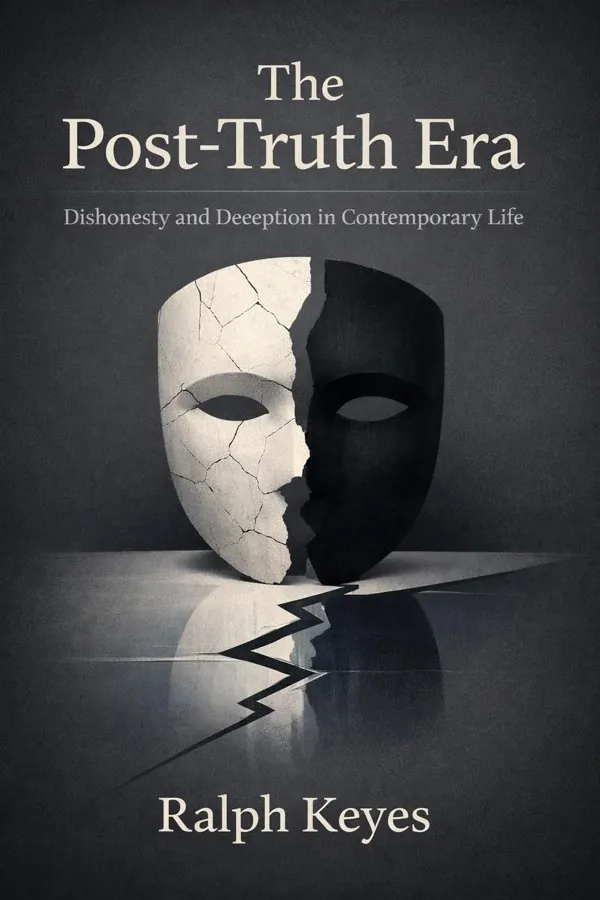
The Post-Truth Era: Dishonesty and Deception in Contemporary Life: Summary & Key Insights
by Ralph Keyes
 10 min9 chaptersAudio available
Key Takeaways from The Post-Truth Era: Dishonesty and Deception in Contemporary Life
A society changes profoundly when honesty stops being admired even by those who fail to live up to it.
When people stop believing that truth is stable, deception becomes easier to defend.
Most dishonesty survives because it is psychologically comfortable before it is socially useful.
Language does more than describe reality; it can anesthetize our moral response to it.
The modern information environment does not merely transmit dishonesty; it often incentivizes it.
What Is The Post-Truth Era: Dishonesty and Deception in Contemporary Life About?
The Post-Truth Era: Dishonesty and Deception in Contemporary Life by Ralph Keyes is a sociology book spanning 11 pages. In The Post-Truth Era, Ralph Keyes examines a disturbing transformation in modern life: the movement from occasional lying to a culture that increasingly tolerates, rewards, and even expects deception. Rather than treating dishonesty as a private moral failure, Keyes shows how it has become woven into public institutions, professional norms, media habits, and everyday relationships. Politics, advertising, self-presentation, education, and personal ambition all play a role in blurring the line between truth and manipulation. What makes the book powerful is its insistence that post-truth is not just about famous lies or public scandals. It is also about softer forms of evasion—spin, exaggeration, selective omission, strategic ambiguity, and euphemism—that allow people to mislead without feeling fully dishonest. Keyes argues that this normalization of deception weakens trust, corrodes civic life, and leaves individuals morally disoriented. As an author known for exploring language, culture, and contemporary behavior, Keyes brings both social observation and ethical clarity to the subject. His book remains highly relevant because it helps readers recognize how dishonesty operates today—and why defending truth is now a cultural as well as personal responsibility.
This FizzRead summary covers all 9 key chapters of The Post-Truth Era: Dishonesty and Deception in Contemporary Life in approximately 10 minutes, distilling the most important ideas, arguments, and takeaways from Ralph Keyes's work. Also available as an audio summary and Key Quotes Podcast.
The Post-Truth Era: Dishonesty and Deception in Contemporary Life
In The Post-Truth Era, Ralph Keyes examines a disturbing transformation in modern life: the movement from occasional lying to a culture that increasingly tolerates, rewards, and even expects deception. Rather than treating dishonesty as a private moral failure, Keyes shows how it has become woven into public institutions, professional norms, media habits, and everyday relationships. Politics, advertising, self-presentation, education, and personal ambition all play a role in blurring the line between truth and manipulation.
What makes the book powerful is its insistence that post-truth is not just about famous lies or public scandals. It is also about softer forms of evasion—spin, exaggeration, selective omission, strategic ambiguity, and euphemism—that allow people to mislead without feeling fully dishonest. Keyes argues that this normalization of deception weakens trust, corrodes civic life, and leaves individuals morally disoriented.
As an author known for exploring language, culture, and contemporary behavior, Keyes brings both social observation and ethical clarity to the subject. His book remains highly relevant because it helps readers recognize how dishonesty operates today—and why defending truth is now a cultural as well as personal responsibility.
Who Should Read The Post-Truth Era: Dishonesty and Deception in Contemporary Life?
This book is perfect for anyone interested in sociology and looking to gain actionable insights in a short read. Whether you're a student, professional, or lifelong learner, the key ideas from The Post-Truth Era: Dishonesty and Deception in Contemporary Life by Ralph Keyes will help you think differently.
- ✓Readers who enjoy sociology and want practical takeaways
- ✓Professionals looking to apply new ideas to their work and life
- ✓Anyone who wants the core insights of The Post-Truth Era: Dishonesty and Deception in Contemporary Life in just 10 minutes
Want the full summary?
Get instant access to this book summary and 100K+ more with Fizz Moment.
Get Free SummaryAvailable on App Store • Free to download
Key Chapters
A society changes profoundly when honesty stops being admired even by those who fail to live up to it. Keyes begins from the idea that lying is not new; human beings have always deceived, concealed, and manipulated. What is new is the weakening of truth’s moral prestige. In earlier periods, people still generally treated honesty as a virtue, even when they violated it. A liar might excuse the act, hide it, or feel ashamed of it. That shame mattered because it preserved a shared standard.
Keyes argues that in contemporary culture, this standard has eroded. Dishonesty is no longer always seen as a moral breach. It is often reframed as strategy, image management, diplomacy, branding, negotiation, or self-protection. This shift is important because once truth becomes only one option among many, deception can flourish without moral resistance. People stop asking, “Is this true?” and start asking, “Does this work?”
You can see this in public life when leaders defend false statements as narrative framing, in workplaces where performance is polished beyond reality, or in personal settings where people curate selective versions of themselves to appear more successful, stable, or happy. Even small deceptions contribute to a culture in which authenticity feels naive and accuracy seems optional.
Keyes does not claim that earlier societies were more honest in practice. His point is subtler: they more clearly recognized honesty as an ideal worth defending. When that ideal weakens, society loses one of its most important moral anchors.
Actionable takeaway: Notice where you excuse falsehood because it feels useful or socially convenient, and deliberately restore one simple rule in your own life: truth deserves preference even when it is uncomfortable.
When people stop believing that truth is stable, deception becomes easier to defend. Keyes connects the rise of post-truth culture to broader intellectual and cultural shifts that questioned certainty, authority, and objectivity. Some of these developments were valuable. They helped expose hypocrisy, challenge rigid dogma, and remind us that perspective shapes perception. But Keyes warns that these insights can be stretched into something corrosive: the belief that truth itself is merely subjective.
Once that mindset spreads, factual disagreement begins to look like a matter of preference rather than evidence. If everyone is assumed to have their own truth, then accuracy loses force and sincerity becomes enough. A person no longer needs to be correct; they only need to claim authenticity. This creates fertile ground for exaggeration, selective storytelling, and ideological distortion.
In practice, this appears in arguments where people dismiss well-supported facts as just another opinion, or in organizations that replace clear accountability with endlessly flexible interpretations. It also appears in personal life when individuals rationalize deceptive behavior by saying their version felt emotionally true, even if it was materially misleading.
Keyes is not defending simplistic certainty. He acknowledges that human knowledge is limited and complicated. His concern is that healthy skepticism has drifted into moral and factual looseness. In such an environment, deception no longer feels like a clear violation because there is no longer a clear standard being violated.
The post-truth era thrives not only on lies but on confusion about whether truth can be meaningfully defended at all. Once ambiguity becomes cultural habit, manipulation gains room to operate.
Actionable takeaway: Distinguish between perspective and fact. Respect differing interpretations, but insist on evidence, verifiability, and precision when claims affect public trust or important decisions.
Most dishonesty survives because it is psychologically comfortable before it is socially useful. Keyes emphasizes that human beings are remarkably skilled at self-deception. We often do not begin by deliberately trying to fool others; we begin by softening reality for ourselves. We reinterpret motives, minimize failures, inflate our good intentions, and construct narratives that protect our self-image. Once we believe those stories, passing them along to others feels easier.
This is a crucial insight because it explains why dishonesty can persist even among people who see themselves as ethical. A manager exaggerates a forecast because optimism feels responsible. A student calls cheating “collaboration.” A politician reframes an inconsistency as evolving judgment. A partner hides details of a conflict because they prefer to think of themselves as kind rather than evasive. In each case, self-deception reduces inner friction.
Keyes suggests that contemporary culture often rewards these habits. Confidence is praised more than accuracy, positivity more than candor, and persuasive storytelling more than sober honesty. Over time, people learn to value the version of reality that feels empowering, flattering, or strategically useful.
The danger is not only personal confusion. Self-deception weakens accountability. If individuals sincerely believe their own distortions, correction starts to feel like attack. That makes honest conversation harder in families, institutions, and politics alike.
Recognizing this pattern requires humility. It means accepting that dishonesty is not always obvious, dramatic, or intentional. Sometimes it looks like selective memory, moral rationalization, or emotionally convenient interpretation. The post-truth era is sustained as much by internal editing as by external propaganda.
Actionable takeaway: Build a habit of self-audit. When you defend your choices, ask: What facts am I avoiding because they threaten the story I prefer to tell about myself?
Language does more than describe reality; it can anesthetize our moral response to it. Keyes pays close attention to euphemism, spin, and verbal softening because they allow deception to spread without sounding harsh or obviously false. Instead of admitting a lie, people speak of misstatements, narrative adjustments, impression management, strategic communication, or plausible deniability. The result is a culture where words blur responsibility rather than clarify it.
This matters because moral judgment often depends on naming things accurately. If layoffs become rightsizing, civilian deaths become collateral damage, cheating becomes gaming the system, and false advertising becomes promotional framing, people feel less urgency to confront what is really happening. Euphemism creates emotional distance. It lets institutions preserve legitimacy while avoiding plain admission.
Everyday life is full of such examples. Employees may hide weak performance behind polished jargon. Public relations teams may frame serious misconduct as a process issue. Individuals may describe gossip as concern, manipulation as influence, or dishonesty as tact. The wording changes, but the underlying act remains deceptive.
Keyes shows that in a post-truth culture, language itself becomes a defensive shield. The more fluent a society becomes in verbal evasions, the harder it is to sustain honest accountability. If words are constantly used to soften, redirect, or obscure, citizens lose one of their main tools for resisting deception: clear description.
The solution is not bluntness for its own sake. Precision can still be humane. But ethical language should illuminate rather than camouflage. Honest speech makes consequences visible.
Actionable takeaway: Pay attention to softened wording. When you hear polished language in public or private settings, translate it into plain speech and ask whether the simpler version reveals avoidance or manipulation.
The modern information environment does not merely transmit dishonesty; it often incentivizes it. Keyes argues that media culture, especially in its faster and more competitive forms, favors attention-grabbing claims, emotional framing, and simplified narratives over patient verification. In such a system, being first can matter more than being right, and being memorable can matter more than being accurate.
This creates a dangerous cycle. Public figures learn that bold statements travel farther than cautious truth. Media outlets amplify conflict because outrage retains audiences. Repetition gives weak claims a sense of familiarity, and familiarity is often mistaken for truth. Meanwhile, corrections rarely spread with the same force as the original distortion.
Technology intensifies these effects. Digital platforms reward speed, shareability, and emotional reaction. Rumors, edited clips, selective statistics, and misleading headlines circulate before context can catch up. Ordinary people become participants in the chain by forwarding information that confirms their views or performs their identity.
Keyes is especially concerned with how this environment changes habits of judgment. Instead of asking whether a claim is well supported, many people ask whether it feels plausible, fits their tribe, or arrives from a trusted personality. This weakens the social discipline required for truth-seeking.
The issue is not that all media are dishonest. Rather, the structure of modern communication often favors distortion unless people actively resist it. Journalism, technology, and audience behavior all shape whether truth can survive public competition.
Actionable takeaway: Slow down your information habits. Before sharing a claim, check the source, look for corroboration, and ask whether the content is informing you or merely triggering you.
Political lying becomes especially dangerous when citizens stop expecting better. Keyes shows how public discourse in the post-truth era is shaped not just by factual inaccuracy, but by the normalization of spin, denial, selective omission, and performative certainty. Politicians have always shaded the truth, but the deeper problem arises when dishonesty becomes accepted as part of the game rather than recognized as a breach of public trust.
In this environment, leaders often communicate less to inform than to control perception. They test narratives, exploit ambiguity, deny what is documented, and reframe failures as attacks from opponents or media enemies. Supporters may tolerate falsehood because they value loyalty, identity, or policy victory more than factual integrity. Opponents may respond with equal distortion, deepening cynicism on all sides.
The result is a public sphere where truth loses authority as a common reference point. Debate becomes harder because citizens no longer share enough agreed-upon reality to argue productively. Institutions suffer too. When officials repeatedly evade accountability, people begin to doubt not just specific leaders but the legitimacy of public life itself.
Keyes warns that democracy depends on more than voting. It requires a culture in which evidence matters, language has consequences, and deception carries reputational cost. Without that, politics drifts toward spectacle, tribalism, and strategic falsehood.
This insight applies beyond national campaigns. It also appears in local leadership, organizational governance, and community decision-making. Wherever persuasion is detached from truth, trust becomes fragile.
Actionable takeaway: Evaluate public figures not only by whether their message aligns with your preferences, but by whether they demonstrate consistency, factual discipline, and willingness to correct false claims.
Markets do not automatically punish dishonesty; they often reward it in the short term. Keyes explores how modern professional culture can normalize deception through incentives tied to image, competition, growth, and performance. In business settings, falsehood rarely arrives as an outright confession of fraud. More often it appears as strategic exaggeration, selective disclosure, inflated promises, manipulated metrics, or polished impressions that conceal inconvenient realities.
Professionals may justify these practices by appealing to pressure. Sales teams overstate capabilities to close deals. Executives present optimistic projections to reassure investors. Companies hide defects behind legal wording. Employees reshape résumés, expense reports, or productivity claims to stay competitive. Each act may seem minor in isolation, but together they create institutional dishonesty.
Keyes argues that the deeper issue is moral drift. When organizations prioritize results above integrity, people quickly learn what is really rewarded. Ethical codes may exist on paper, yet everyday behavior is shaped by incentives, leadership examples, and tolerated shortcuts. If those in power bend the truth without consequence, deception spreads downward.
This is not only a legal problem; it is a cultural one. A workplace that normalizes misleading communication eventually weakens morale, trust, and decision quality. Bad information leads to bad judgment. Teams cannot solve problems they are discouraged from describing honestly.
Keyes invites readers to see professional ethics not as idealistic decoration but as practical necessity. Sustainable institutions depend on truthful reporting, candid communication, and accountability.
Actionable takeaway: In work settings, reward accuracy as much as success. If you lead others, create conditions where people can report problems honestly without fearing punishment for delivering inconvenient truths.
The post-truth era is not confined to headlines and scandals; it lives in ordinary relationships. Keyes insists that everyday deception deserves serious attention because social trust is built locally before it is tested nationally. People lie to avoid conflict, protect image, spare feelings, maintain convenience, or preserve control. Many of these lies appear harmless, yet repeated evasion can quietly damage intimacy and character.
In friendships and families, deception often takes subtle forms: withheld information, staged emotions, false reassurance, excuse-making, and self-serving omissions. In romance, people may hide dissatisfaction, financial realities, commitments, or past behavior. On social platforms, curated self-presentation can create lives that look authentic but are built on selective display. These habits teach people to relate through performance rather than truth.
Keyes does not deny that tact and privacy have a place. Not every thought must be spoken, and honesty need not be cruelty. His concern is that many modern relationships rely on image maintenance so heavily that genuine trust becomes difficult. If people fear that honesty will always be punished or that appearance matters more than reality, they become skilled at emotional editing.
The cost is cumulative. Small lies create uncertainty. They make others question what is real, what is missing, and whether closeness is based on truth or convenience. Over time, deception can become less about isolated statements and more about living behind a managed persona.
Healthy relationships require more than affection; they require credibility. Trust grows when words, actions, and intentions align consistently.
Actionable takeaway: Choose one important relationship and strengthen it through clearer truth-telling—especially where you are tempted to hide discomfort, disappointment, or uncertainty behind convenient half-truths.
Honesty is not sustained by slogans; it must be taught, modeled, and practiced. Keyes argues that a culture of truth depends on moral development long before people enter politics, media, or business. Families, schools, peer groups, and institutions shape whether individuals see honesty as a living discipline or merely as a rule to invoke when useful.
One of Keyes’s concerns is that contemporary education often emphasizes achievement, self-esteem, and performance more than character. Students quickly learn to optimize outcomes, sometimes by cutting corners, borrowing language, gaming evaluations, or rationalizing minor dishonesty as normal competition. If adults respond inconsistently—punishing some lies while rewarding strategic ones—young people absorb confusion rather than principle.
Moral education, in Keyes’s view, is not just about teaching children not to lie. It is about helping them understand why truth matters for trust, fairness, responsibility, and civic life. It also means exposing them to adults who admit mistakes, correct errors, and show that honesty can coexist with ambition and compassion.
This lesson applies to adults as well. Institutions continue to educate us by what they reward. A company that values transparent reporting teaches truthfulness. A school that tolerates plagiarism teaches its opposite. A family that can discuss mistakes without humiliation makes honesty safer and more natural.
Ultimately, Keyes sees restoring truth as an everyday cultural project. People do not become more honest through abstraction alone. They become more honest through habits, examples, and environments that make candor possible and respectable.
Actionable takeaway: Create one regular practice that reinforces honesty—such as admitting mistakes quickly, crediting sources carefully, or inviting candid feedback without retaliation.
All Chapters in The Post-Truth Era: Dishonesty and Deception in Contemporary Life
About the Author
Ralph Keyes is an American author and lecturer known for his wide-ranging work on language, ethics, creativity, and contemporary social behavior. Across his books and essays, he has explored how people communicate, how ambition shapes identity, and how modern culture influences moral judgment. Keyes is especially valued for translating complex social trends into clear, engaging prose that speaks to general readers without sacrificing insight. His writing has appeared in prominent publications, and he has built a reputation as a thoughtful observer of everyday life and public discourse. In The Post-Truth Era, he draws on that background to examine the growing normalization of dishonesty in modern society, offering a sharp and still-relevant account of how deception has become embedded in institutions, media, and personal relationships.
Get This Summary in Your Preferred Format
Read or listen to the The Post-Truth Era: Dishonesty and Deception in Contemporary Life summary by Ralph Keyes anytime, anywhere. FizzRead offers multiple formats so you can learn on your terms — all free.
Available formats: App · Audio · PDF · EPUB — All included free with FizzRead
Download The Post-Truth Era: Dishonesty and Deception in Contemporary Life PDF and EPUB Summary
Key Quotes from The Post-Truth Era: Dishonesty and Deception in Contemporary Life
“A society changes profoundly when honesty stops being admired even by those who fail to live up to it.”
“When people stop believing that truth is stable, deception becomes easier to defend.”
“Most dishonesty survives because it is psychologically comfortable before it is socially useful.”
“Language does more than describe reality; it can anesthetize our moral response to it.”
“The modern information environment does not merely transmit dishonesty; it often incentivizes it.”
Frequently Asked Questions about The Post-Truth Era: Dishonesty and Deception in Contemporary Life
The Post-Truth Era: Dishonesty and Deception in Contemporary Life by Ralph Keyes is a sociology book that explores key ideas across 9 chapters. In The Post-Truth Era, Ralph Keyes examines a disturbing transformation in modern life: the movement from occasional lying to a culture that increasingly tolerates, rewards, and even expects deception. Rather than treating dishonesty as a private moral failure, Keyes shows how it has become woven into public institutions, professional norms, media habits, and everyday relationships. Politics, advertising, self-presentation, education, and personal ambition all play a role in blurring the line between truth and manipulation. What makes the book powerful is its insistence that post-truth is not just about famous lies or public scandals. It is also about softer forms of evasion—spin, exaggeration, selective omission, strategic ambiguity, and euphemism—that allow people to mislead without feeling fully dishonest. Keyes argues that this normalization of deception weakens trust, corrodes civic life, and leaves individuals morally disoriented. As an author known for exploring language, culture, and contemporary behavior, Keyes brings both social observation and ethical clarity to the subject. His book remains highly relevant because it helps readers recognize how dishonesty operates today—and why defending truth is now a cultural as well as personal responsibility.
More by Ralph Keyes

You Might Also Like
Between the World and Me
Ta-Nehisi Coates
10 min
Half the Sky
Nicholas D. Kristof, Sheryl WuDunn
10 min
Men Explain Things To Me
Rebecca Solnit
10 min
Rational Ritual
Michael Suk-Young Chwe
10 min
The New Jim Crow
Michelle Alexander
10 min
Beyond Culture
Edward T. Hall
10 minBrowse by Category
Ready to read The Post-Truth Era: Dishonesty and Deception in Contemporary Life?
Get the full summary and 100K+ more books with Fizz Moment.