
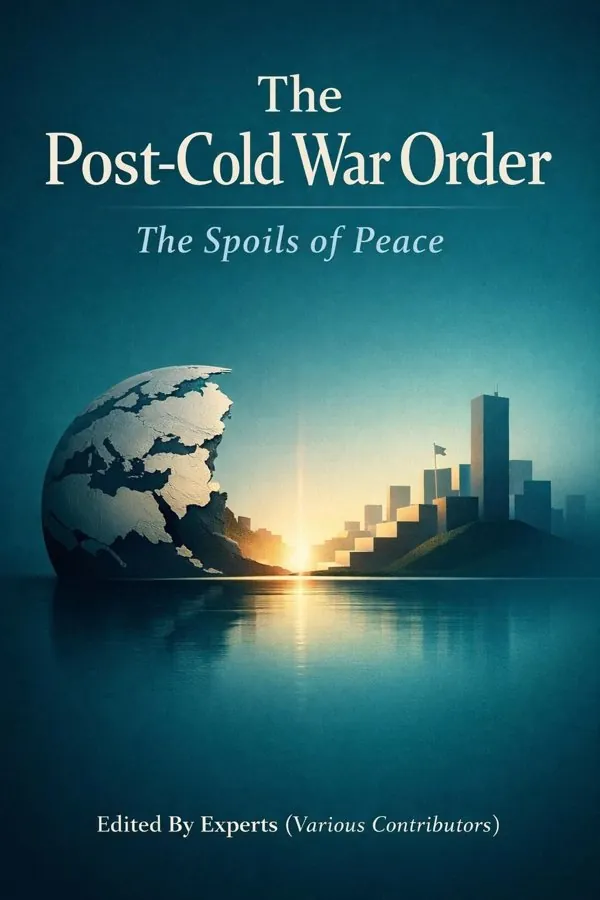
The Post-Cold War Order: The Spoils of Peace: Summary & Key Insights
by Edited By Experts (Various Contributors)
 10 min6 chaptersAudio available
What Is The Post-Cold War Order: The Spoils of Peace About?
The Post-Cold War Order: The Spoils of Peace by Edited By Experts (Various Contributors) is a politics book spanning 6 pages. This collection of scholarly essays examines the transformation of international relations, security structures, and global governance following the end of the Cold War. Contributors analyze the geopolitical shifts, the rise of new powers, and the evolving role of institutions such as NATO and the United Nations in shaping the post-Cold War world order.
This FizzRead summary covers all 6 key chapters of The Post-Cold War Order: The Spoils of Peace in approximately 10 minutes, distilling the most important ideas, arguments, and takeaways from Edited By Experts (Various Contributors)'s work. Also available as an audio summary and Key Quotes Podcast.
The Post-Cold War Order: The Spoils of Peace
This collection of scholarly essays examines the transformation of international relations, security structures, and global governance following the end of the Cold War. Contributors analyze the geopolitical shifts, the rise of new powers, and the evolving role of institutions such as NATO and the United Nations in shaping the post-Cold War world order.
Who Should Read The Post-Cold War Order: The Spoils of Peace?
This book is perfect for anyone interested in politics and looking to gain actionable insights in a short read. Whether you're a student, professional, or lifelong learner, the key ideas from The Post-Cold War Order: The Spoils of Peace by Edited By Experts (Various Contributors) will help you think differently.
- ✓Readers who enjoy politics and want practical takeaways
- ✓Professionals looking to apply new ideas to their work and life
- ✓Anyone who wants the core insights of The Post-Cold War Order: The Spoils of Peace in just 10 minutes
Want the full summary?
Get instant access to this book summary and 100K+ more with Fizz Moment.
Get Free SummaryAvailable on App Store • Free to download
Key Chapters
The disintegration of the Soviet Union in 1991 was both an event and a process — a sudden geopolitical rupture followed by gradual reordering. The essays in this section explore how Europe and Eurasia redefined themselves amid the collapse of a superpower. In the author’s view, the geopolitical landscape of the early 1990s was marked by unequal transitions. Russia, inheriting the Soviet legacy, bore the weight of economic instability and identity crisis, while newly independent states in Central Asia and Eastern Europe sought sovereignty but faced fragile institutions and uncertain borders.
The 'spoils of peace' here included access to markets, control over nuclear arsenals, and influence over emerging democratic spaces. Western Europe, under American guidance, quickly moved to integrate Central and Eastern European nations through political and economic frameworks that would later culminate in EU and NATO enlargement. Yet this process was far from uncontested. For many in Russia and its neighbors, the loss of empire was not a clean separation but a lingering wound. Energy politics, ethnic tensions, and the unresolved status of regions like Chechnya revealed how the Cold War’s geographic boundaries endured in memory and influence.
Through analytical depth, the contributors highlight how the dissolution of the Soviet Union did not simply end bipolarity; it inaugurated an ambiguous era in which unipolar dominance coexisted with regional fragmentation. The post-Soviet moment was a crucible — testing whether international institutions could absorb instability and whether global governance could adapt to the sudden emergence of weak states and uncertain alliances. This chapter captures the sense of both liberation and disorientation that defined 1991 and its aftermath.
In the Cold War, NATO was a defensive shield against Soviet expansion. In the post-Cold War world, it became something far more fluid — a mechanism for managing crises and shaping regional security beyond its traditional borders. The essays describe NATO’s transition from deterrence to intervention, from defending territory to projecting stability.
The author explains that this transformation was institutional as well as conceptual. The alliance sought new legitimacy by reinterpreting its mission: security was no longer about dividing Europe but integrating it. The Balkan wars forced NATO to act, testing its capacity to engage in peace enforcement rather than mere defense. In Bosnia and later Kosovo, NATO assumed roles that blurred the boundaries between military intervention and humanitarian protection.
By the late 1990s, expansion became a central theme. Incorporating former Warsaw Pact countries represented not just a geographic enlargement, but a symbolic redefinition of Europe’s security architecture. Yet critics argued that NATO’s growth provoked Russia and complicated the vision of cooperative security. Through these essays, readers grasp the nuanced tension between inclusion and division — between stabilizing Europe and unsettling the remnants of Soviet influence.
What emerges is an image of NATO as a mirror of Western ambition and anxiety. It embodied the desire for collective responsibility but also revealed the limitations of military diplomacy in a post-ideological age. The shift from defense to management underscored that peace itself required active maintenance, coordination, and often difficult moral choices.
+ 4 more chapters — available in the FizzRead app
All Chapters in The Post-Cold War Order: The Spoils of Peace
About the Author
The volume is edited by a group of international relations scholars and policy experts specializing in global security, diplomacy, and international political economy.
Get This Summary in Your Preferred Format
Read or listen to the The Post-Cold War Order: The Spoils of Peace summary by Edited By Experts (Various Contributors) anytime, anywhere. FizzRead offers multiple formats so you can learn on your terms — all free.
Available formats: App · Audio · PDF · EPUB — All included free with FizzRead
Download The Post-Cold War Order: The Spoils of Peace PDF and EPUB Summary
Key Quotes from The Post-Cold War Order: The Spoils of Peace
“The disintegration of the Soviet Union in 1991 was both an event and a process — a sudden geopolitical rupture followed by gradual reordering.”
“In the Cold War, NATO was a defensive shield against Soviet expansion.”
Frequently Asked Questions about The Post-Cold War Order: The Spoils of Peace
The Post-Cold War Order: The Spoils of Peace by Edited By Experts (Various Contributors) is a politics book that explores key ideas across 6 chapters. This collection of scholarly essays examines the transformation of international relations, security structures, and global governance following the end of the Cold War. Contributors analyze the geopolitical shifts, the rise of new powers, and the evolving role of institutions such as NATO and the United Nations in shaping the post-Cold War world order.
You Might Also Like
Antifa: The Anti-Fascist Handbook
Mark Bray
10 min
Attack from Within: How Disinformation Is Sabotaging America
Barbara McQuade
10 min
Coercion, Capital, and European States, AD 990–1992
Charles Tilly
10 min
Digital Democracy: Concepts, Methodologies, Tools, and Applications
Various Authors
10 min
Fascism
Stanley G. Payne
10 min
Fire And Fury: Inside The Trump White House
Michael Wolff
10 minBrowse by Category
Ready to read The Post-Cold War Order: The Spoils of Peace?
Get the full summary and 100K+ more books with Fizz Moment.