
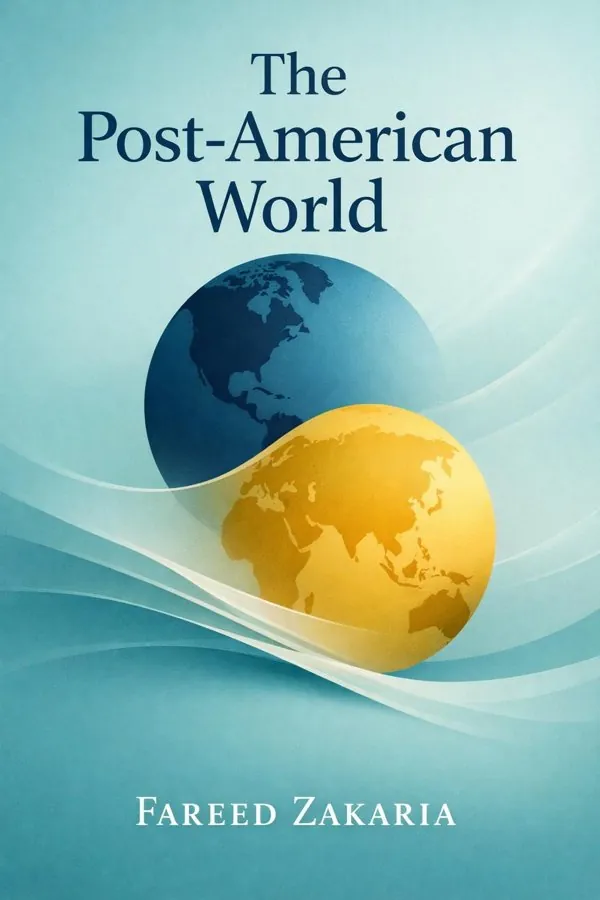
The Post-American World: Summary & Key Insights
 10 min9 chaptersAudio available
Key Takeaways from The Post-American World
The most important change in world politics is not that America is suddenly weak, but that many other countries are becoming stronger.
History rarely stands still, and every dominant power eventually confronts a changing world.
Globalization is often discussed as if it were an American project, but Zakaria shows that its deeper effect has been to enable the success of many others.
Few developments illustrate the post-American world more clearly than China’s ascent.
If China represents disciplined, state-driven acceleration, India represents a slower, noisier, but equally significant route to national rise.
What Is The Post-American World About?
The Post-American World by Fareed Zakaria is a politics book spanning 9 pages. What happens when the most powerful country in modern history is still strong, yet no longer able to shape the world alone? In The Post-American World, Fareed Zakaria argues that the defining story of our era is not America’s collapse but the rapid rise of other nations. Countries such as China and India, along with a wider group of emerging powers, are gaining economic strength, political confidence, and cultural influence. The result is a world in which power is more distributed, competition is more complex, and leadership depends less on command than on adaptation. Zakaria’s book matters because it offers a framework for understanding today’s geopolitical reality: globalization has spread wealth, technology, and ambition far beyond the West. Rather than treating this as a catastrophe, he sees it as a historic transformation that America can navigate successfully if it responds with intelligence and strategic restraint. Drawing on history, economics, diplomacy, and political analysis, Zakaria writes with unusual authority. As a prominent journalist, foreign policy commentator, and scholar of international affairs, he is especially well placed to explain how the United States can remain influential in a world it no longer dominates uncontested.
This FizzRead summary covers all 9 key chapters of The Post-American World in approximately 10 minutes, distilling the most important ideas, arguments, and takeaways from Fareed Zakaria's work. Also available as an audio summary and Key Quotes Podcast.
The Post-American World
What happens when the most powerful country in modern history is still strong, yet no longer able to shape the world alone? In The Post-American World, Fareed Zakaria argues that the defining story of our era is not America’s collapse but the rapid rise of other nations. Countries such as China and India, along with a wider group of emerging powers, are gaining economic strength, political confidence, and cultural influence. The result is a world in which power is more distributed, competition is more complex, and leadership depends less on command than on adaptation.
Zakaria’s book matters because it offers a framework for understanding today’s geopolitical reality: globalization has spread wealth, technology, and ambition far beyond the West. Rather than treating this as a catastrophe, he sees it as a historic transformation that America can navigate successfully if it responds with intelligence and strategic restraint. Drawing on history, economics, diplomacy, and political analysis, Zakaria writes with unusual authority. As a prominent journalist, foreign policy commentator, and scholar of international affairs, he is especially well placed to explain how the United States can remain influential in a world it no longer dominates uncontested.
Who Should Read The Post-American World?
This book is perfect for anyone interested in politics and looking to gain actionable insights in a short read. Whether you're a student, professional, or lifelong learner, the key ideas from The Post-American World by Fareed Zakaria will help you think differently.
- ✓Readers who enjoy politics and want practical takeaways
- ✓Professionals looking to apply new ideas to their work and life
- ✓Anyone who wants the core insights of The Post-American World in just 10 minutes
Want the full summary?
Get instant access to this book summary and 100K+ more with Fizz Moment.
Get Free SummaryAvailable on App Store • Free to download
Key Chapters
The most important change in world politics is not that America is suddenly weak, but that many other countries are becoming stronger. Zakaria’s central insight is that we are living through “the rise of the rest,” a broad redistribution of power from the West to a much wider set of actors. For centuries, economic dynamism, military reach, and cultural prestige were concentrated in Europe and then the United States. Now, growth is spreading across Asia, Latin America, the Middle East, and parts of Africa, creating a more plural world.
This shift can be seen in soaring urban development, rising middle classes, expanding higher education, and the growth of new corporate giants outside the United States. Cities like Shanghai, Bangalore, Dubai, and São Paulo symbolize the new geography of ambition. These societies are not merely copying the West; they are building their own versions of capitalism, governance, and modern identity. That means global power is no longer measured only by military bases or GDP totals, but also by innovation hubs, financial centers, consumer markets, and diplomatic networks.
For readers, this idea has a practical application: stop viewing international affairs through a simple decline narrative. Businesses should look for opportunity beyond traditional Western markets. Students should build global literacy, especially in Asia and other emerging regions. Policymakers should assume that influence now requires coalition-building rather than unilateral action.
Actionable takeaway: Replace the question “Is America falling?” with “How is global power being redistributed, and how should I adapt to that reality?”
History rarely stands still, and every dominant power eventually confronts a changing world. Zakaria places the present moment in a longer historical sequence of transitions, reminding readers that global leadership is never permanent. Yet he also stresses that today’s shift is unusual. The transfer from British primacy to American primacy happened largely within the Western world and among countries that shared many political and cultural assumptions. The current transition is broader, messier, and more diverse.
This matters because the rise of non-Western powers introduces new traditions, priorities, and political models into the global system. China does not approach sovereignty, state authority, or market organization in the same way as the United States. India blends democratic pluralism with uneven development and a distinct civilizational identity. Gulf states, Brazil, and other regional powers each add their own strategic interests. The result is not a neat handover from one hegemon to another, but a diffusion of influence across many centers.
Historical context helps prevent overreaction. Great powers often misread structural change as temporary turbulence. They may cling to old habits, overextend militarily, or ignore domestic renewal. Individuals and institutions can make the same mistake by assuming yesterday’s rules still govern tomorrow’s world. Understanding transitions encourages flexibility and humility.
A practical example is foreign policy planning. Instead of expecting a return to uncontested American dominance, governments and companies should prepare for persistent multipolarity, regional bargaining, and issue-by-issue alliances.
Actionable takeaway: Use history not to predict a repeat of the past, but to recognize that successful powers survive by adjusting early rather than resisting change too long.
Globalization is often discussed as if it were an American project, but Zakaria shows that its deeper effect has been to enable the success of many others. Open markets, technological diffusion, cross-border investment, and global supply chains have allowed countries once considered peripheral to accelerate growth and gain confidence. In that sense, globalization has not simply enriched the United States; it has redistributed capability across the world.
A manufacturer in China can integrate into global production networks. A software engineer in India can serve clients continents away. A sovereign wealth fund in the Gulf can invest strategically in major global industries. Universities, transportation systems, and digital networks connect talent and capital at extraordinary speed. As these capabilities spread, so does political leverage. Economic strength becomes the foundation for diplomatic influence, military modernization, and cultural presence.
Zakaria’s point is especially useful for understanding why the world feels more competitive today. The same systems that created prosperity also multiplied serious contenders. This has implications for careers, business strategy, and national policy. Protectionist nostalgia may sound appealing, but it cannot reverse the fact that talent and production are now globally distributed. The smarter response is to move up the value chain through innovation, education, and institutional excellence.
Consider how companies respond to global competition. The winners often are not those who retreat from international markets, but those who improve product quality, speed, and adaptability while operating globally.
Actionable takeaway: Don’t assume globalization guarantees dominance; treat it as a force that rewards those who continuously upgrade their skills, institutions, and competitive advantages.
Few developments illustrate the post-American world more clearly than China’s ascent. Zakaria presents China as the most dramatic example of a nation converting economic growth into geopolitical significance. In a few decades, China moved from relative isolation to become a central player in manufacturing, trade, infrastructure, technology, and diplomacy. Its rise has altered the assumptions of global politics.
What makes China so consequential is scale. Its population, state capacity, export power, and long-term ambition give it weight that smaller emerging economies cannot match. China builds ports, finances projects, expands military capabilities, and shapes international institutions in ways that affect every region. At the same time, Zakaria avoids simplistic conclusions. China’s rise is impressive, but it also faces internal pressures: demographic shifts, environmental strain, political rigidity, debt concerns, and the challenge of moving from imitation to sustained innovation.
For practical readers, the lesson is to understand China neither as an unstoppable juggernaut nor as a fragile illusion. It is a formidable, enduring power whose decisions will shape markets, technology, and security. Businesses need China literacy. Governments need strategies that combine deterrence, diplomacy, and realism. Citizens need to see that the future of global order will depend in part on how the United States and China manage rivalry without making conflict inevitable.
A useful application is strategic diversification: firms dependent on Chinese supply chains should plan alternatives, but they should also recognize that China remains too large to ignore.
Actionable takeaway: Study China seriously—as a long-term competitor, indispensable economic actor, and complex society—not as a caricature.
If China represents disciplined, state-driven acceleration, India represents a slower, noisier, but equally significant route to national rise. Zakaria highlights India as proof that modern influence can emerge through democratic pluralism rather than centralized command. India’s strengths include an entrepreneurial culture, English-language advantage, large and youthful population, strong private sector, and deep experience with diversity and debate.
India’s path matters because it broadens our understanding of power. Influence in the twenty-first century is not just about manufacturing output or military hardware. It also includes talent, diaspora networks, information technology, culture, legal institutions, and the legitimacy that can come from democratic openness. India’s software and service sectors, global business leaders, and vibrant civil society show how a country can be globally relevant even while struggling with infrastructure gaps, inequality, and bureaucratic friction.
Zakaria does not romanticize India. Its development has been uneven, and its governance challenges are real. Yet this is exactly why its progress is so instructive. It shows that rising powers do not have to look alike. A country can be chaotic and still creative, divided and still resilient. For investors, diplomats, and students, India demands attention not because it mirrors China, but because it offers a different model of ascent.
A practical application is comparative thinking. Instead of treating all emerging powers as one category, ask what specific assets each brings: demography, institutions, technology, geography, or culture.
Actionable takeaway: Evaluate rising countries on their unique strengths and trajectories, and recognize India as a long-term force whose democratic complexity is itself a strategic asset.
The post-American world is not being built by China and India alone. Zakaria emphasizes that a broader set of countries is gaining enough wealth, confidence, and regional influence to matter more than ever before. Brazil, Turkey, South Africa, Indonesia, the Gulf states, and others have become important players in trade, diplomacy, energy, finance, and regional security. Even when they are not superpowers, they can still shape outcomes.
This is a crucial shift because it means influence is now more layered. Regional powers can obstruct great-power plans, broker negotiations, or set agendas in institutions where their voices once carried little weight. Energy exporters can influence markets and strategic alignments. Middle powers can form blocs in global trade talks or climate negotiations. Smaller states with capital, geography, or diplomatic agility can become indispensable in specific issues.
For ordinary readers, this helps explain why world events no longer revolve around a single axis. A crisis in energy, migration, shipping, climate, or technology often involves a web of actors rather than one dominant state imposing a solution. This complexity can be frustrating, but it is also the defining reality of contemporary politics.
A practical example is multinational business strategy. Companies that focus only on the United States, Europe, and China may miss major opportunities in emerging consumer markets and infrastructure growth elsewhere. Likewise, policymakers who ignore regional powers often find their plans stalled.
Actionable takeaway: Build a wider map of relevance—identify the middle and regional powers shaping your sector, issue, or region, and factor them into every serious analysis.
A post-American world does not mean an anti-American world, nor does it mean the United States has become irrelevant. One of Zakaria’s most important corrections is that America still possesses extraordinary strengths: leading universities, unmatched innovative capacity, deep capital markets, military reach, a culture that attracts talent, and institutions that remain highly resilient compared with most competitors. The danger is not immediate collapse. The danger is complacency.
Zakaria argues that America often weakens itself less through external defeat than through internal dysfunction. Political polarization, fiscal irresponsibility, poor infrastructure, educational inequality, and overconfident foreign policy can erode long-term advantage. A nation can remain rich and powerful while still making choices that reduce its relative influence over time. In that sense, the greatest challenge to American leadership may come from within.
This argument is useful beyond national politics. It applies to organizations and individuals as well. Past success can breed rigidity. Dominant firms lose ground when they stop investing, assume loyalty, or ignore emerging competitors. Strong countries behave similarly when they neglect renewal.
A practical example is human capital. America’s continued edge depends heavily on attracting and educating talent. Immigration, research funding, and institutional openness are therefore strategic assets, not side issues.
Actionable takeaway: Treat strength as something to be renewed, not inherited. If you want lasting leadership—whether for a country, company, or career—invest in the domestic foundations that make adaptation possible.
When power is spread more widely, the old rules and institutions start to look outdated. Zakaria argues that global governance still reflects an earlier era, one shaped largely by Western dominance after World War II. Institutions such as the United Nations, World Bank, International Monetary Fund, and other bodies were designed for a world in which a narrow group of powers set the agenda. That world has changed faster than the institutions governing it.
This mismatch creates tension. Rising powers want a larger voice and more recognition. Established powers often want to preserve influence and familiar rules. The result can be paralysis, resentment, or the creation of competing institutions. Yet Zakaria’s broader point is not that international cooperation is obsolete. On the contrary, issues like climate change, terrorism, pandemics, financial instability, and nuclear proliferation make cooperation more necessary than ever. The challenge is to redesign legitimacy and representation so the system reflects current realities.
There is also a cultural dimension. Influence today is not only formal or military; it is shaped by media, education, migration, business, and popular culture. Soft power becomes more contested in a world where more societies are producing their own narratives and aspirations.
A practical implication is that successful leadership now requires inclusion. Countries and institutions that consult broadly and share prestige often accomplish more than those that simply demand compliance.
Actionable takeaway: If you want cooperation in a more crowded world, update the table rather than insisting others accept seats designed in a previous era.
In a world of rising powers, leadership is less about issuing orders and more about shaping environments. Zakaria argues that America’s best strategy is not to try to block every new center of power, but to guide the emerging order in ways that preserve openness, stability, and balance. That requires confidence, patience, and strategic restraint.
This is a demanding idea because restraint is often mistaken for weakness. But Zakaria suggests the opposite: mature power knows when direct control is impossible and when influence depends on enabling others to buy into a broader system. The United States succeeded after World War II not only because it was strong, but because it built institutions, alliances, and rules that others found beneficial. The challenge in the post-American world is to update that style of leadership, not abandon it.
Practical examples include burden-sharing with allies, supporting international institutions even when they are imperfect, and distinguishing between core interests and peripheral distractions. It also means investing in diplomacy, trade, and legitimacy, not just military capacity. For leaders in any field, the principle is similar: durable influence comes from setting terms, building trust, and attracting cooperation, not from micromanaging every outcome.
This idea has personal relevance too. In teams or organizations, people who insist on total control often produce resistance; those who create shared ownership often achieve more.
Actionable takeaway: Lead by building systems others want to join. In a multipolar world, the smartest form of power is the ability to shape choices without trying to dominate every actor.
All Chapters in The Post-American World
About the Author
Fareed Zakaria is an Indian-American journalist, author, and political commentator specializing in international affairs and global politics. Born in India, he later moved to the United States and studied at Yale University and Harvard University, where he earned a doctorate in political science. Zakaria became widely known through his writing for major publications and his role as host of CNN’s Fareed Zakaria GPS, a program focused on world events, diplomacy, and policy analysis. He is recognized for translating complex geopolitical developments into clear, accessible arguments for a broad audience. His work often examines globalization, democracy, emerging powers, and the evolving role of the United States in world affairs. Through books, columns, and television, Zakaria has become one of the most influential public interpreters of twenty-first-century international relations.
Get This Summary in Your Preferred Format
Read or listen to the The Post-American World summary by Fareed Zakaria anytime, anywhere. FizzRead offers multiple formats so you can learn on your terms — all free.
Available formats: App · Audio · PDF · EPUB — All included free with FizzRead
Download The Post-American World PDF and EPUB Summary
Key Quotes from The Post-American World
“The most important change in world politics is not that America is suddenly weak, but that many other countries are becoming stronger.”
“History rarely stands still, and every dominant power eventually confronts a changing world.”
“Globalization is often discussed as if it were an American project, but Zakaria shows that its deeper effect has been to enable the success of many others.”
“Few developments illustrate the post-American world more clearly than China’s ascent.”
“If China represents disciplined, state-driven acceleration, India represents a slower, noisier, but equally significant route to national rise.”
Frequently Asked Questions about The Post-American World
The Post-American World by Fareed Zakaria is a politics book that explores key ideas across 9 chapters. What happens when the most powerful country in modern history is still strong, yet no longer able to shape the world alone? In The Post-American World, Fareed Zakaria argues that the defining story of our era is not America’s collapse but the rapid rise of other nations. Countries such as China and India, along with a wider group of emerging powers, are gaining economic strength, political confidence, and cultural influence. The result is a world in which power is more distributed, competition is more complex, and leadership depends less on command than on adaptation. Zakaria’s book matters because it offers a framework for understanding today’s geopolitical reality: globalization has spread wealth, technology, and ambition far beyond the West. Rather than treating this as a catastrophe, he sees it as a historic transformation that America can navigate successfully if it responds with intelligence and strategic restraint. Drawing on history, economics, diplomacy, and political analysis, Zakaria writes with unusual authority. As a prominent journalist, foreign policy commentator, and scholar of international affairs, he is especially well placed to explain how the United States can remain influential in a world it no longer dominates uncontested.
You Might Also Like

Antifa: The Anti-Fascist Handbook
Mark Bray
10 min
Attack from Within: How Disinformation Is Sabotaging America
Barbara McQuade
10 min
Coercion, Capital, and European States, AD 990–1992
Charles Tilly
10 min
Digital Democracy: Concepts, Methodologies, Tools, and Applications
Various Authors
10 min
Fascism
Stanley G. Payne
10 min
Fire And Fury: Inside The Trump White House
Michael Wolff
10 minBrowse by Category
Ready to read The Post-American World?
Get the full summary and 100K+ more books with Fizz Moment.