
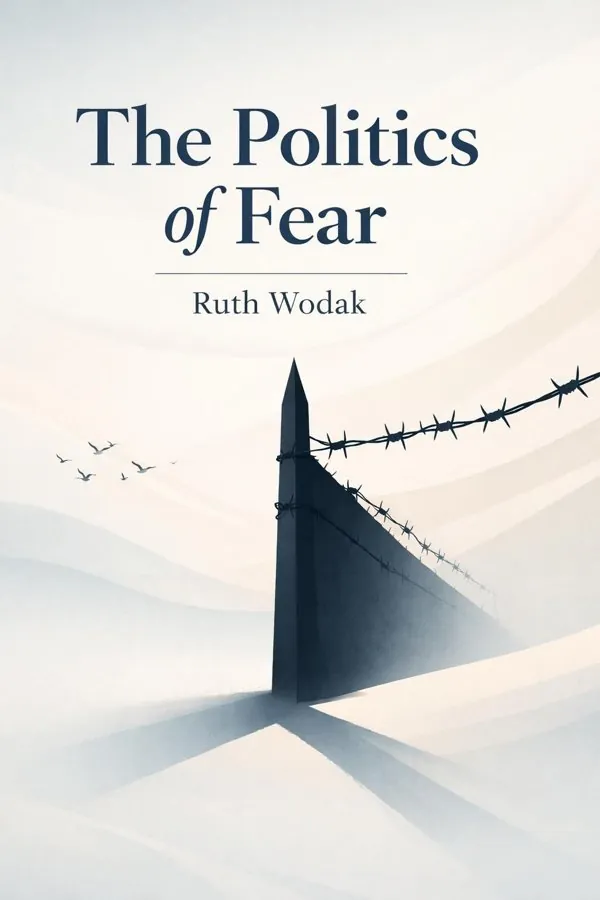
The Politics of Fear: What Right-Wing Populist Discourses Mean: Summary & Key Insights
by Ruth Wodak
 10 min11 chaptersAudio available
What Is The Politics of Fear: What Right-Wing Populist Discourses Mean About?
The Politics of Fear: What Right-Wing Populist Discourses Mean by Ruth Wodak is a politics book spanning 11 pages. This book offers a critical discourse analysis of right-wing populist rhetoric across Europe, exploring how fear is mobilized in political communication. Ruth Wodak examines speeches, media coverage, and policy debates to reveal how nationalist and exclusionary narratives are constructed and legitimized in public discourse.
This FizzRead summary covers all 11 key chapters of The Politics of Fear: What Right-Wing Populist Discourses Mean in approximately 10 minutes, distilling the most important ideas, arguments, and takeaways from Ruth Wodak's work. Also available as an audio summary and Key Quotes Podcast.
The Politics of Fear: What Right-Wing Populist Discourses Mean
This book offers a critical discourse analysis of right-wing populist rhetoric across Europe, exploring how fear is mobilized in political communication. Ruth Wodak examines speeches, media coverage, and policy debates to reveal how nationalist and exclusionary narratives are constructed and legitimized in public discourse.
Who Should Read The Politics of Fear: What Right-Wing Populist Discourses Mean?
This book is perfect for anyone interested in politics and looking to gain actionable insights in a short read. Whether you're a student, professional, or lifelong learner, the key ideas from The Politics of Fear: What Right-Wing Populist Discourses Mean by Ruth Wodak will help you think differently.
- ✓Readers who enjoy politics and want practical takeaways
- ✓Professionals looking to apply new ideas to their work and life
- ✓Anyone who wants the core insights of The Politics of Fear: What Right-Wing Populist Discourses Mean in just 10 minutes
Want the full summary?
Get instant access to this book summary and 100K+ more with Fizz Moment.
Get Free SummaryAvailable on App Store • Free to download
Key Chapters
To understand how fear functions politically, we must first grasp what right-wing populism represents in today’s Europe. At its core, right-wing populism constructs a moral divide between a virtuous ‘people’ and a corrupt ‘elite’. It positions itself as the authentic voice of the nation, untainted by bureaucracy, multiculturalism, or global influence. This movement adapts to local histories yet shares a common grammar of grievance.
My analysis traces this populism through parties such as the Freedom Party of Austria (FPÖ), the UK Independence Party (UKIP), Hungary’s Fidesz, and others. Each deploys nationalism as the cornerstone of their narrative. But nationalism, as I show, is never neutral. It is framed linguistically through appeals to tradition, religion, and heritage, often attached to emotionally charged imagery — flags, borders, families, ‘our culture’. These become semiotic anchors for collective identity in an uncertain world.
Populist discourse relies on the idea of crisis. Whether that crisis is economic migration, European integration, or cultural change, the populist speaker offers simplicity in place of complexity. Thus arises one of its defining strategies: reductionism. Instead of acknowledging the multiplicity of factors shaping society, right-wing populists condense threats into single narratives — and through those narratives, mobilize support.
In the European context, I argue that right-wing populism also thrives on nostalgia: the promise to ‘return’ to an imagined past where order and homogeneity prevailed. Yet this nostalgia is rhetorical rather than historical; it obscures the inequalities and conflicts of that past, transforming memory into myth. Language becomes the tool through which this myth gains power. By observing how leaders speak — not just what they say, but how they frame belonging and betrayal — we uncover the mechanisms that make populism persuasive.
Fear is not a spontaneous emotion in political discourse; it is manufactured, distributed, and reproduced. Throughout Europe, populist movements have mastered the art of emotional mobilization. They speak to very real anxieties — over jobs, identity, security — but redirect those anxieties toward specific scapegoats.
In *The Politics of Fear*, I demonstrate how this process unfolds linguistically. Fear works through repetition, through visual and verbal imagery that depicts danger as imminent. Migrants become ‘waves’, ‘floods’, or ‘invasions’. Europe itself becomes fragile, ‘under siege’. Such metaphors are not innocent; they turn social phenomena into existential threats.
This emotionalization replaces rational discourse with affective appeal. The audience is not invited to deliberate; it is invited to feel — to share outrage and solidarity against the constructed enemy. The effectiveness of this strategy depends on constant dichotomization: there must always be a clear boundary between ‘us’ and ‘them’. Populist leaders present themselves as guardians of the threatened collective, reinforcing their legitimacy through protective vigilance.
But fear does more than win elections. It reshapes the terms of democratic debate. When fear saturates public communication, complexity shrinks and empathy erodes. I argue that this shift in communicative norms — from dialogue to alarm — represents one of the gravest dangers for liberal democracy. Recognizing fear’s discourse therefore becomes essential for defending pluralism.
+ 9 more chapters — available in the FizzRead app
All Chapters in The Politics of Fear: What Right-Wing Populist Discourses Mean
About the Author
Ruth Wodak is an Austrian linguist and professor known for her work in discourse studies, particularly in the areas of political communication, identity, and racism. She has published extensively on critical discourse analysis and the language of politics.
Get This Summary in Your Preferred Format
Read or listen to the The Politics of Fear: What Right-Wing Populist Discourses Mean summary by Ruth Wodak anytime, anywhere. FizzRead offers multiple formats so you can learn on your terms — all free.
Available formats: App · Audio · PDF · EPUB — All included free with FizzRead
Download The Politics of Fear: What Right-Wing Populist Discourses Mean PDF and EPUB Summary
Key Quotes from The Politics of Fear: What Right-Wing Populist Discourses Mean
“To understand how fear functions politically, we must first grasp what right-wing populism represents in today’s Europe.”
“Fear is not a spontaneous emotion in political discourse; it is manufactured, distributed, and reproduced.”
Frequently Asked Questions about The Politics of Fear: What Right-Wing Populist Discourses Mean
The Politics of Fear: What Right-Wing Populist Discourses Mean by Ruth Wodak is a politics book that explores key ideas across 11 chapters. This book offers a critical discourse analysis of right-wing populist rhetoric across Europe, exploring how fear is mobilized in political communication. Ruth Wodak examines speeches, media coverage, and policy debates to reveal how nationalist and exclusionary narratives are constructed and legitimized in public discourse.
You Might Also Like
Antifa: The Anti-Fascist Handbook
Mark Bray
10 min
Attack from Within: How Disinformation Is Sabotaging America
Barbara McQuade
10 min
Coercion, Capital, and European States, AD 990–1992
Charles Tilly
10 min
Digital Democracy: Concepts, Methodologies, Tools, and Applications
Various Authors
10 min
Fascism
Stanley G. Payne
10 min
Fire And Fury: Inside The Trump White House
Michael Wolff
10 minBrowse by Category
Ready to read The Politics of Fear: What Right-Wing Populist Discourses Mean?
Get the full summary and 100K+ more books with Fizz Moment.