
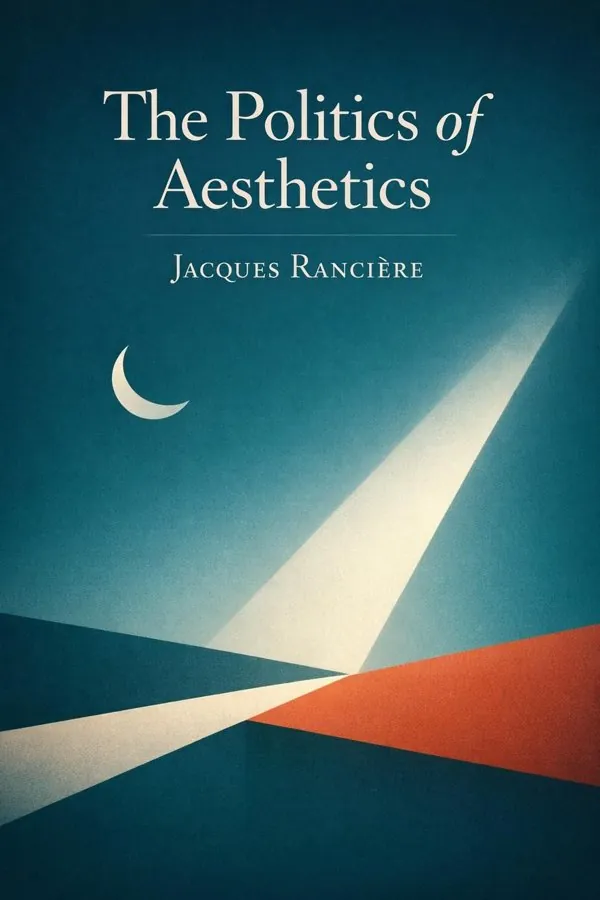
The Politics of Aesthetics: Summary & Key Insights
 10 min10 chaptersAudio available
What Is The Politics of Aesthetics About?
The Politics of Aesthetics by Jacques Rancière is a western_phil book spanning 10 pages. In this influential work, Jacques Rancière examines the relationship between aesthetics and politics, arguing that politics is fundamentally a reconfiguration of the sensible—of what can be seen, said, and thought within a society. He explores how art and politics share a common logic of redistributing the visible and the sayable, thereby redefining the forms of community and subjectivity.
This FizzRead summary covers all 10 key chapters of The Politics of Aesthetics in approximately 10 minutes, distilling the most important ideas, arguments, and takeaways from Jacques Rancière's work. Also available as an audio summary and Key Quotes Podcast.
The Politics of Aesthetics
In this influential work, Jacques Rancière examines the relationship between aesthetics and politics, arguing that politics is fundamentally a reconfiguration of the sensible—of what can be seen, said, and thought within a society. He explores how art and politics share a common logic of redistributing the visible and the sayable, thereby redefining the forms of community and subjectivity.
Who Should Read The Politics of Aesthetics?
This book is perfect for anyone interested in western_phil and looking to gain actionable insights in a short read. Whether you're a student, professional, or lifelong learner, the key ideas from The Politics of Aesthetics by Jacques Rancière will help you think differently.
- ✓Readers who enjoy western_phil and want practical takeaways
- ✓Professionals looking to apply new ideas to their work and life
- ✓Anyone who wants the core insights of The Politics of Aesthetics in just 10 minutes
Want the full summary?
Get instant access to this book summary and 100K+ more with Fizz Moment.
Get Free SummaryAvailable on App Store • Free to download
Key Chapters
Every society is structured by what I call a ‘distribution of the sensible’—a partition of space, time, and activity that decides what is visible, sayable, and doable within its world. This phrase describes a silent order, a configuration of perception that defines who counts and what matters. It may appear as natural, but it is political through and through. Think of how workers were once excluded from the sphere of public speech, seen only as bodies of labor without reason; when they began to write poetry or philosophy, the sensible world itself shifted. Their acts did not simply demand rights—they redrew the perception of what could be thought and expressed.
This is what politics truly is: not the exercise of power within pre-given institutions, but the reconfiguring of those partitions—the moment when those unseen and unheard assert a common world with new forms of visibility. The ‘distribution of the sensible’ is thus both aesthetic and political. It governs the perceptual fabric in which any world exists, and when politics happens, it happens as its disruption.
Politics, as I understand it, is an event—a rupture—when equality asserts itself within inequality. It is the rare moment when those without part, those who stand outside the established hierarchy, reveal a capacity that power claimed they did not have. Politics is the reconfiguration of the sensible, not the administration of interests or the maintenance of order. It occurs when the excluded make themselves visible, when the partition of the world is contested.
This reconfiguration does not take place through force alone but through perception, discourse, and imagination. When a new voice speaks where silence was expected, when a gesture redefines what belongs within art or thought, politics emerges. This is why politics is always aesthetic—it changes the texture of experience, the ways we appear to one another.
+ 8 more chapters — available in the FizzRead app
All Chapters in The Politics of Aesthetics
About the Author
Jacques Rancière is a French philosopher born in 1940, known for his work on politics, aesthetics, and education. A former student of Louis Althusser, he became distinguished for his critique of intellectual hierarchies and his advocacy of radical equality. His books, including 'The Ignorant Schoolmaster' and 'The Politics of Aesthetics', have had a profound impact on contemporary philosophy.
Get This Summary in Your Preferred Format
Read or listen to the The Politics of Aesthetics summary by Jacques Rancière anytime, anywhere. FizzRead offers multiple formats so you can learn on your terms — all free.
Available formats: App · Audio · PDF · EPUB — All included free with FizzRead
Download The Politics of Aesthetics PDF and EPUB Summary
Key Quotes from The Politics of Aesthetics
“Every society is structured by what I call a ‘distribution of the sensible’—a partition of space, time, and activity that decides what is visible, sayable, and doable within its world.”
“Politics, as I understand it, is an event—a rupture—when equality asserts itself within inequality.”
Frequently Asked Questions about The Politics of Aesthetics
The Politics of Aesthetics by Jacques Rancière is a western_phil book that explores key ideas across 10 chapters. In this influential work, Jacques Rancière examines the relationship between aesthetics and politics, arguing that politics is fundamentally a reconfiguration of the sensible—of what can be seen, said, and thought within a society. He explores how art and politics share a common logic of redistributing the visible and the sayable, thereby redefining the forms of community and subjectivity.
You Might Also Like
A Little History of Philosophy
Nigel Warburton
10 min
Areopagitica
John Milton
10 min
How To Think Like A Philosopher: Essential Principles For Clear Thinking
Peter Cave
10 min
Language, Truth and Logic
A. J. Ayer
10 min
The Age of Reason
Thomas Paine
10 min
The Essays
Michel De Montaigne
10 minBrowse by Category
Ready to read The Politics of Aesthetics?
Get the full summary and 100K+ more books with Fizz Moment.