
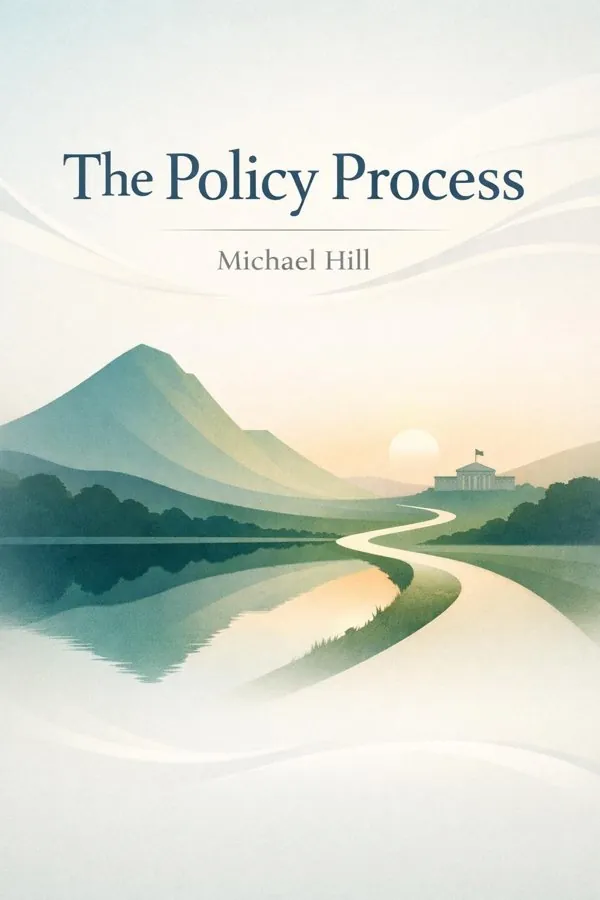
The Policy Process: A Practical Guide for Natural Resource Professionals: Summary & Key Insights
by Michael Hill
 10 min9 chaptersAudio available
What Is The Policy Process: A Practical Guide for Natural Resource Professionals About?
The Policy Process: A Practical Guide for Natural Resource Professionals by Michael Hill is a politics book spanning 9 pages. This book provides a comprehensive introduction to the study of public policy processes, focusing on how policies are formulated, implemented, and evaluated within governmental systems. It explores theoretical frameworks and practical examples to help readers understand the dynamics of policy-making and the roles of various actors involved.
This FizzRead summary covers all 9 key chapters of The Policy Process: A Practical Guide for Natural Resource Professionals in approximately 10 minutes, distilling the most important ideas, arguments, and takeaways from Michael Hill's work. Also available as an audio summary and Key Quotes Podcast.
The Policy Process: A Practical Guide for Natural Resource Professionals
This book provides a comprehensive introduction to the study of public policy processes, focusing on how policies are formulated, implemented, and evaluated within governmental systems. It explores theoretical frameworks and practical examples to help readers understand the dynamics of policy-making and the roles of various actors involved.
Who Should Read The Policy Process: A Practical Guide for Natural Resource Professionals?
This book is perfect for anyone interested in politics and looking to gain actionable insights in a short read. Whether you're a student, professional, or lifelong learner, the key ideas from The Policy Process: A Practical Guide for Natural Resource Professionals by Michael Hill will help you think differently.
- ✓Readers who enjoy politics and want practical takeaways
- ✓Professionals looking to apply new ideas to their work and life
- ✓Anyone who wants the core insights of The Policy Process: A Practical Guide for Natural Resource Professionals in just 10 minutes
Want the full summary?
Get instant access to this book summary and 100K+ more with Fizz Moment.
Get Free SummaryAvailable on App Store • Free to download
Key Chapters
To understand the policy process one must first face a fundamental question: how do governments actually make decisions? Early scholars of public administration described the ‘rational model,’ an ideal method of problem-solving in which decision-makers identify goals, gather data, compare alternatives, and choose the optimal solution. It’s an intellectually appealing model—one that assumes clarity, objectivity, and comprehensive analysis. However, in practice, such rationality rarely exists. Real-world policymaking is constrained by limited information, political pressures, time, and organizational habits.
That realization led to the development of a contrasting view—the ‘incremental model.’ Pioneered by Charles Lindblom in his famous idea of “muddling through,” this model portrays policymaking as a series of pragmatic adjustments rather than sweeping reforms. Decisions evolve gradually, shaped by negotiation and compromise. Policymakers often look for policies that are acceptable to multiple stakeholders rather than theoretically perfect. Incrementalism is not a flaw but a reflection of political reality.
In my own approach, I encourage readers not to see these frameworks as opposites but as complementary perspectives. Rationality is aspirational—it reminds us of the value of analysis and evidence. Incrementalism is descriptive—it explains why change tends to happen in small steps. When environmental managers propose policy revisions, both tendencies appear: the rational desire to maximize sustainability outcomes and the practical need to accommodate institutional and social limits.
The theoretical frameworks offer lenses through which policy actions can be interpreted. Rational models guide planning and evaluation, while incremental approaches teach patience and adaptation. Recognizing both helps professionals anticipate how decisions are likely to evolve and where their expertise can be inserted into the process.
Policies do not exist in a vacuum; they unfold within complex institutional arrangements. Government structures—national, regional, and local—form the stage upon which all policy plays are performed. Each level of governance brings its own rules, cultures, and constraints. In the United Kingdom, for example, local councils must interpret and apply national environmental directives, translating broad principles into context-specific actions.
What makes institutions vital is not just their formal structure but their administrative dynamics. Bureaucracies are often portrayed as slow or overly procedural, yet they are the guardians of stability and continuity. They embed processes that protect public accountability and legal consistency. Understanding institutional processes means understanding how authority is delegated, how budgets are distributed, and how priorities are set.
For professionals in natural resource management, institutionality defines the boundaries of action. A forestry officer must work through layers of approval to implement conservation plans; an environmental scientist may depend on agency coordination to secure funding for research. Recognizing these institutional channels helps avoid frustration and enhances strategic influence.
Administrative systems also mediate interactions between policy and politics. Ministers and elected officials frame the vision, while career civil servants supply technical feasibility and administrative support. Professionals who grasp this interplay can navigate policy networks more effectively—identifying where decisions are truly made and how evidence can be communicated to those in power.
Institutions determine not only what can be done but how it must be done. Their routines, hierarchies, and norms shape every step of the policy process. To operate effectively within them is to combine an understanding of formal mandates with an appreciation for informal relationships—the people behind the process.
+ 7 more chapters — available in the FizzRead app
All Chapters in The Policy Process: A Practical Guide for Natural Resource Professionals
About the Author
Michael Hill is a British political scientist and academic known for his work on public administration and policy analysis. He has taught at the University of Newcastle and the University of Brighton, contributing extensively to the study of policy implementation and governance.
Get This Summary in Your Preferred Format
Read or listen to the The Policy Process: A Practical Guide for Natural Resource Professionals summary by Michael Hill anytime, anywhere. FizzRead offers multiple formats so you can learn on your terms — all free.
Available formats: App · Audio · PDF · EPUB — All included free with FizzRead
Download The Policy Process: A Practical Guide for Natural Resource Professionals PDF and EPUB Summary
Key Quotes from The Policy Process: A Practical Guide for Natural Resource Professionals
“To understand the policy process one must first face a fundamental question: how do governments actually make decisions?”
“Policies do not exist in a vacuum; they unfold within complex institutional arrangements.”
Frequently Asked Questions about The Policy Process: A Practical Guide for Natural Resource Professionals
The Policy Process: A Practical Guide for Natural Resource Professionals by Michael Hill is a politics book that explores key ideas across 9 chapters. This book provides a comprehensive introduction to the study of public policy processes, focusing on how policies are formulated, implemented, and evaluated within governmental systems. It explores theoretical frameworks and practical examples to help readers understand the dynamics of policy-making and the roles of various actors involved.
You Might Also Like
Antifa: The Anti-Fascist Handbook
Mark Bray
10 min
Attack from Within: How Disinformation Is Sabotaging America
Barbara McQuade
10 min
Coercion, Capital, and European States, AD 990–1992
Charles Tilly
10 min
Digital Democracy: Concepts, Methodologies, Tools, and Applications
Various Authors
10 min
Fascism
Stanley G. Payne
10 min
Fire And Fury: Inside The Trump White House
Michael Wolff
10 minBrowse by Category
Ready to read The Policy Process: A Practical Guide for Natural Resource Professionals?
Get the full summary and 100K+ more books with Fizz Moment.