
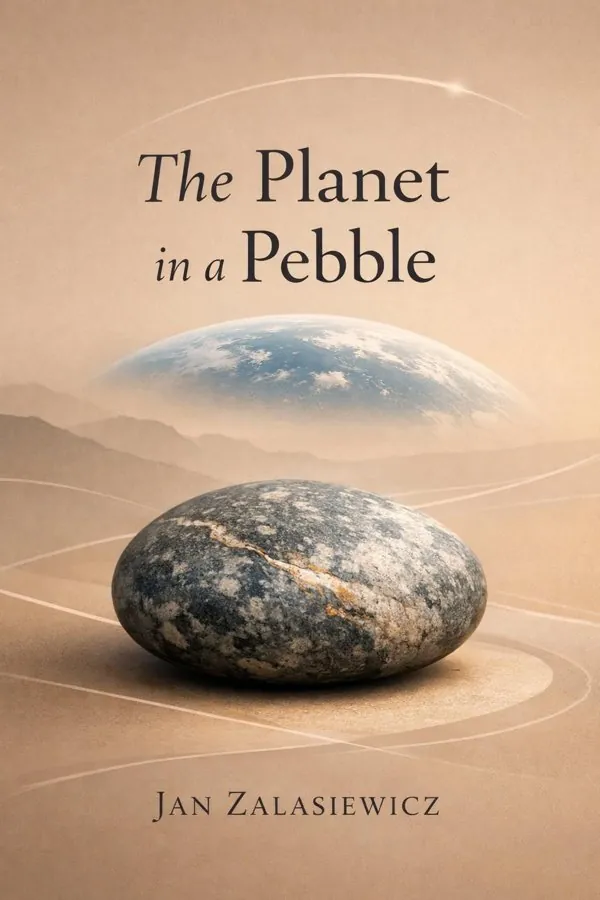
The Planet in a Pebble: A Journey into Earth's Deep History: Summary & Key Insights
 10 min9 chaptersAudio available
What Is The Planet in a Pebble: A Journey into Earth's Deep History About?
The Planet in a Pebble: A Journey into Earth's Deep History by Jan Zalasiewicz is a popular_sci book spanning 9 pages. In this book, geologist Jan Zalasiewicz explores Earth's deep history through the story of a single pebble found on a Welsh beach. Using the pebble as a lens, he traces the planet’s geological and biological evolution—from the formation of minerals to the rise of life and the shaping of continents. The narrative combines scientific insight with poetic reflection, revealing how even the smallest stone holds the record of billions of years of planetary change.
This FizzRead summary covers all 9 key chapters of The Planet in a Pebble: A Journey into Earth's Deep History in approximately 10 minutes, distilling the most important ideas, arguments, and takeaways from Jan Zalasiewicz's work. Also available as an audio summary and Key Quotes Podcast.
The Planet in a Pebble: A Journey into Earth's Deep History
In this book, geologist Jan Zalasiewicz explores Earth's deep history through the story of a single pebble found on a Welsh beach. Using the pebble as a lens, he traces the planet’s geological and biological evolution—from the formation of minerals to the rise of life and the shaping of continents. The narrative combines scientific insight with poetic reflection, revealing how even the smallest stone holds the record of billions of years of planetary change.
Who Should Read The Planet in a Pebble: A Journey into Earth's Deep History?
This book is perfect for anyone interested in popular_sci and looking to gain actionable insights in a short read. Whether you're a student, professional, or lifelong learner, the key ideas from The Planet in a Pebble: A Journey into Earth's Deep History by Jan Zalasiewicz will help you think differently.
- ✓Readers who enjoy popular_sci and want practical takeaways
- ✓Professionals looking to apply new ideas to their work and life
- ✓Anyone who wants the core insights of The Planet in a Pebble: A Journey into Earth's Deep History in just 10 minutes
Want the full summary?
Get instant access to this book summary and 100K+ more with Fizz Moment.
Get Free SummaryAvailable on App Store • Free to download
Key Chapters
When I first examine the pebble, I begin by considering what it is actually made of. Its sandy texture and dull gleam tell me it is a sandstone—a rock composed of countless quartz grains cemented together through time. Each of those grains, a shard of crystallized silica, once formed deep beneath the Earth’s surface as molten rock cooled. Others might carry flecks of feldspar or traces of mica, hinting at the varied parent rocks from which they were born.
Understanding a pebble’s composition opens the door to the idea of geological time. What we hold in our hand may embody hundreds of millions of years of the planet’s transformation. Every mineral crystal in the pebble’s structure endured heat, compression, and chemical change. The quartz within likely crystallized in the Earth’s crust at temperatures exceeding 600°C, in a world that predated all familiar landscapes. The pebble’s components thus preserve a memory of conditions long vanished, and by reading them, we reconstruct entire episodes of planetary history.
To me, this is where geology becomes almost philosophical. Within a pebble’s atoms lies the record of cosmic and terrestrial creation. Nothing about it is random: each crystal grew according to physical laws, integrating into a lattice that has survived eons of pressure and erosion. Once we see that this minute structure is a survivor of deep time, we develop a new reverence for the simple material that makes up our world. The pebble’s composition, though microscopic in grain, is the condensed essence of Earth’s eternal chemistry.
To uncover the pebble’s earlier life, we must imagine a different Earth—one with shallow, tropical seas filled with early marine life and drifting sediments. The grains that now make up my pebble were then suspended in water, moving slowly across the seafloor. Over millions of years, layer upon layer of these sand particles settled, carried by currents and waves. The depth of their burial marked the beginning of a transformation from loose sediment into solid rock.
Those ancient oceans were rich laboratories where life and geology intertwined. Early marine organisms secreted shells and skeletons made of calcium carbonate, while chemical reactions within the seabed produced minerals such as pyrite and glauconite. The dissolved silica that helped form quartz came from the shells of tiny radiolarians and diatoms, microscopic architects of stone. Thus, even in its primal composition, the pebble contains the handiwork of long-extinct life forms.
I’m always struck by how the story of a single rock can illuminate the complexity of early Earth environments. To think that the sands that formed its body were once part of seabeds teeming with primitive ecosystems is to glimpse how intertwined the biological and geological worlds are. Through sedimentation, the living seas gave birth to material forms that would endure long after their inhabitants were gone.
+ 7 more chapters — available in the FizzRead app
All Chapters in The Planet in a Pebble: A Journey into Earth's Deep History
About the Author
Jan Zalasiewicz is a British geologist and paleontologist, a senior lecturer at the University of Leicester, and a member of the Anthropocene Working Group. His research focuses on stratigraphy, paleoenvironments, and the geological record of human impact on Earth. He is also the author of several popular science books on geology and Earth history.
Get This Summary in Your Preferred Format
Read or listen to the The Planet in a Pebble: A Journey into Earth's Deep History summary by Jan Zalasiewicz anytime, anywhere. FizzRead offers multiple formats so you can learn on your terms — all free.
Available formats: App · Audio · PDF · EPUB — All included free with FizzRead
Download The Planet in a Pebble: A Journey into Earth's Deep History PDF and EPUB Summary
Key Quotes from The Planet in a Pebble: A Journey into Earth's Deep History
“When I first examine the pebble, I begin by considering what it is actually made of.”
“To uncover the pebble’s earlier life, we must imagine a different Earth—one with shallow, tropical seas filled with early marine life and drifting sediments.”
Frequently Asked Questions about The Planet in a Pebble: A Journey into Earth's Deep History
The Planet in a Pebble: A Journey into Earth's Deep History by Jan Zalasiewicz is a popular_sci book that explores key ideas across 9 chapters. In this book, geologist Jan Zalasiewicz explores Earth's deep history through the story of a single pebble found on a Welsh beach. Using the pebble as a lens, he traces the planet’s geological and biological evolution—from the formation of minerals to the rise of life and the shaping of continents. The narrative combines scientific insight with poetic reflection, revealing how even the smallest stone holds the record of billions of years of planetary change.
You Might Also Like

Structures: Or Why Things Don"t Fall Down
J.E. Gordon
10 min
The Road to Wigan Pier
George Orwell
10 min
Bonk: The Curious Coupling of Science and Sex
Mary Roach
10 min
First Bite: How We Learn to Eat
Bee Wilson
10 min
In Pursuit Of The Unknown: 17 Equations That Changed The World
Ian Stewart
10 min
Napoleon's Buttons: 17 Molecules That Changed History
Penny Le Couteur and Jay Burreson
10 minBrowse by Category
Ready to read The Planet in a Pebble: A Journey into Earth's Deep History?
Get the full summary and 100K+ more books with Fizz Moment.