
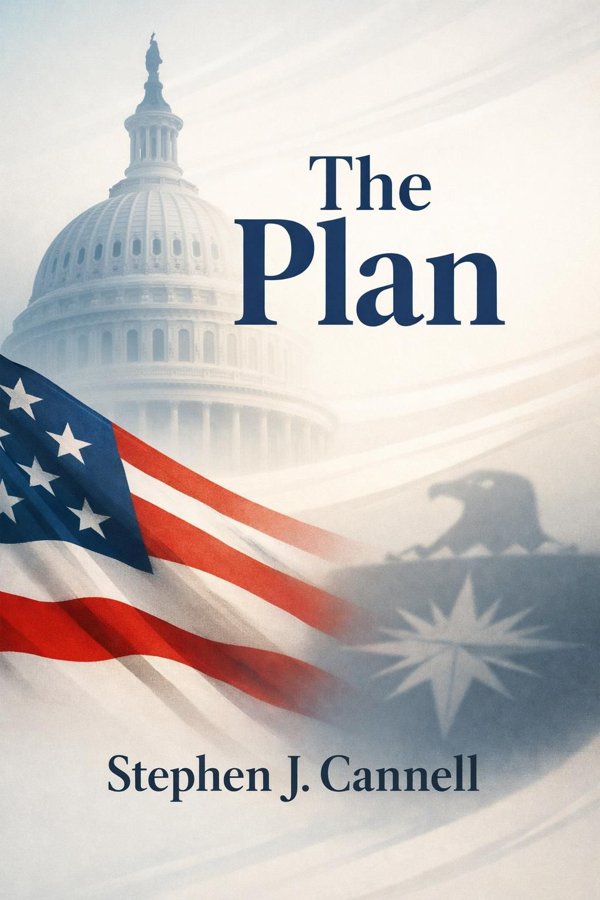
The Plan: Summary & Key Insights
 10 min8 chaptersAudio available
Key Takeaways from The Plan
The closer someone gets to power, the more invisible forces begin to move around them.
A polished public image can conceal a deeply unstable reality.
One reason conspiracies become so powerful is simple: no one sees the whole picture at once.
The pursuit of greatness often begins with conviction, but it can drift into compromise before anyone notices.
In a world shaped by secrecy, trust is never a simple virtue; it is a gamble.
What Is The Plan About?
The Plan by Stephen J. Cannell is a mystery book. Power often looks polished from a distance, but Stephen J. Cannell’s The Plan reveals how quickly the world of presidential politics can turn savage, deceptive, and deadly. Framed as a high-stakes political thriller, the novel follows a presidential hopeful who becomes entangled in a dangerous conspiracy, where ambition, loyalty, and survival collide under relentless public scrutiny. What begins as a campaign built on strategy and image soon spirals into a tense struggle against hidden enemies and carefully engineered manipulation. At its core, The Plan is not just about winning an election. It is about what happens when the machinery of power becomes indistinguishable from a trap. The book matters because it explores fears that feel enduringly real: the corruption of ideals, the vulnerability of public figures, and the way secret agendas can flourish behind patriotic language. Cannell, widely known for his mastery of suspense and fast-moving storytelling, brings cinematic pacing and sharp dramatic instincts to the novel. His experience as a prolific storyteller gives The Plan an urgent, visual quality that makes every revelation hit harder. For readers who enjoy mystery, conspiracy, and political danger, this is a gripping study of how fragile control really is.
This FizzRead summary covers all 8 key chapters of The Plan in approximately 10 minutes, distilling the most important ideas, arguments, and takeaways from Stephen J. Cannell's work. Also available as an audio summary and Key Quotes Podcast.
The Plan
Power often looks polished from a distance, but Stephen J. Cannell’s The Plan reveals how quickly the world of presidential politics can turn savage, deceptive, and deadly. Framed as a high-stakes political thriller, the novel follows a presidential hopeful who becomes entangled in a dangerous conspiracy, where ambition, loyalty, and survival collide under relentless public scrutiny. What begins as a campaign built on strategy and image soon spirals into a tense struggle against hidden enemies and carefully engineered manipulation. At its core, The Plan is not just about winning an election. It is about what happens when the machinery of power becomes indistinguishable from a trap.
The book matters because it explores fears that feel enduringly real: the corruption of ideals, the vulnerability of public figures, and the way secret agendas can flourish behind patriotic language. Cannell, widely known for his mastery of suspense and fast-moving storytelling, brings cinematic pacing and sharp dramatic instincts to the novel. His experience as a prolific storyteller gives The Plan an urgent, visual quality that makes every revelation hit harder. For readers who enjoy mystery, conspiracy, and political danger, this is a gripping study of how fragile control really is.
Who Should Read The Plan?
This book is perfect for anyone interested in mystery and looking to gain actionable insights in a short read. Whether you're a student, professional, or lifelong learner, the key ideas from The Plan by Stephen J. Cannell will help you think differently.
- ✓Readers who enjoy mystery and want practical takeaways
- ✓Professionals looking to apply new ideas to their work and life
- ✓Anyone who wants the core insights of The Plan in just 10 minutes
Want the full summary?
Get instant access to this book summary and 100K+ more with Fizz Moment.
Get Free SummaryAvailable on App Store • Free to download
Key Chapters
The closer someone gets to power, the more invisible forces begin to move around them. One of the central ideas in The Plan is that a presidential campaign is never only about speeches, policies, and public optimism. It is also a magnet for secrets, ambition, leverage, and people who want access at any cost. Cannell uses the story’s conspiracy framework to show that power creates its own ecosystem, and that ecosystem rewards manipulation as often as it rewards merit.
In the novel, the candidate’s rise does not simply bring attention. It triggers scrutiny, opportunism, and concealed agendas. This is what makes the mystery compelling: the threat is not always obvious. It may come disguised as support, advice, or protection. That dynamic mirrors real life in any high-pressure environment, whether politics, business, or media. The more valuable the position, the more likely it is that others will try to shape decisions behind the scenes.
A practical way to read this idea is to think about leadership roles in ordinary settings. A new executive, founder, or public-facing leader often discovers that praise and loyalty can hide private motives. People attach themselves to influence because influence can be converted into status, money, or control. The lesson is not paranoia but awareness. Leaders must understand that visibility increases vulnerability.
Cannell turns this into suspense by making the reader constantly question who benefits from each development. Every shift in the candidate’s situation suggests that the real battle is not the election alone but the unseen contest for control over the person at its center.
Actionable takeaway: when stakes rise, look beyond appearances and ask who gains from every alliance, suggestion, and crisis.
A polished public image can conceal a deeply unstable reality. In The Plan, campaign appearances, messaging, and staged confidence create the illusion of control, yet beneath that performance lies fear, pressure, and escalating danger. Cannell highlights a disturbing truth about political life: what the public sees is often the least revealing part of the story.
This contrast between public image and private reality drives much of the tension. The candidate must function in a world where optics matter constantly. Every smile, every speech, every appearance is part of a crafted narrative. But conspiracies thrive precisely in such environments, because people assume that smooth presentation reflects genuine stability. Cannell uses that gap to great effect. The campaign becomes a theater where danger hides behind routine, and where those closest to the stage may know the least about what is actually happening.
The idea extends far beyond politics. Many institutions depend on a version of managed perception. Companies project confidence while hiding internal chaos. Families preserve appearances while avoiding difficult truths. Individuals curate competence while privately feeling overwhelmed. The Plan reminds readers that image is not proof. In a mystery, that gap creates suspicion; in life, it calls for discernment.
A practical application is to develop the habit of separating presentation from evidence. If a situation seems perfectly controlled, that may be the moment to ask deeper questions. Who is shaping the narrative? What facts are missing? What pressures are being concealed to maintain confidence? Cannell’s story thrives on the danger of accepting appearances too quickly.
Actionable takeaway: do not confuse polish with safety; in high-stakes situations, verify reality instead of trusting the performance.
One reason conspiracies become so powerful is simple: no one sees the whole picture at once. The Plan builds suspense by showing how fragmented information keeps people vulnerable. Different characters possess different pieces of the truth, and those fragments are often misleading on their own. Cannell understands that mystery becomes most effective when knowledge is distributed unevenly, forcing both characters and readers to assemble meaning under pressure.
The candidate’s predicament grows more dangerous because uncertainty slows response. Without a complete understanding of who is involved, what the endgame is, or where the next threat will emerge, every move becomes risky. This reflects an important real-world principle. Whether in politics, organizations, or crises, people often make decisions based on partial information. That opens the door for manipulation, because whoever controls the flow of information can shape perception and delay resistance.
Cannell dramatizes the problem through shifting loyalties, hidden motives, and revelations that arrive just late enough to increase the stakes. The mystery is not only about discovering the truth. It is about surviving long enough to connect the truth. That distinction matters. In a dangerous system, ignorance is not passive; it is weaponized.
Readers can apply this insight in everyday decision-making. If a situation feels confusing, the answer may not be to act faster but to gather better context. Ask who knows what, who is withholding details, and who benefits from confusion. Teams function better when information is shared clearly. Individuals make stronger choices when they resist acting on rumor or assumption.
Actionable takeaway: when events stop making sense, map the missing information before making major decisions.
The pursuit of greatness often begins with conviction, but it can drift into compromise before anyone notices. A major tension in The Plan is the collision between political ambition and moral clarity. Campaigns are fueled by vision, discipline, and the desire to win, yet Cannell shows how those same forces can make people rationalize troubling choices. The line between strategy and corruption narrows when success becomes the supreme goal.
The novel’s political setting intensifies this idea because campaigns reward endurance, messaging discipline, and tactical calculation. In such an atmosphere, ethical shortcuts can appear practical rather than dangerous. A secret is kept for the good of the cause. A questionable alliance is justified as temporary. A betrayal is reframed as necessity. Cannell’s thriller structure exposes how ambition can normalize decisions that would seem unacceptable in calmer circumstances.
This is why the book resonates beyond fiction. Many readers have encountered versions of this dynamic in workplaces, competitive industries, or personal advancement. People rarely announce that they are abandoning their values. Instead, they move step by step, making exceptions under pressure until the original moral boundary disappears. The novel’s conspiracy becomes more than plot machinery; it is also a test of what people will tolerate when prestige, power, or survival is at stake.
A practical use of this idea is to define non-negotiables before high-pressure situations arrive. Ethical standards are hardest to create in the middle of crisis. Leaders, teams, and individuals need principles that remain intact even when the reward for compromise is immediate and attractive. Cannell suggests that the greatest danger is not only external manipulation but internal surrender.
Actionable takeaway: decide your limits before pressure rises, because ambition makes flexible ethics feel reasonable.
In a world shaped by secrecy, trust is never a simple virtue; it is a gamble. The Plan repeatedly emphasizes that the most dangerous decision may not be what action to take, but whom to believe. Political campaigns run on networks of advisors, aides, donors, and strategists, yet the same closeness that makes campaigns effective also creates openings for betrayal. Cannell turns this into one of the book’s most unsettling themes: when everyone is near power, trust itself becomes unstable.
The candidate’s vulnerability is intensified by dependence. No public figure operates alone, and no one can independently verify every detail in a fast-moving campaign. That means judgment must be outsourced, sometimes under extreme stress. The mystery deepens because support and sabotage can look remarkably similar at first. The person offering help may be the one steering events toward disaster.
This idea applies widely. In professional and personal life, trust often forms around familiarity, authority, or urgency. We assume that long-term colleagues, persuasive experts, or people who appear indispensable must be acting in good faith. But Cannell’s story reminds us that trust without verification can become a weakness. The answer is not isolation. It is disciplined trust: confidence tested by consistency, transparency, and evidence.
A practical example is crisis management. When events move quickly, people tend to rely on the loudest or most confident voices. A better approach is to validate claims, compare accounts, and watch for incentives. Who stands to gain from your belief? Who avoids scrutiny? In The Plan, those questions are essential to survival.
Actionable takeaway: trust people gradually and test their reliability against facts, especially when the stakes are high.
Fear does not merely weaken people; it changes how they think. One of the most compelling undercurrents in The Plan is the way fear reshapes perception, timing, and decision-making. Once the conspiracy tightens around the candidate, choices are no longer made in a calm strategic environment. They are made under threat, uncertainty, and pressure. Cannell shows that fear can be as dangerous as any external enemy because it narrows judgment and rewards short-term reactions.
This is a familiar pattern in thrillers, but Cannell uses it with particular effectiveness in the political arena. Campaigns already operate on exhaustion, constant evaluation, and unforgiving timelines. Add danger to that atmosphere, and even intelligent people become vulnerable to panic, overcorrection, denial, or impulsive loyalty. The novel gains much of its tension from this psychological compression. It is not enough to identify the threat. Characters must also resist becoming easier to manipulate because of it.
The idea has broad practical relevance. In workplaces, crises often trigger rushed decisions that create larger problems. In personal conflict, fear can cause people to misread motives or cling to bad options simply because uncertainty feels intolerable. Cannell’s narrative suggests that fear’s first casualty is proportion. Everything starts to feel immediate, absolute, and catastrophic, even when patience or evidence would improve the outcome.
A useful application is to build pause into moments of pressure. Naming the fear, clarifying the actual risk, and separating facts from imagined outcomes can restore perspective. The Plan demonstrates that survival depends not only on courage but on mental discipline. The character who can think clearly under threat gains an enormous advantage.
Actionable takeaway: when fear spikes, slow down long enough to distinguish real danger from distorted urgency.
The most influential figures are not always the ones standing at the podium. The Plan explores a classic but still unsettling political truth: systems of power often elevate hidden operators over visible leaders. While the candidate appears to represent the center of public action, Cannell suggests that the deeper struggle involves people working offstage, shaping events without accepting scrutiny. That hidden architecture gives the novel much of its menace.
This idea matters because it changes how readers understand control. Elections seem to revolve around charismatic personalities, but campaigns are actually ecosystems of strategists, financiers, fixers, and loyalists. When secrecy enters that system, accountability weakens. Those who influence outcomes from the shadows can act more aggressively because they are insulated from public consequence. Cannell uses this asymmetry to create mystery: the visible drama is only the surface expression of deeper design.
Beyond politics, many organizations function similarly. Public leaders often carry responsibility while invisible actors influence priorities, resources, and information flow. A team may appear to answer to one manager while actual direction comes from an unacknowledged stakeholder. Recognizing this dynamic helps people interpret events more accurately. If decisions seem inconsistent with the official narrative, the real authority may lie elsewhere.
The practical lesson is to analyze systems, not just personalities. Ask who controls access, information, timing, or funding. Who can shape outcomes without appearing accountable? Cannell’s thriller reminds readers that focusing only on front-facing figures can lead to dangerous misreadings. Sometimes the most important character in a crisis is the one no one is discussing openly.
Actionable takeaway: when trying to understand power, identify the unseen gatekeepers, not just the public face of leadership.
Events become legible only when motives are understood. In The Plan, surface actions often mislead because behavior makes sense only in light of private agendas. Cannell builds suspense by forcing characters to interpret signals in real time: is this act protection or control, loyalty or positioning, truth or bait? The mystery hinges not merely on what happens, but why it happens.
This emphasis on motive gives the story depth. Plot twists are effective because they reframe earlier actions. A gesture that seemed supportive may reveal strategic self-interest. A warning may contain hidden coercion. A delay may be an act of sabotage. Cannell’s point is that human behavior cannot be read accurately through appearances alone. Motive is the key that turns random incidents into a coherent pattern.
In real life, reading motive is essential in negotiations, leadership, and conflict. People often focus on statements while overlooking incentives. Yet incentives usually reveal more than words. Someone may claim to want resolution while benefiting from continued confusion. Another may seem unhelpful while actually trying to protect a larger objective. Understanding motive requires asking what outcome each person prefers and what they are willing to risk to get it.
A practical method is to pair observation with incentive analysis. What is this person asking for? What changes if I agree? What do they stand to gain from my trust, silence, speed, or fear? Cannell’s thriller rewards readers who think this way, because the story is built on hidden purpose rather than random chaos.
Actionable takeaway: to judge people accurately, look past their words and map the incentives driving their behavior.
All Chapters in The Plan
About the Author
Stephen J. Cannell was a celebrated American writer, producer, and novelist known for his major influence on modern popular storytelling. He built an extraordinary career in television, creating and producing successful series that defined action, crime, and suspense for a wide audience. His reputation rested on strong plot construction, memorable characters, and a sharp instinct for pacing, all of which carried naturally into his fiction. As a novelist, Cannell brought a cinematic style to the page, making his thrillers especially vivid and accessible. His work often explored danger, corruption, loyalty, and the hidden forces behind public events. In The Plan, his command of suspense and dramatic momentum is clear, reflecting the storytelling expertise that made him one of the most recognizable creators in contemporary genre entertainment.
Get This Summary in Your Preferred Format
Read or listen to the The Plan summary by Stephen J. Cannell anytime, anywhere. FizzRead offers multiple formats so you can learn on your terms — all free.
Available formats: App · Audio · PDF · EPUB — All included free with FizzRead
Download The Plan PDF and EPUB Summary
Key Quotes from The Plan
“The closer someone gets to power, the more invisible forces begin to move around them.”
“A polished public image can conceal a deeply unstable reality.”
“One reason conspiracies become so powerful is simple: no one sees the whole picture at once.”
“The pursuit of greatness often begins with conviction, but it can drift into compromise before anyone notices.”
“In a world shaped by secrecy, trust is never a simple virtue; it is a gamble.”
Frequently Asked Questions about The Plan
The Plan by Stephen J. Cannell is a mystery book that explores key ideas across 8 chapters. Power often looks polished from a distance, but Stephen J. Cannell’s The Plan reveals how quickly the world of presidential politics can turn savage, deceptive, and deadly. Framed as a high-stakes political thriller, the novel follows a presidential hopeful who becomes entangled in a dangerous conspiracy, where ambition, loyalty, and survival collide under relentless public scrutiny. What begins as a campaign built on strategy and image soon spirals into a tense struggle against hidden enemies and carefully engineered manipulation. At its core, The Plan is not just about winning an election. It is about what happens when the machinery of power becomes indistinguishable from a trap. The book matters because it explores fears that feel enduringly real: the corruption of ideals, the vulnerability of public figures, and the way secret agendas can flourish behind patriotic language. Cannell, widely known for his mastery of suspense and fast-moving storytelling, brings cinematic pacing and sharp dramatic instincts to the novel. His experience as a prolific storyteller gives The Plan an urgent, visual quality that makes every revelation hit harder. For readers who enjoy mystery, conspiracy, and political danger, this is a gripping study of how fragile control really is.
You Might Also Like

Browse by Category
Ready to read The Plan?
Get the full summary and 100K+ more books with Fizz Moment.