
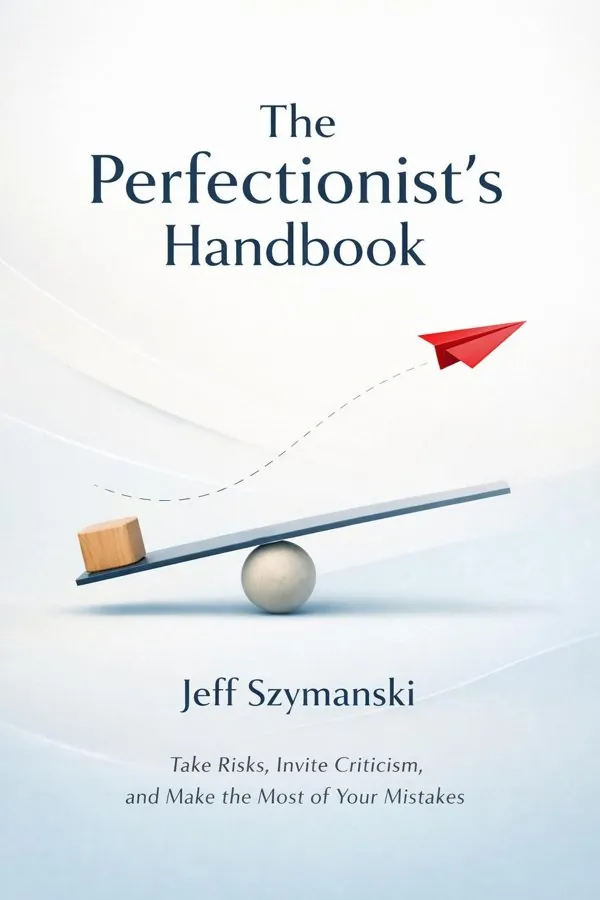
The Perfectionist’s Handbook: Take Risks, Invite Criticism, and Make the Most of Your Mistakes: Summary & Key Insights
 10 min8 chaptersAudio available
What Is The Perfectionist’s Handbook: Take Risks, Invite Criticism, and Make the Most of Your Mistakes About?
The Perfectionist’s Handbook: Take Risks, Invite Criticism, and Make the Most of Your Mistakes by Jeff Szymanski is a psychology book spanning 8 pages. Written by clinical psychologist Jeff Szymanski, this book explores how perfectionism can both drive and hinder success. It offers practical strategies to transform perfectionist tendencies into productive strengths by embracing risk, learning from mistakes, and developing resilience. The author draws on cognitive-behavioral principles to help readers balance high standards with flexibility and self-compassion.
This FizzRead summary covers all 8 key chapters of The Perfectionist’s Handbook: Take Risks, Invite Criticism, and Make the Most of Your Mistakes in approximately 10 minutes, distilling the most important ideas, arguments, and takeaways from Jeff Szymanski's work. Also available as an audio summary and Key Quotes Podcast.
The Perfectionist’s Handbook: Take Risks, Invite Criticism, and Make the Most of Your Mistakes
Written by clinical psychologist Jeff Szymanski, this book explores how perfectionism can both drive and hinder success. It offers practical strategies to transform perfectionist tendencies into productive strengths by embracing risk, learning from mistakes, and developing resilience. The author draws on cognitive-behavioral principles to help readers balance high standards with flexibility and self-compassion.
Who Should Read The Perfectionist’s Handbook: Take Risks, Invite Criticism, and Make the Most of Your Mistakes?
This book is perfect for anyone interested in psychology and looking to gain actionable insights in a short read. Whether you're a student, professional, or lifelong learner, the key ideas from The Perfectionist’s Handbook: Take Risks, Invite Criticism, and Make the Most of Your Mistakes by Jeff Szymanski will help you think differently.
- ✓Readers who enjoy psychology and want practical takeaways
- ✓Professionals looking to apply new ideas to their work and life
- ✓Anyone who wants the core insights of The Perfectionist’s Handbook: Take Risks, Invite Criticism, and Make the Most of Your Mistakes in just 10 minutes
Want the full summary?
Get instant access to this book summary and 100K+ more with Fizz Moment.
Get Free SummaryAvailable on App Store • Free to download
Key Chapters
Perfectionists often operate under a deceptively simple equation: worth equals achievement. You evaluate yourself not by who you are but by what you produce. This thinking pattern is powerful—it gets you out of bed early, keeps you at the desk long after everyone else has gone home, and can make you the star performer in your field. But underneath that drive lies a persistent fear: that if you make a mistake, you will no longer be enough. In clinical terms, perfectionism is a cognitive style characterized by excessively high personal standards and overly critical self-evaluation. When these standards are adaptive—anchored in genuine curiosity or a love of mastery—they lead to productive striving. But when perfectionism becomes maladaptive, it is ruled by fear of failure. You stop being motivated by excellence and start being driven by avoidance. You dread making the wrong move and, paradoxically, make no move at all. Perfectionists tend to be “all-or-nothing” thinkers. You either win or lose, succeed or fail, perfect or worthless. The gray area—the space where learning happens—is dismissed. This mindset creates constant stress, dissatisfaction, and a sense of never quite measuring up. Understanding this pattern is the first step in changing it. Recognizing that perfectionism is not a personality flaw but a learned cognitive habit opens the door to transformation.
One of the great traps of perfectionism is that it feels rational. You believe that if you just work a little harder, double-check your work one more time, or gather a bit more reassurance, you’ll finally feel confident. But perfectionism feeds on itself—the more you try to achieve absolute certainty, the less certain you feel. Cognitive distortions fuel this cycle. Black-and-white thinking makes you see outcomes as absolute success or total failure. Catastrophizing convinces you that a single mistake spells disaster. Overgeneralization teaches you to extend one slip to your entire identity. These patterns are familiar to perfectionists, and each one deepens your dependency on unrealistic standards. Another trap is what I call “the comfort zone paradox.” Perfectionists often appear fearless achievers, but inside they are deeply risk-averse. The thought of making a visible mistake feels intolerable, so you retreat to the tasks you know you can master. What feels like safety is actually stagnation. The more you avoid uncertainty, the smaller your world becomes. Recognizing these traps allows you to shift from blind repetition to conscious choice. You begin to ask, “Is this effort aligned with learning, or am I just trying not to fail?” That subtle distinction marks the turning point from self-protection to self-development.
+ 6 more chapters — available in the FizzRead app
All Chapters in The Perfectionist’s Handbook: Take Risks, Invite Criticism, and Make the Most of Your Mistakes
About the Author
Jeff Szymanski, Ph.D., is a clinical psychologist and executive director of the International OCD Foundation. He has extensive experience in cognitive-behavioral therapy and has taught at Harvard Medical School. His work focuses on helping individuals manage perfectionism, anxiety, and obsessive-compulsive behaviors.
Get This Summary in Your Preferred Format
Read or listen to the The Perfectionist’s Handbook: Take Risks, Invite Criticism, and Make the Most of Your Mistakes summary by Jeff Szymanski anytime, anywhere. FizzRead offers multiple formats so you can learn on your terms — all free.
Available formats: App · Audio · PDF · EPUB — All included free with FizzRead
Download The Perfectionist’s Handbook: Take Risks, Invite Criticism, and Make the Most of Your Mistakes PDF and EPUB Summary
Key Quotes from The Perfectionist’s Handbook: Take Risks, Invite Criticism, and Make the Most of Your Mistakes
“Perfectionists often operate under a deceptively simple equation: worth equals achievement.”
“One of the great traps of perfectionism is that it feels rational.”
Frequently Asked Questions about The Perfectionist’s Handbook: Take Risks, Invite Criticism, and Make the Most of Your Mistakes
The Perfectionist’s Handbook: Take Risks, Invite Criticism, and Make the Most of Your Mistakes by Jeff Szymanski is a psychology book that explores key ideas across 8 chapters. Written by clinical psychologist Jeff Szymanski, this book explores how perfectionism can both drive and hinder success. It offers practical strategies to transform perfectionist tendencies into productive strengths by embracing risk, learning from mistakes, and developing resilience. The author draws on cognitive-behavioral principles to help readers balance high standards with flexibility and self-compassion.
You Might Also Like
The Body Keeps the Score
Bessel van der Kolk
10 min
Surrounded by Idiots
Thomas Erikson
10 min
Emotional Intelligence
Daniel Goleman
10 min
Attached
Amir Levine
10 min
Why Does He Do That
Lundy Bancroft
10 min
Women Who Run with the Wolves
Clarissa Pinkola Estés
10 minBrowse by Category
Ready to read The Perfectionist’s Handbook: Take Risks, Invite Criticism, and Make the Most of Your Mistakes?
Get the full summary and 100K+ more books with Fizz Moment.