
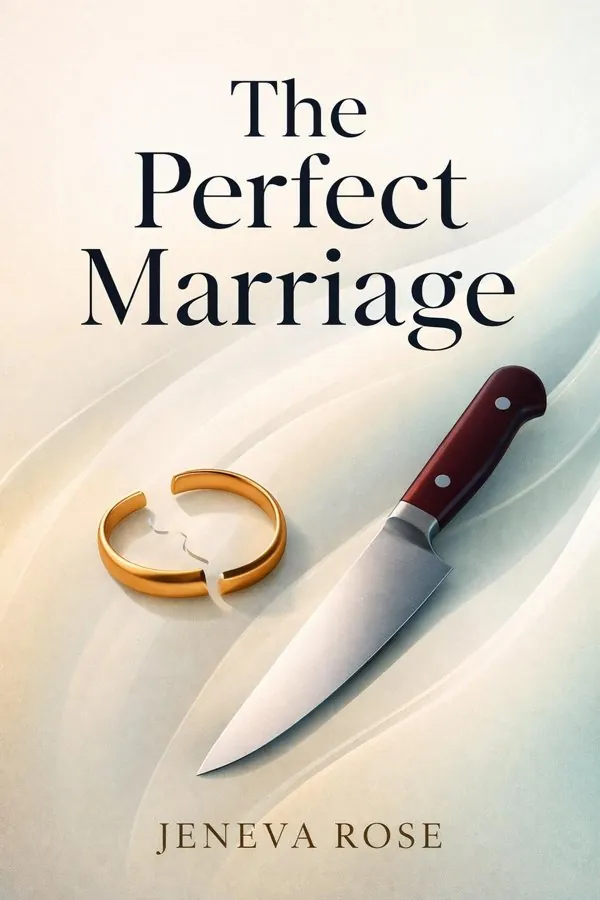
The Perfect Marriage: Summary & Key Insights
by Jeneva Rose
 10 min8 chaptersAudio available
Key Takeaways from The Perfect Marriage
A marriage can look strongest precisely when it is most hollow.
Affairs rarely begin as grand passions; more often, they begin as escape routes.
The most dangerous courtroom is often the one inside the human heart.
The most memorable thrillers do more than surprise; they force readers to reinterpret everything that came before.
Getting away with something does not restore what was broken before the act.
What Is The Perfect Marriage About?
The Perfect Marriage by Jeneva Rose is a mystery book spanning 5 pages. What happens when the person best equipped to expose the truth is also the one with the most to lose? In The Perfect Marriage, Jeneva Rose turns a familiar domestic setup into a sharp, addictive psychological thriller about betrayal, image, and the lies couples tell each other to keep their lives intact. Sarah Morgan is a brilliant, high-powered defense attorney whose career is built on controlling narratives and dismantling doubt. Her husband, Adam, appears to live in the glow of her success, but beneath their polished life lies distance, resentment, and infidelity. When Adam’s mistress, Kelly Summers, is found murdered and Adam becomes the prime suspect, Sarah makes a startling choice: she will defend him in court. From that premise, Rose constructs a tense story that blends legal suspense with intimate emotional warfare. The novel matters because it goes beyond the mechanics of a murder mystery to examine the performance of marriage itself—how ambition, neglect, dependence, and wounded pride can fester behind beautiful surfaces. As Rose’s breakout bestseller, The Perfect Marriage showcases her talent for fast pacing, sharp reversals, and morally unsettling twists that keep readers questioning everyone until the final pages.
This FizzRead summary covers all 8 key chapters of The Perfect Marriage in approximately 10 minutes, distilling the most important ideas, arguments, and takeaways from Jeneva Rose's work. Also available as an audio summary and Key Quotes Podcast.
The Perfect Marriage
What happens when the person best equipped to expose the truth is also the one with the most to lose? In The Perfect Marriage, Jeneva Rose turns a familiar domestic setup into a sharp, addictive psychological thriller about betrayal, image, and the lies couples tell each other to keep their lives intact. Sarah Morgan is a brilliant, high-powered defense attorney whose career is built on controlling narratives and dismantling doubt. Her husband, Adam, appears to live in the glow of her success, but beneath their polished life lies distance, resentment, and infidelity. When Adam’s mistress, Kelly Summers, is found murdered and Adam becomes the prime suspect, Sarah makes a startling choice: she will defend him in court.
From that premise, Rose constructs a tense story that blends legal suspense with intimate emotional warfare. The novel matters because it goes beyond the mechanics of a murder mystery to examine the performance of marriage itself—how ambition, neglect, dependence, and wounded pride can fester behind beautiful surfaces. As Rose’s breakout bestseller, The Perfect Marriage showcases her talent for fast pacing, sharp reversals, and morally unsettling twists that keep readers questioning everyone until the final pages.
Who Should Read The Perfect Marriage?
This book is perfect for anyone interested in mystery and looking to gain actionable insights in a short read. Whether you're a student, professional, or lifelong learner, the key ideas from The Perfect Marriage by Jeneva Rose will help you think differently.
- ✓Readers who enjoy mystery and want practical takeaways
- ✓Professionals looking to apply new ideas to their work and life
- ✓Anyone who wants the core insights of The Perfect Marriage in just 10 minutes
Want the full summary?
Get instant access to this book summary and 100K+ more with Fizz Moment.
Get Free SummaryAvailable on App Store • Free to download
Key Chapters
A marriage can look strongest precisely when it is most hollow. That insight drives the relationship at the center of The Perfect Marriage. Sarah Morgan and Adam Morgan appear, from the outside, to have achieved an enviable life: wealth, status, beauty, and the stability that comes with long-term partnership. But Jeneva Rose reveals that appearances are not evidence of intimacy. Sarah is disciplined, brilliant, and relentlessly career-driven. Adam, by contrast, is charming but increasingly passive, drifting through a life shaped by Sarah’s accomplishments and decisions. Their marriage has structure, but not mutual understanding.
What makes this dynamic compelling is that neither partner is entirely innocent nor entirely villainous in the early stages. Sarah’s emotional distance is not simple cruelty; it grows from ambition, exhaustion, and a deep attachment to control. Adam’s dissatisfaction is not wholly unjustified; he feels unseen, diminished, and lonely. Yet instead of confronting these tensions honestly, both allow silence to harden into resentment. Rose uses their relationship to explore a truth that applies far beyond fiction: many partnerships fail not through one dramatic rupture, but through years of unmet needs left unspoken.
In practical terms, the novel offers a cautionary lesson about emotional complacency. A couple can share a home, a history, and a social identity while privately living in separate emotional worlds. The signs are familiar in real life: routine replacing conversation, image replacing honesty, and assumptions replacing curiosity. Readers may recognize how easy it is to confuse function with connection.
The actionable takeaway is simple but demanding: do not mistake shared logistics for shared intimacy. Healthy relationships require direct conversations about resentment, power, admiration, and emotional neglect before silence turns into something far more destructive.
Affairs rarely begin as grand passions; more often, they begin as escape routes. Adam’s relationship with Kelly Summers is rooted less in love than in longing for a version of himself that feels less diminished. Kelly offers admiration, ease, and attention—the emotional validation Adam no longer feels at home. In that sense, the affair is not just betrayal; it is a symptom of deeper fracture. Rose uses this triangle to show how private dissatisfaction can spill into irreversible consequences.
Kelly is not merely a plot device or the stereotypical “other woman.” Her presence exposes the fault lines in Adam and Sarah’s marriage and intensifies the moral complexity of the novel. Adam wants comfort without accountability. He seeks emotional refuge while still remaining attached to the life Sarah’s success provides. This contradiction is crucial. He sees the affair as separate from his marriage, but Rose makes clear that deception never stays contained. Once someone begins dividing reality into compartments, those walls inevitably collapse.
The murder of Kelly transforms a domestic betrayal into a criminal crisis. Suddenly, private lies become public evidence. Intimate texts, hidden visits, and emotional manipulations are no longer embarrassing secrets; they are pieces of a legal narrative. This collision between emotional misconduct and legal exposure is one of the novel’s strongest ideas. What seems “personal” can quickly become consequential in ways no one anticipates.
Outside the novel, this concept applies to any pattern of self-justifying dishonesty. People often rationalize small deceptions because they seem manageable in the moment. But hidden choices accumulate, and under pressure they can reshape careers, families, and public trust.
The actionable takeaway: never assume a secret exists in isolation. Whether in love, work, or family life, deceptions create chains of consequence that eventually reach far beyond the original lie.
The most dangerous courtroom is often the one inside the human heart. When Sarah chooses to defend Adam after he is accused of murdering Kelly, the novel enters its most fascinating moral territory. On the surface, her decision can be read as loyalty, duty, or even professional confidence. But Rose complicates that reading immediately. Sarah is not simply acting as a devoted wife; she is navigating humiliation, anger, strategic opportunity, and perhaps something darker. The legal defense becomes a stage on which justice and personal emotion compete for control.
Sarah’s role highlights an unsettling truth about expertise: the skills that make someone effective professionally can also make them formidable in deeply personal conflicts. She knows how to shape perception, anticipate attacks, and create doubt. In court, those abilities are ethically bounded by legal procedure. In marriage, however, the use of such skills becomes morally ambiguous. Is she defending Adam because she believes in him, because she refuses to let others define her life, or because she wants control over the outcome for reasons of her own? Rose keeps that question alive, and that uncertainty fuels the suspense.
This key idea also speaks to how people behave under public pressure. When crisis strikes, some individuals do not collapse; they become sharper, more composed, more strategic. That competence can look admirable, but it may also conceal unresolved rage or hidden agendas. In everyday life, we see smaller versions of this when people handle conflict with polished professionalism while privately pursuing vindication.
The practical application is especially relevant in high-stakes decisions: when you are emotionally entangled, your rational choices may not be as neutral as they appear. Competence does not equal objectivity.
The actionable takeaway: before stepping into a conflict involving someone close to you, ask not only what you can do well, but also what motives may be shaping your judgment beneath the surface.
The most memorable thrillers do more than surprise; they force readers to reinterpret everything that came before. The Perfect Marriage earns its title through a twist that reframes the entire story and exposes how thoroughly image, intelligence, and emotional performance can be weaponized. Without relying on shock alone, Rose builds toward the revelation that the neat categories of victim, suspect, spouse, and savior were never stable. The crime is not just an act of violence; it is a carefully managed narrative.
What makes the twist effective is that it emerges from character, not randomness. Rose plants the novel’s final revelation in the central themes from the beginning: control, humiliation, perception, and power. The “perfect crime” here depends not simply on avoiding evidence, but on understanding how other people think. It requires exploiting assumptions—about gender, marriage, ambition, loyalty, and who appears believable under pressure. In that sense, the twist is an argument about social psychology as much as criminal cunning.
Readers can take from this more than admiration for clever plotting. The novel reminds us how often we trust confidence, coherence, and familiarity over truth itself. We assume that the person who appears composed is more credible. We assume that a wife defending her husband must be motivated by love. We assume that outward success signals inward stability. Rose exposes these assumptions as vulnerabilities.
In practical life, this has broad relevance. Whether evaluating a workplace conflict, media story, or personal dispute, people often confuse a convincing narrative with an accurate one. The best manipulators do not invent from nothing; they build lies from what others already want to believe.
The actionable takeaway: when a story feels too clean, too emotionally satisfying, or too perfectly aligned with expectations, pause and question the frame. The truth is often hiding in what seems most believable.
Getting away with something does not restore what was broken before the act. After the novel’s central revelations, Rose turns toward a chilling question: what remains when the illusion survives but the truth underneath has rotted away? The aftermath of The Perfect Marriage is not merely about legal closure. It is about how public appearances can persist even after moral collapse. That is what makes the ending so unsettling. Perfection is exposed as performance, yet performance remains powerful.
The title of the novel becomes especially meaningful here. A “perfect marriage” is not presented as loving, balanced, or emotionally honest. Instead, perfection refers to polish—the ability to preserve a desirable surface while concealing resentment, cruelty, and manipulation. The aftermath shows that social validation often rewards the image of stability more than the reality of integrity. People may continue admiring what they do not truly understand.
This idea resonates strongly outside fiction. In families, institutions, and relationships, reputation can outlive truth. A person can maintain social status while privately causing harm. A couple can appear enviable while emotionally destructive. A successful professional can be celebrated despite profound moral emptiness. Rose suggests that image management is one of the most underestimated forms of power.
The practical implication is sobering: closure is not always justice, and survival is not the same as healing. Many readers finish the novel with unease precisely because the final emotional note denies the comfort of simple restoration. Instead, it asks us to consider how often we accept polished narratives because they spare us the discomfort of looking deeper.
The actionable takeaway: be wary of equating appearances with resolution. In your own life, prioritize honest assessment over image preservation, especially when something feels “fine” only because no one is saying otherwise.
Unequal power in a marriage does not always look like domination; sometimes it looks like admiration curdling into resentment. One of the sharpest undercurrents in The Perfect Marriage is the tension created by Sarah’s success and Adam’s comparative dependence. Sarah is the accomplished attorney, the disciplined achiever, the person whose identity is rooted in competence and momentum. Adam lives adjacent to that success, benefiting from it while also feeling diminished by it. Rose uses this imbalance to explore how gender expectations still shape self-worth, even in modern, affluent relationships.
A high-achieving woman married to a less accomplished man should not, in theory, produce crisis. Yet the novel shows how cultural assumptions about masculinity, provision, and status can distort private emotions. Adam’s infidelity is not excused by these pressures, but it is partly illuminated by them. He seeks in Kelly a version of masculinity built on being desired and affirmed rather than overshadowed. Sarah, meanwhile, may view emotional accommodation as weakness or inefficiency, which further intensifies the divide.
This does not make the novel a social manifesto, but it does make it more psychologically rich. Resentment in marriage often grows not simply from what one partner does, but from what each partner believes they should be. When personal identity becomes tied to role expectations, any imbalance can feel like humiliation.
Readers can apply this insight by examining how status, earnings, professional success, and emotional labor operate in their own relationships. Conflicts that appear to be about time or affection may actually be about pride, relevance, and perceived value.
The actionable takeaway: discuss power openly in close relationships. Talk about money, achievement, dependence, and appreciation before insecurity transforms into contempt or betrayal.
Whoever controls the story often controls the outcome. Throughout The Perfect Marriage, Jeneva Rose demonstrates that survival in both marriage and criminal suspicion depends on narrative management. Sarah excels at this. As an attorney, she understands that facts alone rarely win a case; interpretation does. Motive must be framed, doubt must be introduced, and emotional reactions must be made legible to an audience. In the novel, that legal insight expands into a broader life strategy. People are constantly telling stories about themselves, their relationships, and their innocence.
This idea is central to the book’s suspense. Characters are not merely hiding facts; they are actively curating meanings. Adam wants to see himself as a flawed but not truly bad man. Sarah wants others to interpret her actions through professionalism or devotion rather than control. Even the structure of the thriller plays with readers’ expectations by granting information selectively and encouraging premature conclusions.
In everyday life, narrative control appears in more ordinary settings: during a workplace conflict, after a breakup, in family disputes, on social media, or whenever someone explains their behavior in the most flattering possible light. People often believe their own versions because those versions protect self-image. The danger comes when storytelling becomes a substitute for accountability.
The practical lesson is not that all self-presentation is manipulation. Rather, it is that any high-stakes situation should be examined at two levels: what happened, and how each person wants it understood. Those are not always the same. Learning to notice framing, omission, and emotional positioning can prevent costly misjudgments.
The actionable takeaway: when evaluating a conflict, separate facts from interpretation. Ask what is known, what is assumed, and who benefits from the current version of the story.
Betrayal becomes most destructive when it grows inside a space that once promised safety. The emotional engine of The Perfect Marriage is not just murder or legal peril; it is the slow corrosion of trust. Trust in the novel is not broken in a single instant. It erodes through neglect, secrecy, ego, and avoidance. By the time the most dramatic events unfold, the marriage has already become a place where honesty is impossible. Rose suggests that silence itself can be a form of betrayal when it allows false realities to flourish.
What makes this idea so effective is its familiarity. Many readers may not relate to homicide or courtroom drama, but they will understand the damage caused by unspoken disappointments. When one partner stops telling the truth about loneliness, resentment, desire, or dissatisfaction, the relationship begins operating on false premises. Both people respond to a reality that no longer exists. In that environment, trust becomes performative rather than lived.
The novel also highlights how betrayal is layered. Adam betrays Sarah through infidelity. Sarah’s actions complicate the meaning of loyalty in even deeper ways. Each betrayal is not only about what is done, but about what is withheld. Secrets reshape relationships long before they are discovered.
This has clear real-world application. Silence often feels easier than conflict, especially when preserving peace or image seems urgent. But avoided conversations tend to reappear in more damaging forms: affairs, emotional withdrawal, bitterness, or explosive confrontation. Transparency is uncomfortable in the short term but often protective in the long term.
The actionable takeaway: treat recurring silence as a warning sign, not a strategy. If something important feels too difficult to say, that is usually evidence that it needs to be said sooner rather than later.
All Chapters in The Perfect Marriage
About the Author
Jeneva Rose is an American bestselling author known for psychological thrillers and domestic suspense novels that explore deception, relationships, and moral ambiguity. She rose to prominence with The Perfect Marriage, a breakout hit that attracted a large international audience and established her reputation for twist-driven storytelling. Rose’s fiction often centers on ordinary lives destabilized by secrets, betrayal, and carefully constructed appearances, making her a popular choice for readers who enjoy fast-paced, emotionally charged suspense. Her books are recognized for their accessible prose, cinematic pacing, and dramatic reveals. With a growing body of commercially successful work, Jeneva Rose has become a prominent voice in contemporary thriller fiction, especially among readers drawn to stories where love, manipulation, and hidden motives collide.
Get This Summary in Your Preferred Format
Read or listen to the The Perfect Marriage summary by Jeneva Rose anytime, anywhere. FizzRead offers multiple formats so you can learn on your terms — all free.
Available formats: App · Audio · PDF · EPUB — All included free with FizzRead
Download The Perfect Marriage PDF and EPUB Summary
Key Quotes from The Perfect Marriage
“A marriage can look strongest precisely when it is most hollow.”
“Affairs rarely begin as grand passions; more often, they begin as escape routes.”
“The most dangerous courtroom is often the one inside the human heart.”
“The most memorable thrillers do more than surprise; they force readers to reinterpret everything that came before.”
“Getting away with something does not restore what was broken before the act.”
Frequently Asked Questions about The Perfect Marriage
The Perfect Marriage by Jeneva Rose is a mystery book that explores key ideas across 8 chapters. What happens when the person best equipped to expose the truth is also the one with the most to lose? In The Perfect Marriage, Jeneva Rose turns a familiar domestic setup into a sharp, addictive psychological thriller about betrayal, image, and the lies couples tell each other to keep their lives intact. Sarah Morgan is a brilliant, high-powered defense attorney whose career is built on controlling narratives and dismantling doubt. Her husband, Adam, appears to live in the glow of her success, but beneath their polished life lies distance, resentment, and infidelity. When Adam’s mistress, Kelly Summers, is found murdered and Adam becomes the prime suspect, Sarah makes a startling choice: she will defend him in court. From that premise, Rose constructs a tense story that blends legal suspense with intimate emotional warfare. The novel matters because it goes beyond the mechanics of a murder mystery to examine the performance of marriage itself—how ambition, neglect, dependence, and wounded pride can fester behind beautiful surfaces. As Rose’s breakout bestseller, The Perfect Marriage showcases her talent for fast pacing, sharp reversals, and morally unsettling twists that keep readers questioning everyone until the final pages.
More by Jeneva Rose
You Might Also Like



Browse by Category
Ready to read The Perfect Marriage?
Get the full summary and 100K+ more books with Fizz Moment.