
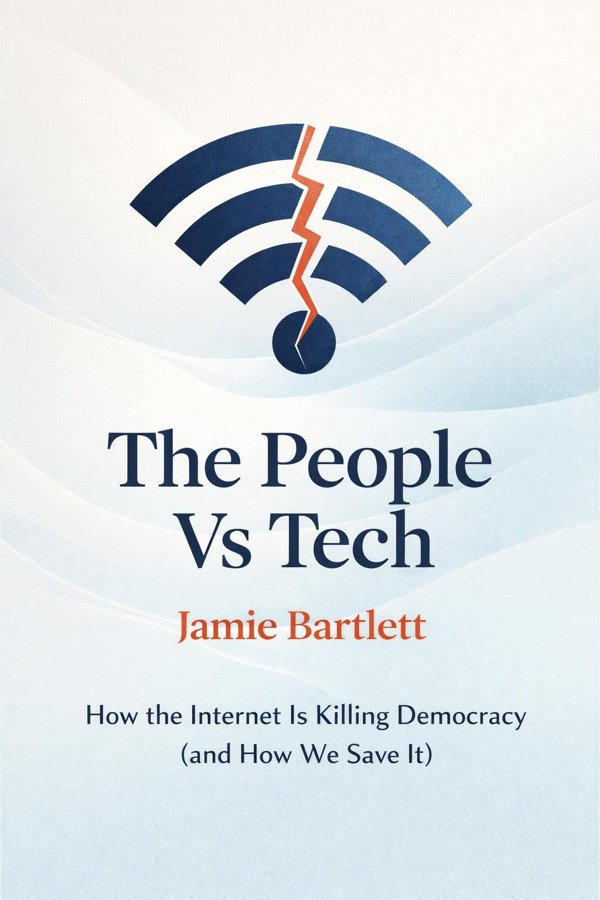
The People Vs Tech: How the Internet Is Killing Democracy (and How We Save It): Summary & Key Insights
 10 min11 chaptersAudio available
What Is The People Vs Tech: How the Internet Is Killing Democracy (and How We Save It) About?
The People Vs Tech: How the Internet Is Killing Democracy (and How We Save It) by Jamie Bartlett is a digital_culture book spanning 11 pages. In this urgent and thought-provoking book, Jamie Bartlett explores how the digital revolution and the rise of big tech are undermining democracy. He argues that social media, data analytics, and algorithmic control are eroding trust, privacy, and civic engagement. Bartlett outlines six key pillars necessary to preserve democratic values in the digital age and offers a roadmap for how societies can adapt to protect freedom and equality.
This FizzRead summary covers all 11 key chapters of The People Vs Tech: How the Internet Is Killing Democracy (and How We Save It) in approximately 10 minutes, distilling the most important ideas, arguments, and takeaways from Jamie Bartlett's work. Also available as an audio summary and Key Quotes Podcast.
The People Vs Tech: How the Internet Is Killing Democracy (and How We Save It)
In this urgent and thought-provoking book, Jamie Bartlett explores how the digital revolution and the rise of big tech are undermining democracy. He argues that social media, data analytics, and algorithmic control are eroding trust, privacy, and civic engagement. Bartlett outlines six key pillars necessary to preserve democratic values in the digital age and offers a roadmap for how societies can adapt to protect freedom and equality.
Who Should Read The People Vs Tech: How the Internet Is Killing Democracy (and How We Save It)?
This book is perfect for anyone interested in digital_culture and looking to gain actionable insights in a short read. Whether you're a student, professional, or lifelong learner, the key ideas from The People Vs Tech: How the Internet Is Killing Democracy (and How We Save It) by Jamie Bartlett will help you think differently.
- ✓Readers who enjoy digital_culture and want practical takeaways
- ✓Professionals looking to apply new ideas to their work and life
- ✓Anyone who wants the core insights of The People Vs Tech: How the Internet Is Killing Democracy (and How We Save It) in just 10 minutes
Want the full summary?
Get instant access to this book summary and 100K+ more with Fizz Moment.
Get Free SummaryAvailable on App Store • Free to download
Key Chapters
The backbone of this book rests on acknowledging how deeply the digital revolution has reshaped society. It’s not simply that we communicate more quickly or have access to more information—every democratic mechanism, from journalism to political campaigning, has been transformed. I explain how technology’s promise of connectivity has yielded both empowerment and chaos. People can express themselves freely online, yet the sheer volume of voices dilutes deliberation and encourages outrage. I describe how the architecture of platforms—likes, shares, notifications—rewards impulsive behavior, privileging speed and emotion over reflection. The digital revolution has also eroded the boundaries between the private and public spheres. Every act online is recorded, categorized, and monetized. In a democracy, this poses a deep dilemma: transparency without privacy leads not to accountability but to fear and conformity. Through historical reflections, I trace how previous revolutions—industrial and print—required new social contracts to balance innovation and liberty. The digital revolution demands the same, but we have been slow to respond. Without deliberate redesign, the infrastructure of the internet will continue to tilt our habits, attention, and incentives away from democratic cooperation. I urge readers to see the revolution not as inevitable progress, but as a terrain of political struggle—where values must be defended and technological power must be made answerable to the people.
Data is the new currency of power, and its use defines the modern political landscape. In this section, I delve into the vast apparatus of data collection that sustains both corporate and governmental control. Every search, click, and swipe feeds a system that knows us better than we know ourselves. I show how data analytics has become a central tool for influence—from tailored advertising to political microtargeting—turning citizens into predictable clusters of behavior rather than autonomous individuals. The Cambridge Analytica scandal serves as an emblematic example, demonstrating how private data can be weaponized to manipulate election outcomes. I argue that democracy thrives on uncertainty—the free interchange of ideas, the right to surprise and change one’s mind. Data-driven governance corrodes this, replacing uncertainty with quantifiable prediction. When decisions are guided by algorithms, accountability recedes behind technical complexity. I reflect on the trade-offs we’ve accepted in exchange for convenience and personalization. We were promised empowerment but received surveillance; we sought knowledge but surrendered autonomy. Reclaiming control over data requires not only laws but a cultural shift—a deeper awareness of how our digital selves are constructed and exploited. As I emphasize, democracy cannot survive if citizens are stripped of opacity and unpredictability, the very traits that make free choice possible.
+ 9 more chapters — available in the FizzRead app
All Chapters in The People Vs Tech: How the Internet Is Killing Democracy (and How We Save It)
About the Author
Jamie Bartlett is a British author and researcher specializing in the intersection of technology, politics, and society. He is the director of the Centre for the Analysis of Social Media at Demos and has written several acclaimed books on digital culture, including 'Radicals' and 'The Dark Net.'
Get This Summary in Your Preferred Format
Read or listen to the The People Vs Tech: How the Internet Is Killing Democracy (and How We Save It) summary by Jamie Bartlett anytime, anywhere. FizzRead offers multiple formats so you can learn on your terms — all free.
Available formats: App · Audio · PDF · EPUB — All included free with FizzRead
Download The People Vs Tech: How the Internet Is Killing Democracy (and How We Save It) PDF and EPUB Summary
Key Quotes from The People Vs Tech: How the Internet Is Killing Democracy (and How We Save It)
“The backbone of this book rests on acknowledging how deeply the digital revolution has reshaped society.”
“Data is the new currency of power, and its use defines the modern political landscape.”
Frequently Asked Questions about The People Vs Tech: How the Internet Is Killing Democracy (and How We Save It)
The People Vs Tech: How the Internet Is Killing Democracy (and How We Save It) by Jamie Bartlett is a digital_culture book that explores key ideas across 11 chapters. In this urgent and thought-provoking book, Jamie Bartlett explores how the digital revolution and the rise of big tech are undermining democracy. He argues that social media, data analytics, and algorithmic control are eroding trust, privacy, and civic engagement. Bartlett outlines six key pillars necessary to preserve democratic values in the digital age and offers a roadmap for how societies can adapt to protect freedom and equality.
More by Jamie Bartlett
You Might Also Like
An Ugly Truth: Inside Facebook’s Battle for Domination
Sheera Frenkel, Cecilia Kang
10 min
Cyber Citizens
Ian Goodfellow
10 min
Digital Minimalism: Choosing a Focused Life in a Noisy World
Cal Newport
10 min
E‑Books & Beyond
Various Authors
10 min
The Future of Media
Various Authors
10 min
This Is Why We Can't Have Nice Things
Whitney Phillips
10 minBrowse by Category
Ready to read The People Vs Tech: How the Internet Is Killing Democracy (and How We Save It)?
Get the full summary and 100K+ more books with Fizz Moment.