
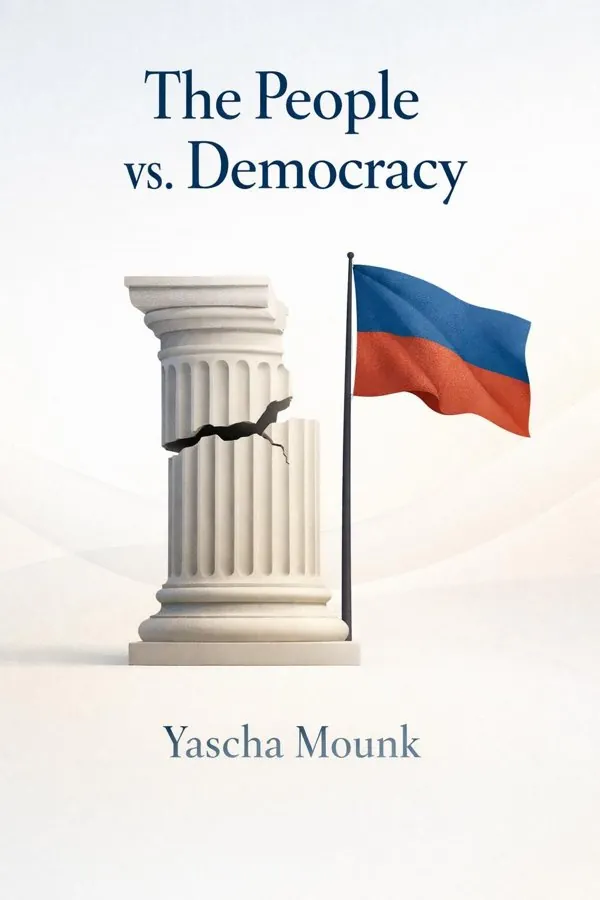
The People vs. Democracy: Why Our Freedom Is in Danger and How to Save It: Summary & Key Insights
by Yascha Mounk
 10 min6 chaptersAudio available
What Is The People vs. Democracy: Why Our Freedom Is in Danger and How to Save It About?
The People vs. Democracy: Why Our Freedom Is in Danger and How to Save It by Yascha Mounk is a politics book spanning 6 pages. In this influential work, Yascha Mounk explores the global rise of populism and the decline of liberal democracy. He argues that the combination of economic stagnation, cultural backlash, and the digital revolution has eroded citizens’ faith in democratic institutions. Mounk examines how democracies can renew themselves by restoring trust, reforming institutions, and addressing inequality before authoritarian populism becomes entrenched.
This FizzRead summary covers all 6 key chapters of The People vs. Democracy: Why Our Freedom Is in Danger and How to Save It in approximately 10 minutes, distilling the most important ideas, arguments, and takeaways from Yascha Mounk's work. Also available as an audio summary and Key Quotes Podcast.
The People vs. Democracy: Why Our Freedom Is in Danger and How to Save It
In this influential work, Yascha Mounk explores the global rise of populism and the decline of liberal democracy. He argues that the combination of economic stagnation, cultural backlash, and the digital revolution has eroded citizens’ faith in democratic institutions. Mounk examines how democracies can renew themselves by restoring trust, reforming institutions, and addressing inequality before authoritarian populism becomes entrenched.
Who Should Read The People vs. Democracy: Why Our Freedom Is in Danger and How to Save It?
This book is perfect for anyone interested in politics and looking to gain actionable insights in a short read. Whether you're a student, professional, or lifelong learner, the key ideas from The People vs. Democracy: Why Our Freedom Is in Danger and How to Save It by Yascha Mounk will help you think differently.
- ✓Readers who enjoy politics and want practical takeaways
- ✓Professionals looking to apply new ideas to their work and life
- ✓Anyone who wants the core insights of The People vs. Democracy: Why Our Freedom Is in Danger and How to Save It in just 10 minutes
Want the full summary?
Get instant access to this book summary and 100K+ more with Fizz Moment.
Get Free SummaryAvailable on App Store • Free to download
Key Chapters
In the wake of World War II, liberal democracy emerged from the rubble as humanity’s best bulwark against tyranny. The carnage of totalitarianism—both fascist and communist—convinced Western societies that individual rights and representative rule were inseparable. The Cold War reinforced this conviction: liberal democracy stood not only as a political system but as a moral beacon. Economic growth, expanding welfare states, and international institutions gave citizens tangible reasons to believe democracy worked.
For decades, this illusion of inevitability persisted. When the Berlin Wall fell, many—including thinkers like Francis Fukuyama—imagined that history had ended in liberal triumph. But that certainty masked fragility. Even then, inequality was widening, civic participation declining, and the promise of shared prosperity fraying. The very success of liberal democracy bred complacency. We came to assume it would endure automatically, without realizing it depended on ongoing renewal and citizens’ belief in its fairness and efficacy.
As I trace in the book, the postwar consensus was a historical anomaly, not a permanent equilibrium. Once the conditions that sustained it—economic security, cultural homogeneity, and restrained media—began to dissolve, democratic norms could erode faster than anyone expected.
In traveling across democracies from the United States to Poland, I found a disquieting pattern: a growing number of citizens no longer value democracy itself. Surveys reveal that fewer young people consider it essential to live in a democracy compared to their grandparents’ generation. This isn’t just apathy; it’s disillusionment. Many feel democratic institutions serve elites, not citizens. Meanwhile, populist leaders offer a seductive promise: to return power to ‘the people.’ But their definition of ‘the people’ is exclusionary—it excludes dissenters, minorities, and critics.
Populism’s rise reflects a deep erosion of trust. Parliaments appear gridlocked, parties indistinguishable, bureaucracies unaccountable. In that environment, demagogues gain traction by claiming to speak for an authentic nation betrayed by corrupt elites. Once in power, they hollow out checks and balances under the guise of majority will. Hungary and Turkey exemplify this drift toward illiberal democracy. In America, we have seen how polarization and contempt for institutional norms can bring even the oldest democracy to the brink.
Behind the statistics lies a moral crisis. When citizens feel unheard, they stop valuing compromise. When truth itself becomes partisan, the shared reality necessary for self-government collapses. This is why defending democracy today requires more than procedural reforms—it demands rekindling a public ethos of trust and tolerance.
+ 4 more chapters — available in the FizzRead app
All Chapters in The People vs. Democracy: Why Our Freedom Is in Danger and How to Save It
About the Author
Yascha Mounk is a German-born political scientist, author, and lecturer at Johns Hopkins University. His research focuses on the crisis of liberal democracy and the challenges of populism in modern societies. Mounk is also a contributing editor at The Atlantic and the founder of the publication Persuasion.
Get This Summary in Your Preferred Format
Read or listen to the The People vs. Democracy: Why Our Freedom Is in Danger and How to Save It summary by Yascha Mounk anytime, anywhere. FizzRead offers multiple formats so you can learn on your terms — all free.
Available formats: App · Audio · PDF · EPUB — All included free with FizzRead
Download The People vs. Democracy: Why Our Freedom Is in Danger and How to Save It PDF and EPUB Summary
Key Quotes from The People vs. Democracy: Why Our Freedom Is in Danger and How to Save It
“In the wake of World War II, liberal democracy emerged from the rubble as humanity’s best bulwark against tyranny.”
“In traveling across democracies from the United States to Poland, I found a disquieting pattern: a growing number of citizens no longer value democracy itself.”
Frequently Asked Questions about The People vs. Democracy: Why Our Freedom Is in Danger and How to Save It
The People vs. Democracy: Why Our Freedom Is in Danger and How to Save It by Yascha Mounk is a politics book that explores key ideas across 6 chapters. In this influential work, Yascha Mounk explores the global rise of populism and the decline of liberal democracy. He argues that the combination of economic stagnation, cultural backlash, and the digital revolution has eroded citizens’ faith in democratic institutions. Mounk examines how democracies can renew themselves by restoring trust, reforming institutions, and addressing inequality before authoritarian populism becomes entrenched.
You Might Also Like
Antifa: The Anti-Fascist Handbook
Mark Bray
10 min
Attack from Within: How Disinformation Is Sabotaging America
Barbara McQuade
10 min
Coercion, Capital, and European States, AD 990–1992
Charles Tilly
10 min
Digital Democracy: Concepts, Methodologies, Tools, and Applications
Various Authors
10 min
Fascism
Stanley G. Payne
10 min
Fire And Fury: Inside The Trump White House
Michael Wolff
10 minBrowse by Category
Ready to read The People vs. Democracy: Why Our Freedom Is in Danger and How to Save It?
Get the full summary and 100K+ more books with Fizz Moment.