
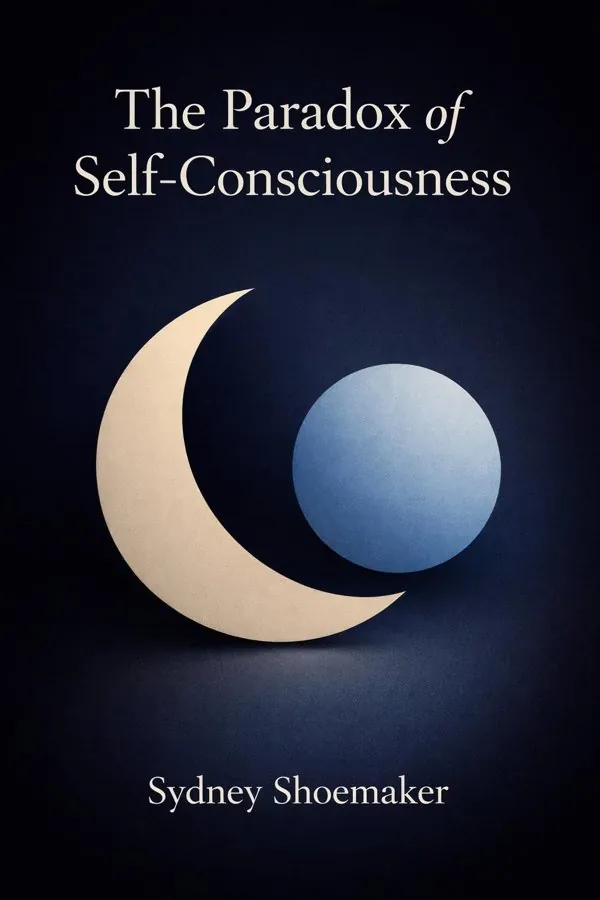
The Paradox of Self-Consciousness: Summary & Key Insights
 10 min10 chaptersAudio available
What Is The Paradox of Self-Consciousness About?
The Paradox of Self-Consciousness by Sydney Shoemaker is a western_phil book spanning 10 pages. In this influential philosophical work, Sydney Shoemaker explores the nature of self-knowledge and self-consciousness, arguing that our ability to know our own mental states is not based on observation but on a constitutive relation between self and mind. The book examines the paradox that arises when trying to explain how one can be both the subject and the object of self-awareness, offering a rigorous analysis that has shaped contemporary debates in philosophy of mind and epistemology.
This FizzRead summary covers all 10 key chapters of The Paradox of Self-Consciousness in approximately 10 minutes, distilling the most important ideas, arguments, and takeaways from Sydney Shoemaker's work. Also available as an audio summary and Key Quotes Podcast.
The Paradox of Self-Consciousness
In this influential philosophical work, Sydney Shoemaker explores the nature of self-knowledge and self-consciousness, arguing that our ability to know our own mental states is not based on observation but on a constitutive relation between self and mind. The book examines the paradox that arises when trying to explain how one can be both the subject and the object of self-awareness, offering a rigorous analysis that has shaped contemporary debates in philosophy of mind and epistemology.
Who Should Read The Paradox of Self-Consciousness?
This book is perfect for anyone interested in western_phil and looking to gain actionable insights in a short read. Whether you're a student, professional, or lifelong learner, the key ideas from The Paradox of Self-Consciousness by Sydney Shoemaker will help you think differently.
- ✓Readers who enjoy western_phil and want practical takeaways
- ✓Professionals looking to apply new ideas to their work and life
- ✓Anyone who wants the core insights of The Paradox of Self-Consciousness in just 10 minutes
Want the full summary?
Get instant access to this book summary and 100K+ more with Fizz Moment.
Get Free SummaryAvailable on App Store • Free to download
Key Chapters
At the heart of my inquiry lies a tension often unnoticed but deeply embedded in philosophical reflection: how can a subject simultaneously stand as the object of its own cognition? When I say, “I am aware of my belief,” it seems that I, the subject, am both standing apart from and yet occupying the belief I scrutinize. This apparent duality produces the paradox of self-consciousness.
Philosophers have long wrestled with this dilemma. If self-knowledge operates through observation, it would require some division between observer and observed within the same mind. That division, however, seems incompatible with the unity of consciousness. My argument begins by reframing the issue: the self does not perceive itself as another entity but is inherently present in its own cognition. In the act of knowing, the mind reflexively reveals its own structure. Thus, the paradox is not a contradiction but a window into the constitutive character of mental life.
Understanding this paradox transforms how we conceive consciousness. Rather than treating the self as an epistemic agent peering inward, we recognize it as the very ground of mental phenomena. Self-consciousness becomes a condition for the possibility of having mental states at all. This move sets the direction for all subsequent discussions in the book and serves as the keystone for resolving confusion that has plagued both empiricist and rationalist accounts of introspection.
The traditional model that likens self-knowledge to inner observation runs into serious problems. It suggests that, just as one perceives an external object, one can 'see' one’s own thoughts or feelings in an inner mental space. But this analogy fails because mental states are not given to consciousness as independent objects; they are experienced as constitutive of our perspective on the world.
When I believe something, I do not first inspect my belief as if it were an interior object and then affirm it as mine. The belief itself involves a first-person stance—it is already imbued with awareness of who holds it. Thus, observation is not the mechanism of self-knowledge; rather, self-knowledge is built into the fabric of mental states themselves. To assume that introspection operates like perception is to obscure what is most distinctively first-personal about consciousness.
By rejecting the observational model, we liberate the study of self-awareness from misleading analogies. The self does not stand before its mental states as a detached spectator; it lives through them. This insight leads to the next step: understanding how self-knowledge arises from the very constitutive relation between subject and state, rather than from any secondary epistemic act.
+ 8 more chapters — available in the FizzRead app
All Chapters in The Paradox of Self-Consciousness
About the Author
Sydney Shoemaker (1931–2022) was an American philosopher renowned for his contributions to the philosophy of mind, metaphysics, and personal identity. He taught for many years at Cornell University and authored several seminal works on self-knowledge, identity, and consciousness.
Get This Summary in Your Preferred Format
Read or listen to the The Paradox of Self-Consciousness summary by Sydney Shoemaker anytime, anywhere. FizzRead offers multiple formats so you can learn on your terms — all free.
Available formats: App · Audio · PDF · EPUB — All included free with FizzRead
Download The Paradox of Self-Consciousness PDF and EPUB Summary
Key Quotes from The Paradox of Self-Consciousness
“At the heart of my inquiry lies a tension often unnoticed but deeply embedded in philosophical reflection: how can a subject simultaneously stand as the object of its own cognition?”
“The traditional model that likens self-knowledge to inner observation runs into serious problems.”
Frequently Asked Questions about The Paradox of Self-Consciousness
The Paradox of Self-Consciousness by Sydney Shoemaker is a western_phil book that explores key ideas across 10 chapters. In this influential philosophical work, Sydney Shoemaker explores the nature of self-knowledge and self-consciousness, arguing that our ability to know our own mental states is not based on observation but on a constitutive relation between self and mind. The book examines the paradox that arises when trying to explain how one can be both the subject and the object of self-awareness, offering a rigorous analysis that has shaped contemporary debates in philosophy of mind and epistemology.
You Might Also Like
A Little History of Philosophy
Nigel Warburton
10 min
Areopagitica
John Milton
10 min
How To Think Like A Philosopher: Essential Principles For Clear Thinking
Peter Cave
10 min
Language, Truth and Logic
A. J. Ayer
10 min
The Age of Reason
Thomas Paine
10 min
The Essays
Michel De Montaigne
10 minBrowse by Category
Ready to read The Paradox of Self-Consciousness?
Get the full summary and 100K+ more books with Fizz Moment.