
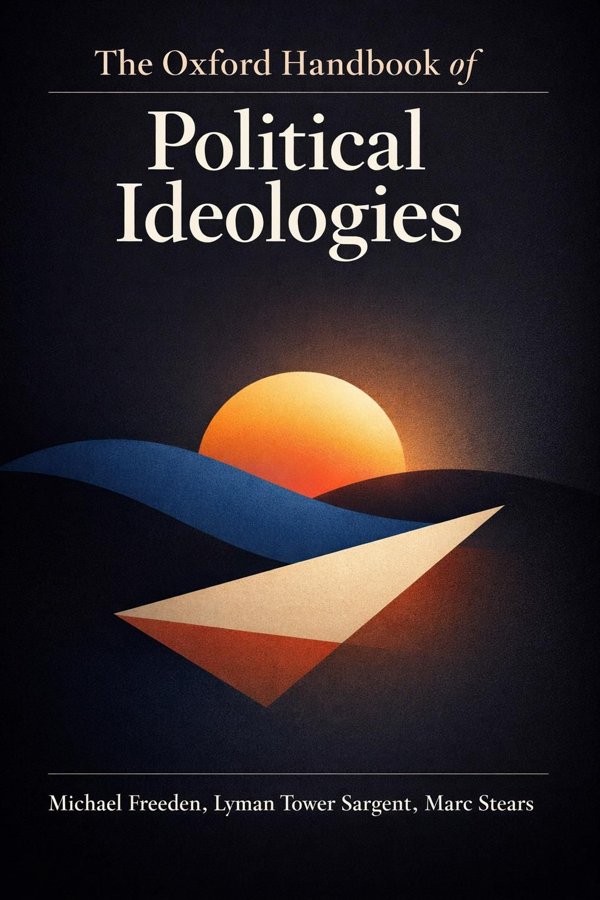
The Oxford Handbook of Political Ideologies: Summary & Key Insights
by Michael Freeden, Lyman Tower Sargent, Marc Stears
 10 min7 chaptersAudio available
What Is The Oxford Handbook of Political Ideologies About?
The Oxford Handbook of Political Ideologies by Michael Freeden, Lyman Tower Sargent, Marc Stears is a politics book spanning 7 pages. The Oxford Handbook of Political Ideologies offers a comprehensive overview of the study of political ideologies, exploring their historical development, conceptual foundations, and contemporary relevance. It brings together leading scholars to examine major ideological traditions such as liberalism, conservatism, socialism, feminism, nationalism, and environmentalism, as well as emerging and hybrid ideologies. The volume provides critical insights into how ideologies shape political thought, identity, and action across different societies.
This FizzRead summary covers all 7 key chapters of The Oxford Handbook of Political Ideologies in approximately 10 minutes, distilling the most important ideas, arguments, and takeaways from Michael Freeden, Lyman Tower Sargent, Marc Stears's work. Also available as an audio summary and Key Quotes Podcast.
The Oxford Handbook of Political Ideologies
The Oxford Handbook of Political Ideologies offers a comprehensive overview of the study of political ideologies, exploring their historical development, conceptual foundations, and contemporary relevance. It brings together leading scholars to examine major ideological traditions such as liberalism, conservatism, socialism, feminism, nationalism, and environmentalism, as well as emerging and hybrid ideologies. The volume provides critical insights into how ideologies shape political thought, identity, and action across different societies.
Who Should Read The Oxford Handbook of Political Ideologies?
This book is perfect for anyone interested in politics and looking to gain actionable insights in a short read. Whether you're a student, professional, or lifelong learner, the key ideas from The Oxford Handbook of Political Ideologies by Michael Freeden, Lyman Tower Sargent, Marc Stears will help you think differently.
- ✓Readers who enjoy politics and want practical takeaways
- ✓Professionals looking to apply new ideas to their work and life
- ✓Anyone who wants the core insights of The Oxford Handbook of Political Ideologies in just 10 minutes
Want the full summary?
Get instant access to this book summary and 100K+ more with Fizz Moment.
Get Free SummaryAvailable on App Store • Free to download
Key Chapters
Ideological analysis begins, for us, with recognition that ideology is not a synonym for distortion. For much of the twentieth century, political theorists viewed ideology through a lens of suspicion — as Marx did, seeing it as a veil obscuring real relations of production, or as positivists did, treating it as an error to be overcome by scientific reasoning. But in this volume, we assert a different path. Ideologies are meaning-making frameworks through which human beings interpret their political worlds. They are not aberrations from rational deliberation; they are the very conditions that make deliberation possible.
The morphology approach, which I (Michael Freeden) have developed, offers a method for understanding this internal structure. Each ideology can be seen as a cluster of political concepts organized in distinctive patterns. Core concepts anchor the system — freedom for liberalism, tradition for conservatism, equality for socialism — yet their meanings vary depending on their neighboring concepts. Surrounding the core are adjacent and peripheral concepts that modify and contextualize the ideological core. Ideological change, therefore, occurs when these relationships are reordered, when previously peripheral ideas move toward the center or vice versa.
This conceptual mapping enables us to treat ideologies not as sealed categories but as dynamic, overlapping formations. Liberalism and conservatism, for example, share conceptual families — order, rights, responsibility — but arrange them differently. Ideology, then, is morphology in motion. Understanding its structure helps us analyze political discourse with empathy and precision, seeing how moral imagination shapes collective reasoning.
Our aim is also to challenge the myth of the ideology-free perspective. Every political actor operates from a conceptual standpoint, whether declared or implicit. The task of ideology studies is not to eliminate presuppositions, but to make them visible. Only then can political argument become a genuine contest of visions rather than a clash of slogans.
The story of political ideologies is the story of modernity’s self-consciousness. From the Enlightenment onward, as societies grappled with industrialization, secularization, and new political forms, the very idea of systematic political belief took shape. Classical political philosophy was concerned with the good life and just rule; ideology, by contrast, emerged when political thought became mass-oriented and mobilized.
During the nineteenth century, liberalism, conservatism, and socialism crystallized as the great triad of modern political ideologies. Each claimed to offer a comprehensive vision of social order. Liberalism championed the autonomy of individuals within the framework of rights and markets; conservatism defended inherited institutions and cultural continuity; socialism called for solidarity grounded in economic justice. Yet these traditions did not evolve in isolation. They defined themselves against one another, borrowing and reframing concepts in a continual ideological dialogue.
The twentieth century brought revolutions and crises that stretched these ideologies to breaking points: fascism’s totalitarian synthesis, communism’s revolutionary universalism, and post-war liberal democracy’s pragmatic equilibrium. After 1945, new waves of ideological awareness arose — feminism, environmentalism, anti-colonial and postcolonial movements — each challenging the universal claims of earlier systems. The Cold War fixated ideology as a term of suspicion; yet, paradoxically, the collapse of grand oppositions in the late twentieth century led to an explosion of ideological plurality rather than its end.
In the twenty-first century, ideologies operate within conditions of fragmentation, digital mediation, and global interdependence. They are less static ‘isms’ and more fluid assemblages of values and narratives. The historical study of ideologies thus becomes a study of adaptation — how traditions reinvent themselves in response to new publics, technologies, and crises of legitimacy.
+ 5 more chapters — available in the FizzRead app
All Chapters in The Oxford Handbook of Political Ideologies
About the Authors
Michael Freeden is a political theorist known for his work on the morphology of political ideologies. Lyman Tower Sargent is an American political scientist specializing in utopian studies and political theory. Marc Stears is a British political theorist and academic with research interests in political ideologies and democratic theory.
Get This Summary in Your Preferred Format
Read or listen to the The Oxford Handbook of Political Ideologies summary by Michael Freeden, Lyman Tower Sargent, Marc Stears anytime, anywhere. FizzRead offers multiple formats so you can learn on your terms — all free.
Available formats: App · Audio · PDF · EPUB — All included free with FizzRead
Download The Oxford Handbook of Political Ideologies PDF and EPUB Summary
Key Quotes from The Oxford Handbook of Political Ideologies
“Ideological analysis begins, for us, with recognition that ideology is not a synonym for distortion.”
“The story of political ideologies is the story of modernity’s self-consciousness.”
Frequently Asked Questions about The Oxford Handbook of Political Ideologies
The Oxford Handbook of Political Ideologies by Michael Freeden, Lyman Tower Sargent, Marc Stears is a politics book that explores key ideas across 7 chapters. The Oxford Handbook of Political Ideologies offers a comprehensive overview of the study of political ideologies, exploring their historical development, conceptual foundations, and contemporary relevance. It brings together leading scholars to examine major ideological traditions such as liberalism, conservatism, socialism, feminism, nationalism, and environmentalism, as well as emerging and hybrid ideologies. The volume provides critical insights into how ideologies shape political thought, identity, and action across different societies.
You Might Also Like
Antifa: The Anti-Fascist Handbook
Mark Bray
10 min
Attack from Within: How Disinformation Is Sabotaging America
Barbara McQuade
10 min
Coercion, Capital, and European States, AD 990–1992
Charles Tilly
10 min
Digital Democracy: Concepts, Methodologies, Tools, and Applications
Various Authors
10 min
Fascism
Stanley G. Payne
10 min
Fire And Fury: Inside The Trump White House
Michael Wolff
10 minBrowse by Category
Ready to read The Oxford Handbook of Political Ideologies?
Get the full summary and 100K+ more books with Fizz Moment.