
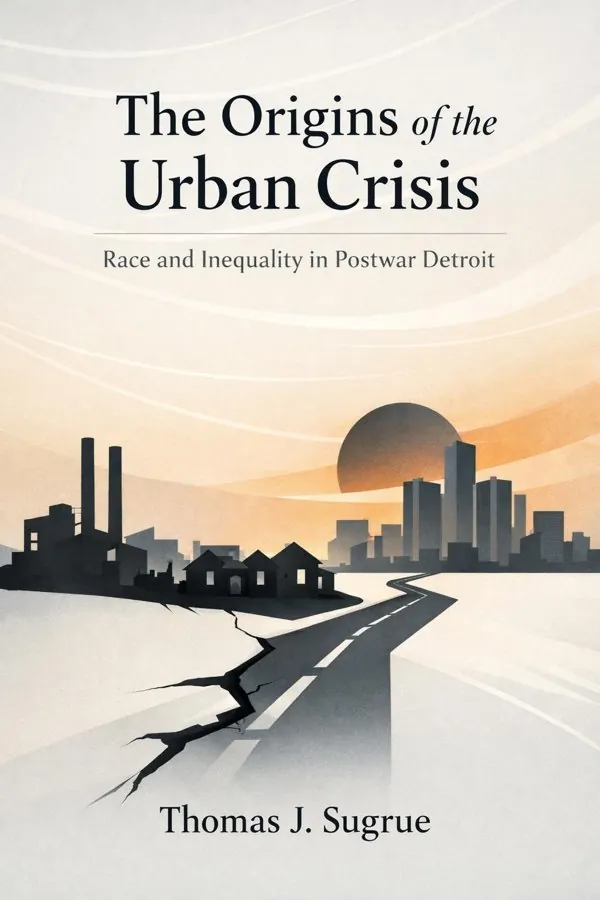
The Origins of the Urban Crisis: Race and Inequality in Postwar Detroit: Summary & Key Insights
 10 min11 chaptersAudio available
What Is The Origins of the Urban Crisis: Race and Inequality in Postwar Detroit About?
The Origins of the Urban Crisis: Race and Inequality in Postwar Detroit by Thomas J. Sugrue is a sociology book spanning 11 pages. This influential study examines the decline of Detroit and the broader transformation of American cities after World War II. Sugrue argues that the roots of urban crisis lie not only in deindustrialization but also in persistent racial discrimination in housing, employment, and politics. Through detailed archival research, he shows how structural racism and economic shifts combined to create enduring patterns of inequality that shaped the modern urban landscape.
This FizzRead summary covers all 11 key chapters of The Origins of the Urban Crisis: Race and Inequality in Postwar Detroit in approximately 10 minutes, distilling the most important ideas, arguments, and takeaways from Thomas J. Sugrue's work. Also available as an audio summary and Key Quotes Podcast.
The Origins of the Urban Crisis: Race and Inequality in Postwar Detroit
This influential study examines the decline of Detroit and the broader transformation of American cities after World War II. Sugrue argues that the roots of urban crisis lie not only in deindustrialization but also in persistent racial discrimination in housing, employment, and politics. Through detailed archival research, he shows how structural racism and economic shifts combined to create enduring patterns of inequality that shaped the modern urban landscape.
Who Should Read The Origins of the Urban Crisis: Race and Inequality in Postwar Detroit?
This book is perfect for anyone interested in sociology and looking to gain actionable insights in a short read. Whether you're a student, professional, or lifelong learner, the key ideas from The Origins of the Urban Crisis: Race and Inequality in Postwar Detroit by Thomas J. Sugrue will help you think differently.
- ✓Readers who enjoy sociology and want practical takeaways
- ✓Professionals looking to apply new ideas to their work and life
- ✓Anyone who wants the core insights of The Origins of the Urban Crisis: Race and Inequality in Postwar Detroit in just 10 minutes
Want the full summary?
Get instant access to this book summary and 100K+ more with Fizz Moment.
Get Free SummaryAvailable on App Store • Free to download
Key Chapters
In the years following 1945, Detroit embodied the triumph of American industry. Its automobile factories churned out products that symbolized freedom and progress; its labor unions commanded national respect; and the city stood as a beacon of working-class prosperity. Veterans returned home to what seemed a limitless horizon—secure jobs, affordable homes, and the conviction that industrial labor would sustain middle-class lives. Federal and local programs promised housing for all, and the rhetoric of economic democracy filled the air.
Yet beneath this promise lay the seeds of division. The vast economic expansion did not touch all Detroiters equally. African American veterans and workers, though essential to wartime production, were often shut out of the postwar boom’s tangible rewards. The city’s housing market and industrial management operated on racial lines so entrenched that prosperity was stratified from the start. Factories relegated black workers to the most dangerous and low-paying jobs. Unions struggled internally with prejudice, sometimes defending seniority systems that perpetuated inequalities rather than dismantled them.
The paradox of Detroit’s postwar moment, therefore, was that abundance coexisted with exclusion. At the center of my research is the recognition that growth itself reinforced segregation. The federal policies meant to promote housing—particularly FHA and VA loans—became vehicles for preserving white homogeneity. Economic success was dependent on racial containment, not integration. As we will see, this contradiction patterned every subsequent stage of Detroit’s decline: industrial restructuring could devastate only because racial inequality had hollowed out the city’s resilience long before deindustrialization took hold.
Housing was where Detroit’s divisions were carved most visibly. The postwar boom brought millions of federal dollars into mortgages and building initiatives, but these resources were distributed according to racialized assumptions about value and risk. White neighborhoods were secured by restrictive covenants, contracts that forbade sales to African Americans. Realtors, banks, and government agencies colluded to map racial boundaries with precision—the infamous “redlining” practices designated black areas as unworthy of investment. Even when African Americans earned enough to buy homes, they faced systematic obstacles that confined them to overcrowded, deteriorating districts on Detroit’s east and near west sides.
This segregation was not merely spatial—it shaped opportunity. Property values, school funding, and local infrastructure followed the racial map. To live on one side of the line was to be excluded from the credit flows and civic developments that turned suburbs into havens of stability. When African Americans attempted to move beyond those lines, they encountered organized resistance: neighborhood associations, mob intimidation, and at times, outright violence. The architecture of exclusion became self-perpetuating—each discriminatory policy made the next seem practical.
As I looked through planning documents and city council minutes, I saw how officials justified these boundaries. They viewed segregation not as racism but as ‘protecting investment stability.’ The language of economics veiled moral failure. By the 1950s, these policies ensured that urban inequality would persist even as the city modernized. The new highways and mortgage markets did not liberate Detroit’s residents; they fortified separation. Housing discrimination thus stood at the root of the urban crisis—not a symptom, but a causal force ensuring that when economic change came, it would hit black communities hardest.
+ 9 more chapters — available in the FizzRead app
All Chapters in The Origins of the Urban Crisis: Race and Inequality in Postwar Detroit
About the Author
Thomas J. Sugrue is an American historian specializing in twentieth-century U.S. history, urban studies, and race relations. He is a professor at New York University and has written extensively on the history of cities, civil rights, and social policy in modern America.
Get This Summary in Your Preferred Format
Read or listen to the The Origins of the Urban Crisis: Race and Inequality in Postwar Detroit summary by Thomas J. Sugrue anytime, anywhere. FizzRead offers multiple formats so you can learn on your terms — all free.
Available formats: App · Audio · PDF · EPUB — All included free with FizzRead
Download The Origins of the Urban Crisis: Race and Inequality in Postwar Detroit PDF and EPUB Summary
Key Quotes from The Origins of the Urban Crisis: Race and Inequality in Postwar Detroit
“In the years following 1945, Detroit embodied the triumph of American industry.”
“Housing was where Detroit’s divisions were carved most visibly.”
Frequently Asked Questions about The Origins of the Urban Crisis: Race and Inequality in Postwar Detroit
The Origins of the Urban Crisis: Race and Inequality in Postwar Detroit by Thomas J. Sugrue is a sociology book that explores key ideas across 11 chapters. This influential study examines the decline of Detroit and the broader transformation of American cities after World War II. Sugrue argues that the roots of urban crisis lie not only in deindustrialization but also in persistent racial discrimination in housing, employment, and politics. Through detailed archival research, he shows how structural racism and economic shifts combined to create enduring patterns of inequality that shaped the modern urban landscape.
You Might Also Like

Between the World and Me
Ta-Nehisi Coates
10 min
Half the Sky
Nicholas D. Kristof, Sheryl WuDunn
10 min
Men Explain Things To Me
Rebecca Solnit
10 min
Rational Ritual
Michael Suk-Young Chwe
10 min
The New Jim Crow
Michelle Alexander
10 min
Beyond Culture
Edward T. Hall
10 minBrowse by Category
Ready to read The Origins of the Urban Crisis: Race and Inequality in Postwar Detroit?
Get the full summary and 100K+ more books with Fizz Moment.