
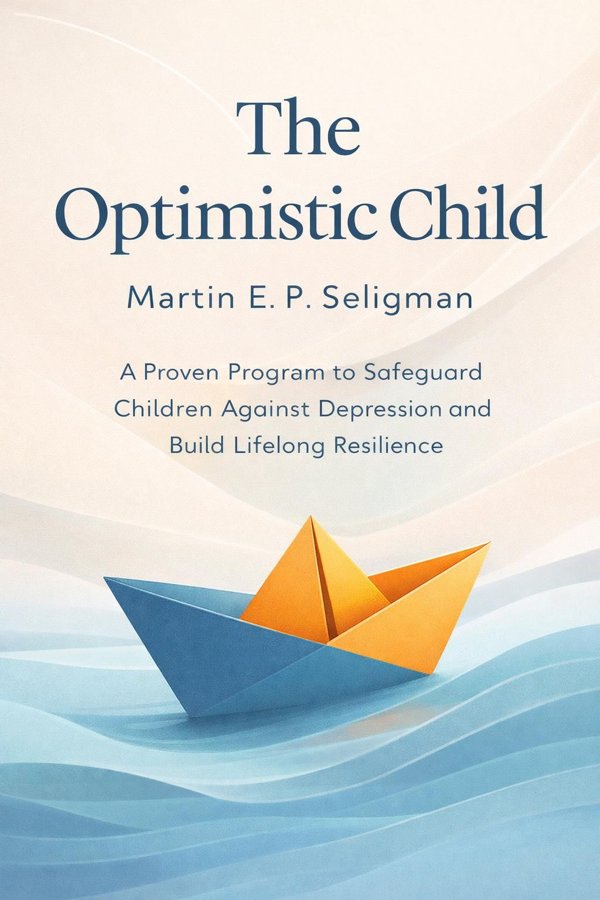
The Optimistic Child: A Proven Program to Safeguard Children Against Depression and Build Lifelong Resilience: Summary & Key Insights
 10 min6 chaptersAudio available
What Is The Optimistic Child: A Proven Program to Safeguard Children Against Depression and Build Lifelong Resilience About?
The Optimistic Child: A Proven Program to Safeguard Children Against Depression and Build Lifelong Resilience by Martin E. P. Seligman is a positive_psych book spanning 6 pages. In this groundbreaking work, psychologist Martin E. P. Seligman presents a scientifically validated program designed to help parents, teachers, and coaches instill optimism in children. Drawing on extensive research in cognitive psychology, the book provides practical strategies to prevent depression and foster resilience, teaching children how to think positively and handle setbacks constructively.
This FizzRead summary covers all 6 key chapters of The Optimistic Child: A Proven Program to Safeguard Children Against Depression and Build Lifelong Resilience in approximately 10 minutes, distilling the most important ideas, arguments, and takeaways from Martin E. P. Seligman's work. Also available as an audio summary and Key Quotes Podcast.
The Optimistic Child: A Proven Program to Safeguard Children Against Depression and Build Lifelong Resilience
In this groundbreaking work, psychologist Martin E. P. Seligman presents a scientifically validated program designed to help parents, teachers, and coaches instill optimism in children. Drawing on extensive research in cognitive psychology, the book provides practical strategies to prevent depression and foster resilience, teaching children how to think positively and handle setbacks constructively.
Who Should Read The Optimistic Child: A Proven Program to Safeguard Children Against Depression and Build Lifelong Resilience?
This book is perfect for anyone interested in positive_psych and looking to gain actionable insights in a short read. Whether you're a student, professional, or lifelong learner, the key ideas from The Optimistic Child: A Proven Program to Safeguard Children Against Depression and Build Lifelong Resilience by Martin E. P. Seligman will help you think differently.
- ✓Readers who enjoy positive_psych and want practical takeaways
- ✓Professionals looking to apply new ideas to their work and life
- ✓Anyone who wants the core insights of The Optimistic Child: A Proven Program to Safeguard Children Against Depression and Build Lifelong Resilience in just 10 minutes
Want the full summary?
Get instant access to this book summary and 100K+ more with Fizz Moment.
Get Free SummaryAvailable on App Store • Free to download
Key Chapters
In the earliest phase of my research, my colleagues and I discovered that animals subjected to uncontrollable shocks eventually stopped trying to escape — even when escape later became possible. This behavioral paralysis, which we called learned helplessness, revealed a psychological principle with powerful implications for humans: the expectation that one’s actions are futile can extinguish effort.
When I translated this model into human behavior, particularly among children, I found something striking. Many children who consistently attribute failure to personal defects — “I’m dumb,” “I can’t do math,” “nobody likes me” — began to show early signs of depression. They ceased trying, not because the environment was objectively impossible, but because they had learned to interpret difficulty as permanent and pervasive.
Learned helplessness erodes not only motivation but also emotional immunity. Children who internalize helplessness become vulnerable to sadness, self-doubt, and withdrawal. But those who learn to view setbacks as temporary challenges remain engaged and emotionally stable. This cognitive perspective difference — between helplessness and mastery — lies at the heart of psychological resilience.
In classrooms, I observed similar patterns: two students scoring poorly on a quiz reacted completely differently. The first said, “The test was unfair, but I can study harder next time,” while the second declared, “I’ll never get math right.” The first explanation preserves hope; the second breeds paralysis. Understanding this distinction laid the groundwork for teaching optimism as a preventive measure against depression.
Explanatory style refers to how we interpret the causes of events, especially adverse ones. Through extensive studies, I found three crucial dimensions: permanence, pervasiveness, and personalization. Pessimists tend to see bad events as permanent (“It will always be this way”), pervasive (“Everything I do goes wrong”), and personal (“It’s my fault”). Optimists, conversely, view setbacks as temporary, specific, and external.
A child’s explanatory style serves as the lens through which they experience reality. Over time, this lens can either distort hope or sharpen problem-solving. The good news is that explanatory style is not fixed. With cognitive tools, parents and teachers can help children reframe their thoughts — to see that one poor performance does not define them, that rejection in one domain does not void worth in another.
Children who develop optimistic explanatory habits become more creative in overcoming setbacks. They persist longer, enjoy healthier relationships, and perform better academically. Research even indicates that such optimism safeguards against early-onset depression. When children learn to challenge catastrophic self-talk — to ask themselves, “Is this really true? Could there be another explanation?” — they build psychological antibodies against despair.
In guiding children, adults must themselves model explanatory balance. If a parent responds to a setback with blame or hopelessness, the child absorbs that explanatory pattern. If the parent instead demonstrates curiosity (“What can we learn here?”), the child internalizes resilience. The family, in this sense, becomes the first classroom for optimism.
+ 4 more chapters — available in the FizzRead app
All Chapters in The Optimistic Child: A Proven Program to Safeguard Children Against Depression and Build Lifelong Resilience
About the Author
Martin E. P. Seligman is an American psychologist, educator, and author known for his pioneering work in positive psychology. He has served as president of the American Psychological Association and is a professor at the University of Pennsylvania. His research focuses on optimism, learned helplessness, and well-being.
Get This Summary in Your Preferred Format
Read or listen to the The Optimistic Child: A Proven Program to Safeguard Children Against Depression and Build Lifelong Resilience summary by Martin E. P. Seligman anytime, anywhere. FizzRead offers multiple formats so you can learn on your terms — all free.
Available formats: App · Audio · PDF · EPUB — All included free with FizzRead
Download The Optimistic Child: A Proven Program to Safeguard Children Against Depression and Build Lifelong Resilience PDF and EPUB Summary
Key Quotes from The Optimistic Child: A Proven Program to Safeguard Children Against Depression and Build Lifelong Resilience
“In the earliest phase of my research, my colleagues and I discovered that animals subjected to uncontrollable shocks eventually stopped trying to escape — even when escape later became possible.”
“Explanatory style refers to how we interpret the causes of events, especially adverse ones.”
Frequently Asked Questions about The Optimistic Child: A Proven Program to Safeguard Children Against Depression and Build Lifelong Resilience
The Optimistic Child: A Proven Program to Safeguard Children Against Depression and Build Lifelong Resilience by Martin E. P. Seligman is a positive_psych book that explores key ideas across 6 chapters. In this groundbreaking work, psychologist Martin E. P. Seligman presents a scientifically validated program designed to help parents, teachers, and coaches instill optimism in children. Drawing on extensive research in cognitive psychology, the book provides practical strategies to prevent depression and foster resilience, teaching children how to think positively and handle setbacks constructively.
You Might Also Like

Don't Sweat the Small Stuff... and It's All Small Stuff
Richard Carlson
10 min
Option B
Sheryl Sandberg & Adam Grant
10 min
Hallelujah Anyway: Rediscovering Mercy
Anne Lamott
10 min
I Can Do It: How to Use Affirmations to Change Your Life
Louise Hay
10 min
The Coffee Bean: A Simple Lesson to Create Positive Change
Jon Gordon, Damon West
10 min
The Happiness Hypothesis: Finding Modern Truth in Ancient Wisdom
Jonathan Haidt
10 minBrowse by Category
Ready to read The Optimistic Child: A Proven Program to Safeguard Children Against Depression and Build Lifelong Resilience?
Get the full summary and 100K+ more books with Fizz Moment.