
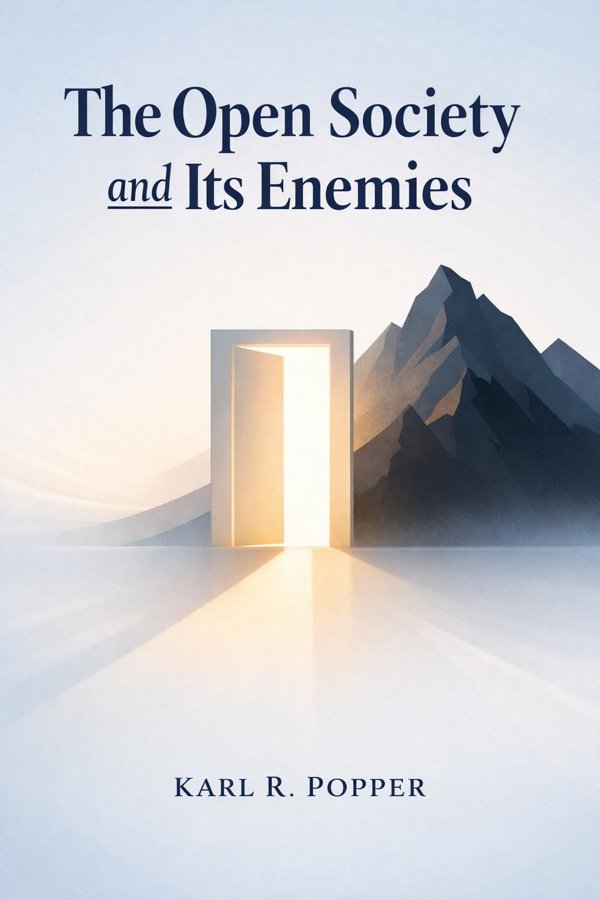
The Open Society and Its Enemies: Summary & Key Insights
 10 min9 chaptersAudio available
What Is The Open Society and Its Enemies About?
The Open Society and Its Enemies by Karl R. Popper is a western_phil book spanning 9 pages. A seminal work of political philosophy, Karl Popper’s 'The Open Society and Its Enemies' defends liberal democracy and critical rationalism against the totalitarian ideologies of the twentieth century. Written during World War II, Popper critiques the historicism and collectivism found in the philosophies of Plato, Hegel, and Marx, arguing that their ideas paved the way for authoritarian regimes. The book champions the 'open society'—a social order based on individual freedom, critical inquiry, and the ability to reform institutions through reasoned debate rather than violence or dogma.
This FizzRead summary covers all 9 key chapters of The Open Society and Its Enemies in approximately 10 minutes, distilling the most important ideas, arguments, and takeaways from Karl R. Popper's work. Also available as an audio summary and Key Quotes Podcast.
The Open Society and Its Enemies
A seminal work of political philosophy, Karl Popper’s 'The Open Society and Its Enemies' defends liberal democracy and critical rationalism against the totalitarian ideologies of the twentieth century. Written during World War II, Popper critiques the historicism and collectivism found in the philosophies of Plato, Hegel, and Marx, arguing that their ideas paved the way for authoritarian regimes. The book champions the 'open society'—a social order based on individual freedom, critical inquiry, and the ability to reform institutions through reasoned debate rather than violence or dogma.
Who Should Read The Open Society and Its Enemies?
This book is perfect for anyone interested in western_phil and looking to gain actionable insights in a short read. Whether you're a student, professional, or lifelong learner, the key ideas from The Open Society and Its Enemies by Karl R. Popper will help you think differently.
- ✓Readers who enjoy western_phil and want practical takeaways
- ✓Professionals looking to apply new ideas to their work and life
- ✓Anyone who wants the core insights of The Open Society and Its Enemies in just 10 minutes
Want the full summary?
Get instant access to this book summary and 100K+ more with Fizz Moment.
Get Free SummaryAvailable on App Store • Free to download
Key Chapters
Closed societies are the natural social form of early human life, fulfilling the deep desire for security and order. Tribal communities are bound together by kinship, custom, and ritual under the dominance of traditional authority. Each person’s place and destiny are defined by the group, and stability is prized above all else. Such societies leave no room for criticism—for to question tradition is to endanger the community’s existence.
The roots of the closed society lie in what I call a 'magical worldview.' People believed that nature, society, and fate formed a single, ordained system governed by mysterious order. Change was perilous, even sacrilegious. When philosophy arose—when rational reflection began to replace myth—humanity took its first step toward openness. Socrates embodied that spirit of dialogue: to ask questions, to admit ignorance, and to seek truth. Yet history is not a straight line. The death of Socrates marked the closed society’s violent reaction to reason and showed how fragile openness can be. Since then, the pursuit of truth and the defense of authority have stood in constant tension.
In 'The Republic,' Plato attempted to construct a perfect social order grounded in justice. His ideal of the philosopher-king appears noble but is deeply dangerous. Such rulers would not only wield political power but also monopolize the interpretation of truth itself. Plato viewed social dynamism as deterioration and idealized stability as perfection. To secure that 'eternal order,' he proposed an education and institutional system that fixed human hierarchy permanently—turning society into a rigid organism whose parts never change.
Plato’s fundamental mistake was to treat human society as a natural organism that can be molded into a final form, rather than as an open system created through individual choices. His philosophy saw change as disease and reform as decay—a logic that leads inevitably to the closed society. The philosopher-king’s rule conceals a hostility toward individual freedom; anyone diverging from philosophical norm is deemed irrational. In the name of reason, Plato undermines reason itself, a paradox I aim to expose.
+ 7 more chapters — available in the FizzRead app
All Chapters in The Open Society and Its Enemies
About the Author
Karl Raimund Popper (1902–1994) was an Austrian-British philosopher of science and political thinker. He is best known for his contributions to the philosophy of science, particularly the concept of falsifiability as a criterion for scientific theories, and for his defense of liberal democracy and critical rationalism. Popper’s works, including 'The Logic of Scientific Discovery' and 'The Open Society and Its Enemies', have had a lasting influence on philosophy, political theory, and the methodology of science.
Get This Summary in Your Preferred Format
Read or listen to the The Open Society and Its Enemies summary by Karl R. Popper anytime, anywhere. FizzRead offers multiple formats so you can learn on your terms — all free.
Available formats: App · Audio · PDF · EPUB — All included free with FizzRead
Download The Open Society and Its Enemies PDF and EPUB Summary
Key Quotes from The Open Society and Its Enemies
“Closed societies are the natural social form of early human life, fulfilling the deep desire for security and order.”
“In 'The Republic,' Plato attempted to construct a perfect social order grounded in justice.”
Frequently Asked Questions about The Open Society and Its Enemies
The Open Society and Its Enemies by Karl R. Popper is a western_phil book that explores key ideas across 9 chapters. A seminal work of political philosophy, Karl Popper’s 'The Open Society and Its Enemies' defends liberal democracy and critical rationalism against the totalitarian ideologies of the twentieth century. Written during World War II, Popper critiques the historicism and collectivism found in the philosophies of Plato, Hegel, and Marx, arguing that their ideas paved the way for authoritarian regimes. The book champions the 'open society'—a social order based on individual freedom, critical inquiry, and the ability to reform institutions through reasoned debate rather than violence or dogma.
You Might Also Like
A Little History of Philosophy
Nigel Warburton
10 min
Areopagitica
John Milton
10 min
How To Think Like A Philosopher: Essential Principles For Clear Thinking
Peter Cave
10 min
Language, Truth and Logic
A. J. Ayer
10 min
The Age of Reason
Thomas Paine
10 min
The Essays
Michel De Montaigne
10 minBrowse by Category
Ready to read The Open Society and Its Enemies?
Get the full summary and 100K+ more books with Fizz Moment.