
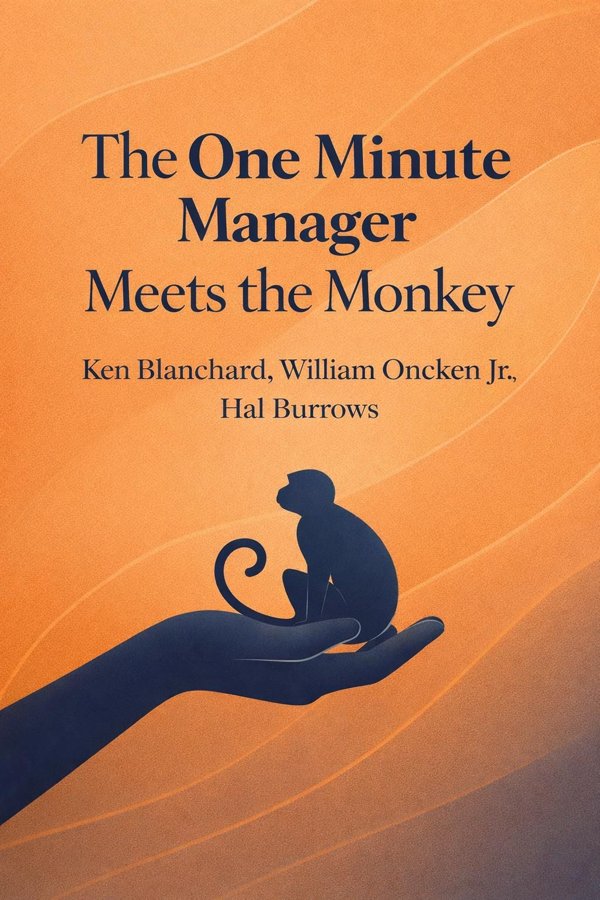
The One Minute Manager: Summary & Key Insights
 10 min9 chaptersAudio available
Key Takeaways from The One Minute Manager
A manager’s stress often comes not from their own workload, but from the work they unknowingly adopt from everyone around them.
Good intentions are often the doorway through which bad management habits enter.
Accountability grows when people know how much initiative is expected of them.
Delegation fails when responsibility is vague.
Empowerment is often misunderstood as simply letting go.
What Is The One Minute Manager About?
The One Minute Manager by Ken Blanchard is a leadership book published in 1989 spanning 6 pages. What if the biggest obstacle to leadership effectiveness is not lack of effort, but misplaced effort? In The One Minute Manager, Ken Blanchard builds on the classic principles of concise, practical leadership by showing why managers so often become overwhelmed: they keep accepting other people’s responsibilities. Drawing on the famous “monkey” metaphor developed by William Oncken Jr. and adapted with Hal Burrows, the book explains how tasks jump from a team member’s back onto a manager’s back during everyday conversations, meetings, and emails. Once that happens, the manager becomes overworked, the employee becomes less accountable, and the organization slows down. This idea matters because it gets to the heart of modern leadership: the role of a manager is not to do everyone else’s work, but to build a system in which people own outcomes. Blanchard’s authority comes from decades of leadership teaching and from co-creating one of the most influential management frameworks ever written. The result is a short, memorable, highly actionable guide to delegation, initiative, follow-up, and trust. For leaders who feel buried in demands, this book offers a simple but powerful shift: stop collecting monkeys, and start developing owners.
This FizzRead summary covers all 9 key chapters of The One Minute Manager in approximately 10 minutes, distilling the most important ideas, arguments, and takeaways from Ken Blanchard's work. Also available as an audio summary and Key Quotes Podcast.
The One Minute Manager
What if the biggest obstacle to leadership effectiveness is not lack of effort, but misplaced effort? In The One Minute Manager, Ken Blanchard builds on the classic principles of concise, practical leadership by showing why managers so often become overwhelmed: they keep accepting other people’s responsibilities. Drawing on the famous “monkey” metaphor developed by William Oncken Jr. and adapted with Hal Burrows, the book explains how tasks jump from a team member’s back onto a manager’s back during everyday conversations, meetings, and emails. Once that happens, the manager becomes overworked, the employee becomes less accountable, and the organization slows down.
This idea matters because it gets to the heart of modern leadership: the role of a manager is not to do everyone else’s work, but to build a system in which people own outcomes. Blanchard’s authority comes from decades of leadership teaching and from co-creating one of the most influential management frameworks ever written. The result is a short, memorable, highly actionable guide to delegation, initiative, follow-up, and trust. For leaders who feel buried in demands, this book offers a simple but powerful shift: stop collecting monkeys, and start developing owners.
Who Should Read The One Minute Manager?
This book is perfect for anyone interested in leadership and looking to gain actionable insights in a short read. Whether you're a student, professional, or lifelong learner, the key ideas from The One Minute Manager by Ken Blanchard will help you think differently.
- ✓Readers who enjoy leadership and want practical takeaways
- ✓Professionals looking to apply new ideas to their work and life
- ✓Anyone who wants the core insights of The One Minute Manager in just 10 minutes
Want the full summary?
Get instant access to this book summary and 100K+ more with Fizz Moment.
Get Free SummaryAvailable on App Store • Free to download
Key Chapters
A manager’s stress often comes not from their own workload, but from the work they unknowingly adopt from everyone around them. That is the central insight behind the “monkey” metaphor. In this framework, a monkey is the next move on a task or problem. When an employee brings an issue to a manager and the manager says, “Leave it with me,” the monkey has just leaped from the employee’s back to the manager’s. The employee leaves relieved, while the manager leaves heavier.
This metaphor is powerful because it reveals a hidden pattern in daily leadership. Many managers believe they are being supportive when they take over problems, answer every question, or solve every bottleneck. In reality, they are often training dependence. The more monkeys they collect, the less time they have for planning, coaching, and strategic work. Meanwhile, team members learn that ownership is optional because the boss will eventually catch the monkey.
Consider a common example: an employee says, “We have a client issue. What should we do?” A monkey-collecting manager replies, “I’ll look into it and get back to you.” A better response is, “What options do you see, and which do you recommend?” In the second case, the monkey stays with the employee, while the manager provides guidance rather than rescue.
The deeper lesson is that leadership is not about absorbing every problem. It is about making sure each monkey has a rightful owner, clear next action, and agreed follow-up. Actionable takeaway: during every work conversation, ask yourself, “Whose monkey is this?” and do not let it transfer to you unless it truly belongs there.
Good intentions are often the doorway through which bad management habits enter. Managers usually take on other people’s monkeys for reasons that sound admirable: they want to help, they want speed, they want quality, and they want to avoid watching someone struggle. Yet each of these motives can create the same result: a leader who becomes the default owner of everyone else’s unfinished work.
One reason this happens is emotional discomfort. It can feel easier to solve a problem than to coach someone through solving it. Another reason is ego. Some managers quietly enjoy being needed because it reinforces their importance. Others inherit monkeys because they have not clearly defined responsibilities, so employees escalate tasks upward by default. In fast-moving environments, people also confuse responsiveness with ownership. A manager who replies instantly to every issue may look efficient, but may actually be creating a bottleneck.
Imagine a department head who regularly says, “Send it to me and I’ll fix it.” At first, the team feels supported. Over time, however, employees stop thinking deeply before escalating issues. They bring half-formed problems instead of recommendations. The manager becomes buried in details and begins complaining about lack of initiative, without realizing they helped create it.
The book encourages managers to see monkey collection as a system problem, not just a personal weakness. If people repeatedly hand over responsibility, something in the culture rewards that behavior. The answer is not cold detachment, but disciplined leadership. Help people think, decide, and act rather than simply taking over.
Actionable takeaway: notice the moments when you are tempted to rescue, and replace “I’ll handle it” with “Walk me through your proposed next step.”
Accountability grows when people know how much initiative is expected of them. One of the book’s most practical contributions is its explanation that not all delegation is the same. Employees can operate at different levels of initiative, and effective managers consciously build people upward from dependence to ownership.
At the lowest level, a person waits until told what to do. At the next level, they ask what to do. More advanced levels include recommending actions, acting and then reporting, or simply acting independently within agreed boundaries. The key is that managers should not assume ownership appears automatically. It must be developed by clarifying what level of initiative a task requires and coaching people toward higher levels over time.
For example, a new hire may initially need to ask before taking action on customer complaints. That is appropriate. But if six months later the same employee still escalates every routine issue, the manager has failed to build initiative. A stronger approach is to say, “For standard complaints under this amount, I want you to resolve them and report back by end of day. For unusual cases, bring me two options and your recommendation.” This gives structure while gradually expanding autonomy.
Managers often complain that employees do not think for themselves, but they rarely ask whether they have trained them to do so. If every recommendation is overruled, every mistake is punished, or every small decision must be approved, initiative withers. Ownership flourishes when expectations are explicit and increasing responsibility is treated as part of development.
Actionable takeaway: identify the initiative level each team member currently uses on key tasks, then set one specific area where they must move one level higher this month.
Delegation fails when responsibility is vague. It is not enough to tell someone, “This is yours.” If a monkey is returned to its rightful owner without clarity, it will soon wander back. The book emphasizes that proper delegation requires a follow-up structure: who owns the next move, what exactly must be done, and when the manager and employee will reconnect.
This matters because many managers unintentionally create reverse delegation. They say, “You handle it,” but never define what success looks like or when to check progress. The employee, unsure and anxious, returns later with the same issue. Then the manager takes over in frustration. The monkey is back.
A better process is concrete. Suppose an employee says a project is behind schedule. Instead of replying, “Keep me posted,” the manager might say, “You own the recovery plan. I want three corrective actions by 3 p.m. We’ll review them together at 4 p.m., and you’ll communicate the final plan to the client by tomorrow morning.” Now the monkey has an owner, a task, a deadline, and a review point.
Follow-up is not micromanagement when it is designed to support ownership. In fact, proper follow-up protects both sides. The employee knows when they will receive support, and the manager avoids becoming the emergency landing zone for every unresolved issue. Over time, regular and disciplined check-ins create a culture where work moves forward without constant rescue.
Actionable takeaway: whenever you delegate or return a problem, define four things before the conversation ends: owner, next action, deadline, and follow-up time.
Empowerment is often misunderstood as simply letting go. In reality, real empowerment is structured trust. The book aligns with the broader One Minute Manager philosophy by showing that people perform best when goals are clear, feedback is timely, and responsibility remains where it belongs. Trust does not mean abandoning employees with a vague instruction and hoping for the best. It means giving them the authority, support, and accountability needed to succeed.
Many managers swing between two extremes: overcontrol and overdistance. In overcontrol, they hold every monkey and monitor every movement. In overdistance, they drop work on employees without guidance and call it empowerment. Neither approach builds capable people. Structured trust sits in the middle. The manager remains involved, but as a coach rather than as the primary worker.
For instance, a sales manager can empower an account executive by setting clear targets, defining pricing authority, and scheduling weekly pipeline reviews. The executive has room to act, but also knows the decision boundaries and support rhythm. This combination increases confidence and reduces unnecessary escalation.
The One Minute Manager approach also reminds us that people need recognition when they handle their monkeys well. If employees take ownership, solve problems, and exercise initiative, managers should reinforce that behavior quickly and specifically. Recognition strengthens responsibility just as much as correction does.
Empowerment works when employees know three things: what result matters, what freedom they have, and when they should reconnect with the manager. Without these, trust becomes confusion.
Actionable takeaway: empower with precision by stating the result, the boundaries, and the next review point every time you hand over meaningful responsibility.
The purpose of better delegation is not merely to lighten a manager’s load. It is to create the freedom required for leadership. When managers spend their days carrying other people’s monkeys, they become reactive administrators rather than strategic leaders. Their calendars fill with follow-ups on tasks that should never have become theirs. As a result, long-term priorities suffer: team development, process improvement, customer relationships, and future planning all get squeezed out.
The book makes a sharp distinction between being busy and being effective. A manager can feel indispensable while actually misusing their time. In fact, being constantly needed is often evidence of poor delegation, not strong leadership. Freedom emerges when managers reserve their attention for work that only they can do and ensure that everyone else fully owns the work that belongs to them.
Think about a leader who finally stops rewriting staff reports, answering every routine approval request, and solving every operational snag personally. At first, this may feel risky. But over time, the team becomes stronger, and the manager gains space for more valuable work: building partnerships, improving systems, identifying talent, and addressing root causes instead of symptoms.
This shift also reduces burnout. Managers often believe the price of leadership is perpetual overload. The authors challenge that assumption. Overload is frequently a symptom of misplaced ownership. Delegation done well does not weaken standards; it raises organizational capacity.
Actionable takeaway: make a list of tasks currently occupying your week and mark which ones only you can do. For everything else, ask whether you are carrying a monkey that should be reassigned.
One of the smartest leadership shifts is learning to manage the point of interaction rather than the whole burden of execution. The book shows that a manager’s job is often to oversee the interface with a task, not to perform the task itself. That means clarifying expectations, checking progress, removing obstacles, and maintaining accountability without absorbing ownership.
This principle is especially useful in meetings and informal conversations, where monkeys often jump unnoticed. An employee walks in with a problem, explains the difficulty, and waits. If the manager starts brainstorming, assigning themselves research, or promising to follow up, the monkey has moved. But if the manager responds by shaping the interface, the monkey stays where it belongs. They might ask, “What have you tried? What do you need from me specifically? When will you bring me your recommendation?”
This distinction matters because many managers overhelp. They think being involved means being responsible. In reality, healthy involvement means maintaining the quality of decisions and the clarity of accountability. A project leader, for example, does not need to design every slide for a team presentation. They need to define the objective, review drafts at the right moments, and ensure the final product meets the standard.
Managing the interface also improves judgment. It forces employees to think before escalating and allows managers to identify where coaching is needed. Over time, the organization becomes more self-correcting because people learn that bringing a problem upward requires ownership, not surrender.
Actionable takeaway: in your next problem-solving conversation, resist answering immediately. First define what kind of help is needed from you without taking over the whole task.
Time management is not mainly about squeezing more into the day. It is about protecting attention for the right work. The monkey framework reveals that many managers lose control of time not because they lack discipline, but because they allow their schedule to be colonized by tasks that originated elsewhere. Every borrowed monkey consumes time twice: once when the manager takes it, and again when they must track, solve, and close it.
This is why monkey management is really priority management. Leaders should separate organizational time into categories: boss-imposed time, system-imposed time, and self-imposed time. Some obligations come from superiors. Some come from the structure of the business. But a surprising amount of overload is self-imposed because managers voluntarily take on issues they should have redirected.
Picture a manager whose day is dominated by urgent requests from team members. They feel they have no time for planning. But if most of those requests are reverse-delegated monkeys, then the problem is not only scheduling; it is ownership discipline. By refusing unnecessary monkey transfers, the manager can reclaim uninterrupted blocks for higher-value work.
Practical techniques help. Set office hours for nonurgent support. Require employees to bring options, not just problems. Use short check-ins instead of endless updates. Clarify decision rights so routine issues do not rise by default. These habits reduce noise and keep priorities visible.
The deeper insight is simple: if you do not protect your time from other people’s monkeys, your calendar will quietly become a record of your avoidance.
Actionable takeaway: review last week’s calendar and identify which meetings, emails, or tasks represented self-imposed monkey work. Eliminate or redesign at least three this week.
The highest purpose of delegation is not efficiency. It is growth. The book ultimately argues that strong managers create people who can think, decide, and act responsibly. When leaders repeatedly take over, they may get short-term relief or speed, but they undermine long-term capability. Dependence becomes normalized, and the organization grows weaker as the leader grows busier.
Developing thinkers requires patience. It usually takes longer at first to ask questions than to give answers. A manager may be tempted to solve a problem in two minutes rather than spend ten coaching someone through it. But that ten-minute investment often prevents dozens of future interruptions. More importantly, it builds confidence and judgment in the employee.
A useful coaching sequence is: ask for the employee’s understanding of the issue, ask what options they see, ask which option they recommend, and ask what support they need. This keeps responsibility with the employee while still allowing the manager to shape quality. Over time, employees begin arriving with stronger analysis and greater initiative because they know that is what leadership expects.
This principle also transforms culture. In dependent cultures, people avoid risk and escalate everything. In ownership cultures, people prepare, decide, and learn. Leaders are still accountable, but they are not the single brain of the organization. They become multipliers of judgment.
The freedom this creates is substantial, but so is the responsibility. Managers must tolerate some learning discomfort and occasional imperfection if they want others to grow.
Actionable takeaway: this week, choose one recurring issue you usually solve yourself and turn it into a coaching conversation that ends with the other person owning the next action.
All Chapters in The One Minute Manager
About the Author
Ken Blanchard is an American leadership expert, business consultant, and bestselling author whose work has shaped modern management practice for decades. He is best known for co-authoring The One Minute Manager, a global classic that made practical leadership principles accessible to millions of readers. Blanchard has written or co-written numerous books on empowerment, customer service, servant leadership, and organizational effectiveness, and his ideas are widely used in companies, schools, nonprofits, and healthcare systems around the world. He is also a co-founder of The Ken Blanchard Companies, a leadership training and development firm. What distinguishes Blanchard’s work is its clarity: he turns complex leadership challenges into simple, memorable frameworks that managers can apply immediately. His influence endures because he focuses not just on results, but on helping people grow while achieving them.
Get This Summary in Your Preferred Format
Read or listen to the The One Minute Manager summary by Ken Blanchard anytime, anywhere. FizzRead offers multiple formats so you can learn on your terms — all free.
Available formats: App · Audio · PDF · EPUB — All included free with FizzRead
Download The One Minute Manager PDF and EPUB Summary
Key Quotes from The One Minute Manager
“A manager’s stress often comes not from their own workload, but from the work they unknowingly adopt from everyone around them.”
“Good intentions are often the doorway through which bad management habits enter.”
“Accountability grows when people know how much initiative is expected of them.”
“Delegation fails when responsibility is vague.”
“Empowerment is often misunderstood as simply letting go.”
Frequently Asked Questions about The One Minute Manager
The One Minute Manager by Ken Blanchard is a leadership book that explores key ideas across 9 chapters. What if the biggest obstacle to leadership effectiveness is not lack of effort, but misplaced effort? In The One Minute Manager, Ken Blanchard builds on the classic principles of concise, practical leadership by showing why managers so often become overwhelmed: they keep accepting other people’s responsibilities. Drawing on the famous “monkey” metaphor developed by William Oncken Jr. and adapted with Hal Burrows, the book explains how tasks jump from a team member’s back onto a manager’s back during everyday conversations, meetings, and emails. Once that happens, the manager becomes overworked, the employee becomes less accountable, and the organization slows down. This idea matters because it gets to the heart of modern leadership: the role of a manager is not to do everyone else’s work, but to build a system in which people own outcomes. Blanchard’s authority comes from decades of leadership teaching and from co-creating one of the most influential management frameworks ever written. The result is a short, memorable, highly actionable guide to delegation, initiative, follow-up, and trust. For leaders who feel buried in demands, this book offers a simple but powerful shift: stop collecting monkeys, and start developing owners.
Compare The One Minute Manager

More by Ken Blanchard

You Might Also Like

Extreme Ownership
Jocko Willink
10 min
Dare to Lead
Brene Brown
10 min
Leaders Eat Last
Simon Sinek
10 min
The 21 Irrefutable Laws of Leadership
John Maxwell
10 min
Start With Why
Simon Sinek
10 min
How to Lead When You're Not in Charge
Clay Scroggins
10 minFeatured In
Browse by Category
Ready to read The One Minute Manager?
Get the full summary and 100K+ more books with Fizz Moment.