
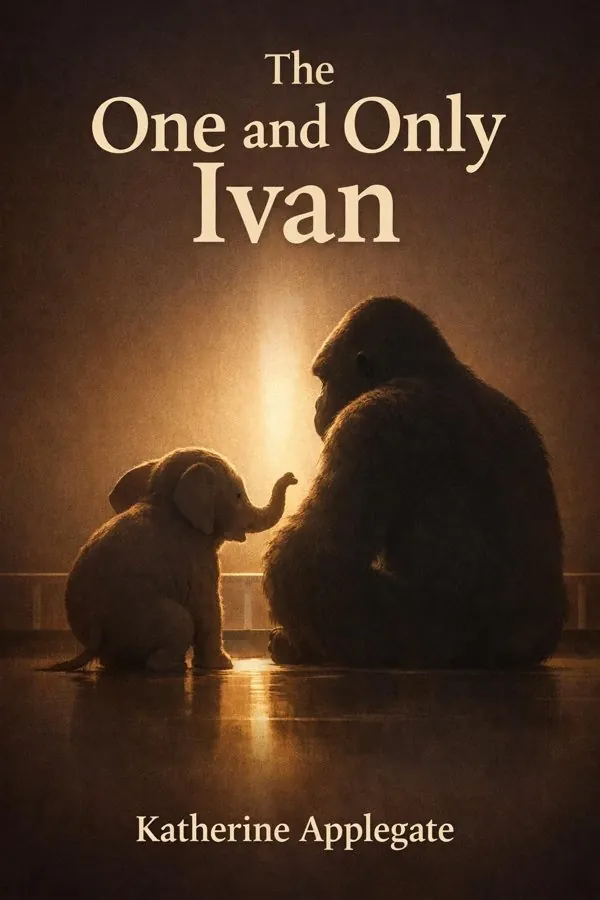
The One and Only Ivan: Summary & Key Insights
 10 min9 chaptersAudio available
Key Takeaways from The One and Only Ivan
Comfort can become a cage when we stop asking whether our world is too small.
We often survive not because our circumstances are kind, but because connection gives suffering meaning.
Memory can be painful, but it is often the first step toward truth.
Sometimes we begin to change only when we see our pain repeated in someone more vulnerable.
When ordinary language fails, creativity can become a form of truth-telling.
What Is The One and Only Ivan About?
The One and Only Ivan by Katherine Applegate is a bestsellers book spanning 6 pages. What does freedom mean to someone who has almost forgotten it exists? In The One and Only Ivan, Katherine Applegate answers that question through the unforgettable voice of Ivan, a silverback gorilla who has spent most of his life in captivity at the Big Top Mall and Video Arcade. His world is small, repetitive, and strangely comfortable—until the arrival of Ruby, a baby elephant whose fear and vulnerability force him to see his life, and theirs, with new clarity. Inspired by the true story of a captive gorilla, this novel blends tenderness, humor, and moral urgency into a story that is as accessible to young readers as it is moving for adults. Applegate, a celebrated children’s author and Newbery Medal winner, writes with remarkable restraint and empathy, allowing big questions about animal welfare, memory, friendship, and responsibility to emerge through simple, powerful scenes. The result is a modern classic that invites readers to look more closely at captivity, compassion, and the quiet courage it takes to protect someone more vulnerable than yourself.
This FizzRead summary covers all 9 key chapters of The One and Only Ivan in approximately 10 minutes, distilling the most important ideas, arguments, and takeaways from Katherine Applegate's work. Also available as an audio summary and Key Quotes Podcast.
The One and Only Ivan
What does freedom mean to someone who has almost forgotten it exists? In The One and Only Ivan, Katherine Applegate answers that question through the unforgettable voice of Ivan, a silverback gorilla who has spent most of his life in captivity at the Big Top Mall and Video Arcade. His world is small, repetitive, and strangely comfortable—until the arrival of Ruby, a baby elephant whose fear and vulnerability force him to see his life, and theirs, with new clarity. Inspired by the true story of a captive gorilla, this novel blends tenderness, humor, and moral urgency into a story that is as accessible to young readers as it is moving for adults. Applegate, a celebrated children’s author and Newbery Medal winner, writes with remarkable restraint and empathy, allowing big questions about animal welfare, memory, friendship, and responsibility to emerge through simple, powerful scenes. The result is a modern classic that invites readers to look more closely at captivity, compassion, and the quiet courage it takes to protect someone more vulnerable than yourself.
Who Should Read The One and Only Ivan?
This book is perfect for anyone interested in bestsellers and looking to gain actionable insights in a short read. Whether you're a student, professional, or lifelong learner, the key ideas from The One and Only Ivan by Katherine Applegate will help you think differently.
- ✓Readers who enjoy bestsellers and want practical takeaways
- ✓Professionals looking to apply new ideas to their work and life
- ✓Anyone who wants the core insights of The One and Only Ivan in just 10 minutes
Want the full summary?
Get instant access to this book summary and 100K+ more with Fizz Moment.
Get Free SummaryAvailable on App Store • Free to download
Key Chapters
Comfort can become a cage when we stop asking whether our world is too small. At the start of The One and Only Ivan, Ivan lives in a glass enclosure inside the Big Top Mall. His days follow a predictable routine: he draws, watches television, listens to humans pass by, and performs on command. He tells himself that this life is enough. He rarely thinks about the jungle, and when he does, the memories are faint and fragmented. This emotional stillness is one of the novel’s most important ideas. Captivity is not only physical; it can also reshape expectations until limitation feels normal.
Ivan’s enclosure becomes a symbol for any life narrowed by habit, resignation, or convenience. He is not openly miserable all the time, which makes his situation more unsettling. The book shows how beings adapt even to conditions that diminish them. Many readers will recognize a version of this in human life: staying in a deadening job because it feels familiar, ignoring unfair systems because they seem permanent, or convincing ourselves that comfort is the same as fulfillment.
Applegate presents Ivan’s world with simplicity, but the emotional effect is sharp. The glass wall allows people to see him without truly knowing him. They project entertainment onto his life while remaining blind to his inner world. That dynamic mirrors how society often treats others—animals or humans—as roles rather than full beings.
A practical lesson from Ivan’s early life is to question the routines we defend simply because they are familiar. Ask yourself what parts of your life are truly chosen and what parts have become invisible cages. Notice where passivity has replaced purpose. The actionable takeaway: identify one “glass wall” in your own life—a limiting routine, belief, or environment—and take one small step this week to challenge it.
We often survive not because our circumstances are kind, but because connection gives suffering meaning. In Ivan’s confined world, his relationships are what make life bearable. Stella, the aging elephant, offers calm wisdom and emotional steadiness. Bob, the stray dog, brings humor, skepticism, and companionship. Julia, the custodian’s daughter, sees Ivan not as a spectacle but as an individual. These bonds reveal that dignity can persist even in harsh conditions when someone is willing to witness another’s life with care.
Stella is especially important because she carries memory. She remembers a different life and understands the cost of captivity more fully than Ivan allows himself to. Her tenderness is not naive; it has been shaped by pain. Yet she still comforts Ruby and speaks with grace. Through her, the novel shows that love is not just affection. It is responsibility, patience, and the refusal to let another creature suffer alone.
These relationships also broaden Ivan’s emotional range. Left alone, he would likely remain detached and passive. But friendship makes moral awakening possible. Bob’s irreverence keeps Ivan grounded. Julia’s attention validates Ivan’s artwork. Stella’s trust gives Ivan a deeper purpose. In this way, Applegate suggests that personal change rarely happens in isolation. We become more courageous when someone else matters to us.
In everyday life, this idea applies to families, classrooms, workplaces, and communities. People can endure much more when they feel seen, and they are more likely to act bravely when they feel connected. Offering consistent presence to a struggling friend, mentoring a child, or simply listening closely can become transformative.
The actionable takeaway: strengthen one meaningful bond this week by showing up more intentionally—listen without distraction, offer practical help, or tell someone clearly that their well-being matters to you.
Memory can be painful, but it is often the first step toward truth. One of the quiet turning points in The One and Only Ivan is Ivan’s relationship to his past. For years, he keeps the wild at a distance. He remembers bits and pieces—his family, the forest, movement, freedom—but these memories are blurred, as if forgetting helps him survive. This is psychologically believable and deeply significant. When pain is overwhelming, numbing can feel safer than remembering. Yet forgetting also allows injustice to continue unchallenged.
As the story unfolds, Ivan begins to reconnect with what he has lost. These echoes of the wild are not romantic decorations; they restore perspective. Once he remembers a life beyond the mall, his enclosure no longer feels inevitable. Memory becomes a moral force. It tells him that another reality existed and therefore another reality might still be possible.
This idea extends beyond the novel’s setting. Individuals and communities often cope with hardship by lowering expectations and forgetting what dignity once looked like. A child may grow used to neglect. A worker may normalize exploitation. A society may become numb to cruelty. Remembering a healthier standard—whether from personal experience, history, or imagination—can reignite the desire for change.
Applegate also suggests that identity depends on memory. Ivan is not just what the mall has made of him. He is also the creature shaped by family, instinct, and belonging. When he recalls the wild, he reclaims part of himself.
Readers can apply this by revisiting moments, values, or experiences that remind them who they are at their best. Reflect on a time when you felt most alive, free, or aligned with your values. The actionable takeaway: write down one memory that reconnects you to a deeper sense of self, and let it guide one decision you make this week.
Sometimes we begin to change only when we see our pain repeated in someone more vulnerable. Ruby’s arrival transforms the emotional center of the novel. She is young, frightened, and newly torn from everything familiar. Unlike Ivan, she has not yet had time to normalize captivity. Her confusion makes visible what Ivan has learned to ignore. Through Ruby, the cost of the animals’ situation can no longer be softened by routine.
Ruby’s presence awakens in Ivan a protective instinct that becomes stronger than his resignation. He sees her future unfolding along the same cruel path that shaped Stella’s life. This recognition is devastating, but it is also catalytic. Hope in the novel does not begin as optimism. It begins as refusal—the refusal to let Ruby inherit the same suffering without resistance.
This is a powerful model of moral growth. Many people tolerate injustice when it affects only them, but act when they see it harming a child, a student, a friend, or a vulnerable stranger. Ruby becomes the mirror that reveals Ivan’s own captivity and the spark that turns concern into purpose.
In practical terms, Ruby’s role reminds us that empathy often grows through proximity. Abstract suffering can be easy to ignore; a single vulnerable individual can change everything. Teachers may feel renewed urgency when they notice one child being left behind. Employees may challenge harmful policies when they see a junior colleague hurt by them. Social change often begins with one face, one story, one relationship.
The actionable takeaway: pay attention to one vulnerable person or group whose needs you may have overlooked. Ask what practical protection, advocacy, or encouragement you can offer, and take one concrete action instead of waiting for someone else to do it.
When ordinary language fails, creativity can become a form of truth-telling. Ivan’s art begins as a pastime, almost a curiosity for the humans around him. He paints because he enjoys color, shape, and the act itself. But over time, art becomes something far greater: a bridge between his inner world and the human world that controls his fate. Since he cannot speak to people in words they understand, he must communicate through images.
This shift gives the novel one of its most memorable themes. Art is not merely decorative; it can carry witness, intention, and moral force. Ivan’s drawings eventually become a message, especially when he begins to depict Ruby and the life she deserves. In doing so, he transforms from passive subject to active communicator. He cannot open the cage with his hands, but he can create images that open human eyes.
Applegate’s treatment of art is especially valuable for young readers because it shows creativity as meaningful agency. A drawing, essay, song, photograph, or poster can influence how others see the world. This is not sentimental. History is full of examples: documentary images that expose injustice, murals that reclaim community pride, writing that gives voice to the overlooked, and student art that raises awareness for causes adults ignore.
On a personal level, art can also help individuals process difficult feelings they cannot yet explain directly. A child may draw what scares them before they can describe it. An adult may journal through confusion before they can act. Creativity clarifies.
The actionable takeaway: use one creative form this week—writing, drawing, music, or design—to express something important that is hard to say directly. Then share it, if appropriate, with someone who needs to understand what matters to you.
Freedom is most powerful when it is imagined first as a possibility worth pursuing. As Ivan commits himself to helping Ruby, the novel shifts from observation to action. He no longer simply notices injustice; he begins to strategize. This movement matters because compassion without action can become another form of helplessness. Ivan’s goal is not abstract liberation for all beings everywhere. It is specific, practical, and urgent: get Ruby to a place where she can live with safety, space, and dignity.
The story shows that change often starts with a clear, focused objective rather than a grand plan. Ivan uses what he has—his art, his intelligence, his persistence—to influence the humans around him. He cannot control every outcome, but he can create the conditions for others to respond differently. This reflects how advocacy works in real life. A person may not be able to solve a system alone, but they can document harm, tell a story persuasively, gather allies, and push institutions toward better choices.
Freedom in the novel is also relational. It is not only about escaping a cage; it is about restoring the possibility of natural life, companionship, movement, and choice. This is an important distinction. We often define freedom too narrowly, as the absence of restraint, when it also requires the presence of humane conditions in which life can flourish.
Readers can apply this idea by turning concern into a concrete plan. If something is wrong in your school, workplace, neighborhood, or family system, define one achievable change. Gather evidence, communicate clearly, and stay patient.
The actionable takeaway: choose one issue you care about and translate your concern into one specific next step—a conversation, letter, petition, donation, or creative project—that moves the situation closer to real improvement.
The novel’s emotional force comes from a simple but radical invitation: see animals not as attractions, but as individuals with memory, feeling, and worth. The One and Only Ivan does not lecture in a heavy-handed way. Instead, it lets readers inhabit Ivan’s perspective. That narrative choice changes everything. Once we experience boredom, grief, humor, affection, and longing through his eyes, it becomes much harder to view captive animals as harmless entertainment.
This theme reaches beyond one gorilla and one elephant. Applegate challenges the assumptions behind industries and habits that depend on distancing humans from animal suffering. When animals are packaged as spectacles, mascots, products, or background scenery, their inner lives are easier to ignore. The novel reverses that distancing by granting full emotional subjectivity to creatures often viewed from the outside.
This does not require readers to arrive at identical political conclusions. But it does ask for deeper ethical attention. How are animals housed? What kinds of entertainment depend on confinement or coercion? What responsibilities come with human power over other living beings? These questions are increasingly relevant in discussions about zoos, circuses, conservation, farming, and pet ownership.
In everyday life, this perspective can lead to more thoughtful choices. Families might research whether an animal attraction prioritizes welfare and conservation. Students might explore humane education projects. Pet owners might reflect on whether they are meeting an animal’s emotional as well as physical needs.
The actionable takeaway: examine one way you interact with animals—through entertainment, consumption, education, or care—and make one more informed, compassionate choice based on the question, “Does this respect the animal as a living being rather than an object?”
Not all courage looks dramatic; sometimes it begins as a private promise. Ivan is not a conventional hero charging into battle. His courage is quiet, patient, and deeply relational. He changes because he makes a commitment—to Stella, to Ruby, and eventually to the truth of what he knows. This matters because many readers underestimate their own power when they do not feel bold, charismatic, or influential. Applegate shows that moral courage often grows slowly from loyalty and conscience.
Ivan’s bravery involves risk. Acting means abandoning emotional detachment. It means hoping again, which opens him to disappointment. It means trusting that his efforts might matter even when success is uncertain. That kind of courage is familiar in everyday life. A student reports bullying. A worker speaks up about unfair treatment. A friend intervenes when someone is being harmed. A parent advocates for a child others overlook. None of these acts may seem grand from the outside, but each requires inner steadiness.
The novel also suggests that courage can be contagious. Stella’s dignity influences Ivan. Julia’s attention amplifies his message. Human change becomes possible because one creature refuses to remain silent in the only way he can. This is how many meaningful changes happen in real communities: one person acts, another notices, and momentum builds.
A practical lesson here is to stop waiting until you feel fearless. Courage usually comes after commitment, not before. Start with what matters enough to protect.
The actionable takeaway: identify one situation where you have been silent despite caring. Decide on one modest but brave action—speaking up, checking in, reporting a problem, or offering support—and do it even if your voice shakes.
Hope becomes real when it is tied to responsibility rather than wishful thinking. The One and Only Ivan is moving because it does not confuse hope with fantasy. The characters do not survive by pretending everything is fine. Instead, hope emerges when someone chooses to care enough to act. Ivan’s growth is ultimately a shift from self-protective numbness to responsible love.
This is one of the book’s most enduring contributions. In many stories, hope appears as a feeling that arrives from outside. Here, hope is built through attention, promise, and effort. Stella entrusts Ruby’s future to Ivan. Ivan honors that trust by doing something difficult and sustained. Julia recognizes the meaning of his art and helps translate it into human action. Each small act of responsibility strengthens the possibility of a better ending.
This idea is deeply practical. In personal life, hope grows when we keep commitments, not just when we dream. Relationships improve when people follow through. Communities become kinder when individuals accept responsibility for the vulnerable. Even large social problems become more manageable when translated into concrete duties: mentor one child, support one family, protect one place, advocate for one reform.
For readers, especially younger ones, the lesson is empowering. You do not need total control to make a difference. You need care, persistence, and a willingness to do the part that is yours.
The actionable takeaway: choose one person, cause, or responsibility that deserves more than your sympathy. Define one ongoing commitment you can realistically keep—weekly help, regular advocacy, consistent attention—and let your hope take the form of dependable action.
All Chapters in The One and Only Ivan
About the Author
Katherine Applegate is an American author widely respected for her contributions to children’s and young adult literature. She has written across genres, but she is especially known for creating emotionally rich stories that explore empathy, resilience, friendship, and the lives of animals and children facing difficult circumstances. She first gained major popularity as a co-creator of the bestselling Animorphs series, and later earned critical acclaim for The One and Only Ivan, which won the Newbery Medal. Inspired by the real-life story of a captive gorilla, that novel showcased her gift for combining simple language with profound emotional and ethical insight. Applegate’s work is often praised for taking young readers seriously while remaining warm, accessible, and imaginative. She remains an important voice in contemporary children’s fiction.
Get This Summary in Your Preferred Format
Read or listen to the The One and Only Ivan summary by Katherine Applegate anytime, anywhere. FizzRead offers multiple formats so you can learn on your terms — all free.
Available formats: App · Audio · PDF · EPUB — All included free with FizzRead
Download The One and Only Ivan PDF and EPUB Summary
Key Quotes from The One and Only Ivan
“Comfort can become a cage when we stop asking whether our world is too small.”
“We often survive not because our circumstances are kind, but because connection gives suffering meaning.”
“Memory can be painful, but it is often the first step toward truth.”
“Sometimes we begin to change only when we see our pain repeated in someone more vulnerable.”
“When ordinary language fails, creativity can become a form of truth-telling.”
Frequently Asked Questions about The One and Only Ivan
The One and Only Ivan by Katherine Applegate is a bestsellers book that explores key ideas across 9 chapters. What does freedom mean to someone who has almost forgotten it exists? In The One and Only Ivan, Katherine Applegate answers that question through the unforgettable voice of Ivan, a silverback gorilla who has spent most of his life in captivity at the Big Top Mall and Video Arcade. His world is small, repetitive, and strangely comfortable—until the arrival of Ruby, a baby elephant whose fear and vulnerability force him to see his life, and theirs, with new clarity. Inspired by the true story of a captive gorilla, this novel blends tenderness, humor, and moral urgency into a story that is as accessible to young readers as it is moving for adults. Applegate, a celebrated children’s author and Newbery Medal winner, writes with remarkable restraint and empathy, allowing big questions about animal welfare, memory, friendship, and responsibility to emerge through simple, powerful scenes. The result is a modern classic that invites readers to look more closely at captivity, compassion, and the quiet courage it takes to protect someone more vulnerable than yourself.
More by Katherine Applegate
You Might Also Like
The Godfather
Mario Puzo
10 min
The Handmaid's Tale
Margaret Atwood
10 min
The Hunger Games
Suzanne Collins
10 min
The Nightingale
Kristin Hannah
10 min
The Seven Husbands of Evelyn Hugo
Taylor Jenkins Reid
10 min
Backwater Justice
Fern Michaels
10 minBrowse by Category
Ready to read The One and Only Ivan?
Get the full summary and 100K+ more books with Fizz Moment.