
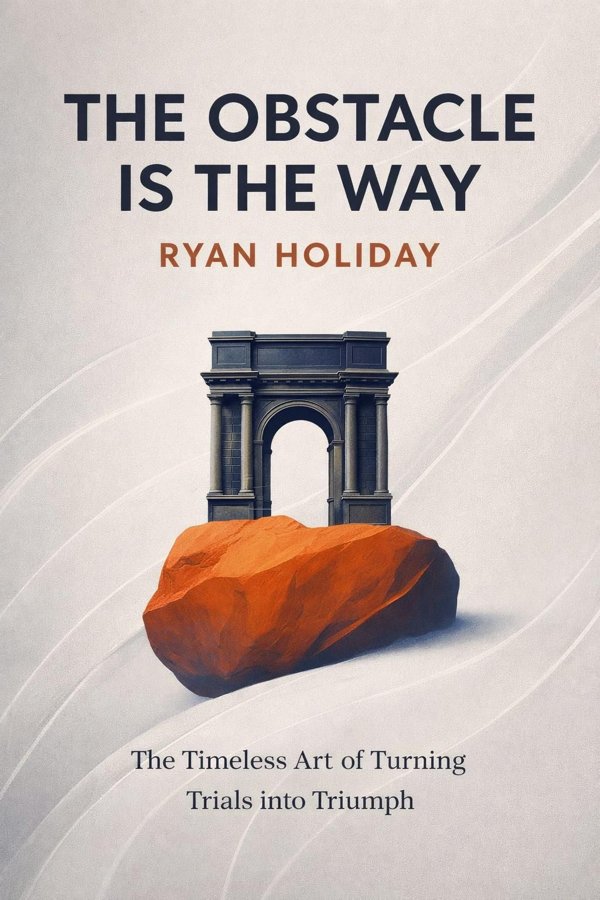
The Obstacle Is the Way: The Timeless Art of Turning Trials into Triumph: Summary & Key Insights
by Ryan Holiday
 10 min9 chaptersAudio available
Key Takeaways from The Obstacle Is the Way: The Timeless Art of Turning Trials into Triumph
The first battle is rarely with the obstacle itself; it is with the story you tell yourself about it.
Insight without movement is comforting but useless.
Some obstacles cannot be solved quickly.
The book’s title expresses more than a motivational slogan.
Much suffering comes from trying to control what was never ours to command.
What Is The Obstacle Is the Way: The Timeless Art of Turning Trials into Triumph About?
The Obstacle Is the Way: The Timeless Art of Turning Trials into Triumph by Ryan Holiday is a mindset book spanning 4 pages. What if the thing blocking your path is actually the path forward? In The Obstacle Is the Way, Ryan Holiday revives a central insight from Stoic philosophy: difficulties do not merely interrupt our progress—they reveal the very work we must do to grow, lead, and succeed. Drawing especially on the wisdom of Marcus Aurelius, Epictetus, and Seneca, Holiday argues that our greatest power lies not in controlling events, but in controlling how we see them, respond to them, and endure them. This book matters because obstacles are universal. Careers stall, plans collapse, relationships strain, markets shift, and unexpected crises arrive without permission. Holiday offers a framework for meeting these moments with clarity instead of panic. He organizes the Stoic approach into three disciplines—perception, action, and will—showing how anyone can transform setbacks into opportunities. Holiday writes with unusual authority because he bridges ancient philosophy and modern ambition. As a bestselling author known for making Stoicism practical, he combines historical stories, sharp insight, and direct advice. The result is a book that feels both timeless and urgently useful for contemporary life.
This FizzRead summary covers all 9 key chapters of The Obstacle Is the Way: The Timeless Art of Turning Trials into Triumph in approximately 10 minutes, distilling the most important ideas, arguments, and takeaways from Ryan Holiday's work. Also available as an audio summary and Key Quotes Podcast.
The Obstacle Is the Way: The Timeless Art of Turning Trials into Triumph
What if the thing blocking your path is actually the path forward? In The Obstacle Is the Way, Ryan Holiday revives a central insight from Stoic philosophy: difficulties do not merely interrupt our progress—they reveal the very work we must do to grow, lead, and succeed. Drawing especially on the wisdom of Marcus Aurelius, Epictetus, and Seneca, Holiday argues that our greatest power lies not in controlling events, but in controlling how we see them, respond to them, and endure them.
This book matters because obstacles are universal. Careers stall, plans collapse, relationships strain, markets shift, and unexpected crises arrive without permission. Holiday offers a framework for meeting these moments with clarity instead of panic. He organizes the Stoic approach into three disciplines—perception, action, and will—showing how anyone can transform setbacks into opportunities.
Holiday writes with unusual authority because he bridges ancient philosophy and modern ambition. As a bestselling author known for making Stoicism practical, he combines historical stories, sharp insight, and direct advice. The result is a book that feels both timeless and urgently useful for contemporary life.
Who Should Read The Obstacle Is the Way: The Timeless Art of Turning Trials into Triumph?
This book is perfect for anyone interested in mindset and looking to gain actionable insights in a short read. Whether you're a student, professional, or lifelong learner, the key ideas from The Obstacle Is the Way: The Timeless Art of Turning Trials into Triumph by Ryan Holiday will help you think differently.
- ✓Readers who enjoy mindset and want practical takeaways
- ✓Professionals looking to apply new ideas to their work and life
- ✓Anyone who wants the core insights of The Obstacle Is the Way: The Timeless Art of Turning Trials into Triumph in just 10 minutes
Want the full summary?
Get instant access to this book summary and 100K+ more with Fizz Moment.
Get Free SummaryAvailable on App Store • Free to download
Key Chapters
The first battle is rarely with the obstacle itself; it is with the story you tell yourself about it. Ryan Holiday emphasizes that events are neutral before we label them as disasters, insults, failures, or dead ends. This is the Stoic insight at the heart of perception: if you can govern your interpretation, you can prevent difficulty from turning into despair.
Most people react automatically. A rejected proposal becomes proof they are not talented enough. A job loss becomes evidence that life is unfair. A criticism becomes a personal attack. But Holiday argues that these judgments are optional. The obstacle may be real, but the panic, exaggeration, and self-pity often come from perception, not reality. Clear seeing allows you to distinguish what happened from what you fear it means.
This shift is not about naive optimism or pretending hard things are easy. It is about disciplined objectivity. Instead of saying, “This ruins everything,” ask, “What exactly has happened? What remains under my control? What can this teach me?” A founder whose product fails can either spiral into shame or gather customer feedback and improve. An athlete recovering from injury can either resent the delay or use the period to strengthen technique, patience, and mental toughness.
Holiday shows that calm perception creates strategic advantage. When others overreact, you conserve energy, think more clearly, and see openings they miss. The obstacle has not disappeared, but it has stopped owning your mind.
Actionable takeaway: The next time you face a setback, separate facts from interpretation. Write down what happened in plain, neutral language, then list three possible opportunities or lessons hidden inside it.
Insight without movement is comforting but useless. After perception clears the mind, action changes reality. Holiday argues that obstacles rarely dissolve through reflection alone. They must be met with disciplined effort, creative problem-solving, and repeated attempts. If perception teaches you not to panic, action teaches you not to freeze.
One of the book’s strongest ideas is that progress often comes through iteration rather than dramatic breakthroughs. People imagine success as one decisive victory, but in practice it is usually built from small, stubborn steps. When a route is blocked, you take another. When a plan fails, you revise it. When resources are limited, you work with what you have. Action is not reckless motion; it is intelligent persistence.
Holiday draws attention to qualities such as initiative, adaptability, pragmatism, and humility. These matter because obstacles often destroy idealized plans. A manager dealing with a budget cut cannot cling to the original blueprint. A student who struggles in one subject cannot wish the difficulty away. A writer receiving rejection after rejection cannot improve by resentment alone. In each case, the useful question is not “Why is this happening to me?” but “What can I do next?”
There is also a moral dimension to action. Stoicism rejects excuses. You may not be responsible for every hardship, but you are responsible for your response. Even limited action restores agency. A phone call, a revised draft, a hard conversation, a new skill learned—these are how blocked energy becomes forward motion.
Actionable takeaway: When confronted with a problem, define the smallest useful step you can take in the next 24 hours. Do that step before you spend more time analyzing the obstacle.
Some obstacles cannot be solved quickly. Some must be survived. That is where will enters. In Holiday’s framework, will is the inner strength that allows you to endure pain, uncertainty, loss, delay, and frustration without breaking. If perception governs the mind and action governs behavior, will governs your ability to stay intact when events refuse to cooperate.
This matters because life does not always reward effort immediately. You can make smart decisions and still face illness, betrayal, public criticism, or months of stalled progress. In those seasons, persistence is not glamorous. It looks like patience, emotional control, humility, and faithfulness to principle. Holiday presents will as a kind of moral stamina—the ability to remain steady when you cannot yet overcome.
Stoicism teaches that while external outcomes may be beyond your control, your character remains yours. A person enduring unemployment can still preserve dignity, routine, and self-respect. A leader facing public pressure can still respond honestly and calmly. Someone grieving a painful loss cannot erase the event, but can choose not to let suffering become bitterness. This is not denial of pain. It is mastery within pain.
Holiday also suggests that adversity can deepen perspective. Hardship strips away illusion, tests priorities, and reveals what truly matters. People often discover resilience only after they are forced to rely on it. The obstacle becomes a training ground for endurance, compassion, and seriousness.
Actionable takeaway: When you cannot change the situation, focus on preserving your inner standards. Choose one practice—such as journaling, exercise, prayer, meditation, or disciplined routine—that helps you remain stable while the storm passes.
The book’s title expresses more than a motivational slogan. It captures a radical shift in strategy: instead of treating obstacles as interruptions to your path, treat them as the path itself. Holiday argues that the very thing you resist often contains the exact lesson, skill, or transformation required for your next level of growth.
This idea challenges the common belief that success depends on ideal conditions. In reality, great performers, leaders, and creators are often shaped by resistance. Constraints force ingenuity. Criticism sharpens craft. Pressure reveals weakness. Delay builds patience. An entrepreneur learns from failed launches. A new manager grows through conflict. A person rebuilding after heartbreak learns self-knowledge and emotional discipline. What looked like blockage becomes preparation.
Holiday’s insight here is deeply Stoic: events do not simply happen to us; they become material for virtue and effectiveness. A traffic jam can become a lesson in patience. A hostile workplace can become training in composure and strategic communication. A personal failure can become a mirror showing where ego, laziness, or confusion were quietly undermining progress.
This does not mean every obstacle is good in itself. Some experiences are painful, unjust, or tragic. But even then, you can ask what worthy response remains possible. That question protects you from helplessness. It turns adversity into raw material for courage, wisdom, and adaptation.
Actionable takeaway: The next time you feel blocked, ask one direct question: “If this obstacle were my teacher, what would it be trying to train in me?” Then act on the answer.
Much suffering comes from trying to control what was never ours to command. Holiday repeatedly returns to a foundational Stoic distinction: some things are up to us, and some are not. Our judgments, effort, values, and choices belong to us. Other people’s opinions, market conditions, timing, and many outcomes do not. Confusing these categories creates frustration, anxiety, and wasted energy.
This principle is incredibly practical. Imagine preparing for an interview. You can control your preparation, punctuality, research, and presence. You cannot control the interviewer’s preferences, internal politics, or final decision. Or consider launching a business. You can control the quality of the offer, customer service, and consistency. You cannot control every economic shift or competitor move. Peace and effectiveness increase when attention returns to controllable inputs.
Holiday does not suggest indifference to results. Rather, he proposes disciplined focus. The more you obsess over what you cannot guarantee, the more scattered your effort becomes. By concentrating on process, you regain strength. Athletes understand this well: focus on form, training, and execution, not on applause. Professionals thrive when they emphasize standards and habits instead of external validation.
This distinction also weakens resentment. When someone criticizes you unfairly, your power lies not in forcing them to change, but in choosing your response. When plans collapse, your next move matters more than your complaint. Freedom grows when you stop demanding control over uncontrollable things.
Actionable takeaway: Divide your current challenge into two lists: “under my control” and “not under my control.” Put your time, emotion, and effort only into the first list for the next week.
In moments of pressure, emotion is loud but rarely wise. Holiday shows that obstacles often defeat people not because the challenge is unbeatable, but because they become impulsive, angry, fearful, or distracted. Stoicism offers a countercultural remedy: train discipline so that when crisis arrives, your behavior is guided by principle rather than feeling.
Discipline does not mean emotional numbness. It means creating enough space between feeling and reaction that you can choose well. When insulted, disciplined people do not instantly retaliate. When disappointed, they do not abandon their standards. When overwhelmed, they do not let urgency destroy judgment. This restraint becomes a competitive advantage because many avoidable problems are caused by overreaction.
Holiday illustrates that pressure reveals preparation. If you have built habits of focus, patience, and self-command in ordinary life, you are more capable in extraordinary situations. A surgeon cannot panic in the operating room. A parent cannot indulge every mood during a family emergency. A business leader cannot make strategic decisions based only on wounded pride. In each case, emotional control protects both performance and character.
Discipline also helps with temptation. Obstacles often invite shortcuts: blame others, cut corners, quit too soon, seek comfort instead of growth. The Stoic response is to stay aligned with what is right and useful, even when that path is slower or less rewarding in the short term.
Actionable takeaway: Pick one recurring emotional trigger—criticism, delay, rejection, or uncertainty—and create a rule for it. For example: “When criticized, I wait one hour before responding.” Practice the rule until it becomes automatic.
Ego is often a hidden obstacle behind the visible one. Holiday suggests that pride, entitlement, and the need to appear certain can make problems much worse. Humility, by contrast, keeps you teachable. It allows you to accept reality, revise your approach, and learn from what hurts your pride.
This matters because obstacles frequently expose the gap between our self-image and our actual abilities. A failed presentation may reveal weak communication skills. A struggling company may expose poor leadership habits. A broken relationship may uncover selfishness or avoidance. Ego wants to deny these truths, blame others, or protect reputation. Humility asks, “What is this showing me that I need to see?”
Adaptation becomes possible only when reality is allowed to instruct you. A humble entrepreneur studies customer behavior instead of insisting the market is wrong. A humble employee accepts feedback and improves. A humble athlete changes training methods after repeated losses. The obstacle stops being an insult and becomes information.
Holiday’s Stoic approach is not self-belittling. It is strong enough to tell the truth. Humility means your identity is not so fragile that it cannot withstand correction. In fact, humility often accelerates progress because it shortens the distance between error and adjustment.
There is freedom in releasing the need to be impressive. Once you stop defending an image, you can focus on becoming effective. That is when obstacles lose much of their power.
Actionable takeaway: After your next setback, ask a trusted person one question: “What am I not seeing about my role in this?” Listen without defending yourself, and use the answer to make one specific adjustment.
Many obstacles win simply because people stop too soon. Holiday makes clear that persistence is not blind stubbornness; it is the disciplined willingness to continue intelligently when progress is slow, invisible, or uneven. In a world addicted to speed and immediate results, persistence becomes a rare and powerful advantage.
The key is understanding that worthwhile goals often demand sustained effort through boredom, repetition, and temporary failure. A book is written page by page. Trust is earned conversation by conversation. Expertise is built through practice, correction, and time. Obstacles test whether your commitment is real or merely emotional enthusiasm dressed up as ambition.
Holiday shows that persistence works best when paired with flexibility. You do not keep repeating the same failed move forever. You keep moving toward the goal while adjusting method, timing, and tactics. A salesperson changes the pitch. A student changes the study system. A recovering patient changes the pace but remains committed to healing. Persistence says, “I will find a way, even if this version of the plan is not the one.”
There is also a psychological reward in persistence. Every act of returning strengthens identity. You begin to see yourself as someone who can endure discomfort and continue. That self-trust becomes fuel for future trials.
In this sense, persistence is not just about achieving outcomes. It is about becoming the kind of person who is not easily defeated by delay or difficulty.
Actionable takeaway: Choose one important goal you have been inconsistent with and define a minimum daily standard you can sustain for 30 days. Let consistency, not intensity, be the measure of commitment.
The deepest promise of The Obstacle Is the Way is not merely better performance. It is transformation. Holiday argues that adversity can refine character, clarify purpose, and mature a person in ways comfort never could. While no one seeks pain for its own sake, hardship often reveals what ease conceals.
When plans break down, you discover whether your values are real or decorative. When recognition disappears, you learn whether you can work without applause. When loss strips away certainty, you are forced to ask what matters most. These moments are painful, but they can become profoundly meaningful if approached with honesty and courage.
Holiday’s Stoicism is practical rather than abstract. He is not saying suffering automatically ennobles people. Many hardships make people smaller, angrier, or more cynical. Growth happens only when adversity is met with reflection, discipline, and deliberate choice. The obstacle must be worked with. But if it is, it can create wisdom, resilience, gratitude, and moral seriousness.
Consider someone who survives a public failure and becomes less ego-driven. Or a person who endures caregiving, grief, or illness and emerges with deeper compassion. Or a professional who loses status and finally builds a life aligned with genuine priorities rather than borrowed ambitions. In each case, adversity becomes not just a test, but a turning point.
Actionable takeaway: Think of one painful experience from your past and identify one enduring strength, value, or insight it gave you. Then ask how you can use that hard-earned wisdom to help yourself or someone else today.
All Chapters in The Obstacle Is the Way: The Timeless Art of Turning Trials into Triumph
About the Author
Ryan Holiday is an American author, strategist, and one of the most influential modern voices on Stoic philosophy. He began his career in marketing and media, working with major brands before turning to writing full time. Holiday is best known for making ancient wisdom accessible to contemporary readers, especially in books such as The Obstacle Is the Way, Ego Is the Enemy, and Stillness Is the Key. His work blends philosophy, history, psychology, and practical self-mastery, often focusing on resilience, discipline, ambition, and character. Through his books, talks, and essays, he has helped popularize Stoicism for a new generation of readers seeking clarity and strength in a fast-moving world.
Get This Summary in Your Preferred Format
Read or listen to the The Obstacle Is the Way: The Timeless Art of Turning Trials into Triumph summary by Ryan Holiday anytime, anywhere. FizzRead offers multiple formats so you can learn on your terms — all free.
Available formats: App · Audio · PDF · EPUB — All included free with FizzRead
Download The Obstacle Is the Way: The Timeless Art of Turning Trials into Triumph PDF and EPUB Summary
Key Quotes from The Obstacle Is the Way: The Timeless Art of Turning Trials into Triumph
“The first battle is rarely with the obstacle itself; it is with the story you tell yourself about it.”
“Insight without movement is comforting but useless.”
“Some obstacles cannot be solved quickly.”
“The book’s title expresses more than a motivational slogan.”
“Much suffering comes from trying to control what was never ours to command.”
Frequently Asked Questions about The Obstacle Is the Way: The Timeless Art of Turning Trials into Triumph
The Obstacle Is the Way: The Timeless Art of Turning Trials into Triumph by Ryan Holiday is a mindset book that explores key ideas across 9 chapters. What if the thing blocking your path is actually the path forward? In The Obstacle Is the Way, Ryan Holiday revives a central insight from Stoic philosophy: difficulties do not merely interrupt our progress—they reveal the very work we must do to grow, lead, and succeed. Drawing especially on the wisdom of Marcus Aurelius, Epictetus, and Seneca, Holiday argues that our greatest power lies not in controlling events, but in controlling how we see them, respond to them, and endure them. This book matters because obstacles are universal. Careers stall, plans collapse, relationships strain, markets shift, and unexpected crises arrive without permission. Holiday offers a framework for meeting these moments with clarity instead of panic. He organizes the Stoic approach into three disciplines—perception, action, and will—showing how anyone can transform setbacks into opportunities. Holiday writes with unusual authority because he bridges ancient philosophy and modern ambition. As a bestselling author known for making Stoicism practical, he combines historical stories, sharp insight, and direct advice. The result is a book that feels both timeless and urgently useful for contemporary life.
More by Ryan Holiday
You Might Also Like
Featured In
Browse by Category
Ready to read The Obstacle Is the Way: The Timeless Art of Turning Trials into Triumph?
Get the full summary and 100K+ more books with Fizz Moment.