
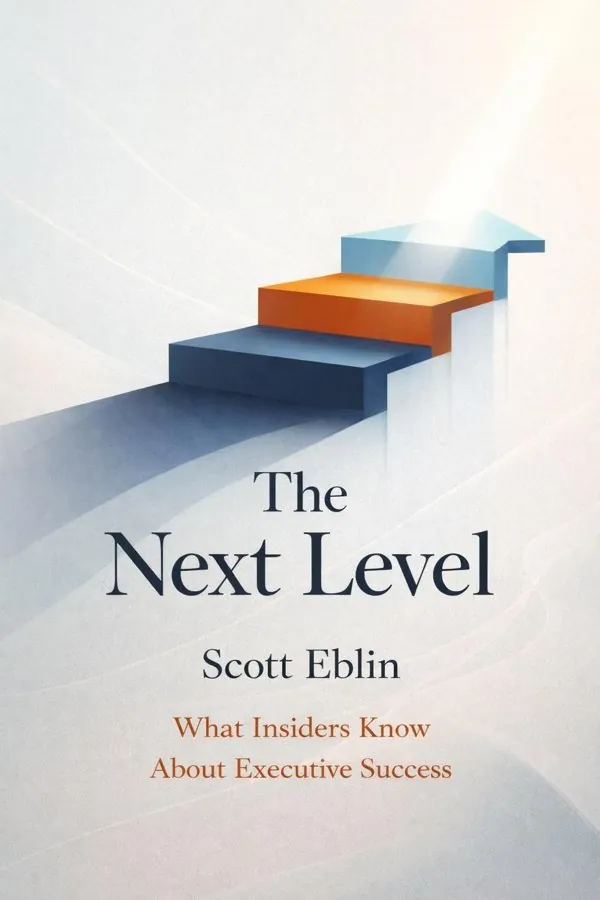
The Next Level: What Insiders Know About Executive Success: Summary & Key Insights
by Scott Eblin
 10 min9 chaptersAudio available
Key Takeaways from The Next Level: What Insiders Know About Executive Success
A promotion is not proof that you should keep leading the same way at a larger scale.
Executive growth is rarely about adding more effort; it is about replacing outdated habits.
Many rising leaders are promoted because they are exceptionally capable, but executive success begins when capability stops being expressed through personal output alone.
If managers win by mastering the immediate, executives win by seeing beyond it.
The higher leaders rise, the less their success can depend on individual excellence alone.
What Is The Next Level: What Insiders Know About Executive Success About?
The Next Level: What Insiders Know About Executive Success by Scott Eblin is a leadership book spanning 12 pages. Moving into a senior leadership role looks like a reward from the outside, but in practice it is often a complete reset. The habits that made someone a high-performing manager can become liabilities when they step into executive responsibility. In The Next Level, executive coach Scott Eblin explains this transition with unusual clarity. Rather than offering abstract leadership theory, he focuses on the real behavioral shifts leaders must make when they move from hands-on execution to broad organizational impact. His core idea is simple and memorable: success at higher levels depends on what leaders choose to let go of and what they intentionally pick up. What makes the book especially useful is Eblin’s practical authority. As an executive coach who has worked closely with senior leaders across industries, he draws on firsthand experience with the pressures, blind spots, and expectations that accompany promotion. He gives readers self-assessment tools, reflective questions, and direct advice for changing behavior in visible, measurable ways. For aspiring executives, newly promoted leaders, and organizations grooming top talent, this book is a valuable guide to making the leap from competent management to credible executive leadership.
This FizzRead summary covers all 9 key chapters of The Next Level: What Insiders Know About Executive Success in approximately 10 minutes, distilling the most important ideas, arguments, and takeaways from Scott Eblin's work. Also available as an audio summary and Key Quotes Podcast.
The Next Level: What Insiders Know About Executive Success
Moving into a senior leadership role looks like a reward from the outside, but in practice it is often a complete reset. The habits that made someone a high-performing manager can become liabilities when they step into executive responsibility. In The Next Level, executive coach Scott Eblin explains this transition with unusual clarity. Rather than offering abstract leadership theory, he focuses on the real behavioral shifts leaders must make when they move from hands-on execution to broad organizational impact. His core idea is simple and memorable: success at higher levels depends on what leaders choose to let go of and what they intentionally pick up.
What makes the book especially useful is Eblin’s practical authority. As an executive coach who has worked closely with senior leaders across industries, he draws on firsthand experience with the pressures, blind spots, and expectations that accompany promotion. He gives readers self-assessment tools, reflective questions, and direct advice for changing behavior in visible, measurable ways. For aspiring executives, newly promoted leaders, and organizations grooming top talent, this book is a valuable guide to making the leap from competent management to credible executive leadership.
Who Should Read The Next Level: What Insiders Know About Executive Success?
This book is perfect for anyone interested in leadership and looking to gain actionable insights in a short read. Whether you're a student, professional, or lifelong learner, the key ideas from The Next Level: What Insiders Know About Executive Success by Scott Eblin will help you think differently.
- ✓Readers who enjoy leadership and want practical takeaways
- ✓Professionals looking to apply new ideas to their work and life
- ✓Anyone who wants the core insights of The Next Level: What Insiders Know About Executive Success in just 10 minutes
Want the full summary?
Get instant access to this book summary and 100K+ more with Fizz Moment.
Get Free SummaryAvailable on App Store • Free to download
Key Chapters
A promotion is not proof that you should keep leading the same way at a larger scale. That is the central insight behind The Next Level. Scott Eblin argues that when professionals move into executive roles, their vantage point fundamentally changes. They are no longer judged mainly by how efficiently they solve problems or how effectively they manage their own teams. Instead, they are evaluated by how well they shape direction, align people, influence across boundaries, and create confidence in the broader organization.
This shift often catches leaders off guard because the behaviors that brought them success in earlier roles were reinforced for years. They were rewarded for being decisive, responsive, detail-oriented, and personally dependable. At the executive level, however, those same strengths can become constraints if they lead to overinvolvement, micromanagement, or narrow thinking. An executive who still operates like a super-manager can unintentionally slow decisions, weaken team ownership, and miss larger strategic threats or opportunities.
Eblin’s contribution is to frame executive success as a transition of perspective. The leader must move from the near view to the wide-angle lens. Instead of asking, “How do I make this work?” they must ask, “What should the organization become, and how do I position others to deliver it?” For example, a newly promoted division head may need to spend less time reviewing project details and more time meeting cross-functional peers, clarifying priorities, and shaping culture.
The practical lesson is to treat advancement as reinvention. Do not assume past behaviors will automatically scale. Identify which expectations have changed in your new role and deliberately redesign how you spend your time, attention, and influence.
Executive growth is rarely about adding more effort; it is about replacing outdated habits. Eblin organizes the book around what he calls the behavioral equation: to succeed at the next level, leaders must let go of certain behaviors and pick up others. This framework is powerful because it cuts through vague advice and makes development concrete. Leadership improvement becomes less about personality and more about visible, repeatable choices.
The idea matters because many leaders think development means doing more of everything: more meetings, more communication, more involvement, more control. In reality, higher-level success often requires subtraction before addition. If a leader keeps clinging to hands-on execution, constant approval, and individual problem-solving, there will be no space for strategic thinking, enterprise leadership, and broader influence. Letting go is not loss; it is how capacity is created.
Eblin’s equation is useful in daily practice. A leader can review a difficult week and ask two simple questions: What did I hold onto that belongs to my old role? What new behavior should I have demonstrated instead? For instance, if a vice president spent hours rewriting a team presentation, the behavior to let go may be doing, while the behavior to pick up may be coaching and setting standards. If a senior leader resolved an issue without involving peers, the behavior to let go may be self-reliance, while the new behavior may be collaboration and influence.
The framework also lowers defensiveness. It does not suggest that old habits were wrong. It simply says they may no longer be sufficient. The actionable takeaway is to choose one “let go” behavior and one “pick up” behavior this month, then track where each shows up in your calendar, decisions, and interactions.
Many rising leaders are promoted because they are exceptionally capable, but executive success begins when capability stops being expressed through personal output alone. Eblin emphasizes the importance of letting go of doing. At lower levels, being the person who fixes problems quickly is a major asset. At the executive level, staying trapped in execution can prevent others from growing and can keep the leader focused on today’s tasks instead of tomorrow’s direction.
Doing feels productive because it produces immediate results. Delegating, coaching, and stepping back often feel slower and less certain. That is why leaders under pressure tend to retreat into familiar competence. They answer the email themselves, revise the plan themselves, jump into the customer issue themselves. But every time an executive becomes the default problem solver, they send a subtle message: important work still depends on me, not on the system or the team.
Eblin encourages leaders to reframe their value. The executive’s job is not to personally complete the most important work. It is to ensure the most important work gets completed by the right people in the right way. A functional leader, for example, may need to stop leading weekly tactical reviews and instead ask their direct reports to own those meetings while they focus on long-term capability, stakeholder alignment, and strategic priorities.
A practical application is to audit your involvement. Look at recurring activities and ask: Am I participating because my role truly requires it, or because I am more comfortable doing than leading? Start transferring ownership of one recurring task, define decision rights clearly, and resist the urge to take it back at the first sign of imperfection. The actionable takeaway is simple: measure your impact less by what you complete and more by what your team can now do without you.
If managers win by mastering the immediate, executives win by seeing beyond it. One of the most important behaviors Eblin urges leaders to pick up is strategic thinking. This is not about using impressive language or creating long presentations about the future. It is about developing the discipline to notice patterns, anticipate consequences, understand the external environment, and make choices that position the organization for long-term success.
Strategic thinking is often crowded out by urgency. Executives can spend entire weeks reacting to issues, attending meetings, and solving near-term operational challenges. The danger is not just exhaustion; it is invisibility of the future. Leaders become so immersed in today’s demands that they fail to examine shifting customer expectations, competitive moves, market risks, talent gaps, or cultural drift. By the time those issues become obvious, the window to respond may have narrowed.
Eblin suggests that strategic capacity comes from intention. Leaders need protected time to think, not just to act. They also need broader inputs: data from outside the function, conversations across the organization, and awareness of what is happening in the industry. A sales leader, for instance, should not only review quarterly numbers but also ask what customer buying behavior is signaling about product design, service delivery, and future margins.
To make strategic thinking practical, executives can adopt a few questions: What trends matter most right now? What assumptions are we making? What are we not discussing because the current model still seems to work? Build regular reflection into your calendar, and bring future-oriented questions into team meetings. The actionable takeaway is to reserve recurring time each week for strategic reflection and use it to identify one decision that should be guided by long-term positioning rather than short-term convenience.
The higher leaders rise, the less their success can depend on individual excellence alone. Eblin highlights a crucial shift: executives must let go of self-reliance and pick up true team leadership. Self-reliance is often rewarded early in a career. It signals competence, drive, and accountability. But at the executive level, overreliance on yourself can isolate you, bottleneck decisions, and reduce the collective intelligence available to the business.
Executives operate in environments that are too complex for solo leadership. They must coordinate across functions, integrate competing priorities, and build alignment among people with different expertise and incentives. A leader who believes they always need to be the most informed or most capable person in the room can unintentionally weaken collaboration. Team members stop taking initiative, peers hesitate to contribute, and important perspectives are lost.
Picking up team leadership means creating conditions where others contribute at a higher level. It involves setting clear direction, selecting strong talent, encouraging productive tension, and helping a leadership team work as a unit rather than as a set of individual performers. For example, a department head may have several direct reports who each lead well within their own silos but rarely coordinate with one another. The executive task is not just to manage each one separately. It is to forge them into a leadership team that solves enterprise problems together.
This shift also requires emotional discipline. Team leadership means listening more, asking better questions, and sharing ownership of outcomes. A practical first step is to notice where you habitually default to “I” instead of “we.” In your next leadership meeting, spend less time giving answers and more time prompting interdependence among your team. The actionable takeaway is to identify one area where your team still depends too heavily on you and redesign it so the group, not the individual executive, carries the solution.
Executives often discover that authority alone is not enough. As roles expand, leaders must let go of control and pick up organizational influence. Control is attractive because it creates clarity and predictability. But in complex organizations, no executive can directly command every outcome. Results increasingly depend on people outside formal reporting lines: peers, partners, boards, key customers, and informal power centers.
Eblin’s point is that senior leadership is an influence job. Leaders who keep trying to control everything usually become frustrated. They escalate too quickly, over-specify solutions, or rely on hierarchy when persuasion and coalition-building would be more effective. This may produce short-term compliance, but it rarely generates commitment. And without commitment, execution weakens as soon as the leader’s direct attention shifts elsewhere.
Influence begins with understanding the broader system. Who shapes decisions here? What matters to them? How can your priorities be framed in terms that connect to their goals? A finance executive trying to drive cost discipline, for instance, may fail if the message is purely about cuts. The effort becomes more persuasive if linked to investment capacity, strategic flexibility, and protection of long-term competitiveness.
Eblin encourages executives to spend more time in relationship-building before they need something. Influence is easier when trust already exists. It also grows when leaders communicate with brevity, credibility, and awareness of the audience. Rather than forcing consensus, effective executives create enough shared understanding that others choose to move in the same direction.
The actionable takeaway is to map one important initiative and list the people you need to influence beyond your chain of command. Then tailor your message to each stakeholder’s priorities and begin building support before formal decisions are required.
Executive presence is often misunderstood as polish, charisma, or style, but Eblin treats it as something deeper and more accessible: the alignment between how a leader shows up and what the role requires. Presence is not about pretending to be someone else. It is about communicating confidence, clarity, composure, and credibility in a way that helps others trust your judgment under pressure.
This matters because senior leaders are constantly interpreted. People watch not only what executives decide but how they react, listen, speak, and carry themselves. A scattered update can create doubt. A defensive answer can signal insecurity. An inability to stay calm in ambiguity can spread anxiety across the organization. Presence is therefore not superficial. It is part of how leaders stabilize and guide others.
Eblin connects executive presence to concrete behaviors. Do you speak with focus, or do you overwhelm people with unnecessary detail? Do you listen without interrupting? Do you enter important meetings prepared to clarify priorities rather than simply report activity? Do your nonverbal signals support confidence and openness? A newly promoted executive, for example, may know the business deeply but undermine their own credibility by rambling, overexplaining, or appearing rushed in high-stakes discussions.
Presence can be developed through feedback and practice. Leaders can ask trusted colleagues how they come across in meetings, presentations, and difficult conversations. They can rehearse messages, simplify communication, and learn to pause instead of filling silence with qualifiers. They can also pay attention to energy and demeanor, especially when stress rises.
The actionable takeaway is to identify one behavior that affects your executive presence, such as talking too much, rushing responses, or appearing tense, and practice replacing it with a more composed alternative in every key interaction this week.
Leadership failure is not always caused by poor strategy or weak intelligence; sometimes it is caused by depletion. Eblin gives unusual emphasis to personal sustainability, arguing that executives cannot consistently perform at a high level if their physical, emotional, and mental reserves are constantly drained. This is a vital idea because many leaders treat exhaustion as evidence of commitment, even while their judgment, patience, and effectiveness deteriorate.
At senior levels, the demands are relentless. There is more visibility, more ambiguity, more travel, more conflict, and more responsibility for outcomes you do not fully control. In that context, sustainability becomes a leadership capability, not a lifestyle luxury. A tired executive is more likely to overreact, miss signals, communicate poorly, and retreat into old habits such as doing, controlling, or avoiding difficult conversations.
Eblin encourages leaders to pay attention to routines that either renew or deplete them. Sleep, exercise, reflection, nutrition, boundaries, and recovery time are not separate from performance; they shape performance. So do emotional habits such as rumination, constant availability, and lack of perspective. For example, an executive who starts every morning by reacting to overnight messages may spend the entire day in a defensive mindset. One who begins with planning, thinking, and exercise is more likely to lead proactively.
Personal sustainability also includes values and meaning. Leaders need to know what grounds them, what relationships matter, and what tradeoffs they are willing or unwilling to make. Without that clarity, work can expand endlessly.
The actionable takeaway is to choose one sustainable leadership habit to protect daily, such as exercise, focused planning time, or a firm shutdown routine, and treat it as non-negotiable support for better decisions, steadier presence, and stronger long-term performance.
Insight does not change behavior unless it becomes a disciplined practice. One of the book’s strongest practical contributions is its use of self-assessment tools and action planning. Eblin understands that leaders often receive broad feedback like “be more strategic” or “delegate more,” but struggle to convert those phrases into specific development steps. His approach helps readers identify where they are stuck and what they must do differently.
Self-assessment matters because executives often operate with incomplete self-awareness. The higher someone rises, the less candid feedback they may receive. People become more cautious, and leaders can start mistaking silence for effectiveness. Structured reflection creates an alternative source of truth. It helps leaders see patterns in how they spend time, where they create dependency, and which old habits resurface under pressure.
Action planning makes development operational. Instead of promising to become a better leader in general, the executive chooses targeted shifts tied to actual situations. For example, if an assessment reveals weak strategic focus, the plan might include blocking two hours weekly for future-oriented thinking, discussing long-term risks in staff meetings, and scheduling monthly customer or market insight reviews. If the issue is control, the plan might involve clarifying delegated decisions, limiting meeting attendance, and coaching rather than correcting direct reports.
Eblin’s method works because it connects aspiration to observable behavior. It also invites accountability. A leader can share the plan with a mentor, manager, coach, or trusted colleague and ask for feedback on progress. Small, repeated shifts are more likely to stick than dramatic but unsustained change efforts.
The actionable takeaway is to create a 30-day next-level plan with one behavior to stop, one to start, and one metric or observation that will help you know whether the change is actually happening.
All Chapters in The Next Level: What Insiders Know About Executive Success
About the Author
Scott Eblin is an executive coach, keynote speaker, and author focused on leadership effectiveness, executive presence, and career transitions at senior levels. He is the co-founder of The Eblin Group, a leadership development firm that works with organizations and senior professionals to improve performance and prepare leaders for greater responsibility. Eblin is especially known for translating executive leadership challenges into practical behavioral tools that readers and clients can apply immediately. His work draws on years of coaching high-potential managers, vice presidents, and C-suite leaders across industries, giving him a grounded view of what really changes as people rise in organizations. In The Next Level, he brings that experience together in a clear, actionable framework for leaders who want to succeed in larger, more complex roles.
Get This Summary in Your Preferred Format
Read or listen to the The Next Level: What Insiders Know About Executive Success summary by Scott Eblin anytime, anywhere. FizzRead offers multiple formats so you can learn on your terms — all free.
Available formats: App · Audio · PDF · EPUB — All included free with FizzRead
Download The Next Level: What Insiders Know About Executive Success PDF and EPUB Summary
Key Quotes from The Next Level: What Insiders Know About Executive Success
“A promotion is not proof that you should keep leading the same way at a larger scale.”
“Executive growth is rarely about adding more effort; it is about replacing outdated habits.”
“Many rising leaders are promoted because they are exceptionally capable, but executive success begins when capability stops being expressed through personal output alone.”
“If managers win by mastering the immediate, executives win by seeing beyond it.”
“The higher leaders rise, the less their success can depend on individual excellence alone.”
Frequently Asked Questions about The Next Level: What Insiders Know About Executive Success
The Next Level: What Insiders Know About Executive Success by Scott Eblin is a leadership book that explores key ideas across 9 chapters. Moving into a senior leadership role looks like a reward from the outside, but in practice it is often a complete reset. The habits that made someone a high-performing manager can become liabilities when they step into executive responsibility. In The Next Level, executive coach Scott Eblin explains this transition with unusual clarity. Rather than offering abstract leadership theory, he focuses on the real behavioral shifts leaders must make when they move from hands-on execution to broad organizational impact. His core idea is simple and memorable: success at higher levels depends on what leaders choose to let go of and what they intentionally pick up. What makes the book especially useful is Eblin’s practical authority. As an executive coach who has worked closely with senior leaders across industries, he draws on firsthand experience with the pressures, blind spots, and expectations that accompany promotion. He gives readers self-assessment tools, reflective questions, and direct advice for changing behavior in visible, measurable ways. For aspiring executives, newly promoted leaders, and organizations grooming top talent, this book is a valuable guide to making the leap from competent management to credible executive leadership.
More by Scott Eblin
You Might Also Like

Extreme Ownership
Jocko Willink
10 min
Dare to Lead
Brene Brown
10 min
Leaders Eat Last
Simon Sinek
10 min
The 21 Irrefutable Laws of Leadership
John Maxwell
10 min
Start With Why
Simon Sinek
10 min
How to Lead When You're Not in Charge
Clay Scroggins
10 minBrowse by Category
Ready to read The Next Level: What Insiders Know About Executive Success?
Get the full summary and 100K+ more books with Fizz Moment.