
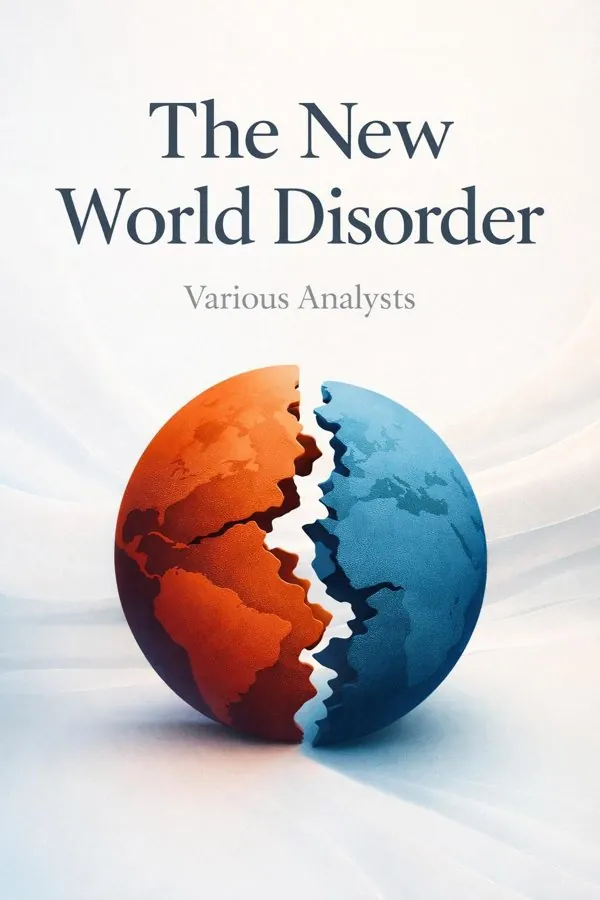
The New World Disorder: Summary & Key Insights
 10 min9 chaptersAudio available
Key Takeaways from The New World Disorder
History rarely ends cleanly; it usually leaves debris behind.
Winning a rivalry is easier than managing the world that follows.
When global tension declines, local violence does not automatically disappear.
The dream of unity often grows strongest in the shadow of past division.
The forces that connect the world also make it easier for shocks to travel.
What Is The New World Disorder About?
The New World Disorder by Various Analysts is a politics book spanning 5 pages. What happens when the system that organized global politics for nearly half a century suddenly disappears? The New World Disorder tackles that question through a wide-ranging collection of essays examining the turbulent years after the Cold War. Rather than celebrating a smooth transition into peace and prosperity, the book argues that the collapse of the Soviet Union unleashed a far messier reality: fragile states, ethnic conflict, economic upheaval, contested borders, and a new struggle over what global leadership should look like. It explores how the end of bipolar rivalry created both opportunity and instability, from American power and European integration to conflicts in the Balkans and the Middle East. What makes the book especially valuable is its multi-voiced perspective. Written by analysts and scholars in political science, international relations, and economics, it avoids simplistic triumphalism and instead maps the complexity of a world no longer governed by familiar rules. For readers trying to understand the roots of today’s geopolitical tensions, this book remains strikingly relevant. It shows that the post-Cold War era was not the birth of a stable order, but the beginning of an unsettled and still unfolding global transformation.
This FizzRead summary covers all 9 key chapters of The New World Disorder in approximately 10 minutes, distilling the most important ideas, arguments, and takeaways from Various Analysts's work. Also available as an audio summary and Key Quotes Podcast.
The New World Disorder
What happens when the system that organized global politics for nearly half a century suddenly disappears? The New World Disorder tackles that question through a wide-ranging collection of essays examining the turbulent years after the Cold War. Rather than celebrating a smooth transition into peace and prosperity, the book argues that the collapse of the Soviet Union unleashed a far messier reality: fragile states, ethnic conflict, economic upheaval, contested borders, and a new struggle over what global leadership should look like. It explores how the end of bipolar rivalry created both opportunity and instability, from American power and European integration to conflicts in the Balkans and the Middle East. What makes the book especially valuable is its multi-voiced perspective. Written by analysts and scholars in political science, international relations, and economics, it avoids simplistic triumphalism and instead maps the complexity of a world no longer governed by familiar rules. For readers trying to understand the roots of today’s geopolitical tensions, this book remains strikingly relevant. It shows that the post-Cold War era was not the birth of a stable order, but the beginning of an unsettled and still unfolding global transformation.
Who Should Read The New World Disorder?
This book is perfect for anyone interested in politics and looking to gain actionable insights in a short read. Whether you're a student, professional, or lifelong learner, the key ideas from The New World Disorder by Various Analysts will help you think differently.
- ✓Readers who enjoy politics and want practical takeaways
- ✓Professionals looking to apply new ideas to their work and life
- ✓Anyone who wants the core insights of The New World Disorder in just 10 minutes
Want the full summary?
Get instant access to this book summary and 100K+ more with Fizz Moment.
Get Free SummaryAvailable on App Store • Free to download
Key Chapters
History rarely ends cleanly; it usually leaves debris behind. The dissolution of the Soviet Union was not simply the disappearance of one superpower, but the unraveling of the political, military, and ideological framework that had structured international life since 1945. When the USSR collapsed, newly independent states emerged with weak institutions, uncertain borders, struggling economies, and unresolved ethnic tensions. What looked like liberation from one perspective also produced power vacuums, identity crises, and regional instability.
The book emphasizes that the Soviet collapse changed more than Eastern Europe or Central Asia. It altered the strategic assumptions of every major government. NATO had to redefine its purpose. The United States suddenly faced a world without a peer competitor. Former Soviet republics had to choose between national sovereignty, regional dependence, and integration with Western institutions. Nuclear weapons, military assets, intelligence networks, and economic ties did not simply vanish; they had to be redistributed, controlled, or contested.
A practical example is Ukraine’s early post-Soviet position: independent in law, vulnerable in geography, and tied by history and infrastructure to Russia. Another is the Caucasus, where long-suppressed tensions resurfaced into open conflict. The book shows that when empires fall, the real challenge begins after the flag comes down.
For modern readers, this idea has lasting value. Many current conflicts cannot be understood without recognizing how post-Soviet fragmentation shaped borders, loyalties, and strategic fears. Policymakers, investors, journalists, and citizens all benefit from viewing state collapse not as an event, but as a long transition.
Actionable takeaway: When analyzing major geopolitical change, look beyond the symbolic moment of collapse and ask what institutions, identities, and security arrangements are left unresolved.
Winning a rivalry is easier than managing the world that follows. In the early 1990s, the United States appeared to stand alone as the dominant global power. The Gulf War seemed to demonstrate unmatched military reach, technological superiority, and the ability to shape international coalitions. Yet The New World Disorder questions whether this was true unipolarity or only a temporary advantage before other powers, regions, and actors pushed back.
The essays argue that American power after the Cold War was real but incomplete. Military strength did not automatically produce political legitimacy, economic control, or long-term stability. The United States could intervene, but it could not dictate outcomes everywhere. Humanitarian crises, ethnic wars, and fractured states demanded forms of engagement that conventional superpower strategy was not designed to handle. This exposed a central tension: should America act as global policeman, reluctant hegemon, or first among equals in a wider network of institutions?
The book’s analysis remains relevant because similar questions continue to define debates over U.S. foreign policy. Consider interventions in Iraq, coalition-building against terrorism, or strategic competition with China. In each case, military capacity must be weighed against local complexity, alliance management, and domestic political limits. Power is not just the ability to act; it is the ability to shape durable outcomes.
For readers, the practical lesson is to resist simplistic labels like “sole superpower.” Dominance in one domain may conceal weakness in others. The most effective foreign policy often depends on calibration, restraint, and coalition legitimacy rather than displays of force alone.
Actionable takeaway: Evaluate global leadership by asking not only who has the most power, but who can convert power into stable, accepted, and lasting results.
When global tension declines, local violence does not automatically disappear. One of the book’s sharpest insights is that the end of the Cold War did not produce peace; it shifted the geography and character of conflict. Instead of a single overarching confrontation between two superpowers, the world saw the rise of regional wars fueled by nationalism, sectarian identity, collapsing states, and contested sovereignty.
The Balkans and the Middle East serve as major examples. In the former Yugoslavia, the removal of Cold War constraints exposed deep historical grievances and institutional weakness. Ethnic identity became militarized, and the international community struggled to respond quickly or coherently. In the Middle East, the Gulf War highlighted both the reach of external powers and the enduring volatility of the region. Long-standing disputes, authoritarian regimes, uneven development, and strategic resources made it a persistent center of instability.
The book shows that regional conflicts are rarely isolated. Refugee flows affect neighboring states. Energy markets react. International law is tested. Great powers become involved, sometimes reluctantly, sometimes opportunistically. This is especially relevant today in places where internal conflicts quickly gain international dimensions through sanctions, proxy support, migration pressures, or cyber activity.
A practical application of this insight is policy design. Governments and institutions cannot treat every conflict as either a local humanitarian issue or a grand strategic showdown. Effective response requires understanding historical narratives, state capacity, economic incentives, and the role of external patrons.
The broader message is that the post-Cold War world became more fragmented, not less dangerous. Disorder often arises not from one central enemy, but from many overlapping crises.
Actionable takeaway: To understand any regional conflict, analyze the local identities driving it, the institutional weaknesses enabling it, and the international interests sustaining it.
The dream of unity often grows strongest in the shadow of past division. After the Cold War, Europe faced a historic opportunity to deepen integration, expand democracy, and redefine itself beyond the East-West divide. Yet The New World Disorder makes clear that European integration was never just a technical process of treaties and markets. It was also a political struggle over identity, sovereignty, legitimacy, and the meaning of belonging.
The book explores how the European project gained momentum through economic interdependence, institutional cooperation, and the promise of peace. Former communist states sought entry into Western structures not only for prosperity, but for recognition and security. At the same time, integration created anxiety. Who would make decisions? How much authority should national governments surrender? Could a common European identity coexist with strong local loyalties and different historical experiences?
These tensions continue to shape Europe today. Debates over migration, fiscal policy, democratic accountability, and defense cooperation all reflect the same unresolved question: can supranational institutions protect stability without eroding democratic attachment at the national level? The book anticipated that globalization would intensify this challenge by making economic integration easier while making political consensus harder.
A useful example is the contrast between support for open markets and resistance to centralized governance. People may welcome cross-border trade, travel, and investment while still rejecting external control over domestic priorities. That contradiction is central to the European story.
The lesson extends far beyond Europe. Any project of regional integration must address emotional and historical loyalties, not only economic incentives.
Actionable takeaway: When assessing integration efforts, look at both institutional design and public identity, because systems endure only when people feel represented within them.
The forces that connect the world also make it easier for shocks to travel. The New World Disorder treats globalization not as a celebratory slogan, but as a transforming process with uneven consequences. As trade barriers fell, capital moved faster, communication accelerated, and markets became more integrated, many countries gained access to new opportunities. Yet these same dynamics exposed societies to financial volatility, labor disruption, cultural anxiety, and growing inequality.
The book shows that globalization after the Cold War was tied to a broader ideological shift. Liberalization, privatization, and market integration were often presented as inevitable. But what looked efficient at the macro level could be painful at the human level. Industries collapsed under foreign competition, social protections weakened, and states struggled to regulate transnational capital. In former communist countries especially, rapid transition often produced corruption, oligarchic structures, and social disillusionment instead of broad-based prosperity.
This insight remains useful in evaluating current debates over supply chains, inflation, outsourcing, and digital platforms. For example, a country may benefit from export growth while becoming dangerously dependent on imported energy, semiconductors, or food. Likewise, businesses can scale globally while communities face stagnant wages and loss of bargaining power.
The essays encourage a more balanced understanding of globalization: it is neither a universal cure nor a pure threat. Its effects depend on institutions, sequencing, social cushions, and political accountability. Countries that combine openness with strong governance tend to adapt better than those that liberalize without safeguards.
The practical lesson is clear: interdependence requires resilience. Economic openness works best when paired with domestic capacity, strategic planning, and inclusive policies.
Actionable takeaway: Treat globalization as a tool to be governed, not a force to be worshipped or feared, and build buffers before crises reveal your dependencies.
People do not stop needing belonging just because ideology loses its grip. One of the book’s most important themes is the return of nationalism and identity politics after the Cold War. During the bipolar era, many local tensions were frozen, redirected, or subordinated to superpower logic. Once that structure weakened, suppressed identities re-emerged with enormous force, often shaping politics more powerfully than abstract commitments to liberal order or economic modernization.
The essays explain that identity can be constructive or destructive. It can inspire democratic self-determination, cultural renewal, and political participation. But it can also harden into exclusion, grievance, and violence, especially when leaders mobilize history, ethnicity, religion, or language to consolidate power. In fragile states, identity becomes a shortcut to political loyalty when institutions are weak and trust is low.
The Balkans offered an especially tragic example, where competing national narratives and fears of domination escalated into ethnic cleansing and war. But the broader lesson applies widely. Identity politics influences secessionist movements, immigration debates, minority rights disputes, and populist mobilization across democracies and authoritarian systems alike.
For today’s readers, this is a reminder that policy cannot be built on material incentives alone. Infrastructure, trade, and constitutional reforms matter, but they do not automatically resolve symbolic questions of dignity, memory, and recognition. Leaders who ignore identity leave space for extremists to weaponize it.
A practical application is conflict prevention. Early warning systems should pay attention not only to military buildup or economic decline, but to rhetoric about purity, betrayal, and historical revenge.
Actionable takeaway: In politics, always ask what identities are being activated, who benefits from that activation, and whether institutions are strong enough to channel it peacefully.
Institutions built for one era are often judged harshly in the next. The New World Disorder examines how bodies such as the United Nations, NATO, the European Community, and international financial institutions struggled to adapt after the Cold War. Their original purposes had been shaped by bipolar competition, deterrence, reconstruction, and alliance management. But the post-Cold War environment demanded new responses to ethnic conflict, failed states, humanitarian intervention, peacekeeping, sanctions, and economic transition.
The book argues that institutional legitimacy depends not just on ideals, but on performance. The UN might embody universal aspiration, yet still falter in execution when member states lack consensus. NATO could lose its original enemy but reinvent itself through enlargement and crisis management. Financial institutions could promote reform while also being criticized for imposing one-size-fits-all prescriptions. In every case, adaptation was necessary but politically contested.
This matters because modern governance problems are inherently transnational. Pandemics, refugee flows, cyber threats, debt crises, climate disruption, and supply chain shocks all exceed the capacity of individual states acting alone. Yet cooperation becomes difficult precisely when national interests diverge most sharply.
A practical example is peacekeeping. Deploying observers may help freeze violence, but without political settlement, economic recovery, and local legitimacy, missions can become temporary bandages rather than solutions. The book invites readers to judge institutions by fit: are they equipped for the challenge they claim to address?
The broader lesson is that no international order sustains itself automatically. Rules require enforcement, adaptation, and political backing.
Actionable takeaway: When evaluating global institutions, focus on mandate, incentives, and member commitment rather than assuming that formal existence guarantees real capacity.
Markets do not emerge in a vacuum; they are built through power, law, and social trust. The New World Disorder pays close attention to the economic transitions that followed the Cold War, especially in post-communist societies. The move from planned economies to market systems was often described as a technical matter of privatization, deregulation, and liberalization. But the book shows that these reforms were deeply political and socially disruptive.
In many countries, rapid economic change outpaced institutional development. Property rights were unclear, legal systems weak, and regulatory agencies immature. This created opportunities for corruption, insider privatization, and concentration of wealth. Instead of broad middle-class capitalism, some states produced oligarchic structures in which political influence and economic ownership became tightly fused. The resulting inequality damaged faith in democracy and made citizens vulnerable to authoritarian appeals promising stability or national restoration.
This is a crucial lesson for any reform process. Whether in emerging markets, post-conflict states, or heavily indebted economies, economic restructuring cannot be separated from governance quality. Sudden liberalization without safety nets can devastate households. Privatization without oversight can delegitimize reform itself. External advisers may favor speed, but social legitimacy often depends on sequencing and transparency.
A practical modern parallel can be seen in debates over austerity, digital disruption, or energy transition. Even necessary change can provoke backlash if its costs are concentrated and its benefits delayed or captured by elites.
The book’s insight is that economics shapes political order. Material insecurity changes how people vote, whom they trust, and what kinds of leaders they tolerate.
Actionable takeaway: Support reform that combines market change with institution-building, legal clarity, and social protection, because durable economic transformation requires public trust.
The most dangerous threats are often the ones old frameworks fail to recognize. In its concluding reflections, The New World Disorder argues that the post-Cold War world requires more flexible forms of governance because emerging dangers do not fit the traditional model of interstate rivalry alone. Security increasingly involves non-state actors, environmental stress, economic contagion, migration pressures, terrorism, organized crime, and technological disruption.
The essays challenge readers to move beyond narrow military definitions of security. A country may possess strong armed forces and still be vulnerable to financial collapse, institutional decay, demographic pressure, or transnational criminal networks. Likewise, global threats can build gradually until they become acute crises, by which point fragmented governance systems struggle to respond.
This perspective has proven remarkably prescient. Cyberattacks, pandemics, climate-linked instability, and disinformation campaigns all illustrate how power now operates through networks as much as territory. Traditional sovereignty remains important, but it is no longer sufficient as the sole organizing principle for solving cross-border problems.
The practical implication is that governments need broader strategic literacy. Ministries must cooperate across sectors. Intelligence must include economic and environmental indicators. International partnerships should include not just states, but scientific bodies, civil society, and private infrastructure providers.
For individual readers, the lesson is equally valuable: interpreting global affairs requires attention to systems, not just headlines. Major disruptions often begin in neglected domains before spilling into politics and security.
The book ultimately argues that disorder is not a temporary deviation from order, but a condition of a fast-changing world that must be managed with humility, adaptability, and institutional imagination.
Actionable takeaway: Build decision-making systems that can detect weak signals early and respond across sectors, because tomorrow’s crises rarely announce themselves in familiar forms.
All Chapters in The New World Disorder
About the Author
Various Analysts refers to the group of contributors behind The New World Disorder, a collection of essays written by scholars and specialists in political science, international relations, regional conflict, and global economics. Rather than offering a single-author perspective, the book draws on multiple expert voices to interpret the geopolitical upheavals that followed the end of the Cold War. These contributors bring academic depth and policy awareness to subjects such as the Soviet collapse, American power, European integration, ethnic conflict, and globalization. Their collective strength lies in interdisciplinary analysis: combining historical context, strategic insight, and economic understanding to explain a rapidly changing world. This multi-author approach gives the book both breadth and credibility, making it especially valuable for readers seeking a nuanced account of post-Cold War disorder.
Get This Summary in Your Preferred Format
Read or listen to the The New World Disorder summary by Various Analysts anytime, anywhere. FizzRead offers multiple formats so you can learn on your terms — all free.
Available formats: App · Audio · PDF · EPUB — All included free with FizzRead
Download The New World Disorder PDF and EPUB Summary
Key Quotes from The New World Disorder
“History rarely ends cleanly; it usually leaves debris behind.”
“Winning a rivalry is easier than managing the world that follows.”
“When global tension declines, local violence does not automatically disappear.”
“The dream of unity often grows strongest in the shadow of past division.”
“The forces that connect the world also make it easier for shocks to travel.”
Frequently Asked Questions about The New World Disorder
The New World Disorder by Various Analysts is a politics book that explores key ideas across 9 chapters. What happens when the system that organized global politics for nearly half a century suddenly disappears? The New World Disorder tackles that question through a wide-ranging collection of essays examining the turbulent years after the Cold War. Rather than celebrating a smooth transition into peace and prosperity, the book argues that the collapse of the Soviet Union unleashed a far messier reality: fragile states, ethnic conflict, economic upheaval, contested borders, and a new struggle over what global leadership should look like. It explores how the end of bipolar rivalry created both opportunity and instability, from American power and European integration to conflicts in the Balkans and the Middle East. What makes the book especially valuable is its multi-voiced perspective. Written by analysts and scholars in political science, international relations, and economics, it avoids simplistic triumphalism and instead maps the complexity of a world no longer governed by familiar rules. For readers trying to understand the roots of today’s geopolitical tensions, this book remains strikingly relevant. It shows that the post-Cold War era was not the birth of a stable order, but the beginning of an unsettled and still unfolding global transformation.
You Might Also Like
Antifa: The Anti-Fascist Handbook
Mark Bray
10 min
Attack from Within: How Disinformation Is Sabotaging America
Barbara McQuade
10 min
Coercion, Capital, and European States, AD 990–1992
Charles Tilly
10 min
Digital Democracy: Concepts, Methodologies, Tools, and Applications
Various Authors
10 min
Fascism
Stanley G. Payne
10 min
Fire And Fury: Inside The Trump White House
Michael Wolff
10 minBrowse by Category
Ready to read The New World Disorder?
Get the full summary and 100K+ more books with Fizz Moment.