
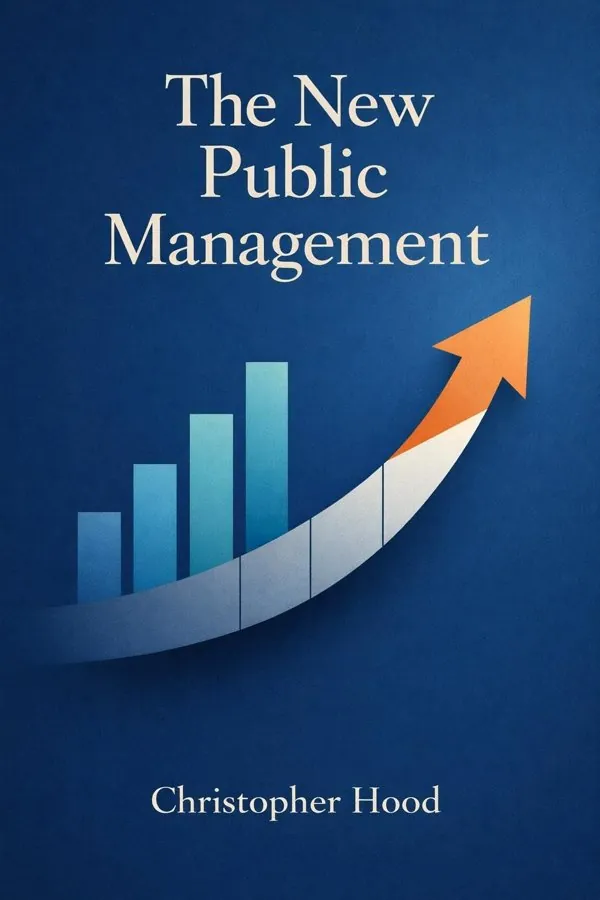
The New Public Management: Summary & Key Insights
 10 min9 chaptersAudio available
Key Takeaways from The New Public Management
Major reform movements often begin with frustration, and New Public Management emerged from deep dissatisfaction with the old bureaucratic state.
Ideas rarely arrive alone, and New Public Management was built from a striking fusion of intellectual currents.
A reform movement becomes powerful when it can be reduced to a recognizable set of doctrines, and Hood is famous for identifying exactly that in New Public Management.
What gets measured does not simply get managed—it gets redefined.
When governments embrace efficiency, they do more than cut costs—they redefine what counts as good public service.
What Is The New Public Management About?
The New Public Management by Christopher Hood is a politics book spanning 6 pages. What happens when governments start borrowing the language, tools, and incentives of business? In The New Public Management, Christopher Hood examines one of the most important shifts in modern governance: the move away from traditional bureaucracy toward a style of administration built on performance metrics, managerial discretion, competition, and measurable results. Rather than treating this transformation as a simple modernization story, Hood asks harder questions. Where did these ideas come from? Why did they spread so quickly across countries? And what do societies gain—or lose—when public services are run more like firms than public institutions? This book matters because New Public Management, or NPM, did not merely change internal government procedures. It reshaped how states define efficiency, accountability, citizenship, and public value. Many of today’s debates about targets, outsourcing, audit culture, and customer service in government still carry its imprint. Hood is uniquely qualified to guide this discussion. As one of the leading scholars of public administration, he combines historical knowledge, conceptual clarity, and critical distance to explain both the promise and the pitfalls of NPM. The result is an essential framework for understanding how contemporary government works.
This FizzRead summary covers all 9 key chapters of The New Public Management in approximately 10 minutes, distilling the most important ideas, arguments, and takeaways from Christopher Hood's work. Also available as an audio summary and Key Quotes Podcast.
The New Public Management
What happens when governments start borrowing the language, tools, and incentives of business? In The New Public Management, Christopher Hood examines one of the most important shifts in modern governance: the move away from traditional bureaucracy toward a style of administration built on performance metrics, managerial discretion, competition, and measurable results. Rather than treating this transformation as a simple modernization story, Hood asks harder questions. Where did these ideas come from? Why did they spread so quickly across countries? And what do societies gain—or lose—when public services are run more like firms than public institutions?
This book matters because New Public Management, or NPM, did not merely change internal government procedures. It reshaped how states define efficiency, accountability, citizenship, and public value. Many of today’s debates about targets, outsourcing, audit culture, and customer service in government still carry its imprint. Hood is uniquely qualified to guide this discussion. As one of the leading scholars of public administration, he combines historical knowledge, conceptual clarity, and critical distance to explain both the promise and the pitfalls of NPM. The result is an essential framework for understanding how contemporary government works.
Who Should Read The New Public Management?
This book is perfect for anyone interested in politics and looking to gain actionable insights in a short read. Whether you're a student, professional, or lifelong learner, the key ideas from The New Public Management by Christopher Hood will help you think differently.
- ✓Readers who enjoy politics and want practical takeaways
- ✓Professionals looking to apply new ideas to their work and life
- ✓Anyone who wants the core insights of The New Public Management in just 10 minutes
Want the full summary?
Get instant access to this book summary and 100K+ more with Fizz Moment.
Get Free SummaryAvailable on App Store • Free to download
Key Chapters
Major reform movements often begin with frustration, and New Public Management emerged from deep dissatisfaction with the old bureaucratic state. For much of the twentieth century, public administration in many countries was organized around hierarchical rules, standardized procedures, career civil service structures, and close political oversight. This model offered stability, continuity, and a degree of fairness because decisions were supposed to follow formal rules rather than personal whim. But by the 1970s and 1980s, critics increasingly saw bureaucracy as slow, costly, rigid, and unresponsive.
Economic strain played a major role in this shift. Fiscal crises, rising public expectations, and skepticism about state capacity pushed governments to search for alternatives. At the same time, broader ideological changes made private-sector methods appear more attractive. If businesses could innovate, cut waste, and focus on results, why couldn’t government? This question helped set the stage for a profound reframing of public administration. Officials were encouraged to think less like custodians of process and more like managers of performance.
Hood shows that NPM was not simply an administrative tweak. It represented a challenge to the assumptions of classic bureaucracy. Traditional administration prioritized legality, consistency, and rule-following. NPM emphasized flexibility, outputs, measurable goals, and cost consciousness. Instead of asking whether procedures were followed correctly, reformers increasingly asked whether services were delivered efficiently and whether outcomes could be demonstrated.
A practical example is the transformation of a ministry that once judged success by adherence to budget rules but later assessed itself through service targets, cost-per-unit measures, and management contracts. The logic of administration changed from process control to performance control.
Actionable takeaway: When evaluating any public institution, ask what problem its design is trying to solve—fairness through rules or efficiency through management—and notice what each approach may sacrifice.
Ideas rarely arrive alone, and New Public Management was built from a striking fusion of intellectual currents. Hood traces its foundations to two broad sources: managerialism and market-oriented economic thought. Managerialism promoted the belief that strong leadership, strategic planning, performance incentives, and hands-on management could improve almost any organization. In this view, good management is a transferable skill, whether one is running a corporation, a hospital, or a government agency.
The second source came from economics, especially theories that distrusted monopolies and celebrated competition, choice, and incentives. Public choice theory, transaction-cost reasoning, and principal-agent analysis all contributed to the NPM worldview. These approaches suggested that bureaucrats, like everyone else, respond to incentives and may pursue their own interests unless monitored or disciplined by clear contracts, competition, or performance systems.
Together, these strands created a powerful reform message: public organizations should be made more efficient by separating purchasers from providers, exposing agencies to competition, measuring outputs, decentralizing operations, and rewarding results. This intellectual blend was especially attractive in countries seeking to restrain public spending while improving service quality.
Consider the example of public transport. Under a traditional model, a government department might directly own, manage, and regulate services. Under NPM-inspired thinking, routes could be competitively tendered, providers benchmarked, and contracts tied to punctuality and customer satisfaction. The goal is not simply to spend less, but to redesign the system so incentives produce better outcomes.
Hood’s insight is that NPM was persuasive because it sounded both practical and theoretically grounded. It offered a toolkit, but also a story about human behavior and organizational performance.
Actionable takeaway: Whenever a reform promises efficiency, look beneath the surface and identify the assumptions it makes about incentives, competition, and the behavior of public officials.
A reform movement becomes powerful when it can be reduced to a recognizable set of doctrines, and Hood is famous for identifying exactly that in New Public Management. At its core, NPM advances a cluster of ideas: professional management, explicit standards and measures of performance, output controls, disaggregation of large bureaucracies, competition, private-sector management styles, and disciplined use of resources. These doctrines do not always appear together in pure form, but they define the family resemblance of NPM reforms across countries.
The first doctrine is the rise of visible, active management. Instead of relying mainly on procedural compliance, organizations are expected to have leaders who set priorities, monitor results, and intervene to improve performance. The second is the insistence on explicit targets. If success cannot be measured, reformers argue, it cannot be managed. Third comes output control: agencies are assessed by what they produce rather than simply by how faithfully they follow rules. Fourth is organizational disaggregation, in which large departments are broken into smaller units with clearer responsibilities. Fifth is competition, often introduced through contracting out or quasi-markets. Sixth is the borrowing of private-sector techniques such as performance pay or strategic planning. Seventh is greater cost discipline.
These doctrines changed everyday government life. A school system might publish test score targets, benchmark districts, decentralize budgets to principals, and tie funding to performance. A hospital network might separate purchasing from provision and compare units on waiting times and treatment outcomes.
But Hood also implies that each doctrine creates tensions. What happens when measurable outputs crowd out harder-to-measure public values? What happens when managers gain discretion but accountability becomes murkier?
Actionable takeaway: If you are assessing a reform program, map it against these doctrines to see which version of NPM is being pursued and what trade-offs it may create.
What gets measured does not simply get managed—it gets redefined. One of Hood’s most consequential insights is that performance measurement is not a neutral tool. In the NPM framework, metrics are supposed to create clarity, discipline, and comparability. Agencies are given targets, outputs are counted, costs are tracked, and managers are judged by whether they hit agreed benchmarks. This can generate focus and reveal inefficiencies that once hid behind bureaucratic routines.
In practice, however, performance systems also shape incentives in powerful ways. If a tax office is judged by speed of processing, it may prioritize easy cases over complex ones. If police departments are measured by crime statistics, reporting practices may shift. If schools are ranked by exam scores, teachers may narrow instruction to tested material. Hood’s point is not that measurement is useless, but that indicators can distort behavior when they become proxies for the mission itself.
Still, NPM’s emphasis on measurement has undeniable benefits. Before the spread of performance regimes, many public organizations had only vague notions of success. Citizens could be told money was spent and procedures followed, but not whether outcomes improved. Metrics helped expose weak performers, compare units, and create pressure for improvement. Waiting times in hospitals, response times in emergency services, and processing times in licensing departments are examples where measurement can visibly improve service delivery.
The challenge is to measure intelligently. Good systems combine quantitative and qualitative indicators, short-term and long-term goals, and internal learning with external accountability. They also recognize that many public goods—trust, equity, civic inclusion—are difficult to capture numerically.
Actionable takeaway: Use performance indicators as signals, not as the whole truth; always ask what important outcomes may be missing from the dashboard.
When governments embrace efficiency, they do more than cut costs—they redefine what counts as good public service. New Public Management pushed a new public ethos in which thrift, responsiveness, and service quality became central virtues. Citizens were increasingly described as customers, agencies were expected to improve value for money, and public servants were urged to think in terms of results rather than administrative routine.
This shift had a clear appeal. Taxpayers want services that work. Long queues, unresponsive offices, and wasteful spending undermine trust in government. NPM promised to make the public sector more attentive to users by introducing customer charters, complaint systems, service standards, and benchmarking. In many settings, this improved the everyday experience of dealing with the state. A licensing office that once operated with little regard for waiting times might, under NPM, redesign workflows, publish service commitments, and monitor user satisfaction.
Yet Hood also helps us see that the customer metaphor is incomplete. Citizens are not merely consumers buying individual services. They are members of a political community with rights, obligations, and interests that extend beyond personal convenience. A customer may value speed, while a citizen may also care about fairness, legality, and equal treatment. For example, a welfare office designed solely for efficiency might process straightforward applications quickly but underserve vulnerable people who need more time and support.
The new public ethos therefore contains a tension. Efficiency is important, but public service also involves stewardship, equity, and democratic legitimacy. Governments cannot be judged only by whether they deliver faster or cheaper; they must also be judged by whom they include, whom they protect, and how transparently they act.
Actionable takeaway: In any public service reform, pair efficiency goals with explicit safeguards for fairness, accessibility, and equal treatment.
Reform often promises clearer accountability, but fragmentation can make responsibility harder to trace. One of the central paradoxes in Hood’s analysis is that NPM sought to improve accountability through targets, audits, contracts, and transparent reporting, yet its organizational changes sometimes complicated the very thing they were meant to clarify. When large ministries are broken into agencies, services are outsourced, and quasi-markets are introduced, citizens may struggle to know who is answerable when something goes wrong.
Traditional bureaucracy linked accountability to hierarchy. A minister oversaw a department; a department supervised officials; rules created clear chains of responsibility. NPM loosened some of those chains in the name of flexibility and performance. Managers gained discretion, providers operated at arm’s length, and contracts replaced direct command. In theory, this made accountability more precise because expectations were written down and results measured. In practice, it could create a maze of shared responsibility.
Imagine a privatized or contracted public service that fails—a rail operator misses targets, a welfare contractor underperforms, or a private prison faces scandal. Is the contractor to blame? The regulator? The ministry that designed the contract? The politician who approved the model? NPM systems often multiply the actors involved while relying on audits and indicators to hold them together.
Hood’s broader point is that accountability has many forms: political, legal, managerial, professional, and public. Strengthening one form may weaken another. A tightly audited agency may satisfy managerial accountability while becoming less open to professional judgment or public deliberation.
Actionable takeaway: When public functions are dispersed across agencies and contractors, build accountability maps that identify who decides, who delivers, who monitors, and who answers to citizens.
Competition can sharpen performance, but public services are not ordinary commodities. A major pillar of New Public Management was the belief that market mechanisms—or at least market-like arrangements—could improve government. Hood examines how reforms introduced contracting out, purchaser-provider splits, internal markets, and benchmarking to mimic the discipline of competition even where full privatization was impossible or undesirable.
The logic is straightforward. If monopolistic public providers face no competition, they may become complacent, inefficient, or insulated from user needs. By allowing multiple providers to bid for contracts or compete for funding, governments hope to lower costs and raise quality. In health care, for example, one agency might purchase services while different hospitals or providers compete to deliver them. In local government, waste collection, maintenance, or social services might be contracted to outside firms under performance terms.
These arrangements can work well under certain conditions: clear contracts, measurable outputs, capable oversight, and real alternatives among providers. But Hood highlights the limits. Public services often involve complex needs, incomplete information, and social goals that are hard to encode in contracts. A low-cost provider may win a bid but deliver poor quality. Monitoring costs may rise. Competitive tendering may produce savings in the short term while hollowing out long-term capacity inside government.
Moreover, competition can encourage gaming. Providers may select easy clients, avoid expensive cases, or focus on contract compliance rather than meaningful service. In areas like policing, welfare, or child protection, the human stakes make simplistic market analogies especially risky.
Actionable takeaway: Before introducing competition into public services, test whether outcomes are truly measurable, whether oversight capacity exists, and whether public values can survive the contractual model.
Administrative reforms travel surprisingly fast when they speak the language of modernity. One reason New Public Management became so influential is that it appeared adaptable across political systems, policy sectors, and national traditions. Hood shows how NPM spread through OECD countries and beyond, often carried by fiscal pressure, international advice networks, reform-minded politicians, and the prestige of success stories from early adopters such as the United Kingdom, New Zealand, and Australia.
This diffusion was not uniform. Some governments pursued radical restructuring, creating executive agencies, internal markets, and aggressive privatization. Others adopted softer versions, such as performance budgeting, managerial training, or customer-service initiatives. In some cases NPM was embraced as a coherent ideology; in others it arrived piecemeal as a set of techniques. Yet the recurring themes remained recognizable: flexibility, outputs, competition, audit, and cost control.
The spread of NPM also reveals how reform ideas gain legitimacy. They are often framed not as ideology but as common sense. To resist them can seem like defending inefficiency. That rhetorical power helped NPM travel. International organizations, consulting firms, and policy networks translated local experiments into global templates. Soon, reforms in tax administration, education, health care, and local government began to share a similar vocabulary.
But Hood cautions against assuming one-size-fits-all success. Institutions differ. A reform that works in a centralized, high-capacity state may fail in a fragmented system with weak oversight. Importing managerial tools without the surrounding legal, professional, and political supports can produce superficial compliance rather than genuine improvement.
Actionable takeaway: Treat celebrated reform models as context-dependent; before copying them, ask what institutional capacities and political conditions made them work in the first place.
The most enduring reforms are those that continue to shape institutions even after enthusiasm fades, and this is exactly the case with New Public Management. Hood does not present NPM as a simple triumph or a simple mistake. Instead, he shows it as a complex transformation with genuine achievements and serious unintended consequences. It improved cost consciousness, elevated management quality in some areas, and made performance a central concern of government. It challenged complacency and forced public organizations to justify what they do.
At the same time, critics argue that NPM fragmented the state, overvalued measurable outputs, weakened public-service ethics, and imported private-sector assumptions that do not always fit collective goods. The rise of audit culture sometimes led to box-ticking, defensive administration, and gaming. Professionals such as teachers, doctors, and civil servants could feel squeezed between formal targets and real human needs. Political leaders, meanwhile, could use managerial rhetoric to promise more control than they actually possessed.
Hood’s lasting contribution is to show that NPM should be judged neither by its slogans nor by its most extreme applications. Its legacy is mixed because governance itself is mixed. Modern states need efficiency and responsiveness, but they also need legitimacy, resilience, and democratic accountability. In many countries, post-NPM reforms have tried to correct the excesses of fragmentation by emphasizing coordination, collaboration, digital integration, and public value. Yet the fingerprints of NPM remain everywhere—in targets, audits, agency structures, procurement systems, and the language of outcomes.
Actionable takeaway: The wisest response to NPM is not total rejection or blind acceptance, but selective use—retain tools that improve performance while restoring coordination, trust, and democratic purpose.
All Chapters in The New Public Management
About the Author
Christopher Hood is a distinguished British political scientist and public administration scholar best known for his work on government reform, regulation, and the design of public institutions. Over the course of his academic career, he has held prominent positions at leading universities, including the University of Oxford, where his research helped shape modern debates on governance and administrative change. Hood is especially influential for his analysis of New Public Management, a term and framework he helped define with exceptional clarity. His writing stands out for combining theoretical rigor with practical relevance, making complex institutional issues accessible without oversimplifying them. Across his work, he has examined accountability, bureaucracy, executive government, and the unintended consequences of reform, earning a reputation as one of the most important interpreters of contemporary public administration.
Get This Summary in Your Preferred Format
Read or listen to the The New Public Management summary by Christopher Hood anytime, anywhere. FizzRead offers multiple formats so you can learn on your terms — all free.
Available formats: App · Audio · PDF · EPUB — All included free with FizzRead
Download The New Public Management PDF and EPUB Summary
Key Quotes from The New Public Management
“Major reform movements often begin with frustration, and New Public Management emerged from deep dissatisfaction with the old bureaucratic state.”
“Ideas rarely arrive alone, and New Public Management was built from a striking fusion of intellectual currents.”
“A reform movement becomes powerful when it can be reduced to a recognizable set of doctrines, and Hood is famous for identifying exactly that in New Public Management.”
“What gets measured does not simply get managed—it gets redefined.”
“When governments embrace efficiency, they do more than cut costs—they redefine what counts as good public service.”
Frequently Asked Questions about The New Public Management
The New Public Management by Christopher Hood is a politics book that explores key ideas across 9 chapters. What happens when governments start borrowing the language, tools, and incentives of business? In The New Public Management, Christopher Hood examines one of the most important shifts in modern governance: the move away from traditional bureaucracy toward a style of administration built on performance metrics, managerial discretion, competition, and measurable results. Rather than treating this transformation as a simple modernization story, Hood asks harder questions. Where did these ideas come from? Why did they spread so quickly across countries? And what do societies gain—or lose—when public services are run more like firms than public institutions? This book matters because New Public Management, or NPM, did not merely change internal government procedures. It reshaped how states define efficiency, accountability, citizenship, and public value. Many of today’s debates about targets, outsourcing, audit culture, and customer service in government still carry its imprint. Hood is uniquely qualified to guide this discussion. As one of the leading scholars of public administration, he combines historical knowledge, conceptual clarity, and critical distance to explain both the promise and the pitfalls of NPM. The result is an essential framework for understanding how contemporary government works.
You Might Also Like
Antifa: The Anti-Fascist Handbook
Mark Bray
10 min
Attack from Within: How Disinformation Is Sabotaging America
Barbara McQuade
10 min
Coercion, Capital, and European States, AD 990–1992
Charles Tilly
10 min
Digital Democracy: Concepts, Methodologies, Tools, and Applications
Various Authors
10 min
Fascism
Stanley G. Payne
10 min
Fire And Fury: Inside The Trump White House
Michael Wolff
10 minBrowse by Category
Ready to read The New Public Management?
Get the full summary and 100K+ more books with Fizz Moment.