
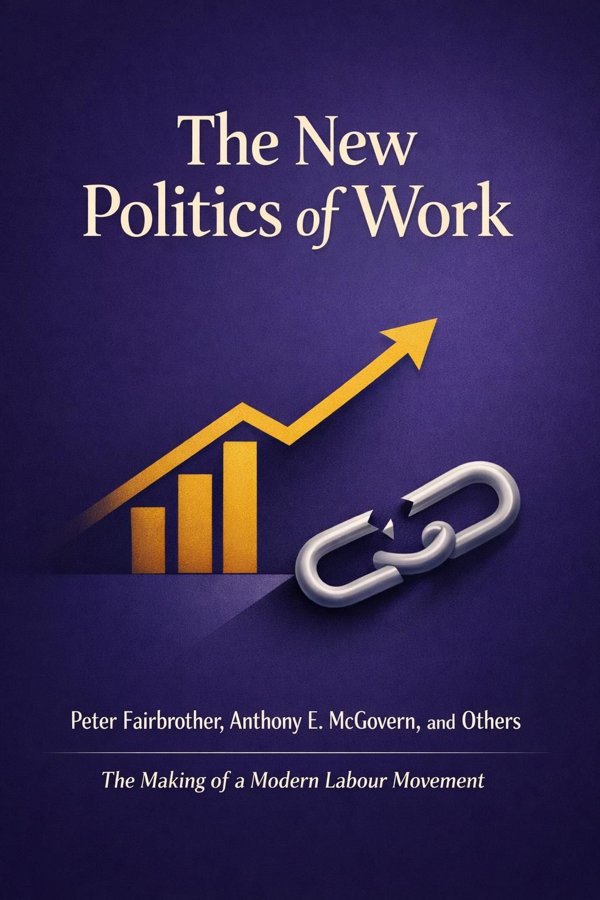
The New Politics of Work: The Making of a Modern Labour Movement: Summary & Key Insights
by Peter Fairbrother, Anthony E. McGovern, and Others
 10 min10 chaptersAudio available
Key Takeaways from The New Politics of Work: The Making of a Modern Labour Movement
A labor movement is easiest to understand when you see what has been lost.
When capital becomes mobile, labor’s old maps stop working.
The politics of work no longer starts and ends where people clock in.
Decline is not destiny, but renewal never happens automatically.
Workers gain power when their struggles become everyone’s concern.
What Is The New Politics of Work: The Making of a Modern Labour Movement About?
The New Politics of Work: The Making of a Modern Labour Movement by Peter Fairbrother, Anthony E. McGovern, and Others is a sociology book spanning 10 pages. Work has become one of the central battlegrounds of modern society. Stable jobs, national bargaining systems, and traditional union strongholds have been weakened by globalization, privatization, outsourcing, and managerial reform. In The New Politics of Work, Peter Fairbrother, Anthony E. McGovern, and their collaborators examine what happens when the old institutions of labor no longer fit the realities of contemporary employment. Rather than treating labor decline as inevitable, they ask how workers, unions, and communities can rebuild collective power under new conditions. This book matters because it shifts the conversation from nostalgia to strategy. It shows that the politics of work is no longer confined to the factory gate or bargaining table; it now stretches across supply chains, local communities, public policy, gender relations, and transnational networks. The authors bring strong authority to the topic through their expertise in sociology, industrial relations, labor policy, and organizational change. Their analysis combines historical depth with practical insight, making the book valuable not only for scholars but also for union activists, policy thinkers, and anyone trying to understand why work has become so politically contested. It is a sharp guide to how modern labor movements are being remade.
This FizzRead summary covers all 10 key chapters of The New Politics of Work: The Making of a Modern Labour Movement in approximately 10 minutes, distilling the most important ideas, arguments, and takeaways from Peter Fairbrother, Anthony E. McGovern, and Others's work. Also available as an audio summary and Key Quotes Podcast.
The New Politics of Work: The Making of a Modern Labour Movement
Work has become one of the central battlegrounds of modern society. Stable jobs, national bargaining systems, and traditional union strongholds have been weakened by globalization, privatization, outsourcing, and managerial reform. In The New Politics of Work, Peter Fairbrother, Anthony E. McGovern, and their collaborators examine what happens when the old institutions of labor no longer fit the realities of contemporary employment. Rather than treating labor decline as inevitable, they ask how workers, unions, and communities can rebuild collective power under new conditions.
This book matters because it shifts the conversation from nostalgia to strategy. It shows that the politics of work is no longer confined to the factory gate or bargaining table; it now stretches across supply chains, local communities, public policy, gender relations, and transnational networks. The authors bring strong authority to the topic through their expertise in sociology, industrial relations, labor policy, and organizational change. Their analysis combines historical depth with practical insight, making the book valuable not only for scholars but also for union activists, policy thinkers, and anyone trying to understand why work has become so politically contested. It is a sharp guide to how modern labor movements are being remade.
Who Should Read The New Politics of Work: The Making of a Modern Labour Movement?
This book is perfect for anyone interested in sociology and looking to gain actionable insights in a short read. Whether you're a student, professional, or lifelong learner, the key ideas from The New Politics of Work: The Making of a Modern Labour Movement by Peter Fairbrother, Anthony E. McGovern, and Others will help you think differently.
- ✓Readers who enjoy sociology and want practical takeaways
- ✓Professionals looking to apply new ideas to their work and life
- ✓Anyone who wants the core insights of The New Politics of Work: The Making of a Modern Labour Movement in just 10 minutes
Want the full summary?
Get instant access to this book summary and 100K+ more with Fizz Moment.
Get Free SummaryAvailable on App Store • Free to download
Key Chapters
A labor movement is easiest to understand when you see what has been lost. The book begins by situating modern labor politics within the postwar settlement that dominated much of the twentieth century. In many industrial societies, unions were embedded in durable institutions: sectoral bargaining, large workplaces, welfare-state protections, and political arrangements that recognized labor as a legitimate social partner. Workers often expected long-term employment, employers negotiated within established frameworks, and governments mediated class conflict through law and policy.
This historical context matters because it created the benchmark against which current changes are measured. The old system was never universal, fully fair, or free from exclusion. Women, migrants, precarious workers, and racial minorities were often marginalized even when unions were strong. Still, the postwar era gave organized labor a structural foothold that made collective action more sustainable. Union identity was tied to stable occupational communities and clear employer boundaries.
Fairbrother, McGovern, and colleagues show that modern labor politics cannot be rebuilt simply by copying that settlement. The economic base has changed, the workforce is more fragmented, and political support for social compromise has weakened. Yet the era remains instructive because it reveals how institutions can stabilize bargaining power and turn conflict into negotiated outcomes.
In practice, this means labor organizers and policymakers should look beyond short-term campaigns and ask what durable structures support collective voice. That could include sectoral bargaining in fragmented industries, stronger labor law, or public policies that reduce insecurity. Actionable takeaway: study the postwar model not as a golden age to restore, but as evidence that worker power grows when collective organization is backed by institutions.
When capital becomes mobile, labor’s old maps stop working. One of the book’s central arguments is that globalization transformed employment relations by weakening the territorial and organizational boundaries on which traditional labor movements depended. Firms no longer operate as self-contained national employers; they outsource, subcontract, relocate, and spread production across multiple sites and countries. As a result, the direct relationship between employer, worker, and union has become far more fragmented.
This restructuring changed not only where work happens, but how power works. Employers can play workforces against one another, threaten relocation, and shift risk onto suppliers, temporary workers, or gig-like contractual arrangements. Even workers who remain formally employed by large organizations often find themselves inside leaner, more performance-driven systems. The old union strategy of negotiating with a single identifiable employer becomes harder when control is dispersed through networks of contractors and transnational management structures.
The authors do not treat globalization as an unstoppable force of nature. Instead, they show it as a political and organizational process shaped by deregulation, privatization, and employer strategy. That distinction matters because what has been politically constructed can also be politically contested. For example, transport workers may need to organize not only at the company level but across logistics chains; public-sector unions facing privatization may need alliances with service users and local communities.
The practical lesson is clear: labor politics must follow the real structure of economic power, not outdated institutional assumptions. Mapping supply chains, identifying decision-makers, and coordinating across worksites become essential organizing tools. Actionable takeaway: if work is organized through networks, then worker power must also be organized through networks.
The politics of work no longer starts and ends where people clock in. A major insight of the book is that contemporary labor struggles are increasingly shaped by forces outside the immediate employment relationship. Questions of housing, public services, migration, welfare policy, environmental change, and local economic development now directly influence workers’ lives and bargaining capacity. This means labor politics has expanded from industrial relations into a broader field of social conflict.
The “new politics of work” refers to this shift. Traditional labor politics often focused on wages, hours, and conditions negotiated between unions and employers. Those issues remain important, but they are no longer sufficient. A hospital cleaner employed through a contractor, for instance, may face low pay because of procurement policy, privatization, immigration controls, and weak local labor standards all at once. Likewise, warehouse workers may experience intense surveillance and insecurity shaped by global logistics systems, digital technologies, and land-use decisions made far from the shop floor.
The authors argue that successful labor movements increasingly connect workplace grievances to wider struggles over democracy, citizenship, and social justice. This does not dilute class politics; it updates it. Workers are not only employees but also residents, carers, consumers of public services, and members of communities affected by corporate and state decisions.
Practically, this broadens the repertoire of organizing. Campaigns might target municipal procurement rules, demand living-wage ordinances, or mobilize public support around service quality rather than only employee interests. It also encourages unions to build narratives that resonate with the wider public. Actionable takeaway: frame labor issues not as narrow workplace complaints, but as public questions about how society distributes security, dignity, and power.
Decline is not destiny, but renewal never happens automatically. The book gives close attention to union renewal and argues that modern labor movements must rethink how they organize, recruit, and exercise leadership. Many unions were built for an era of large, stable workplaces and routine collective bargaining. In fragmented labor markets, those inherited forms can become too slow, too centralized, or too disconnected from precarious workers to remain effective.
Renewal involves more than membership drives. It requires organizational reinvention: developing workplace leaders, decentralizing initiative where appropriate, investing in training, improving communication, and creating structures that make participation meaningful. A union cannot simply ask workers to join; it must demonstrate relevance in sectors where fear, turnover, and employer hostility are high. This is especially true in service work, logistics, subcontracting, and parts of the public sector undergoing restructuring.
The authors emphasize that renewal is both strategic and cultural. A union may need to move from servicing members to organizing with them. Instead of relying mainly on officials to solve problems, it can cultivate active members who identify issues, recruit coworkers, and coordinate action. Examples include local campaigns around outsourcing, coordinated workplace mapping, and issue-based organizing that connects daily concerns to wider institutional demands.
Importantly, renewal also means confronting internal barriers. Unions may need to open leadership pathways for younger workers, women, migrants, and racialized members whose experience of work differs from traditional core constituencies. Without internal change, external adaptation remains limited.
Actionable takeaway: treat renewal as a redesign of union purpose and practice, not a marketing effort. Build organizations that workers can participate in, not just organizations that speak on their behalf.
Workers gain power when their struggles become everyone’s concern. One of the book’s most compelling themes is the rise of community and social movement unionism. In contexts where workplace bargaining alone is too weak, unions increasingly collaborate with neighborhood groups, faith organizations, advocacy campaigns, and civil society networks. These alliances help labor move beyond the limits of traditional industrial action and build wider moral and political legitimacy.
This approach is especially important where employment is fragmented or public-facing. For example, a campaign by care workers may resonate more strongly when linked to the quality and accessibility of elder care. School staff can build leverage by connecting labor issues to the defense of public education. Transit workers may frame their demands around safety, service reliability, and investment in communities. Such alliances make it harder for employers or governments to portray labor claims as self-interested.
The authors show that community unionism is not merely an add-on to conventional union activity. It reflects a deeper recognition that insecurity at work is tied to insecurity in everyday life. When housing costs rise, public services decline, and local jobs disappear, worker grievances become social grievances. Unions that understand this can mobilize broader coalitions and operate more effectively in political arenas.
Still, alliances require real partnership, not symbolic outreach. Unions must listen to community priorities, share decision-making, and avoid treating allies as campaign accessories. The strongest coalitions are built on mutual benefit and trust.
Actionable takeaway: identify the social impact of workplace issues and organize around it. If a labor dispute affects families, neighborhoods, or public services, build a coalition that reflects that reality from the beginning.
A labor movement that speaks for workers in the abstract may miss the workers who most need it. The book highlights how gender, diversity, and social difference reshape the politics of work. Contemporary labor markets are structured by inequalities involving gender, race, migration status, age, and occupation. These are not side issues to class politics; they are part of how class is experienced, organized, and contested.
Traditional labor institutions often grew around male-dominated industrial work and assumed a relatively standardized worker identity. But modern employment is far more diverse. Women are concentrated in care, education, retail, and other service sectors where emotional labor, flexible scheduling, and part-time work are common. Migrant workers may face legal precarity alongside workplace exploitation. Racialized workers may encounter discrimination in hiring, promotion, and discipline. If unions ignore these realities, they weaken both their legitimacy and their organizing capacity.
The authors argue that inclusive labor politics requires changes in both agenda and structure. Bargaining demands may need to include childcare, predictable scheduling, anti-harassment protections, equal pay, and support for migrant rights. Internal union processes must also create representative leadership and accessible routes for participation. Diversity is not just demographic representation; it is a transformation of what labor organizations see as central concerns.
Practical examples include campaigns for pay equity in feminized sectors, organizing strategies tailored to multilingual workforces, and leadership programs designed to bring underrepresented members into decision-making roles. These efforts broaden union relevance and sharpen its understanding of exploitation.
Actionable takeaway: analyze every workplace issue through the lens of who is most affected and why. A stronger labor movement is built by organizing difference, not smoothing it over.
If corporations operate across borders, labor cannot remain politically local. The book explores the growing importance of transnational labor networks in an era when investment, supply chains, and management decisions routinely cross national boundaries. Traditional union power was often rooted in national institutions, but globalization allows firms to evade local pressure by shifting production or sourcing. That makes cross-border coordination increasingly necessary.
Transnational labor action can take many forms: information sharing between unions in different countries, joint campaigns targeting multinational firms, international framework agreements, pressure through global union federations, and solidarity actions across supplier networks. None of these mechanisms is simple or uniformly effective, but they represent attempts to close the gap between global corporate organization and nationally bounded labor institutions.
The authors are realistic about the challenges. Labor movements operate in different legal systems, political cultures, and resource environments. Workers in different locations may also face competing pressures, especially when employers encourage concession bargaining by threatening relocation. Building solidarity under these conditions requires more than slogans; it requires sustained coordination, shared analysis, and institutions capable of maintaining long-term relationships.
Examples are particularly relevant in manufacturing, transport, logistics, and public services influenced by international restructuring. A campaign may begin locally but gain strength by exposing a multinational’s global reputation or by connecting workers across a chain of production and delivery.
Actionable takeaway: whenever a workplace conflict involves a multinational company, ask where else the firm is vulnerable. Build relationships beyond the immediate site, because modern labor leverage often depends on reaching across borders as effectively as capital does.
Markets do not replace politics; they reorganize it. A powerful contribution of the book is its insistence that the state remains central to the politics of work, even under neoliberalism. Deregulation, privatization, contracting out, and labor-market flexibility are not signs of state withdrawal so much as signs of state reorientation. Governments reshape employment relations through law, funding models, public-sector reform, welfare policy, and the rules that govern organizing and bargaining.
This means labor movements cannot focus only on employers. Policy and institutional change set the terrain on which unions operate. For instance, public procurement can either reward low-road employment practices or require decent labor standards. Collective bargaining laws can either support sectoral coordination or leave workers isolated at firm level. Welfare regimes can cushion insecurity or intensify pressure to accept poor-quality jobs. In each case, state decisions influence how difficult it is to build worker power.
The authors show that neoliberal restructuring often depoliticizes labor issues by presenting them as administrative or economic necessities. Yet these are deeply political choices. Whether a public service is outsourced, whether worker voice is protected, and whether employment rights are enforceable are all contested questions. Labor movements that ignore the state risk fighting symptoms while policy continues to reproduce insecurity.
In practical terms, unions and labor advocates must combine industrial strategy with institutional strategy. That can include lobbying, legal reform campaigns, participation in public inquiries, and coalition-building around labor standards. Success often depends on linking immediate disputes to demands for rule changes.
Actionable takeaway: do not treat labor law and public policy as background conditions. Make them organizing targets, because durable gains usually require changing the rules as well as winning the fight.
Technology can isolate workers, but it can also help them find one another. The book’s discussion of new forms of collective action points toward the growing importance of digital communication and flexible mobilization in modern labor politics. In workplaces characterized by high turnover, dispersed locations, variable schedules, or weak formal representation, digital tools can make organizing faster, more visible, and more inclusive.
Messaging apps, online forums, social media campaigns, and digital petitions allow workers to share grievances, circulate evidence, coordinate responses, and connect with supporters beyond the workplace. A scattered group of platform workers, delivery drivers, or care employees may not share a break room, but they can still build a common narrative and act collectively. Digital visibility can also pressure employers sensitive to public reputation.
At the same time, the authors’ broader framework reminds readers not to fetishize technology. Digital tools are not substitutes for organization, leadership, or strategy. Online outrage without structure can dissipate quickly. Employers also use digital systems for surveillance, scheduling control, and performance management, which can deepen insecurity. Effective labor politics therefore uses digital means in combination with face-to-face trust-building, democratic decision-making, and clear escalation plans.
Practical applications include maintaining multilingual communications with dispersed workers, gathering rapid feedback during disputes, and linking local actions to national or international campaigns. Digital methods are especially useful in sectors where workers rarely meet in person or where official union access is limited.
Actionable takeaway: use digital tools to lower the barriers to participation, but anchor every online campaign in real relationships, clear demands, and a plan for sustained collective action.
Hope matters in labor politics, but strategy matters more. The book closes by asking what a renewed politics of work would actually require. The answer is not a single model or miracle solution. Instead, Fairbrother, McGovern, and their co-authors present renewal as a long-term process of recomposition: rebuilding worker power through new alliances, new organizational forms, new scales of action, and a more expansive understanding of justice at work.
The challenges are serious. Employment is fragmented, union density has declined in many countries, and neoliberal ideas have normalized insecurity as flexibility. Yet the book rejects fatalism. Workers still generate social value, still experience common pressures, and still have reasons to act collectively. The task is to recognize where leverage now exists and to build organizations capable of using it.
A renewed labor movement must be strategic in several senses. It must identify power in supply chains and institutions rather than only in single worksites. It must connect workplace demands with community concerns and public policy. It must organize workers who have historically been excluded from labor’s core identity. And it must think internationally while acting effectively at local and national levels.
This vision is demanding because it requires patience, experimentation, and internal change. But it is also realistic. Modern labor movements are not made by waiting for old conditions to return; they are made by learning how to organize under current ones.
Actionable takeaway: stop asking whether labor can go back to its old form. Ask instead what forms of organization, coalition, and strategy can turn today’s fragmented workforce into a collective political force.
All Chapters in The New Politics of Work: The Making of a Modern Labour Movement
About the Authors
Peter Fairbrother is a British sociologist widely recognized for his scholarship on labor studies, industrial relations, union renewal, and the changing politics of work. His research has focused particularly on public-sector restructuring, organizational change, and the ways workers respond collectively to economic and political transformation. Anthony E. McGovern is known for work in labor policy, employment relations, and organizational change, bringing a complementary perspective on institutions and workplace reform. The additional contributors to this volume expand its reach through expertise in sociology, labor movements, and political economy. Together, they offer a multidisciplinary analysis of how globalization, neoliberalism, and social change have reshaped worker organization. Their combined work gives the book both academic depth and practical relevance for understanding the making of a modern labor movement.
Get This Summary in Your Preferred Format
Read or listen to the The New Politics of Work: The Making of a Modern Labour Movement summary by Peter Fairbrother, Anthony E. McGovern, and Others anytime, anywhere. FizzRead offers multiple formats so you can learn on your terms — all free.
Available formats: App · Audio · PDF · EPUB — All included free with FizzRead
Download The New Politics of Work: The Making of a Modern Labour Movement PDF and EPUB Summary
Key Quotes from The New Politics of Work: The Making of a Modern Labour Movement
“A labor movement is easiest to understand when you see what has been lost.”
“When capital becomes mobile, labor’s old maps stop working.”
“The politics of work no longer starts and ends where people clock in.”
“Decline is not destiny, but renewal never happens automatically.”
“Workers gain power when their struggles become everyone’s concern.”
Frequently Asked Questions about The New Politics of Work: The Making of a Modern Labour Movement
The New Politics of Work: The Making of a Modern Labour Movement by Peter Fairbrother, Anthony E. McGovern, and Others is a sociology book that explores key ideas across 10 chapters. Work has become one of the central battlegrounds of modern society. Stable jobs, national bargaining systems, and traditional union strongholds have been weakened by globalization, privatization, outsourcing, and managerial reform. In The New Politics of Work, Peter Fairbrother, Anthony E. McGovern, and their collaborators examine what happens when the old institutions of labor no longer fit the realities of contemporary employment. Rather than treating labor decline as inevitable, they ask how workers, unions, and communities can rebuild collective power under new conditions. This book matters because it shifts the conversation from nostalgia to strategy. It shows that the politics of work is no longer confined to the factory gate or bargaining table; it now stretches across supply chains, local communities, public policy, gender relations, and transnational networks. The authors bring strong authority to the topic through their expertise in sociology, industrial relations, labor policy, and organizational change. Their analysis combines historical depth with practical insight, making the book valuable not only for scholars but also for union activists, policy thinkers, and anyone trying to understand why work has become so politically contested. It is a sharp guide to how modern labor movements are being remade.
You Might Also Like

Between the World and Me
Ta-Nehisi Coates
10 min
Half the Sky
Nicholas D. Kristof, Sheryl WuDunn
10 min
Men Explain Things To Me
Rebecca Solnit
10 min
Rational Ritual
Michael Suk-Young Chwe
10 min
The New Jim Crow
Michelle Alexander
10 min
Beyond Culture
Edward T. Hall
10 minBrowse by Category
Ready to read The New Politics of Work: The Making of a Modern Labour Movement?
Get the full summary and 100K+ more books with Fizz Moment.